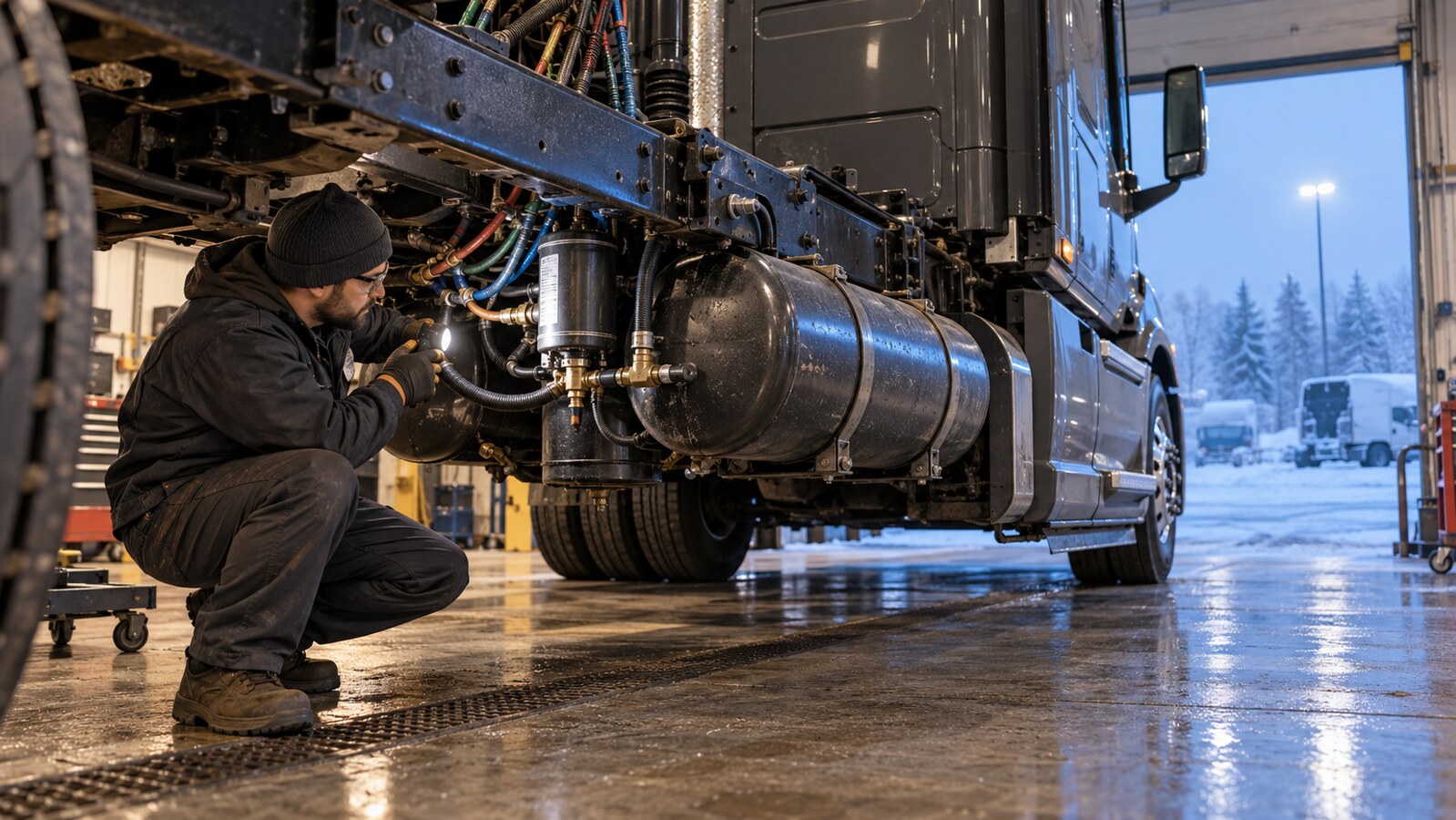
A truck’s air dryer rarely gets much attention when it is working. Then the weather turns cold, moisture freezes where it should not, and the entire air system starts demanding attention at the worst possible time.
The air dryer is more than a winter accessory. It helps remove moisture, oil aerosols, and other contamination from compressed air before that contamination reaches reservoirs, valves, brake components, automated manual transmissions, and other air-operated equipment. Bendix notes that modern commercial vehicles depend on clean, dry air for far more than the foundation brakes.
Start with the reservoirs
A useful first check is simple: drain the air reservoirs and look closely at what comes out. A small amount of moisture after a major temperature swing can be temporary. Bendix says an ambient change greater than about 30 degrees Fahrenheit within 24 hours can produce short-term condensation that may be reabsorbed after normal operation.
Repeated water, excessive liquid, or oil mixed with water is different. Those findings deserve diagnosis instead of a quick drain-and-forget response. Excessive moisture can point toward a saturated dryer cartridge, incorrect plumbing, an air compressor problem, or unusually high air demand.
Five warning signs worth investigating
- Pressure takes longer to build. If a familiar truck suddenly needs three or four minutes instead of roughly one or two to reach operating pressure, look for leakage or a valve problem.
- The compressor cycles more often. Frequent charging may mean the system is losing air. It also increases the workload on the dryer cartridge.
- The purge valve leaks, sticks, or behaves differently. A weak or intermittent purge can come from seal wear or contamination.
- Water keeps returning to the tanks. One unusual weather event may explain a little water. A pattern needs a real inspection.
- Oil appears with the moisture. Oil can attack seals, contribute to leaks, and damage valves or brake-chamber diaphragms.
Inspect the plumbing, not only the cartridge
A new cartridge cannot correct a badly routed discharge line. The line from the compressor to the dryer should follow the vehicle manufacturer’s routing requirements. Bendix specifically warns against low spots, droops, or loops that can become water traps. Also inspect air lines for rubbing, heat damage, loose supports, and fittings that show signs of leakage.
Check the dryer mounting hardware and follow the service data for torque values. A heavy assembly vibrating on loose hardware can create secondary problems that are easy to mistake for a failed dryer.
Service intervals depend on the job
There is no honest one-size-fits-all cartridge interval. Bendix recommends following the truck manufacturer’s schedule first. As general guidance, the company lists six-to-12-month replacement for vehicles with high or sensitive air demand and 12-to-24-month replacement for standard-demand line-haul service. Age, compressor condition, climate, duty cycle, lift axles, bulk unloading, central tire inflation, and other pneumatic equipment can shorten the interval.
A monthly reservoir check gives a fleet real evidence instead of relying only on mileage. Record what is found. A trend is often more useful than a single inspection.
Do not ignore slow pressure build or repeated moisture
An air system that is slow to charge, cycles constantly, or carries contamination needs attention from a qualified technician. Air brakes are a safety-critical system, and the correct repair depends on the exact compressor, dryer, governor, valves, and vehicle configuration.
The best winter air-system repair is the one completed before the first hard freeze. A few minutes spent draining reservoirs, watching pressure build, and inspecting the dryer system can prevent a much longer roadside delay.
Sources
Featured image source: Original AI-generated editorial image created exclusively for MechanicCarWorld, September 22, 2026.