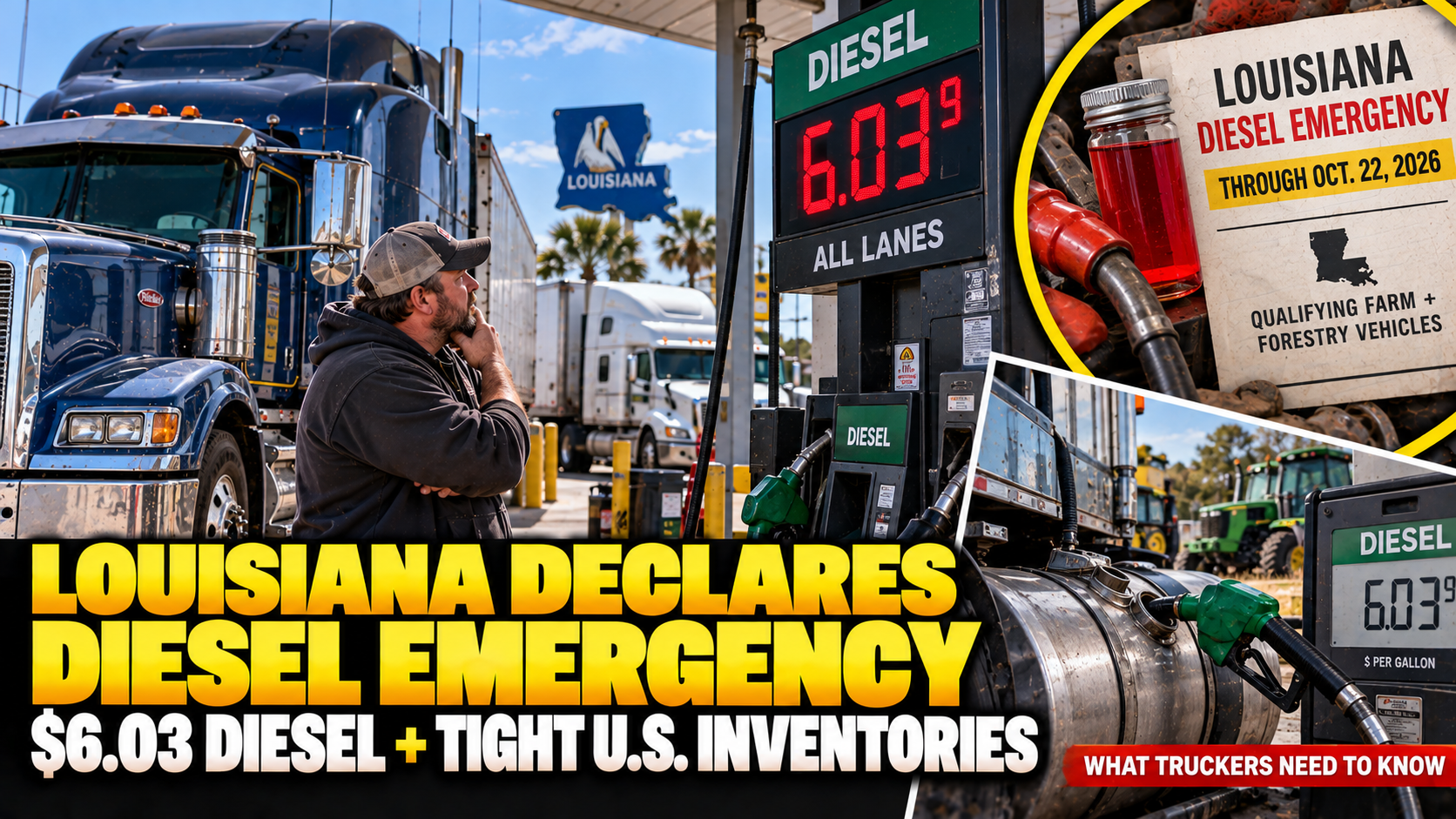
Louisiana has taken an unusual step over diesel fuel.
On September 23, 2026, Governor Jeff Landry’s office announced a state
of emergency aimed at helping farmers and timber harvesters deal with
record diesel costs and tight distillate supplies. The temporary order
allows qualifying Louisiana farm-use and forest-products vehicles to use
dyed diesel they already have on hand without the normal state penalty
through October 22, 2026.
The announcement immediately caught the attention of truckers, farmers,
diesel mechanics, fleet owners, and anyone whose livelihood depends on
fuel.
The headline number is hard to ignore: Louisiana’s governor’s office
says the state average retail diesel price reached a record $6.03 per
gallon. The same announcement says U.S. distillate fuel-oil inventories
were 12.5 percent below the five-year average.
Those numbers matter, but the situation needs to be described carefully.
Louisiana’s order does not mean every truck stop in the state is out of
diesel. It does not mean ordinary highway trucks everywhere can legally
fill with dyed diesel. And it does not prove a nationwide diesel
shortage is about to shut down trucking.
What it does show is that diesel availability and cost have become
serious enough for Louisiana to temporarily change state enforcement
rules for specific agricultural and forestry vehicles during peak
harvest operations.
For truckers, that raises a bigger question.
What happens when diesel stops being only a price problem and starts
becoming an availability problem?
That is where the story becomes important far beyond one fuel receipt.
What Louisiana Actually Did
Louisiana’s emergency action is targeted, not a blanket permission slip
for every diesel vehicle.
According to the governor’s office, the executive order temporarily
suspends the state penalty for using dyed diesel in vehicles registered
as Class 2 Forest Products or Class 5 Farm Use. The relief runs through
October 22, 2026 and is intended to help during peak harvesting
operations.
Dyed diesel is ordinary diesel fuel marked with red dye to identify it
for off-road use. It is commonly used in farm tractors, construction
equipment, generators, irrigation equipment, forestry machines and other
qualifying off-highway applications. Because off-road fuel is generally
not subject to the same highway excise taxes, its use in normal licensed
highway vehicles is restricted.
The emergency order matters because many farms and forestry operations
already have dyed diesel stored for equipment. Temporarily allowing
qualifying vehicles to use that fuel gives those operations another
source of fuel during a period of unusually high prices and tight
supply.
The order also directs Louisiana’s Department of Revenue secretary to
request federal penalty relief from the IRS. That distinction is
important. State action can address state penalties, but federal
fuel-tax rules are separate.
For an ordinary over-the-road driver, the safe takeaway is simple: do
not read the headline as permission to put red diesel into a highway
tractor. The Louisiana relief is specific to qualifying vehicles and a
defined emergency period.
The bigger signal is the reason the state acted at all.
Farm and forestry operations are fuel-intensive. Harvest cannot always
be delayed until prices improve. A combine, tractor, log truck or
support vehicle may have to work when crops, weather and contracts say
it has to work. When diesel becomes both unusually expensive and
unusually tight, those businesses have less flexibility than a consumer
who can postpone a road trip.
That is why the emergency is worth watching even for drivers who will
never qualify for the dyed-diesel exemption.
Why $6.03 Diesel Changes the Conversation
Fuel is not a small operating expense in trucking.
A long-haul tractor can burn a large amount of diesel every week. When
the per-gallon price rises sharply, the impact multiplies across every
mile.
A one-dollar increase does not sound catastrophic when viewed as a
single gallon. Across hundreds or thousands of gallons, it becomes a
major cash-flow issue.
Owner-operators feel that quickly because they may buy the fuel directly
before receiving payment for the load. Fleets have more purchasing
leverage and may use contracts, bulk fuel, hedging strategies or
sophisticated fuel programs, but they are not immune to sustained
increases.
Fuel surcharges can help pass some of the cost through to customers, but
timing matters. A carrier may buy expensive fuel today while the
surcharge formula adjusts later. Contracts vary. Spot-market loads may
not compensate the carrier in the same way as dedicated freight.
High fuel prices can also change behavior.
Drivers may become more disciplined about idle time, routing, speed,
tire pressure and unnecessary deadhead miles. Fleets may move equipment
differently. Shippers may see higher transportation costs. Marginal
loads become harder to justify.
But high price and physical shortage are different problems.
If diesel is expensive but available, the truck can still move if
somebody can pay for the fuel.
If diesel is not available at the location where the truck needs it,
price becomes secondary.
A driver cannot negotiate with an empty underground tank.
That is why the Louisiana story has attracted so much attention. The
emergency order connects record prices with tight national distillate
inventories. It pushes the conversation from “How much does diesel
cost?” toward “How much diesel is available, where is it available, and
who gets it when inventories are tight?”
What the 12.5 Percent Inventory Figure Means
Louisiana’s governor’s office says national distillate fuel-oil
inventories were 12.5 percent below the five-year average when it
announced the emergency.
Distillate is a broader category than only highway diesel. It includes
fuels used across transportation, heating and industrial activity.
Being below a five-year average does not mean the country has 12.5
percent less fuel than it needs tomorrow. It is a comparison with a
historical range, not a countdown clock.
Still, lower inventories matter because inventories act as a cushion.
Fuel supply is constantly moving through refineries, pipelines,
terminals, barges, trucks and retail stations. Demand is also constantly
changing. Agriculture can increase seasonal demand. Weather can disrupt
transportation. Refineries periodically shut units for maintenance.
International markets influence product flows. Unexpected equipment
failures can reduce output.
When inventories are comfortable, the system has more room to absorb a
disruption.
When inventories are tight, a regional problem can become visible
faster.
That does not guarantee stations will run dry. It means the margin for
error can be smaller.
The U.S. Energy Information Administration has also reported that tight
global distillate supplies and elevated crude-oil prices have
contributed to higher diesel prices in recent months. EIA explains that
retail diesel reflects crude costs, refining economics, distribution,
retail margins and taxes.
For drivers, the most useful way to think about inventories is not as a
prediction of disaster.
Think of them as shock absorbers.
A truck with plenty of suspension travel can absorb a bump more easily
than one already sitting near the limit.
Fuel inventories play a similar role in the supply system.
The lower the cushion, the more attention the market pays to the next
refinery outage, pipeline problem, weather event or demand surge.
Why Diesel Supply Is So Important to Trucking
Modern freight networks depend on diesel in a way that is easy to ignore
when fuel is always available.
A tractor can be perfectly maintained, fully loaded and scheduled to the
minute. Without fuel, none of that matters.
Diesel powers a large share of the heavy trucks moving freight between
factories, distribution centers, ports, farms, warehouses and stores. It
also powers a huge amount of the equipment surrounding that freight:
farm machinery, construction machines, some refrigeration systems,
generators and industrial equipment.
That creates overlapping demand.
A farmer may need diesel to harvest the crop before a truck can haul it.
A timber operation may need fuel for skidders and loaders before a log
truck leaves the site.
A construction project may need fuel for excavators and loaders before
materials move.
A distribution network may need diesel-powered trucks at several stages
before a product reaches a store.
This is why a genuine fuel-availability problem would not stay isolated
inside the trucking industry.
The first effect would be operational.
Drivers would spend more time planning fuel stops. Dispatchers would
route around locations with limited availability. Fleets with bulk
storage would watch inventory closely. Fuel-card networks and truck-stop
reports would become more important.
The second effect would be economic.
If trucks travel extra miles to find fuel, those miles cost money. If
drivers wait in line, that time has value. If a carrier must buy from a
more expensive supplier, the cost of the load changes.
The third effect could reach shippers and consumers.
Transportation is embedded in the cost of almost everything physical.
That does not mean a short regional fuel disruption automatically
creates empty shelves.
Supply chains have buffers too.
But trucking is one of the systems that connects nearly every other
system. When trucks become harder or more expensive to operate, the
effect can spread.
What Truckers Would Likely Notice First
If tight diesel supplies developed into localized shortages, truckers
would probably notice the problem unevenly.
Fuel does not disappear from an entire country at the same moment.
One terminal can be tight while another has product.
One truck stop can run low while a competitor down the road still has
fuel.
A rural area can experience different conditions from a major interstate
corridor.
The earliest signs could include unusually fast price changes, fuel
stops reporting temporary outages, purchase limits, longer lines, fleet
messages changing preferred fuel locations, or dispatchers asking
drivers to arrive with more fuel before entering a tight market.
Owner-operators might react differently from large fleets.
A large carrier may have negotiated networks, private terminals, bulk
tanks or centralized fuel planning.
An independent driver may rely more heavily on retail truck stops and
fuel-card discounts.
Agricultural and forestry carriers may face another complication: their
demand can be concentrated by season. Harvest does not spread itself
evenly across the calendar.
Drivers should also distinguish between social-media reports and
verified local conditions.
A photograph of one station with bags over the pumps does not prove a
statewide shortage.
At the same time, waiting until every station is empty before taking a
regional problem seriously would be equally unwise.
The practical response is information.
Know the range of the truck.
Know the route.
Know which stops are reliable.
Pay attention to fleet notices and reputable fuel information.
Avoid running unnecessarily low when traveling into an area reporting
supply constraints.
And do not panic-buy fuel in ways that create additional pressure.
Trucking works best when decisions are based on current operating
information rather than rumors.
Why Farmers and Forestry Operators Are at the Center of Louisiana’s Order
Louisiana’s emergency relief specifically focuses on agriculture and
forestry for a reason.
Those industries combine heavy diesel use with time-sensitive work.
A farmer cannot always wait two weeks for a better fuel market if a crop
is ready and weather is moving in.
A timber operation may have equipment, workers and transportation
scheduled around a narrow window.
The governor’s announcement notes that the order comes during peak
harvest operations and specifically allows eligible operators to use
dyed diesel they already possess.
That phrase matters: fuel they already have on hand.
Many farms maintain tanks for off-road equipment. That stored fuel can
represent a useful reserve, but under normal rules it cannot simply be
transferred into licensed highway vehicles without tax and regulatory
consequences.
Temporarily relaxing the state penalty for specified farm and forest
vehicles effectively makes existing local fuel stocks more flexible.
It does not create new diesel.
It changes which existing diesel can be used in which qualifying
vehicles.
That distinction is central to understanding the policy.
For trucking, it is another reminder that fuel supply is not only about
total gallons in the country.
Location matters.
Tax classification matters.
Infrastructure matters.
The right fuel can exist ten feet away from a truck and still not be
legally usable in that truck under normal circumstances.
Emergency rules can change some of those constraints temporarily, but
they do not eliminate the physical limits of supply.
Dyed Diesel: What Drivers Need to Understand
Red or dyed diesel is often misunderstood when emergency fuel stories
circulate.
The dye does not turn diesel into a fundamentally different fuel for an
engine. Its primary purpose is identification for tax and regulatory
treatment.
Off-road users can buy fuel for qualifying uses without the highway
taxes attached to on-road diesel. Because of that tax difference,
authorities restrict its use in highway vehicles.
Enforcement can include checking tanks for dye.
That is why truckers should be careful with headlines saying a state
“allows red diesel.”
The important questions are: Which vehicles? Under what registration
class? During what dates? Which state penalties are suspended? What
federal rules still apply?
In Louisiana’s case, the governor’s office says the state penalty
suspension applies to Class 2 Forest Products and Class 5 Farm Use
vehicles through October 22, 2026.
That is much narrower than saying all diesel trucks in Louisiana can use
red fuel.
The order also seeks federal penalty relief, underscoring that state and
federal rules are not identical.
For an owner-operator hauling general freight, experimenting with dyed
fuel because of a social-media post could become an expensive mistake.
The emergency itself is significant.
The exemption must still be read accurately.
Could This Spread Beyond Louisiana?
Nobody can responsibly say from Louisiana’s emergency order alone that a
nationwide diesel shortage is inevitable.
Fuel markets are dynamic.
Prices affect demand.
Refinery output changes.
Imports and exports change.
Inventories rise and fall.
Regional logistics can improve or deteriorate quickly.
But truckers are right to watch the situation beyond Louisiana because
the inventory figure cited by the state is national, not only local.
EIA has also described tight global distillate supply as a factor in
elevated diesel prices.
That means the pressure is broader than one Louisiana tax rule.
Whether other states take similar emergency action will depend on their
own fuel conditions, agricultural needs, laws and political decisions.
The most useful question is therefore not “Will every state run out?”
It is “What indicators would show that tight supply is becoming a
broader operational problem?”
Those indicators include repeated regional outages, emergency waivers in
additional states, unusual wholesale price movements, terminal
allocation, sustained inventory declines, refinery disruptions and
reports from major fuel networks.
One isolated event is information.
A pattern is more important.
Truckers live by patterns.
One hot tire may be road debris.
The same tire running hot every trip is a diagnosis.
Fuel markets deserve the same discipline.
What a Real Diesel Shortage Would Do to Freight
A serious, widespread diesel shortage would not stop every truck
simultaneously.
The effects would arrive in layers.
Essential and high-value freight would likely receive priority from
carriers and shippers because limited fuel makes every mile more
valuable.
Some lower-margin freight could become harder to move at existing rates.
Carriers might reduce empty repositioning.
Routes could change around fuel availability.
Private fleets with onsite storage could have an advantage until their
own tanks needed replenishment.
Small carriers without bulk storage could be more exposed to retail
disruptions.
Agriculture would face special pressure during harvest because machinery
and transportation need fuel at the same time.
Refrigerated freight would attract attention because
temperature-controlled supply chains have less flexibility than some dry
goods.
Construction schedules could be affected if both equipment and delivery
trucks compete for expensive fuel.
Again, this is a description of how a genuine shortage could propagate,
not a claim that all of those effects are currently happening in
Louisiana.
That distinction matters.
The current confirmed facts are the emergency order, record Louisiana
diesel price cited by the governor’s office, below-average national
distillate inventories, and temporary dyed-diesel relief for qualifying
farm and forestry vehicles.
Everything beyond that depends on how supply, demand and logistics
develop.
The Difference Between a Price Crisis and a Supply Crisis
Drivers already know how painful expensive diesel can be.
A supply problem is different.
Price pressure asks: Can I afford this fuel?
Supply pressure asks: Can I obtain it where and when I need it?
The two can reinforce each other.
Tight supply pushes buyers to compete for available gallons, which can
lift prices.
Higher prices can reduce some demand, encourage conservation and attract
additional supply.
Markets constantly respond.
But transportation is less flexible than many other forms of
consumption.
A family can postpone a weekend trip.
A loaded truck with a delivery appointment cannot simply stop using
energy.
A farmer with weather approaching cannot always delay harvest.
That is why diesel markets can become economically painful before the
country literally “runs out.”
The phrase “diesel shortage” can also be misleading if it makes people
imagine every storage tank becoming empty.
Real-world shortages are often regional, temporary and logistical.
There may be fuel in the national system but not enough at the terminal
serving a particular market.
There may be product at a refinery but transportation constraints
getting it to retail locations.
There may be sufficient supply overall but a sudden demand spike in one
region.
For truckers, local availability is what matters.
A national inventory chart cannot put fuel into a tractor sitting beside
an empty pump.
How Truckers Can Prepare Without Panicking
Preparation does not require panic.
The first step is knowing the truck’s real fuel range under the load and
conditions being driven.
Do not base range on the best fuel economy the truck ever achieved empty
with a tailwind.
Know a conservative number.
Second, plan fuel stops before entering areas where credible reports
show supply problems.
Third, keep communication open with dispatch, fleet fuel departments and
other drivers.
Fourth, watch reputable sources rather than relying entirely on viral
posts.
Fifth, maintain the truck.
A fuel shortage is a terrible time to lose efficiency because of
underinflated tires, dragging brakes, unnecessary idling or a mechanical
problem.
Sixth, owner-operators should understand how their fuel surcharge or
rate structure responds to rapid price changes.
A profitable load at one diesel price can become a poor load at another.
Seventh, do not assume emergency dyed-diesel rules apply to you.
Check the actual order and applicable state and federal requirements.
Finally, avoid behavior that makes a tight market worse.
If every driver tries to top every tank at the first rumor of shortage,
local stations can experience artificial spikes in demand.
Prepared is different from panicked.
Why Mechanics Should Pay Attention Too
Diesel mechanics may feel fuel-market stress indirectly.
When fuel gets expensive, owners pay closer attention to fuel economy.
Complaints about low power, excessive regeneration, boost leaks,
dragging brakes, alignment, tire wear and injector performance can
suddenly become more urgent because wasted fuel costs more.
Fleets may postpone nonessential cosmetic work while prioritizing
reliability and efficiency.
At the same time, trying to save fuel by neglecting maintenance can
backfire.
Incorrect tire pressure increases rolling resistance.
Cooling problems can force derates.
Aftertreatment faults can increase downtime.
Fuel-system contamination can become especially expensive when
replacement fuel is already costly.
Mechanics also need to be ready for questions about dyed diesel.
The engine may not care about the color, but tax law does.
A technician should not confuse mechanical compatibility with legal
permission.
That distinction is especially important during emergency orders that
apply only to specific vehicle classes.
Why This Matters to Consumers Who Never Drive a Diesel
Many people will never personally buy a gallon of diesel.
They still depend on it.
Food travels from farms and processors to warehouses and stores.
Building materials travel to jobsites.
Replacement auto parts travel to repair shops.
Packages travel between distribution centers.
Heavy equipment builds and maintains infrastructure.
Diesel is embedded in those movements.
Higher transportation costs do not automatically appear as an obvious
“diesel fee” on a store receipt.
They can become part of the cost structure behind products and services.
A temporary regional fuel problem may be absorbed with little visible
effect.
A sustained broader problem would be harder to hide.
This is why truckers often recognize fuel trouble before the general
public does.
Drivers see the pump price every day.
Dispatchers see route changes.
Fleet managers see fuel invoices.
Farmers see bulk-delivery prices.
Those are early operational signals.
What We Know—and What We Don’t
The confirmed facts are serious enough without exaggeration.
Louisiana declared a diesel-related state of emergency.
The state says diesel reached a record $6.03 per gallon.
The governor’s office says national distillate inventories were 12.5
percent below the five-year average.
The order temporarily suspends Louisiana penalties for dyed-diesel use
in specified Class 2 Forest Products and Class 5 Farm Use vehicles
through October 22, 2026.
EIA says tight global distillate supplies and elevated crude-oil prices
have contributed to higher diesel prices.
What is not established by those facts is equally important.
They do not establish that every Louisiana truck stop is running out of
diesel.
They do not establish that all highway trucks may use dyed diesel.
They do not prove that a nationwide trucking shutdown is imminent.
Good reporting keeps those boundaries clear.
Truckers do not need sensationalism to understand why this matters.
A record fuel price plus tight inventories plus an emergency regulatory
response is already worth paying attention to.
The Question Every Driver Is Asking
How quickly would trucking feel it if diesel shortages spread?
Potentially very quickly at the local level.
A driver entering an affected region could feel it the same day through
unavailable pumps, longer fuel stops or changed routing.
A carrier could feel it through higher wholesale or retail prices almost
immediately.
Shippers could feel it as carriers adjust rates, capacity or fuel
surcharges.
Broader consumer effects would depend on how widespread and persistent
the disruption became.
A short local outage is not the same as a sustained multi-state
shortage.
Duration matters.
Geography matters.
The type of freight matters.
Available inventories and alternate supply routes matter.
That is why the next few weeks of data and real-world fuel availability
deserve more attention than dramatic predictions.
For now, Louisiana has provided a clear warning light.
Not necessarily an engine-failure light.
But definitely a warning light.
Drivers should watch the gauge.
Bottom Line
Louisiana’s diesel emergency is important because it sits at the
intersection of three pressures: record state diesel prices,
below-average national distillate inventories, and peak agricultural
demand.
The state’s response is temporary and targeted. It allows specified farm
and forestry vehicles to use dyed diesel already on hand without the
normal Louisiana penalty through October 22, 2026.
For the wider trucking industry, the emergency is not proof that the
country is about to run out of diesel.
It is a reminder of how dependent freight is on a fuel system most
people only notice when the price sign changes.
Expensive diesel hurts.
Unavailable diesel stops movement.
That is why truckers should watch verified fuel availability, inventory
trends, refinery conditions, emergency waivers and local reports
closely.
The question is no longer only what diesel costs in Louisiana today.
The question is whether tight inventories remain a price problem—or
begin creating wider availability problems.
Drivers, what are you seeing where you run?
Are prices rising fast?
Are fuel stops operating normally?
Have you seen purchase limits or temporary outages?
And if diesel shortages spread beyond Louisiana, how quickly do you
think trucking would feel it?
Sources used for fact-checking
– Office of Governor Jeff Landry, September 23, 2026: “Lowering Fuel
Costs, Governor Jeff Landry Takes Action to Help Louisiana Farmers
and Timber Harvesters.”
– U.S. Energy Information Administration, September 18, 2026: “What
goes into diesel prices?”
– U.S. Energy Information Administration, Gasoline and Diesel Fuel
Update, September 22, 2026.
Article note: Conditions can change quickly. Drivers and operators
should check current state orders, tax rules, fuel availability and
official guidance before making fueling decisions.
How Diesel Moves From Refinery to Truck Stop
Diesel does not travel directly from a refinery nozzle into a highway
tractor.
Product moves through a chain that can include refineries, pipelines,
marine transport, storage terminals, tanker trucks and retail stations.
Each link has capacity limits.
That is why a national supply number cannot describe every local market
perfectly.
A refinery can be producing fuel while a terminal in another region is
tight. A terminal can have product while a retail station waits for a
tanker delivery. Weather can affect marine movement. Pipeline scheduling
can affect timing. Trucking itself is required to move fuel the final
miles to many stations.
This creates an unusual feedback loop: diesel trucks are part of the
system that distributes diesel.
If fuel logistics become strained, tanker fleets, terminal operations
and retail replenishment become especially important.
For an over-the-road driver, the practical lesson is that local
information matters. A national headline can be accurate while
conditions along a particular route remain normal. The reverse can also
happen: national supply can look adequate while one market experiences a
temporary logistical shortage.
That is why fleet fuel departments watch more than retail price signs.
They care about terminal supply, regional differentials, rack prices,
contract availability and operational reports.
Independent drivers may not have access to all of that information, but
they can still watch patterns across reputable truck stops and official
sources.
A single empty station is an inconvenience.
Multiple empty stations supplied by the same regional network can be a
signal.
Understanding the distribution chain helps drivers tell the difference.
Why Refinery Maintenance Matters in the Fall
Refineries are complex industrial facilities that require planned
maintenance.
Maintenance periods can reduce the amount of fuel being produced at a
particular facility for a period of time.
Normally, inventories and supply from other facilities help cover those
changes.
When inventories are already tight, traders and fuel buyers pay more
attention to maintenance schedules because there is less cushion.
Agricultural demand can also rise during harvest.
Those two factors can overlap seasonally.
That does not mean fall maintenance automatically creates a shortage.
It means the system has several moving pieces at once.
Crude-oil availability is another piece.
Refinery economics are another.
International demand is another.
EIA’s recent explanation of diesel pricing points to both elevated crude
prices and tight global distillate supply.
Truckers experience the combined result at the pump without necessarily
seeing which piece changed first.
That is why diesel can move sharply even when a driver has not heard
about a hurricane, refinery fire or pipeline outage.
The wholesale market can react before the retail sign catches up.
For carriers, rapid changes make fuel-management discipline more
valuable.
For drivers, it reinforces the importance of not assuming yesterday’s
price or availability will remain unchanged throughout a long route.
Why Fuel Surcharges Do Not Make High Diesel Irrelevant
People sometimes say trucking companies should not care about diesel
prices because fuel surcharges cover the increase.
The reality is more complicated.
Fuel-surcharge programs vary by customer and contract.
Some use an index and a baseline fuel price.
Some adjust weekly.
Some loads in the spot market may have no separate surcharge at all
because fuel cost is effectively included in the negotiated rate.
Even when a surcharge compensates for higher diesel, timing and cash
flow matter.
The carrier buys fuel continuously.
Payment for freight may arrive later.
A sharp increase can therefore require more working capital even if some
cost is eventually recovered.
Fuel efficiency also matters because a surcharge formula may assume a
certain fuel economy or mileage structure.
Deadhead miles may not be compensated the same way as loaded miles.
Out-of-route miles to find fuel can create additional cost.
Idling in a long fuel line burns time and sometimes fuel.
For an owner-operator, these details can determine whether a load that
looked profitable when booked still makes sense when delivered.
That is why fuel-market instability affects business decisions before
any physical shortage develops.
What Fleets With Bulk Fuel Can—and Cannot—Do
Some fleets, farms and industrial operations maintain their own fuel
storage.
That can provide flexibility.
Bulk purchasing may reduce dependence on a single retail location and
allow an operation to manage deliveries around its schedule.
But a bulk tank is not an unlimited supply.
It still has to be replenished.
If distributors face allocation or delayed deliveries, private storage
eventually feels the same upstream constraints.
Storage also comes with responsibilities involving fuel quality, water
control, filtration, tank maintenance, environmental rules and fire
safety.
Keeping more fuel on site is not simply a matter of buying a bigger
tank.
During tight markets, bulk customers may watch inventory levels more
closely and order earlier.
Again, that behavior can increase near-term demand if many buyers react
at once.
The best fuel plan is therefore not panic storage.
It is knowing normal consumption, expected delivery lead time, usable
storage capacity and the reliability of suppliers.
The Farmer-Trucker Connection
Louisiana’s emergency highlights how closely farming and trucking are
connected.
A crop does not teleport from a field into a grocery store.
Harvest equipment uses fuel.
Grain carts and support vehicles use fuel.
Some drying and irrigation operations use energy.
Trucks move harvested products to elevators, processors, mills or ports.
Other trucks bring seed, fertilizer, parts, feed and equipment back into
rural communities.
Forestry has a similar chain.
Machines cut and move timber.
Loaders prepare it.
Trucks haul it.
Mills process it.
Finished products move again.
When diesel becomes expensive or scarce, several links can be affected
at once.
That is one reason agricultural fuel emergencies can matter to drivers
who never haul a bushel of grain or a load of logs.
The same fuel market supports many industries simultaneously.
What Drivers Should Not Do
A tight fuel market creates temptation to improvise.
That is where expensive mistakes happen.
Do not assume dyed diesel is legal in your highway truck because
somebody posted a photograph of an emergency order.
Do not carry fuel in unapproved containers or create unsafe transfer
setups.
Do not bypass emissions, fuel or safety systems trying to gain a tiny
efficiency advantage.
Do not intentionally run a modern diesel nearly empty to chase a cheaper
station if doing so risks fuel-system problems or leaves no reserve for
unexpected detours.
Do not trust a viral claim that every station in a state is dry without
checking.
And do not ignore credible local reports simply because national
headlines say supply is adequate.
The professional response is boring: verify, plan, maintain and
document.
Boring keeps freight moving.
Quick Questions Truckers Are Asking
Does Louisiana’s order mean all truckers can use red diesel?
No. The governor’s announcement identifies Class 2 Forest Products and
Class 5 Farm Use vehicles for the temporary state penalty suspension.
Other drivers should not assume they qualify.
How long does the Louisiana relief last?
The governor’s office says the state penalty suspension runs through
October 22, 2026.
Is $6.03 the national diesel price?
No. The $6.03 figure cited by Louisiana is the state’s average retail
diesel price in the governor’s announcement.
Does 12.5 percent below the five-year average mean the U.S. is almost out of diesel?
No. It means reported distillate inventories were below the historical
five-year average by that amount. It is a measure of inventory
tightness, not a statement that only a few days of fuel remain.
Why does dyed diesel exist?
The dye identifies fuel intended for tax-exempt or differently taxed
off-road uses. The engine can burn diesel regardless of the dye, but
legal use depends on tax and vehicle rules.
Can high prices themselves reduce demand?
Yes. Higher prices can encourage conservation and change purchasing
behavior, though essential freight and harvest operations have less
flexibility than discretionary travel.
Would truck stops be the first place a driver notices a shortage?
Often they would be one of the first visible points, but fleets may
receive earlier information through suppliers, fuel networks, terminals
or internal purchasing teams.
Would every state be affected equally?
No. Fuel markets are regional. Refinery locations, pipelines, terminals,
local demand, taxes and transportation links all influence conditions.
Can a carrier simply raise rates when diesel rises?
Sometimes, but not instantly or completely. Contracts, competition,
surcharge formulas and freight-market conditions determine how much cost
can be passed through.
Why are farmers receiving special attention?
Harvest is time-sensitive and diesel-intensive. Louisiana’s order is
designed to give qualifying agricultural and forestry operations more
flexibility with fuel they already possess.
Six Scenarios That Show How a Diesel Problem Could Develop
Scenario 1: One Truck Stop Runs Out
A single station outage can happen for ordinary logistical reasons. A
delayed tanker, equipment issue or local demand spike does not establish
a regional shortage. Drivers should check nearby locations and avoid
spreading an unverified statewide claim.
Scenario 2: Several Stops in One Market Report Limits
Multiple reports in the same market deserve more attention. Dispatch and
fuel planning may need to route trucks to alternate locations before
entering the affected area. The cost is not only higher fuel; it can
include additional miles and time.
Scenario 3: Terminals Begin Allocating Product
If suppliers limit how much customers can lift from a terminal, the
problem is upstream of individual stations. That can affect multiple
retailers and fleets supplied by the same terminal.
Scenario 4: More States Issue Emergency Waivers
Additional state actions would be a stronger sign that tight supply is
creating operational problems across a wider area. Each order would
still need to be read separately because eligibility and legal relief
can differ.
Scenario 5: Prices Rise but Pumps Remain Available
This is painful but operationally different from a shortage. Freight can
continue moving while carriers, shippers and consumers absorb or
redistribute the higher cost.
Scenario 6: Agricultural Demand Peaks at the Same Time
Harvest can concentrate diesel demand in rural regions. Fuel used by
equipment and trucks may rise simultaneously, making local distribution
and storage especially important.
A Practical Driver Checklist for the Next Few Weeks
Before dispatch, know the truck’s conservative range under the expected
load.
Check planned fuel locations rather than assuming every usual stop will
have the same price or supply.
Keep enough reserve to handle a closed station, traffic detour or
changed delivery appointment.
Watch messages from your carrier or fuel-card network.
If you are independent, compare reliable truck-stop information along
the route.
Record unusually high prices when negotiating or reviewing loads so you
understand the real fuel cost.
Keep tires properly inflated and address mechanical conditions that
waste fuel.
Avoid unnecessary idle time where safe and practical.
Do not interpret Louisiana’s dyed-diesel order as a nationwide
exemption.
If you operate a qualifying Louisiana farm or forestry vehicle, read the
actual state guidance and confirm how federal requirements apply.
Treat claims of shortages the same way you treat a strange mechanical
noise: verify before replacing the whole story with a guess.
Why MechanicCarWorld Is Watching This Story
MechanicCarWorld normally focuses on the machines: trucks, engines,
repair shops, tractors and farm equipment.
Diesel supply connects all of them.
A perfect engine cannot work without fuel.
A farmer cannot harvest efficiently without energy.
A trucker cannot haul freight on an empty tank.
A mechanic cannot diagnose a fuel-quality complaint without
understanding what went into the tank.
That makes Louisiana’s emergency more than a political or financial
headline.
It is an operating story.
For now, the most useful approach is to stay factual.
Louisiana has acted.
Diesel is extremely expensive there.
National distillate inventories are below their five-year average.
The state has temporarily opened a narrow path for qualifying
agricultural and forestry vehicles to use dyed fuel already on hand.
What happens next depends on supply, demand, refinery operations,
logistics and the duration of the pressure.
That is what drivers should watch.
Diesel-Market Terms Drivers Keep Hearing
Distillate fuel oil: A petroleum-product category that includes diesel
fuels and other middle-distillate products.
Inventory: Fuel held in storage within the supply system. Inventory
provides a buffer between production, distribution and demand.
Five-year average: A historical comparison used to show whether current
inventory is relatively high or low versus recent years.
Dyed diesel: Diesel marked with red dye for qualifying off-road or
tax-exempt uses. Legal restrictions apply to highway use.
Rack price: The wholesale price at a terminal where fuel is loaded into
tanker trucks for delivery.
Fuel surcharge: A mechanism used in many freight contracts to adjust
transportation charges as fuel prices change.
Allocation: A supplier limit on how much fuel a customer can purchase or
lift during a period of tight supply.
Crack spread: A market measure used as a proxy for refinery margins,
comparing petroleum-product prices with crude-oil input prices.
Understanding these terms makes diesel headlines easier to interpret
without turning every price spike into a prediction of empty pumps.