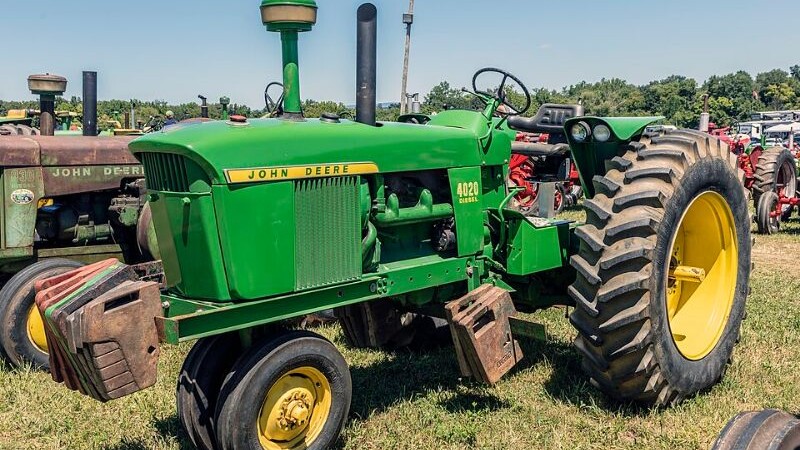
The auctioneer called Grandpa’s John Deere “yard art with a good seat.”
Most of the crowd laughed.
I did not.
The 1968 John Deere 4020 had been the first tractor I ever drove. It pulled the planter across our fields outside Winterset, Iowa, before I was tall enough to press the clutch without sliding off the seat.
But by the morning of the farm auction, its green paint had faded, the rear tires were checked, and a coffee can covered the exhaust.
Grandpa had died in February.
By September, the bank wanted the operating note settled and my mother wanted the farmhouse empty before winter.
“We can’t keep every memory,” she told me.
“This one still runs.”
“Then somebody will pay for it.”
I had spent the night before the sale in the machine shed with a battery charger, fresh diesel, and Grandpa’s old half-inch wrench. The tractor had not moved in six years.
At 1:20 in the morning, after I cleaned the fuel bowl and bled the lines, the six-cylinder diesel finally started.
The sound rattled dust from the rafters.
I laughed, then cried where nobody could see me.
The next day, it brought only scrap-yard bids.
“Eight hundred?” the auctioneer called. “Anybody at eight?”
A man in a brown canvas coat raised one finger.
He stood beyond the hay rack, away from the dealers. He was in his late sixties with a gray beard and mud dried to the knees of his boots.
“Eight hundred,” the auctioneer said. “Now nine.”
A salvage buyer near the front nodded.
The man in the coat raised his finger again.
The bids climbed slowly.
At $2,600, the salvage buyer quit.
I felt sick. The rebuilt injection pump alone was worth nearly that.
Then the stranger called, “Five thousand.”
The crowd went quiet.
The auctioneer blinked.
“Sir, I have twenty-six hundred.”
“I said five.”
There were no more bids.
After the hammer fell, the stranger did not go to the payment trailer. He walked straight to me.
“You’re Harold Bennett’s granddaughter,” he said.
“Mara.”
He removed his cap.
“Leon Price. I farm over by Chariton.”
The town was almost ninety miles away. I had never heard his name.
“How did you know Grandpa?”
Leon looked at the tractor.
“Your grandfather kept my farm from going under.”
In the spring of 1986, Leon was twenty-seven, newly married, and farming rented ground with a worn Allis-Chalmers. Three days into planting, its transmission failed.
A repair shop quoted more money than he had. Rain was coming. His operating loan was already stretched to the limit.
Leon called equipment dealers, neighbors, and relatives. Everyone needed their own tractor.
Then Harold Bennett arrived with the 4020 on a gooseneck trailer.
“Grandpa drove to Chariton?” I asked.
Leon nodded.
“Said he heard I was in a bind.”
Harold left the tractor for seventeen days. He refused rent and would not accept fuel money.
Leon finished planting hours before four days of rain.
That crop paid the bank, bought groceries, and kept his lease for another year.
“I tried to repay him every fall,” Leon said. “He told me to help the next farmer.”
“Why didn’t he ever tell us?”
Leon smiled.
“Because then he would’ve had to admit he was a good man.”
He reached into his coat and handed me a photograph.
Grandpa stood beside the John Deere in a muddy field, thirty-eight years younger, holding a thermos and squinting into the sun. Painted on the planter behind him was the name Price Farms.
On the back, Grandpa had written: Leon got it in. Rain came Sunday.
I asked why Leon had bid twice what the tractor was worth.
“I didn’t come to buy a tractor,” he said. “I came to settle an account.”
He went to the payment trailer and returned with a stamped receipt. Then he placed the John Deere’s key in my hand.
“It’s yours.”
I stared at him.
“You just paid five thousand dollars.”
“Your grandfather gave me more than that.”
My mother had joined us by then. She looked at the receipt, the key, and the photograph.
“We can’t take this,” she said.
Leon’s voice softened.
“Ma’am, Harold spent thirty-eight years telling me how to pay him back. Please don’t make me ignore him now.”
We kept the 4020.
Not as yard art.
That winter, Leon and I rebuilt the brakes in Grandpa’s shop. He brought seals, service manuals, and a dented red toolbox. I supplied pizza and the same terrible coffee Grandpa used to make.
Leon showed me where Harold had welded a crack in the battery box during those seventeen days in 1986. I showed him the notch Grandpa cut into the throttle quadrant so I could remember the engine speed for baling hay.
By April, the tractor had new rear tires, working lights, and enough compression to start without ether on a cold morning.
I used it to plant twelve acres of sweet corn on the piece of the farm my mother decided not to sell.
Leon drove over for the first pass.
Before he climbed into the seat, he taped a small paper card beneath the instrument panel.
It read: Account settled. Pay the next farmer.
That July, a teenager two roads over called because the hydraulic pump on his tractor failed with forty acres of hay on the ground and rain in the forecast.
I loaded Grandpa’s 4020 onto our trailer.
When the boy asked what I charged, I gave him the answer that had traveled across three counties and almost four decades.
“Help the next farmer.”
Story note: This is an original dramatized automotive story created for entertainment.
Featured image: “John Deere 4020 tractor,” photographed by Acroterion, via Wikimedia Commons (CC BY-SA 4.0). Image cropped for display.