The first thing Travis Bennett told me was that he wanted the truck safe
enough to sell.
The first thing his sister told me was not to take anything apart until
she got there.
Those two instructions arrived twenty minutes apart, and both were about
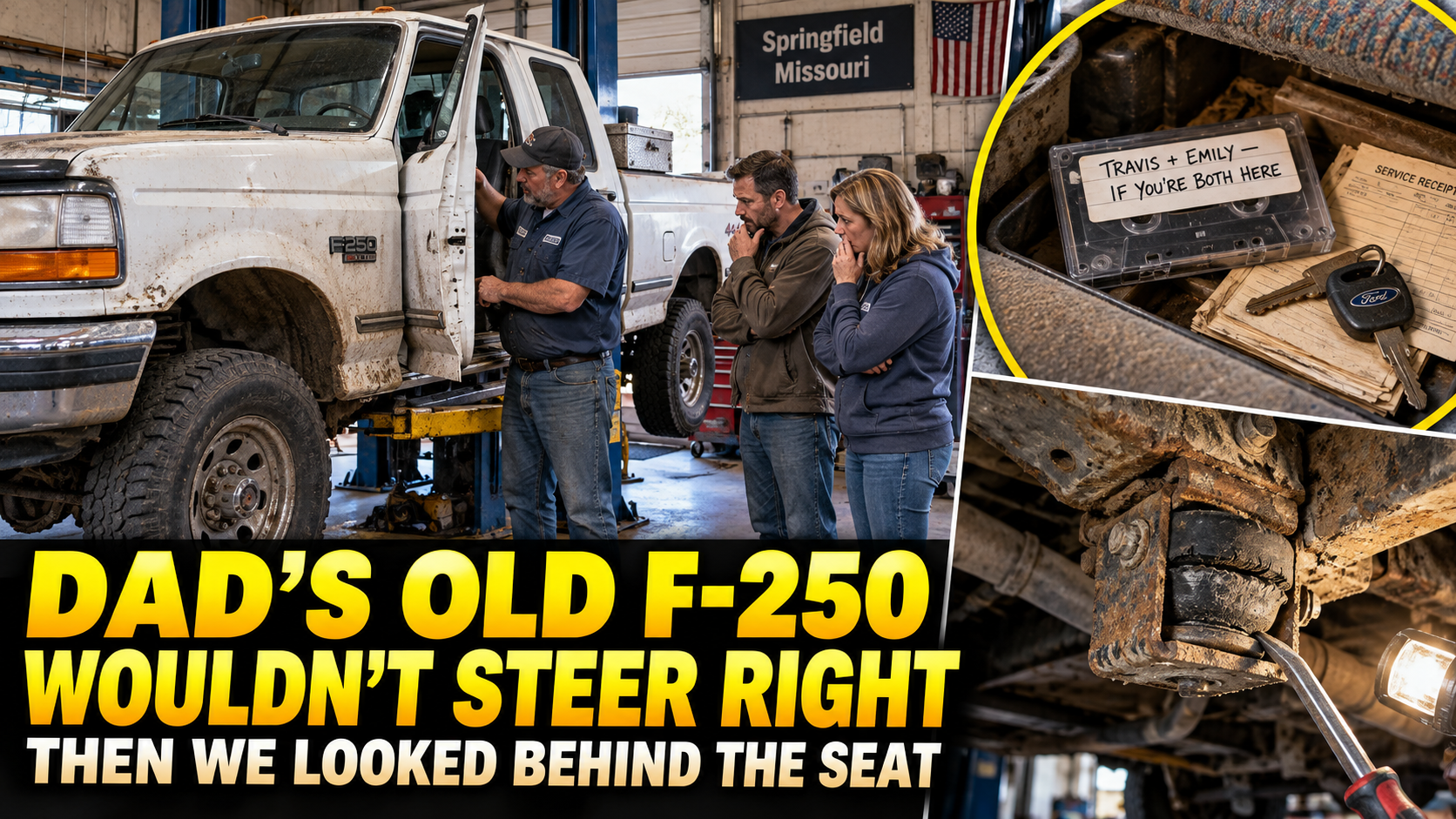
the same faded white 1997 Ford F-250 sitting crooked in the gravel
outside my shop.
I have owned a small independent repair shop outside Springfield,
Missouri, for more than twenty years. We work on a little of everything,
but old pickups make up a big part of what comes through the doors.
Around here, a truck can be transportation, a tool, a family record, and
a source of arguments all at the same time.
This Ford looked like it had been all four.
It was an extended-cab F-250 with a 7.3-liter Power Stroke diesel, an
automatic transmission, two-wheel drive, and 329,684 miles showing on
the odometer. The white paint had gone chalky on the hood and roof. The
driver’s door sagged just enough that you had to lift it slightly when
closing it. The rear bumper had been pushed inward on the passenger side
years ago. A steel crossover toolbox sat behind the cab, and the bed
floor showed the scars of lumber, fence posts, chains, and whatever else
had been thrown into it over nearly three decades.
It was not a collector truck.
It was a work truck.
And from the way Travis talked about it, that distinction mattered.
“My dad kept everything too long,” he said when he dropped it off on a
Tuesday morning. “Mowers, tools, trucks, coffee cans full of bolts. This
thing’s got almost three hundred thirty thousand on it. I just need to
know what it takes to make it drive straight so I can move it.”
“Move it where?” I asked.
“Sell it.”
He said it quickly, as if the decision had already been made.
I walked around the truck and wrote down the obvious items. Both front
tires had uneven wear. The steering wheel sat a few degrees off center.
The left front shock was damp. There was play somewhere in the steering
that I could feel before I even started it.
“Any history on the front end?”
“Dad did most of his own stuff. A shop replaced some parts last year. I
don’t know what.”
“Any records?”
Travis pointed at the cab.
“If there are, they’re probably buried in there.”
Then his phone rang.
He looked at the screen, sighed, and stepped away.
I could hear only his side.
“No, Emily. I’m at the shop.”
Pause.
“No, I’m not selling it today.”
Another pause.
“I said I’m getting it checked.”
He lowered his voice and walked farther toward the parking lot.
Family vehicle disputes are not rare in a repair shop. Sometimes one
person wants to restore something and another wants the garage space
back. Sometimes siblings disagree about what Dad’s old car is worth.
Sometimes a widow wants to keep a truck that costs more to maintain than
she can reasonably spend.
I try not to become the referee.
My job is to tell people what the machine needs.
Travis came back irritated.
“My sister thinks Dad’s truck is a museum exhibit.”
I handed him the work authorization.
“I’ll diagnose the steering first. I won’t sell it for you, and I won’t
decide who gets it.”
That got half a smile.
“Fair enough.”
He signed.
Before he left, he added one more thing.
“If you find a bunch of other stuff, call me before you go crazy. I’m
not restoring it.”
I told him I understood.
About twenty minutes later, the shop phone rang.
A woman introduced herself as Emily Bennett.
“I’m Roy Bennett’s daughter,” she said. “My brother just brought you
Dad’s white Ford.”
“Yes.”
“Have you started on it?”
“Not yet.”
There was a pause.
Then she said something that made me reach for a pen.
“Please don’t let my brother take anything apart until you look behind
the seat.”
I looked through the office window at the truck.
“What am I looking for?”
“I don’t know exactly.”
That was not the answer I expected.
She continued.
“My dad told me once that if anything happened to him, Travis and I
needed to go through the truck together. He specifically said not to let
Travis clean it out by himself.”
“Did he say why?”
“No. And before you ask, no, I don’t think there’s money in it.”
“I wasn’t going to ask.”
“You were thinking it.”
I laughed.
“Maybe a little.”
She said she could be at the shop after lunch.
I told her I would limit my work to an initial inspection until she
arrived.
At that point, I still believed the interesting part of the day would be
whatever was hidden behind the seat.
I was wrong.
The steering problem had been waiting for somebody to pay attention to
it for more than twenty years.
The Steering Problem That Didn’t Add Up
I pulled the Ford into bay two just before noon.
The 7.3 started after a couple of revolutions and settled into the
familiar uneven diesel clatter those trucks make when they are cold.
There was a little haze from the exhaust, but nothing unusual for an
engine with that mileage. Oil pressure came up. The transmission engaged
normally. The brake pedal was firm.
On a slow lap around the building, the steering felt worse than Travis
had described.
There was a dead area near center, but it was not the simple
loose-gearbox feeling I expected. The truck would take a set, then seem
to shift slightly under me when I changed direction. Over the broken
pavement behind the shop, I felt a dull movement through the floor.
Back inside, I put it on the lift.
My technician, Luis, was finishing a brake job in the next bay.
“Come feel this when you get a minute,” I told him.
I started at the tires and worked inward.
The left front had feathering and shoulder wear. The right front was not
much better. There was some play in the tie-rod ends, but not enough to
explain everything. The drag link had been replaced recently. The
steering gear showed normal seepage for its age, not a major leak. The
wheel bearings were serviceable. Ball-joint movement was present but not
dramatic.
Then Luis got under it while I rocked the steering wheel.
“Again,” he said.
I moved the wheel left and right.
He watched the linkage.
“Gear’s moving.”
“So is the pitman arm.”
“Linkage is moving.”
“Yeah.”
I stopped.
The steering wheel still had more movement than the linkage suggested.
That sent me upward.
On these older trucks, steering complaints can come from several places,
and by the time a vehicle has lived nearly thirty years, you cannot
assume every bracket, bushing, mount, or repair is still exactly where
the factory put it.
I checked the column and intermediate shaft.
There was wear, but again, not enough.
Then I had Luis move the wheel while I watched the relationship between
the cab, column, and frame.
That was when I saw it.
“Stop.”
He stopped.
“Do it again. Slow.”
The cab shifted.
Not much.
Maybe a few millimeters.
But the movement was there.
I grabbed a light and inspected the cab mounts.
The front mounts were aged but intact. The left rear cab mount was
another story. The rubber had compressed and split. The bracket area
showed old rust staining and evidence that somebody had worked there
before.
I put a pry bar where I could load the mount safely.
The cab moved more than it should have.
That mattered because the steering column is attached to the cab while
the steering gear is mounted to the frame. If the cab moves relative to
the frame, the driver can feel movement and steering behavior that gets
blamed on the column, gearbox, or linkage.
Luis looked at me.
“That’s ugly.”
“It’s old.”
“Think that’s all of it?”
“No.”
That answer is important.
Finding one bad part does not mean you stop diagnosing.
The truck still had worn steering components. It still needed an
alignment check. The tires still told a story. But the cab movement
explained why replacing ordinary front-end parts might not have
eliminated the strange sensation.
I lowered the truck enough to inspect the interior around the column and
floor.
The carpet was worn through near the pedals. The bench seat had a tear
repaired with gray tape. A faded ball cap sat behind the passenger seat.
There were two tow straps, a pair of gloves, a rain jacket, an old road
atlas, and enough receipts in the door pocket to start a small
accounting firm.
Then I noticed a cut in the carpet behind the bench.
It was too straight to be accidental.
I leaned closer.
Under the carpet was the edge of a small rectangular steel plate secured
with four bolts.
It was not factory.
I remembered Emily’s call.
I did not touch it.
Instead, I called Travis.
“I found part of your steering problem,” I told him.
“How bad?”
“Not transmission-money bad, if that’s what you’re asking.”
He laughed once.
I explained the cab mount movement and the other wear I had found.
“So fix the mount and align it?”
“Not that simple. I want to inspect the bracket closely, replace what’s
actually worn, and then measure everything before I promise you
anything.”
“Okay.”
“There’s something else.”
Silence.
“Behind the seat.”
His tone changed.
“What?”
“A bolted plate under the carpet.”
Another silence.
Then he said, “Open it.”
“Your sister asked me to wait until she got here.”
He exhaled hard.
“This is exactly what I’m talking about.”
“I’m not getting between you two.”
“It’s my truck too.”
“Which is why I’m waiting until both of you are standing here.”
He did not like that answer.
But he accepted it.
At 1:37 that afternoon, a dark blue Honda pulled into the lot.
Emily Bennett stepped out carrying a manila envelope and an old
photograph.
She looked at the Ford before she looked at me.
For a few seconds, she just stood there.
Then she said, “It looks smaller than I remember.”
That sentence told me the truck was never going to be just a truck.
The Photograph
Emily was forty-two, a few years younger than Travis. She worked at a
dental office in town and had two teenage daughters. She told me all of
that while we waited for her brother to return.
Their father, Roy, had died six weeks earlier after a short illness.
He had owned the F-250 since 1998.
“He bought it used with about twenty thousand miles,” she said. “I was
fourteen. Travis was seventeen.”
“What did he use it for?”
“Everything.”
That answer covered a lot.
Roy had worked maintenance at a food-processing plant. On evenings and
weekends he repaired fences, hauled firewood, pulled a small equipment
trailer, helped neighbors move, and occasionally drove three hours to
pick up machinery nobody else in the family thought they needed.
“He wasn’t a farmer,” Emily said, “but he was always helping somebody
who was.”
She handed me the photograph.
It was an old glossy print with rounded corners, slightly faded.
Roy stood beside the white Ford in what looked like the summer of 1998.
He was younger, leaner, wearing a blue work shirt. Emily and Travis
stood near the passenger door. Behind the seat, visible through the open
driver’s door, was a narrow black box mounted against the rear cab wall.
I looked at the current truck.
There was no black box there now.
“What was that?”
“I don’t know.”
“Tool storage?”
“Maybe. Dad built things.”
On the back of the photograph, somebody had written:
FIRST TRIP — TABLE ROCK — JULY 1998
Below that, in different ink, was another line.
KEEP THE FORD UNTIL BOTH KIDS UNDERSTAND WHY.
I looked at Emily.
“Your dad wrote this?”
“The first line is Mom’s handwriting. The second is Dad’s.”
“When was the second line added?”
“No idea.”
Their mother had died nine years earlier.
After that, Roy kept living in the same house, driving the same truck,
and refusing most suggestions that he replace anything simply because it
was old.
“He wasn’t cheap exactly,” Emily said. “He just hated throwing away
something that could still work.”
“That explains half my customer base.”
She smiled.
Then Travis arrived.
He walked into the bay, saw the photograph in my hand, and immediately
looked annoyed.
“You brought that?”
Emily folded her arms.
“Yes.”
“Why?”
“Because Dad told us to go through the truck together.”
“He told you that. He never told me.”
“He tried to tell you lots of things.”
There it was.
The real repair order.
Not steering.
History.
I stepped between the truck and my toolbox.
“Before this becomes Thanksgiving dinner, can we agree on one thing?”
They both looked at me.
“The plate stays closed unless both of you say open it.”
Travis shrugged.
“Fine. Open it.”
Emily stared at the floor for a few seconds.
Then she nodded.
“Okay.”
We disconnected both batteries before removing the bench seat. That was
partly habit and partly because old trucks often contain wiring
modifications that deserve respect.
The seat bolts fought us.
One came out normally. One needed penetrating oil. A rear bolt had
enough corrosion around it that I worked it back and forth rather than
risk snapping it.
When the seat finally came out, we had a clear view of the cut carpet.
The steel plate was about ten inches wide and maybe four inches tall.
Luis looked over from the next bay.
“Factory option?” he joked.
“No,” I said.
The bolts were small and rusty but came free.
Behind the plate was a shallow cavity somebody had fabricated between
trim and the rear cab wall. It was carefully made, not hacked together.
Inside were four things.
An old Ford key.
A stack of folded service receipts held by a rubber band that had almost
turned to powder.
A small cassette tape in a clear plastic case.
And a sealed envelope.
The cassette had black marker writing on the label.
TRAVIS + EMILY — IF YOU’RE BOTH HERE
Neither sibling spoke.
Emily reached toward it, then stopped.
Travis picked up the receipts instead.
“Of course,” he said quietly. “Dad leaves us paperwork.”
He tried to make it a joke.
It did not land.
I took the receipts only after he handed them to me.
Most were ordinary.
Tires.
Batteries.
Brake work.
A transmission service.
An alternator.
Then one from 2004 caught my attention.
The invoice was from a shop called Miller’s Auto & Alignment, a business
I vaguely remembered from years ago.
The typed complaint said:
CUSTOMER STATES STEERING CLUNK / WANDER / COLUMN FEELS LOOSE
Below the parts and labor lines, somebody had written by hand:
CAB MOVEMENT FOUND. L/R CAB MOUNT AREA. DO NOT REPLACE COLUMN UNTIL
CHECKING CAB MOUNT MOVEMENT.
I read it twice.
“That’s interesting.”
Travis looked over.
“What?”
I showed him.
Emily leaned in.
The date was twenty-two years old.
The complaint sounded almost exactly like the one that had brought the
truck to me.
“What did they fix?” Travis asked.
“Looks like they repaired something at the mount and replaced a bushing.
But this note says they were already watching movement between the cab
and frame.”
“So Dad knew?”
“He knew there had been a problem there.”
I inspected the mount area again with the old receipt in mind.
Now I could see the history more clearly.
A bracket had been repaired years earlier. The work was not terrible,
but corrosion and age had taken their toll. The rubber mount had
collapsed. The repair area needed to be cleaned and evaluated before I
decided whether it could be reused or needed more work.
The hidden compartment had already helped diagnose the truck.
But nobody was looking at the truck anymore.
They were looking at the cassette.
Travis finally said, “Does anybody even have something that plays that?”
Luis raised his hand from the next bay.
“My dad does.”
We all turned toward him.
“What?” he said. “He never throws anything away.”
For the first time that afternoon, Emily laughed.
Roy’s Voice
Luis’s father lived ten minutes from the shop.
He brought us an old portable cassette player that looked like it had
survived three garages and at least one roof leak. Luis cleaned the tape
head, checked the batteries, and tested it with another cassette before
we risked Roy’s.
By then it was nearly four.
I had work waiting.
Customers needed calls.
A Tahoe needed rear brakes. A Tacoma needed an alternator. A landscaping
company was asking when its dump truck would be ready.
A repair shop does not stop because one old Ford becomes interesting.
So I told Travis and Emily they could use the office.
They both said no.
They wanted to listen beside the truck.
We put the cassette into the player.
Luis pressed play.
There was hiss.
Then a click.
Then an older man’s voice.
“If this thing still works, that’s a miracle.”
Emily covered her mouth.
Travis looked away.
Roy continued.
“And if both of you are actually standing in the same place long enough
to hear it, that’s a bigger miracle.”
Travis laughed despite himself.
The recording had been made only a few years earlier. Roy’s voice
sounded tired but clear.
He said he did not know who would hear the tape first, and that was why
he had hidden it where neither child was likely to find it accidentally.
Then he said something that changed the mood.
“Before either of you gets excited, there is no money in this truck.”
Emily looked at Travis.
He shook his head.
“See?”
Roy went on.
“No gold. No bonds. No secret bank account. If you’re disappointed, you
learned the wrong lesson already.”
That sounded like the kind of sentence a father writes after decades of
knowing exactly how his children will react.
The tape was about fourteen minutes long.
Roy talked about the truck.
But mostly, he talked about them.
He reminded Travis about learning to back a trailer in the church
parking lot and getting angry every time Roy made him pull forward and
try again.
He reminded Emily about a trip to Table Rock Lake when rain came through
a bad window seal and she spent an hour holding a towel against the
door.
He talked about their mother.
He talked about how the truck had hauled lumber for the deck behind the
family house, pulled a borrowed tractor when a neighbor’s barn flooded,
carried both kids to college at different times, and brought their
mother home from the hospital after surgery.
Then he addressed the reason for the recording.
“I know you two are going to fight about my stuff.”
Travis stared at the floor.
“I know because you fight about things that aren’t even mine.”
Emily wiped her eyes.
Roy said he did not care whether they kept the Ford.
That surprised both of them.
“I mean that,” he said. “Don’t turn a worn-out truck into a shrine.
Machines are supposed to work. If it doesn’t make sense to keep it, sell
it. If one of you wants it, be fair to the other one.”
Then came the part that explained the photograph.
“The reason I told Emily you both needed to go through the truck is
because there’s one more envelope in there. Don’t open it until you
understand the steering problem.”
Travis looked at me.
I looked at the sealed envelope still lying in the compartment.
Roy continued.
“If the truck is doing that old wandering thing again, don’t start
throwing parts at it. Check the left rear cab mount and the old bracket
repair. Miller caught it the first time. I fixed it again years later. I
always meant to redo it properly when I had the bed off, and I never
did.”
I felt a strange satisfaction hearing that.
Not because I had solved anything brilliant.
Because the truck’s history and the physical evidence agreed.
That is what good diagnosis is supposed to feel like.
Roy’s voice continued.
“Mike at Miller’s told me something in 2004. He said, ‘Don’t let a loose
truck make you a parts changer.’ I remembered that.”
Then he paused.
The tape hissed.
“When you know what’s wrong with the Ford, open the envelope.”
The recording ended a minute later with a message about their mother.
Nothing dramatic.
Nothing polished.
Just a father telling two adult children to stop treating every
disagreement like a contest.
At the very end, he said:
“Travis, listen before you decide.
Emily, decide eventually.
You both know which one of you needs which advice.”
Click.
The tape stopped.
Nobody said anything for a while.
Then Travis looked at his sister.
“That was aimed at you.”
Emily stared at him.
“You cannot possibly be serious.”
He smiled.
She hit him lightly on the shoulder.
And for about ten seconds, the tension in the shop disappeared.
Then Travis pointed at the envelope.
“So we diagnose the truck.”
I nodded.
“We diagnose the truck.”
Diagnosis Before Sentiment
The next morning, I started over.
That may sound unnecessary because we already knew about the cab mount.
But an old note is not a diagnosis.
A dead man’s recording is not a diagnosis.
A customer’s belief is not a diagnosis.
You still inspect the machine in front of you.
I documented steering-wheel free play, inspected the steering gear
attachment, checked the pitman arm, drag link, tie rods, wheel bearings,
ball joints, and column shaft. I checked tire pressures and recorded
tread wear. I inspected the frame around the steering gear for cracking
and movement. I looked for anything that could create a safety issue.
There were several worn items.
The outer tie-rod end on the passenger side had measurable play.
The steering damper was tired.
The left front shock was leaking.
The front tires were old enough that I would not have trusted them for
long highway use even if the wear had been perfect.
But the unusual clunk and changing steering feel were strongly connected
to cab movement.
The left rear cab mount rubber had deteriorated badly. The old bracket
repair showed corrosion between overlapping metal. Under load, the mount
allowed the cab to shift enough to change what the driver felt through
the column and floor.
It was not causing the front wheels to magically steer themselves.
That distinction matters.
The steering linkage still controlled the wheels.
But the driver’s reference point—the cab, seat, column, and body—was
moving relative to the frame. Combined with actual wear in the linkage,
it created a vague, inconsistent sensation that encouraged previous
people to chase the steering itself.
I showed Travis and Emily.
I put a dial indicator where they could see movement while we carefully
loaded the cab.
Travis frowned.
“That little bit?”
“Little movements matter when they’re happening where they shouldn’t.”
“So Dad drove it like this?”
“Not necessarily this bad. Rubber keeps aging. Rust keeps working. His
note says he repaired it more than once.”
Emily asked the better question.
“Can it be fixed correctly?”
“Yes, assuming the metal cleans up the way I think it will.”
“How much?”
I gave them a range, not a fantasy.
The mount area needed disassembly before I could see the full condition.
I also recommended replacing the worn steering parts, addressing the
leaking shock as a pair, installing safe front tires, and aligning the
truck after the repairs.
Travis did the math in his head.
“That’s more than I wanted to spend before selling it.”
Emily said nothing.
I told them they did not have to decide immediately.
Then Travis surprised me.
“Fix it.”
Emily turned toward him.
He shrugged.
“If we’re going to find out what Dad was trying to tell us, we might as
well make the thing safe.”
That was the first decision they made together.
The repair took two days.
Once the mount came apart, we found exactly what old repairs often hide:
work that had been adequate for its time but was never meant to last
forever.
The bracket had been reinforced with a plate. The welds were still
mostly sound, but corrosion had developed around the layered metal. We
cleaned the area, evaluated what remained, removed compromised material,
and repaired the structure properly before installing new mount
components.
We did not turn it into a show truck.
We did not powder-coat the frame.
We did not replace every bushing because it looked old.
We repaired what needed repair.
The worn steering components were replaced. The shocks were done as a
pair. The front tires were replaced. We lubricated service points,
checked the brakes, inspected hoses and lines, and corrected a loose
battery hold-down while we were there.
Then the truck went for alignment.
The before measurements showed the effects of wear and years of use, but
nothing suggested a bent frame or catastrophic front-end problem.
After repair and alignment, I drove it.
The difference was immediate.
The F-250 still drove like a 1997 heavy-duty pickup.
That means it did not suddenly become a modern rack-and-pinion half-ton
with silent steering and luxury-car isolation.
But it tracked.
The strange floor movement was gone.
The steering response was consistent.
The clunk had disappeared.
I drove it on a two-lane road, through a rough industrial section, and
up to highway speed.
Then I brought it back.
Travis and Emily were waiting.
I handed Travis the keys.
“Now you can open the envelope.”
He looked at Emily.
This time, he did not reach for it first.
He handed it to her.
The Envelope
The envelope contained three pages.
The first was a handwritten letter from Roy.
The second was a photocopy of an old receipt from July 1998.
The third was a simple list of names and dates.
Emily read the letter aloud.
Roy began by explaining why he bought the Ford.
Not the practical reason.
The real reason.
In 1998, Travis was seventeen and angry at nearly everything.
Roy and his son had been fighting constantly.
Travis wanted a car.
Roy wanted him to save money.
Travis wanted more freedom.
Roy thought freedom came after responsibility.
Neither of them knew how to talk without turning the conversation into
an argument.
One Friday night, Travis left the house after a fight and stayed with a
friend.
The next morning, Roy saw an advertisement for the used F-250.
He did not need a diesel pickup that badly.
He bought it anyway.
His plan was to use the truck as an excuse to spend time with his son.
That was what the 1998 receipt showed.
Not the purchase price.
A receipt for a used utility trailer.
Roy wrote:
I COULDN’T GET YOU TO SIT AT THE KITCHEN TABLE WITH ME FOR TEN MINUTES,
BUT YOU WOULD RIDE TWO HOURS IF I SAID WE WERE PICKING UP AN ENGINE OR A
MOWER.
Travis stopped smiling.
Roy had started taking small hauling jobs on weekends.
Some paid fifty dollars.
Some paid fuel money.
Some were favors.
He did not do it because the family desperately needed the income.
He did it because Travis liked going.
Emily listened quietly.
Then Roy’s letter turned to her.
When she was fourteen, she thought those Saturday trips meant her father
preferred her brother.
So Roy started taking her on Sunday drives.
Not hauling jobs.
Just errands, lake trips, flea markets, and visits to her grandmother.
That was why the photograph from Table Rock mattered.
It was one of the first trips when all three went together without
fighting.
The black box visible behind the seat had been Roy’s original storage
box for receipts, maps, spare keys, and small tools.
Years later, after the box rusted and rattled, he removed it and built
the hidden compartment.
The list on the third page documented some of the truck’s family
history.
1998 — TABLE ROCK — FIRST TRIP ALL THREE
1999 — TRAVIS FIRST TRAILER BACKING WITHOUT ME YELLING
2000 — EMILY MOVED TO COLLEGE
2002 — BROUGHT EMILY HOME AFTER CAR BROKE
2003 — TRAVIS BORROWED TRUCK, RETURNED WITH EMPTY TANK
Beside that one, Roy had added:
STILL MAD
Travis laughed.
The list continued.
2006 — HAULED LUMBER FOR DECK
2008 — PULLED MARTIN’S TRACTOR OUT AFTER FLOOD
2011 — MOM’S SURGERY — TRUCK WOULDN’T START AT HOSPITAL — CAM SENSOR
2017 — EMILY’S GIRLS LEARNED TO DRIVE IN FIELD
2019 — TRAVIS FINALLY ADMITTED DIESELS ARE BETTER
Travis interrupted.
“I never admitted that.”
Emily pointed at the paper.
“Dad says you did.”
“Dad lied.”
I was standing a few feet away trying to pretend I was busy organizing
tools.
I was not fooling anybody.
Roy’s final paragraphs were the reason for everything.
He wrote that after their mother’s death, he noticed Travis and Emily
drifting into old habits.
Travis made fast decisions and expected everyone else to catch up.
Emily delayed decisions because making them felt like losing something.
Roy worried that when he died, his possessions would become weapons in
arguments neither child actually cared about winning.
So he chose the truck as a test.
Not because it was his most valuable possession.
Because it was the one thing both children remembered differently.
To Travis, the truck represented work.
To Emily, it represented family.
Roy wanted them to understand that both were true.
Then came the line that made Emily stop reading.
IF ONE OF YOU WANTS THE FORD, DON’T KEEP IT BECAUSE YOU THINK I LIVE IN
IT.
She took a breath.
I’M NOT IN THE SEAT, THE TOOLBOX, THE DIESEL SMELL, OR THE DENT IN THE
BUMPER.
I’M IN WHAT YOU REMEMBER DOING TOGETHER.
She continued.
IF NEITHER OF YOU NEEDS THE TRUCK, SELL IT TO SOMEBODY WHO WILL USE IT.
IF ONE OF YOU DOES NEED IT, PAY THE OTHER FAIRLY.
BUT BEFORE YOU DECIDE, TAKE ONE DRIVE TO TABLE ROCK TOGETHER.
NO SPOUSES.
NO KIDS.
NO ARGUMENT ABOUT THE RADIO.
JUST ONCE.
Travis rubbed his forehead.
“This is ridiculous.”
Emily folded the letter.
“You’re going.”
“I didn’t say I wasn’t.”
“Good.”
He looked at me.
“You see what he did?”
“What?”
“He turned a cab mount into a road trip.”
I smiled.
“Pretty efficient diagnosis.”
The Test Drive That Wasn’t Mine
They picked the truck up Friday afternoon.
The invoice was not small, but it was nowhere near the cost of replacing
every steering component people might have guessed at over the years.
I gave them the old parts.
I always offer that when practical, especially when a repair has been
confusing.
Travis held the collapsed cab-mount rubber in his hand.
“This caused all that weird feeling?”
“This plus the actual steering wear. Problems stack.”
He nodded.
That phrase seemed to stay with him.
Problems stack.
Before they left, Emily put the cassette and letter back into the hidden
compartment.
I told her that was probably not the best long-term storage place for
paper if moisture ever got into the cab.
She immediately removed them.
“Dad would appreciate that,” she said.
Travis drove.
Emily sat on the passenger side.
The old Ford left my parking lot and headed south.
I assumed that was the end of my involvement.
It was not.
Monday morning, Travis came back.
No appointment.
No warning.
He walked into the office carrying two coffees.
“One for you,” he said.
“What did I do?”
“Nothing. That’s why it’s safe to drink.”
He sat down.
They had made the drive to Table Rock.
At first, he said, it was awkward.
They had not spent two hours alone together in years.
They talked about their father’s house, which still needed to be sold.
They talked about tools. They talked about their mother’s jewelry. They
argued briefly about a lawn tractor.
Then Emily found the old road atlas behind the seat.
Inside it was a route marked in blue ink.
The route led to the same public lake access shown in the 1998
photograph.
So they followed it.
The place had changed.
The parking area was paved differently.
Trees were taller.
The little store they remembered was gone.
But part of the shoreline looked familiar.
They parked the F-250 and sat on the tailgate.
That was where Travis finally told Emily why he wanted to sell the truck
so quickly.
It was not because he hated it.
It was because he wanted it.
Badly.
And he did not think he could afford to buy out her share fairly.
Their father’s estate was modest. The house had value, but there were
expenses. Travis had recently gone through a divorce. He was renting a
smaller place and trying to get his finances under control.
“If I acted like the truck was junk,” he told me, “then selling it felt
easier.”
I looked at him.
“And your sister?”
“She knew.”
“Of course she knew.”
“She said she’d known since the funeral.”
Emily had been resisting the sale for the opposite reason.
She did not actually want the truck.
She had nowhere to keep it.
She did not need a three-quarter-ton diesel.
What she wanted was proof that Travis was not disposing of their
father’s life just to finish the estate faster.
Roy had predicted both of them accurately.
Travis made fast decisions to avoid sitting with difficult feelings.
Emily resisted decisions because finality hurt.
The truck forced them into the same cab long enough to say it.
“So what are you doing with it?” I asked.
“Keeping it.”
“How are you handling her share?”
He smiled.
“That got complicated.”
Their father’s letter said to be fair.
So they decided not to use a sentimental number.
They got two independent estimates of the truck’s value in its repaired
condition.
They subtracted the repair costs they had jointly authorized from the
estate before calculating the remaining value.
Then Travis agreed to pay Emily her share over several months.
Emily agreed because she did not need the money immediately.
But she added one condition.
“She gets to borrow it?”
“No.”
“What?”
“I have to take her girls out in it once a year.”
I laughed.
“That seems manageable.”
“Wait. There’s more.”
Emily wanted the hidden compartment left in place.
Not as a shrine.
As a record.
Every year, whoever used the truck for something memorable had to add
one line to a new notebook.
Not an emotional essay.
Just a date and what the truck did.
“Like Dad’s list,” I said.
“Exactly.”
I thought that was a better use for a hidden compartment than cash.
Then Travis became serious.
“There’s one thing I wanted to ask you.”
“What?”
“Do you think Dad knew that mount would fail again?”
I considered it.
“He knew it had been a problem. He knew the repair was old. He probably
noticed symptoms coming back. But I can’t tell you exactly what he knew
at the end.”
“So the whole thing wasn’t staged?”
“The mechanical problem? No. I don’t think your dad secretly destroyed a
cab mount to teach you a lesson.”
That got a laugh.
“He just used a real problem he understood.”
“That’s what it looks like.”
Travis nodded.
“That sounds like him.”
What 330,000 Miles Actually Means
A month later, the Ford returned for an oil change.
Travis had already put nearly two thousand miles on it.
He had cleaned the interior but resisted the urge to make it look new.
The taped seat was still taped. The dented bumper was still dented. He
had replaced a cracked mirror and repaired the tailgate latch.
He also had me inspect a small oil leak.
On a 7.3 Power Stroke with that kind of mileage, you do not assume every
wet surface means disaster. You clean, identify the source, monitor what
matters, and prioritize.
That is one reason I liked the way this story ended.
Nobody decided the truck had become priceless.
Nobody ordered a frame-off restoration.
Nobody spent forty thousand dollars chasing a memory.
They treated it like Roy had treated it.
As a machine worth maintaining when the work made sense.
The leak turned out to be manageable.
While the truck was in the shop, I looked at the notebook Travis had
placed in the compartment.
The first new entry read:
2026 — TRAVIS + EMILY — TABLE ROCK AGAIN — NO ARGUMENT ABOUT RADIO
Below it, in different handwriting:
HE PICKED TERRIBLE MUSIC.
Below that:
SHE COMPLAINED FOR 96 MILES.
I closed the notebook.
A few months passed.
Then Emily brought the truck in.
That surprised me.
“Where’s Travis?”
“At work.”
“Why do you have it?”
She pointed toward the bed.
Two bicycles were strapped inside.
“My girls wanted to ride a trail near the lake.”
“You borrowed the diesel to haul two bicycles?”
“Dad would have.”
I could not argue with that.
She had stopped because one front marker light was out and Travis had
told her not to ignore anything electrical on an old truck.
We replaced a bulb.
Before she left, she asked if I had ever met Roy.
I told her I did not think so.
“That’s weird,” she said.
“Why?”
“You know more about his truck than some people who knew him.”
I disagreed.
“I know what the truck shows me.”
That is different.
Machines preserve evidence, but they do not explain themselves.
A worn pedal tells you somebody drove a lot.
It does not tell you where they were going.
A dent tells you something made contact.
It does not tell you whether the owner laughed, cursed, or never
admitted what happened.
A repair receipt can show what failed.
It cannot show who was sitting in the waiting room.
That was the real value of Roy’s notebook and tape.
They did not make the F-250 mechanically special.
They connected the mechanical evidence to the people who lived around
it.
And that connection mattered when the family had to decide what came
next.
The Parts Roy Didn’t Replace
The following winter gave the Ford another chance to test everybody’s
patience.
Travis called me on a cold Thursday morning.
“It cranks slow.”
“How cold?”
“Eighteen degrees.”
“Batteries?”
“Don’t start.”
“That means you know.”
“I know they’re old.”
Diesel ownership has a way of turning battery maintenance into a moral
issue.
The truck still had a matched pair, but they were beyond the age where I
trusted them in winter. We load-tested both and confirmed what the slow
crank already suggested.
Travis approved two batteries.
While it was there, I noticed the glow-plug system deserved attention
too. The truck started, but not as cleanly as it should.
That led to another conversation about diagnosis.
Old vehicles invite a dangerous kind of enthusiasm after an emotional
event.
Once someone decides to “save Dad’s truck,” every aged component starts
looking like a candidate for replacement.
That can turn preservation into indiscriminate parts changing.
I told Travis the same thing Roy’s old alignment-shop note had
effectively said.
Fix evidence.
Do not fix anxiety.
We tested the system.
We repaired what testing supported.
We left working components alone.
Travis was learning.
So was Emily.
Their father’s possessions were being divided without the explosion both
had expected. They sold some tools. Travis kept a large bench vise.
Emily kept their mother’s cedar chest. They donated boxes of ordinary
household items. They argued about a socket set, then discovered it was
missing three sockets and neither actually wanted it.
The house sold in spring.
The F-250 did not.
By then, the notebook had more entries.
One recorded a trip to help Emily’s oldest daughter move into her first
apartment.
Another recorded hauling storm-damaged fence panels from a neighbor’s
property.
One simply said:
TRAILER LIGHT GROUND — FIXED IN RAIN — DAD WOULD HAVE LAUGHED
That entry made me think about the strange way useful objects gather
meaning.
A vehicle does not need to be rare to become important.
The Ford was not a Shelby, a Hemi car, a split-window Corvette, or a
low-mile survivor.
Its value came from repetition.
The same seat.
The same diesel rattle.
The same bed.
The same family climbing in and out through different stages of life.
That kind of value is difficult because it does not transfer cleanly to
a buyer.
A stranger might see a worn-out old diesel.
A family sees twenty-eight years.
Roy seemed to understand that.
His letter did not tell them the truck was priceless.
It told them not to confuse memory with metal.
That distinction probably saved the Ford.
If he had ordered them never to sell it, the truck might have become a
burden.
Instead, he gave them permission to choose.
Travis chose to keep it.
And because the choice was his, he maintained it without resentment.
The Day the Toolbox Came Off
About a year after the steering repair, Travis decided to replace the
rusting crossover toolbox.
He called before removing it.
“There’s writing underneath.”
I thought he meant on the bed.
He sent me a photograph.
On the bottom of the old steel toolbox, in white paint marker, Roy had
written:
IF YOU’RE READING THIS, THE BOX FINALLY LOST.
Below that:
BUY A BETTER ONE.
There was no secret message.
No hidden family revelation.
Just Roy making a joke for a future he knew he would probably never see.
That may have been my favorite discovery.
Stories about old vehicles often get exaggerated because people want
every hidden note to reveal a fortune, a secret identity, or a rare
factory option.
Real life is usually smaller.
And better.
A man knew his toolbox was rusting.
He wrote a joke underneath it.
Years later, his son found it.
Travis bought an aluminum replacement.
He did not throw the old box away immediately.
He cut out the small section containing Roy’s writing, cleaned the
edges, and mounted it on his garage wall.
Emily accused him of becoming sentimental.
He denied it.
She sent me the text exchange.
TRAVIS: IT’S SHOP DECOR.
EMILY: IT IS LITERALLY DAD’S HANDWRITING.
TRAVIS: INDUSTRIAL SHOP DECOR.
EMILY: YOU ARE IMPOSSIBLE.
Their relationship had not transformed into perfect harmony.
That would have been less believable than finding gold behind the seat.
They still disagreed.
They still annoyed each other.
But the arguments stopped carrying the same threat.
Neither seemed afraid that every disagreement would become the one that
separated them permanently.
Sometimes a repaired relationship is not one where people stop fighting.
It is one where they stop leaving.
A Mechanic’s View of Family History
I have thought about Roy’s truck more than I expected.
Part of that is because the diagnosis itself was satisfying.
A steering complaint had survived multiple repairs because the symptom
crossed the boundary between body and chassis. The driver felt looseness
through the steering and floor, so attention naturally went toward
steering parts. Some of those parts really were worn, which made the
picture even more confusing.
But the cab mount movement was a major clue.
The old 2004 receipt confirmed the problem had history.
Roy’s recording confirmed he understood that history.
None of those pieces replaced inspection.
Together, they made the diagnosis stronger.
That is how old vehicles should be approached.
History matters.
Evidence matters more.
The other reason I remember the truck is that repair shops see families
at unusual moments.
People bring us cars when they are moving.
When a child starts driving.
When a parent stops driving.
When somebody dies.
When money is tight.
When a job changes.
When a marriage ends.
When a vehicle that used to be ordinary suddenly becomes the last
physical thing connected to someone.
Mechanics are not counselors.
We should not pretend to be.
But if you stay in this business long enough, you learn that the
sentence “What’s this going to cost?” sometimes means more than money.
It can mean:
Is this worth saving?
Am I being foolish?
Can I let this go?
Will my brother think I cheated him?
Would Dad be angry if I sold it?
Those questions are not on a scan tool.
You still have to answer the mechanical question first.
What is wrong?
What is unsafe?
What can wait?
What is the evidence?
What will the repair realistically accomplish?
Clear mechanical information gives people room to make the emotional
decision themselves.
That was my role with the F-250.
I did not tell Travis to keep it.
I did not tell Emily to let it go.
I told them why the steering felt wrong and what it would take to repair
it.
Roy handled the rest twenty years earlier with a receipt, a cassette,
and enough understanding of his children to know they would need a push.
The Second Table Rock Photograph
Two years after the original repair, I received a Christmas card at the
shop.
The front showed a photograph.
A faded white 1997 Ford F-250 sat near Table Rock Lake.
Travis stood on one side.
Emily stood on the other.
Between them were Emily’s two daughters and Travis’s teenage son.
The truck looked cleaner than it had the day I first saw it, but not
dramatically different.
The bumper was still dented.
The paint was still faded.
The new toolbox was visible behind the cab.
On the back of the card, Emily had written:
SECOND TRIP ALL OF US — NOBODY HELD A TOWEL AGAINST THE DOOR THIS TIME.
Below it, Travis had added:
STEERING STILL STRAIGHT.
I put the card on the bulletin board in my office.
A customer saw it a few weeks later.
“Nice old Ford,” he said. “Yours?”
“No.”
“Customer?”
“Yeah.”
“What’s the story?”
I looked at the photograph.
There were several ways I could have answered.
I could have told him about the cab mount.
I could have told him about the hidden compartment.
I could have told him about the cassette.
Instead, I said:
“Family finally figured out what the truck was for.”
He nodded as if that made sense.
Maybe it did.
Because that was the lesson Roy had been trying to leave behind.
The F-250 had never been about preserving an object exactly as he left
it.
It had always been about using a machine as an excuse to do something
together.
In 1998, Roy bought a diesel pickup partly because his teenage son would
ride with him if there was a trailer involved.
He took his daughter on drives because she needed time with him too.
Years later, when he saw his adult children drifting apart, he used the
same truck one more time.
He could not force them to agree.
He could not make them grieve the same way.
He could not guarantee they would keep the Ford.
So he left them a process.
Diagnose before replacing.
Listen before deciding.
Drive together before selling.
That is not bad advice for a truck.
It is even better advice for a family.
What the Old Receipts Told Us
Before Travis took the truck home, we went through the rest of Roy’s
service receipts and built a simple timeline. This was not necessary to
repair the cab mount, but it was useful for deciding how to maintain a
vehicle with more than three hundred thousand miles.
The records were imperfect. Some years had detailed invoices. Other
years had only parts-store receipts with Roy’s handwriting on the back.
A few entries were nothing more than mileage and a part number.
That is normal.
Owners who maintain their own vehicles rarely create the kind of clean
history people imagine when they hear “service records.”
What mattered was pattern.
Roy recorded oil changes more consistently than anything else. He noted
transmission services. He had dates for batteries, belts, hoses, brakes,
and cooling-system work. He wrote down when the camshaft position sensor
failed at the hospital in 2011. He even recorded the brand of wiper
blades he disliked.
One note said:
DON’T BUY THESE AGAIN — CHATTER LIKE TEETH
Emily laughed when she read it.
“He complained about wipers for a month.”
Another receipt showed a starter replacement.
Travis remembered that one because Roy had made him help in the
driveway.
“I was home for Christmas,” he said. “It was freezing. He said it would
take an hour.”
“How long?”
“Six.”
“That sounds right.”
The records also showed restraint.
Roy did not replace things just because they were old.
When an alternator tested correctly, he left it.
When a shop recommended monitoring a seep, he monitored it.
When tires aged out, he replaced them even if tread remained.
That gave me a better picture of the owner than any speech could.
He was not neglectful.
He was not obsessive.
He was practical.
That history helped us create a maintenance plan for Travis.
We did not know the exact condition of every internal component, so we
did not pretend we did.
We established baselines where useful.
We checked fluids.
We inspected belts and hoses.
We looked for active leaks.
We checked brake condition.
We tested charging performance.
We noted items that deserved future attention.
I told Travis to think in three categories.
Safety.
Reliability.
Preference.
Safety items come first.
Reliability items are addressed according to evidence, use, and risk.
Preference items are where owners can spend unlimited money making an
old truck look or feel newer.
“Where does the dented bumper go?” he asked.
“Preference, unless it’s loose or dangerous.”
“Dad would agree.”
“Where does the torn seat go?”
“Preference.”
“Good.”
“Where does the radio that only plays one speaker go?”
“Emergency.”
Emily said, “Ignore him.”
That conversation mattered because it changed the way Travis approached
ownership.
He had begun the week thinking there were only two choices.
Sell the truck.
Or restore it.
There was a third choice.
Use it.
Maintain it intelligently.
Accept that an old work truck can be safe and useful without being
cosmetically perfect.
That is the choice he made.
It was probably the choice Roy expected.
The receipts did one more thing.
They showed how often the Ford had been used to help other people.
Roy sometimes wrote the purpose of a trip beside fuel or repair entries.
MARTIN BARN.
EMILY MOVE.
CHURCH TRAILER.
MOM HOSPITAL.
TOM’S MOWER.
FLOOD FENCE.
None of those notes meant anything to me.
They meant everything to the siblings.
Each one triggered a memory.
The truck’s history was not a straight line of mechanical failures.
It was a list of reasons the engine had been started.
That distinction stayed with me.
Mechanics usually see mileage as wear.
Owners see mileage as life.
Both views are correct.
The trick is not confusing one for the other.
Three hundred thirty thousand miles meant bushings had aged, seals had
hardened, wiring had lived through heat cycles, and thousands of gallons
of fuel had passed through the system.
It also meant hundreds of mornings, errands, jobs, arguments, favors,
and trips.
The repair records connected those two histories.
By the time we finished sorting them, Travis no longer talked about the
truck as if it were an inconvenient object.
Emily no longer talked about it as if touching anything would erase
their father.
They were beginning to see it accurately.
Old.
Useful.
Imperfect.
Repairable.
Meaningful.
And not sacred.
That was probably the balance Roy wanted.
THE FIRST TIME ROY LET TRAVIS DRIVE IT
A week after the Table Rock trip, Travis remembered another story that
had never made it onto Roy’s list.
He was seventeen the first time Roy let him drive the F-250 alone. A
neighbor needed a small utility trailer returned across town. Roy came
home exhausted, and Travis asked for the keys. Roy said no. Travis
argued, then stopped. He went outside, checked the trailer lights, hitch
pin, safety chains, and tires, came back inside, and put the keys to his
own car on the table.
Roy looked at him. “What are you doing?”
“Showing you I’m not trying to go anywhere else.”
Roy handed him the Ford keys. “Straight there. Straight back.”
Travis remembered feeling ten feet tall. The diesel was louder and the
truck larger than anything he normally drove. The empty trailer moved
differently behind it, and he watched the mirrors the whole way. He
delivered it, put ten dollars of diesel in the tank, and came home.
Roy was on the porch.
“How’d it go?”
“Fine.”
“Hit anything?”
“No.”
“Trailer still there?”
“Yes.”
“Then I guess you can drive.”
That was all.
Emily remembered the same day differently. She remembered standing at
the window, convinced her brother would wreck.
“I was fourteen,” she told him years later. “You were an idiot.”
“I was an excellent driver.”
“You backed Mom’s car into the trash cans two months earlier.”
“That was unrelated.”
Their disagreement became another lesson. A family history is rarely one
perfectly clean story. Everybody remembers from a different seat.
That was why the new notebook slowly changed. They started writing not
only dates, but who had been there and what each person remembered.
Sometimes two versions appeared under the same entry.
The Table Rock return trip read:
TRAVIS: NO ARGUMENT ABOUT RADIO.
EMILY: THIS IS FALSE.
Nobody had to win the memory. The notebook was better because it allowed
disagreement.
Months later, Travis’s teenage son wanted to learn how to back a
trailer. Travis took him to an empty church parking lot in the F-250.
Back.
Pull forward.
Correct.
Back again.
After the fourth attempt, the boy got frustrated. Travis nearly snapped,
then remembered his father making him do the same thing.
He got out and pointed at the trailer tires relative to the painted
lines.
“Don’t fight the wheel,” he said. “Make a small correction and give the
trailer time to show you what it did.”
His son tried again.
Better.
Not perfect.
Better.
When they finished, Travis added a line to the notebook:
TAUGHT HIM TO BACK A TRAILER. I DID NOT YELL AS MUCH AS GRANDPA.
His son added:
HE YELLED.
Emily later added:
CONFIRMED.
That was when the notebook stopped being only Roy’s record and became
the family’s.
The truck had moved forward.
So had they.
There was another reason that memory mattered. Travis finally understood
why Roy had bought a truck he did not strictly need in 1998. Work had
been Roy’s easiest language. If he wanted time with his teenage son, he
created a job that required two people. A trailer to return. A mower to
pick up. Lumber to haul. A fence to repair.
Roy did not sit Travis down and announce that they needed to improve
their relationship.
He handed him gloves.
He pointed at a hitch.
He asked, “You coming?”
For some families, that is how the important conversations begin.
Not across a table.
Across a truck cab.
Emily had needed something different. Roy eventually recognized that
too. She did not care about trailers or machinery the way Travis did. So
he found other reasons to drive with her. Lake trips. Errands. Flea
markets. Visits to family.
The vehicle was the same.
The invitation was different.
Years later, the hidden cassette did exactly what those old trips had
done.
It put the two siblings in one place long enough to listen.
That made the steering repair feel almost accidental.
But it was not.
Roy had chosen a real mechanical problem because he trusted a process
both children understood: find the symptom, inspect the evidence, do not
replace things blindly, and make a decision only after you know what is
actually wrong.
It was a mechanic’s logic applied to a family argument.
And somehow, it worked.
Epilogue: The Next Driver
The F-250 is still around.
It crossed 350,000 miles not long ago.
Travis sent me a photograph of the odometer.
His message said:
DAD WOULD SAY IT’S BARELY BROKEN IN.
I replied:
DAD ISN’T PAYING THE REPAIR BILLS.
He sent back a laughing emoji.
The truck has needed ordinary old-truck work since then.
A water pump.
Front brakes.
A window regulator.
A leaking return line.
Nothing about keeping an old vehicle means pretending maintenance is
free.
That is another reason Roy’s letter was smart.
He gave Travis permission to sell it someday.
That matters.
A family heirloom should not become a financial trap just because
somebody loved it first.
Travis says his son may want the truck eventually.
Maybe he will.
Maybe he will not.
If the boy gets it, he will inherit something more useful than a rule
that says NEVER SELL.
He will get the notebook.
He will see what the truck did.
He will know why certain repairs were made.
He will know that his grandfather hid a cassette behind the seat because
two stubborn adult children needed to hear the same message at the same
time.
And he will know that the most important repair in the story was not the
cab mount.
The cab mount was rubber, steel, corrosion, labor, alignment, and a few
worn steering parts.
We fixed that in a shop.
The harder problem had been building for years.
Travis thought making a fast decision was the same as being practical.
Emily thought refusing to decide was the same as protecting a memory.
Roy knew both of them well enough to leave instructions that challenged
exactly those habits.
Travis had to listen.
Emily had to decide.
The truck gave them a place to do both.
When I first saw that faded Ford, I thought it was another high-mileage
pickup with loose steering.
Mechanically, that is exactly what it was.
But the best old vehicles are often two things at once.
They are machines with ordinary failures.
And they are containers for extraordinary amounts of ordinary life.
A worn cab mount does not know who rode above it.
A steering column does not remember arguments.
A diesel engine does not care who is sitting in the passenger seat.
People provide the meaning.
That is why I still think about the line Roy left in the letter:
Don’t keep the Ford because you think I live in it.
He was right.
Roy did not live in the truck.
But because he had used it for nearly three decades—to work, to haul, to
help, to argue, to teach, to travel, and to spend time with his
children—the truck had become a map of where the family had been.
The hidden compartment did not contain money.
It contained context.
And context was what they needed.
The last time the Ford came into my shop, Travis had added another line
to the notebook.
I did not read it until he told me to.
It said:
350,112 MILES — TOOK MY SON TO PICK UP HIS FIRST PROJECT CAR. HE TALKED
THE WHOLE WAY HOME.
Below it, in smaller handwriting:
NOW I UNDERSTAND WHY DAD BOUGHT THE TRUCK.
I closed the notebook and put it back behind the seat.
Some repairs are finished when the bolts are torqued.
Some take a little longer.