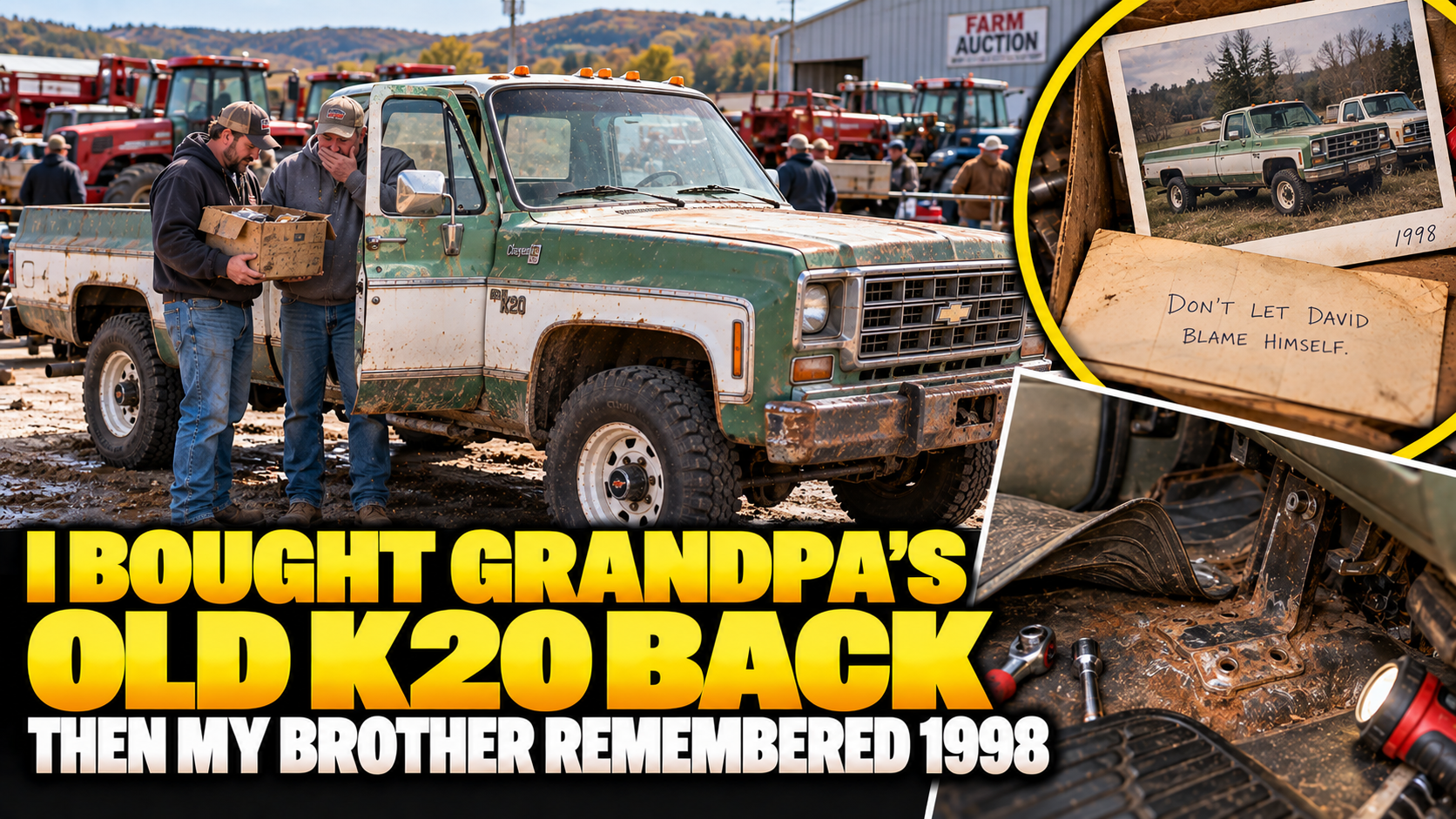
I went to a farm auction outside Lebanon, Missouri, because I needed a
used rolling toolbox.
I came home owning my grandfather’s truck.
The 1976 Chevrolet K20 sat at the far end of the equipment row between a
worn stock trailer and a three-point brush cutter.
Faded green.
White roof.
Long bed.
Four-wheel drive.
Homemade rear bumper.
Dent behind the passenger door.
I knew the dent.
My brother David put it there in 1998.
Grandpa Earl sold the truck days later.
For twenty-eight years, David believed those two events were connected.
Then we pulled up the old rubber floor mat.
Four holes beside the transmission tunnel started telling a different
story.
The Truck at the End of the Row
I went to the auction for a rolling toolbox, not a truck. The K20 sat
beyond a line of hay equipment wearing the same faded green paint and
homemade bumper I remembered from childhood.
The older I get, the less I trust the clean version of any family story.
Clean stories usually arrive years later. They lose weather, money
problems, half-finished repairs, arguments nobody remembers correctly,
and practical decisions that made sense only on a particular day.
The K20 had become one of those stories.
Grandpa loved truck.
David damaged truck.
Grandpa sold truck.
Therefore Grandpa sold truck because David damaged it.
That version fit in one sentence.
It was also wrong.
The physical truck gave us evidence the family version had missed. Old
holes in the floor were not decorative. The bracket had wear showing it
had actually been used. Saved hardware fit the hole pattern. The
Polaroid tied the truck to Walter. Dates tied Walter’s injury to the
period when the Chevy left our family.
No single clue was magical.
They mattered because they agreed.
That is the same way I approach mechanical diagnosis. One clue can
mislead you. Independent clues pointing in the same direction deserve
attention.
We also had to keep emotion from turning the truck into something
mechanically special.
It was still a nearly fifty-year-old farm pickup.
Age does not care who your grandfather was.
Rubber deteriorates. Brake fluid absorbs moisture. Steel corrodes. Fuel
turns bad. Seals harden. Electrical connections oxidize. Tires age even
when tread remains.
A vehicle can be emotionally priceless and mechanically unsafe at the
same time.
So we treated the story and the repair as separate jobs.
The story asked what happened in 1998.
The repair asked what condition the truck was in now.
We did not let one answer replace the other.
David struggled with that.
Every time we found another worn component, he looked disappointed.
“I thought Grandpa kept everything perfect.”
“No,” I told him. “He kept things working.”
There is a difference.
Working equipment accumulates compromises. A farmer may use what is
available because rain is coming. A bracket may be fabricated because
the correct solution cannot happen that day. A repair may remain for
years because it keeps doing its job.
Some choices are smart.
Some age badly.
Some must be corrected by the next owner.
Respecting the person who made an old repair does not require preserving
it forever.
That mattered with the homemade control bracket.
It was historically important because it explained Grandpa’s decision.
That did not mean we would bolt a decades-old homemade accessibility
arrangement back into active service without proper modern evaluation.
We photographed it, recorded where it mounted and preserved it with the
truck’s history.
Then we focused on making the current controls and the rest of the
vehicle safe for the people who would drive it now.
David liked that distinction.
Preserving a story did not mean freezing a machine in time.
The same applied to the dent.
We could repair it later.
We could leave it.
It was not sacred.
It simply was no longer proof of what David had spent decades believing.
As the work continued, our conversations changed.
David stopped asking whether Grandpa had been angry.
He started asking what Grandpa had actually done.
He had modified a truck for a friend.
He had sold it when that friend needed transportation.
He had written a note because he apparently realized David might
misunderstand.
He had failed to make sure David ever read it.
Good intentions do not automatically create good communication.
Grandpa could be generous and still leave a mess behind.
David could make a stupid teenage decision and still not deserve thirty
years of guilt.
Both things could be true.
Real families rarely give you perfect heroes and villains.
They give you people who love each other, get angry, fail to explain
themselves, and assume there will be time later.
Then later disappears.
The truck gave us another chance at the conversation.
Not with Grandpa.
With each other.
By the end of this part of the story, David stopped saying, “Grandpa
sold it because of me.”
He started saying, “I thought Grandpa sold it because of me.”
That one extra phrase changed everything.
It turned a fact into what it had always been:
an assumption.
Why Grandpa’s Chevy Was Different
Grandpa Earl used the K20 for fencing, feed, firewood, winter chores and
anything else a Missouri farm could ask of an old four-wheel-drive
pickup.
The older I get, the less I trust the clean version of any family story.
Clean stories usually arrive years later. They lose weather, money
problems, half-finished repairs, arguments nobody remembers correctly,
and practical decisions that made sense only on a particular day.
The K20 had become one of those stories.
Grandpa loved truck.
David damaged truck.
Grandpa sold truck.
Therefore Grandpa sold truck because David damaged it.
That version fit in one sentence.
It was also wrong.
The physical truck gave us evidence the family version had missed. Old
holes in the floor were not decorative. The bracket had wear showing it
had actually been used. Saved hardware fit the hole pattern. The
Polaroid tied the truck to Walter. Dates tied Walter’s injury to the
period when the Chevy left our family.
No single clue was magical.
They mattered because they agreed.
That is the same way I approach mechanical diagnosis. One clue can
mislead you. Independent clues pointing in the same direction deserve
attention.
We also had to keep emotion from turning the truck into something
mechanically special.
It was still a nearly fifty-year-old farm pickup.
Age does not care who your grandfather was.
Rubber deteriorates. Brake fluid absorbs moisture. Steel corrodes. Fuel
turns bad. Seals harden. Electrical connections oxidize. Tires age even
when tread remains.
A vehicle can be emotionally priceless and mechanically unsafe at the
same time.
So we treated the story and the repair as separate jobs.
The story asked what happened in 1998.
The repair asked what condition the truck was in now.
We did not let one answer replace the other.
David struggled with that.
Every time we found another worn component, he looked disappointed.
“I thought Grandpa kept everything perfect.”
“No,” I told him. “He kept things working.”
There is a difference.
Working equipment accumulates compromises. A farmer may use what is
available because rain is coming. A bracket may be fabricated because
the correct solution cannot happen that day. A repair may remain for
years because it keeps doing its job.
Some choices are smart.
Some age badly.
Some must be corrected by the next owner.
Respecting the person who made an old repair does not require preserving
it forever.
That mattered with the homemade control bracket.
It was historically important because it explained Grandpa’s decision.
That did not mean we would bolt a decades-old homemade accessibility
arrangement back into active service without proper modern evaluation.
We photographed it, recorded where it mounted and preserved it with the
truck’s history.
Then we focused on making the current controls and the rest of the
vehicle safe for the people who would drive it now.
David liked that distinction.
Preserving a story did not mean freezing a machine in time.
The same applied to the dent.
We could repair it later.
We could leave it.
It was not sacred.
It simply was no longer proof of what David had spent decades believing.
As the work continued, our conversations changed.
David stopped asking whether Grandpa had been angry.
He started asking what Grandpa had actually done.
He had modified a truck for a friend.
He had sold it when that friend needed transportation.
He had written a note because he apparently realized David might
misunderstand.
He had failed to make sure David ever read it.
Good intentions do not automatically create good communication.
Grandpa could be generous and still leave a mess behind.
David could make a stupid teenage decision and still not deserve thirty
years of guilt.
Both things could be true.
Real families rarely give you perfect heroes and villains.
They give you people who love each other, get angry, fail to explain
themselves, and assume there will be time later.
Then later disappears.
The truck gave us another chance at the conversation.
Not with Grandpa.
With each other.
By the end of this part of the story, David stopped saying, “Grandpa
sold it because of me.”
He started saying, “I thought Grandpa sold it because of me.”
That one extra phrase changed everything.
It turned a fact into what it had always been:
an assumption.
The Sale Nobody Explained
In 1998 Grandpa sold the Chevy abruptly. David was seventeen and had
borrowed it without permission shortly before it disappeared. For years
he assumed those events were connected.
The older I get, the less I trust the clean version of any family story.
Clean stories usually arrive years later. They lose weather, money
problems, half-finished repairs, arguments nobody remembers correctly,
and practical decisions that made sense only on a particular day.
The K20 had become one of those stories.
Grandpa loved truck.
David damaged truck.
Grandpa sold truck.
Therefore Grandpa sold truck because David damaged it.
That version fit in one sentence.
It was also wrong.
The physical truck gave us evidence the family version had missed. Old
holes in the floor were not decorative. The bracket had wear showing it
had actually been used. Saved hardware fit the hole pattern. The
Polaroid tied the truck to Walter. Dates tied Walter’s injury to the
period when the Chevy left our family.
No single clue was magical.
They mattered because they agreed.
That is the same way I approach mechanical diagnosis. One clue can
mislead you. Independent clues pointing in the same direction deserve
attention.
We also had to keep emotion from turning the truck into something
mechanically special.
It was still a nearly fifty-year-old farm pickup.
Age does not care who your grandfather was.
Rubber deteriorates. Brake fluid absorbs moisture. Steel corrodes. Fuel
turns bad. Seals harden. Electrical connections oxidize. Tires age even
when tread remains.
A vehicle can be emotionally priceless and mechanically unsafe at the
same time.
So we treated the story and the repair as separate jobs.
The story asked what happened in 1998.
The repair asked what condition the truck was in now.
We did not let one answer replace the other.
David struggled with that.
Every time we found another worn component, he looked disappointed.
“I thought Grandpa kept everything perfect.”
“No,” I told him. “He kept things working.”
There is a difference.
Working equipment accumulates compromises. A farmer may use what is
available because rain is coming. A bracket may be fabricated because
the correct solution cannot happen that day. A repair may remain for
years because it keeps doing its job.
Some choices are smart.
Some age badly.
Some must be corrected by the next owner.
Respecting the person who made an old repair does not require preserving
it forever.
That mattered with the homemade control bracket.
It was historically important because it explained Grandpa’s decision.
That did not mean we would bolt a decades-old homemade accessibility
arrangement back into active service without proper modern evaluation.
We photographed it, recorded where it mounted and preserved it with the
truck’s history.
Then we focused on making the current controls and the rest of the
vehicle safe for the people who would drive it now.
David liked that distinction.
Preserving a story did not mean freezing a machine in time.
The same applied to the dent.
We could repair it later.
We could leave it.
It was not sacred.
It simply was no longer proof of what David had spent decades believing.
As the work continued, our conversations changed.
David stopped asking whether Grandpa had been angry.
He started asking what Grandpa had actually done.
He had modified a truck for a friend.
He had sold it when that friend needed transportation.
He had written a note because he apparently realized David might
misunderstand.
He had failed to make sure David ever read it.
Good intentions do not automatically create good communication.
Grandpa could be generous and still leave a mess behind.
David could make a stupid teenage decision and still not deserve thirty
years of guilt.
Both things could be true.
Real families rarely give you perfect heroes and villains.
They give you people who love each other, get angry, fail to explain
themselves, and assume there will be time later.
Then later disappears.
The truck gave us another chance at the conversation.
Not with Grandpa.
With each other.
By the end of this part of the story, David stopped saying, “Grandpa
sold it because of me.”
He started saying, “I thought Grandpa sold it because of me.”
That one extra phrase changed everything.
It turned a fact into what it had always been:
an assumption.
Buying It Back
The auctioneer had only partial history. The truck had passed through
another local farm family and later sat in a machine shed. I bought it
knowing nostalgia did not make it roadworthy.
The older I get, the less I trust the clean version of any family story.
Clean stories usually arrive years later. They lose weather, money
problems, half-finished repairs, arguments nobody remembers correctly,
and practical decisions that made sense only on a particular day.
The K20 had become one of those stories.
Grandpa loved truck.
David damaged truck.
Grandpa sold truck.
Therefore Grandpa sold truck because David damaged it.
That version fit in one sentence.
It was also wrong.
The physical truck gave us evidence the family version had missed. Old
holes in the floor were not decorative. The bracket had wear showing it
had actually been used. Saved hardware fit the hole pattern. The
Polaroid tied the truck to Walter. Dates tied Walter’s injury to the
period when the Chevy left our family.
No single clue was magical.
They mattered because they agreed.
That is the same way I approach mechanical diagnosis. One clue can
mislead you. Independent clues pointing in the same direction deserve
attention.
We also had to keep emotion from turning the truck into something
mechanically special.
It was still a nearly fifty-year-old farm pickup.
Age does not care who your grandfather was.
Rubber deteriorates. Brake fluid absorbs moisture. Steel corrodes. Fuel
turns bad. Seals harden. Electrical connections oxidize. Tires age even
when tread remains.
A vehicle can be emotionally priceless and mechanically unsafe at the
same time.
So we treated the story and the repair as separate jobs.
The story asked what happened in 1998.
The repair asked what condition the truck was in now.
We did not let one answer replace the other.
David struggled with that.
Every time we found another worn component, he looked disappointed.
“I thought Grandpa kept everything perfect.”
“No,” I told him. “He kept things working.”
There is a difference.
Working equipment accumulates compromises. A farmer may use what is
available because rain is coming. A bracket may be fabricated because
the correct solution cannot happen that day. A repair may remain for
years because it keeps doing its job.
Some choices are smart.
Some age badly.
Some must be corrected by the next owner.
Respecting the person who made an old repair does not require preserving
it forever.
That mattered with the homemade control bracket.
It was historically important because it explained Grandpa’s decision.
That did not mean we would bolt a decades-old homemade accessibility
arrangement back into active service without proper modern evaluation.
We photographed it, recorded where it mounted and preserved it with the
truck’s history.
Then we focused on making the current controls and the rest of the
vehicle safe for the people who would drive it now.
David liked that distinction.
Preserving a story did not mean freezing a machine in time.
The same applied to the dent.
We could repair it later.
We could leave it.
It was not sacred.
It simply was no longer proof of what David had spent decades believing.
As the work continued, our conversations changed.
David stopped asking whether Grandpa had been angry.
He started asking what Grandpa had actually done.
He had modified a truck for a friend.
He had sold it when that friend needed transportation.
He had written a note because he apparently realized David might
misunderstand.
He had failed to make sure David ever read it.
Good intentions do not automatically create good communication.
Grandpa could be generous and still leave a mess behind.
David could make a stupid teenage decision and still not deserve thirty
years of guilt.
Both things could be true.
Real families rarely give you perfect heroes and villains.
They give you people who love each other, get angry, fail to explain
themselves, and assume there will be time later.
Then later disappears.
The truck gave us another chance at the conversation.
Not with Grandpa.
With each other.
By the end of this part of the story, David stopped saying, “Grandpa
sold it because of me.”
He started saying, “I thought Grandpa sold it because of me.”
That one extra phrase changed everything.
It turned a fact into what it had always been:
an assumption.
Four Holes Under the Mat
With the worn rubber floor covering lifted, four old mounting holes
appeared beside the transmission tunnel. Their pattern suggested a
removed accessory rather than random damage.
The older I get, the less I trust the clean version of any family story.
Clean stories usually arrive years later. They lose weather, money
problems, half-finished repairs, arguments nobody remembers correctly,
and practical decisions that made sense only on a particular day.
The K20 had become one of those stories.
Grandpa loved truck.
David damaged truck.
Grandpa sold truck.
Therefore Grandpa sold truck because David damaged it.
That version fit in one sentence.
It was also wrong.
The physical truck gave us evidence the family version had missed. Old
holes in the floor were not decorative. The bracket had wear showing it
had actually been used. Saved hardware fit the hole pattern. The
Polaroid tied the truck to Walter. Dates tied Walter’s injury to the
period when the Chevy left our family.
No single clue was magical.
They mattered because they agreed.
That is the same way I approach mechanical diagnosis. One clue can
mislead you. Independent clues pointing in the same direction deserve
attention.
We also had to keep emotion from turning the truck into something
mechanically special.
It was still a nearly fifty-year-old farm pickup.
Age does not care who your grandfather was.
Rubber deteriorates. Brake fluid absorbs moisture. Steel corrodes. Fuel
turns bad. Seals harden. Electrical connections oxidize. Tires age even
when tread remains.
A vehicle can be emotionally priceless and mechanically unsafe at the
same time.
So we treated the story and the repair as separate jobs.
The story asked what happened in 1998.
The repair asked what condition the truck was in now.
We did not let one answer replace the other.
David struggled with that.
Every time we found another worn component, he looked disappointed.
“I thought Grandpa kept everything perfect.”
“No,” I told him. “He kept things working.”
There is a difference.
Working equipment accumulates compromises. A farmer may use what is
available because rain is coming. A bracket may be fabricated because
the correct solution cannot happen that day. A repair may remain for
years because it keeps doing its job.
Some choices are smart.
Some age badly.
Some must be corrected by the next owner.
Respecting the person who made an old repair does not require preserving
it forever.
That mattered with the homemade control bracket.
It was historically important because it explained Grandpa’s decision.
That did not mean we would bolt a decades-old homemade accessibility
arrangement back into active service without proper modern evaluation.
We photographed it, recorded where it mounted and preserved it with the
truck’s history.
Then we focused on making the current controls and the rest of the
vehicle safe for the people who would drive it now.
David liked that distinction.
Preserving a story did not mean freezing a machine in time.
The same applied to the dent.
We could repair it later.
We could leave it.
It was not sacred.
It simply was no longer proof of what David had spent decades believing.
As the work continued, our conversations changed.
David stopped asking whether Grandpa had been angry.
He started asking what Grandpa had actually done.
He had modified a truck for a friend.
He had sold it when that friend needed transportation.
He had written a note because he apparently realized David might
misunderstand.
He had failed to make sure David ever read it.
Good intentions do not automatically create good communication.
Grandpa could be generous and still leave a mess behind.
David could make a stupid teenage decision and still not deserve thirty
years of guilt.
Both things could be true.
Real families rarely give you perfect heroes and villains.
They give you people who love each other, get angry, fail to explain
themselves, and assume there will be time later.
Then later disappears.
The truck gave us another chance at the conversation.
Not with Grandpa.
With each other.
By the end of this part of the story, David stopped saying, “Grandpa
sold it because of me.”
He started saying, “I thought Grandpa sold it because of me.”
That one extra phrase changed everything.
It turned a fact into what it had always been:
an assumption.
The Box That Followed the Truck
A cardboard box contained old trim, a fabricated steel bracket, a
Polaroid and a folded envelope. The bracket aligned with the old cab
mounting holes.
The older I get, the less I trust the clean version of any family story.
Clean stories usually arrive years later. They lose weather, money
problems, half-finished repairs, arguments nobody remembers correctly,
and practical decisions that made sense only on a particular day.
The K20 had become one of those stories.
Grandpa loved truck.
David damaged truck.
Grandpa sold truck.
Therefore Grandpa sold truck because David damaged it.
That version fit in one sentence.
It was also wrong.
The physical truck gave us evidence the family version had missed. Old
holes in the floor were not decorative. The bracket had wear showing it
had actually been used. Saved hardware fit the hole pattern. The
Polaroid tied the truck to Walter. Dates tied Walter’s injury to the
period when the Chevy left our family.
No single clue was magical.
They mattered because they agreed.
That is the same way I approach mechanical diagnosis. One clue can
mislead you. Independent clues pointing in the same direction deserve
attention.
We also had to keep emotion from turning the truck into something
mechanically special.
It was still a nearly fifty-year-old farm pickup.
Age does not care who your grandfather was.
Rubber deteriorates. Brake fluid absorbs moisture. Steel corrodes. Fuel
turns bad. Seals harden. Electrical connections oxidize. Tires age even
when tread remains.
A vehicle can be emotionally priceless and mechanically unsafe at the
same time.
So we treated the story and the repair as separate jobs.
The story asked what happened in 1998.
The repair asked what condition the truck was in now.
We did not let one answer replace the other.
David struggled with that.
Every time we found another worn component, he looked disappointed.
“I thought Grandpa kept everything perfect.”
“No,” I told him. “He kept things working.”
There is a difference.
Working equipment accumulates compromises. A farmer may use what is
available because rain is coming. A bracket may be fabricated because
the correct solution cannot happen that day. A repair may remain for
years because it keeps doing its job.
Some choices are smart.
Some age badly.
Some must be corrected by the next owner.
Respecting the person who made an old repair does not require preserving
it forever.
That mattered with the homemade control bracket.
It was historically important because it explained Grandpa’s decision.
That did not mean we would bolt a decades-old homemade accessibility
arrangement back into active service without proper modern evaluation.
We photographed it, recorded where it mounted and preserved it with the
truck’s history.
Then we focused on making the current controls and the rest of the
vehicle safe for the people who would drive it now.
David liked that distinction.
Preserving a story did not mean freezing a machine in time.
The same applied to the dent.
We could repair it later.
We could leave it.
It was not sacred.
It simply was no longer proof of what David had spent decades believing.
As the work continued, our conversations changed.
David stopped asking whether Grandpa had been angry.
He started asking what Grandpa had actually done.
He had modified a truck for a friend.
He had sold it when that friend needed transportation.
He had written a note because he apparently realized David might
misunderstand.
He had failed to make sure David ever read it.
Good intentions do not automatically create good communication.
Grandpa could be generous and still leave a mess behind.
David could make a stupid teenage decision and still not deserve thirty
years of guilt.
Both things could be true.
Real families rarely give you perfect heroes and villains.
They give you people who love each other, get angry, fail to explain
themselves, and assume there will be time later.
Then later disappears.
The truck gave us another chance at the conversation.
Not with Grandpa.
With each other.
By the end of this part of the story, David stopped saying, “Grandpa
sold it because of me.”
He started saying, “I thought Grandpa sold it because of me.”
That one extra phrase changed everything.
It turned a fact into what it had always been:
an assumption.
The Photograph From 1998
The Polaroid showed the K20 beside another work truck. Grandpa stood
with his friend Walter, who was using crutches after a serious leg
injury. On the back was the line DON’T LET DAVID BLAME HIMSELF.
The older I get, the less I trust the clean version of any family story.
Clean stories usually arrive years later. They lose weather, money
problems, half-finished repairs, arguments nobody remembers correctly,
and practical decisions that made sense only on a particular day.
The K20 had become one of those stories.
Grandpa loved truck.
David damaged truck.
Grandpa sold truck.
Therefore Grandpa sold truck because David damaged it.
That version fit in one sentence.
It was also wrong.
The physical truck gave us evidence the family version had missed. Old
holes in the floor were not decorative. The bracket had wear showing it
had actually been used. Saved hardware fit the hole pattern. The
Polaroid tied the truck to Walter. Dates tied Walter’s injury to the
period when the Chevy left our family.
No single clue was magical.
They mattered because they agreed.
That is the same way I approach mechanical diagnosis. One clue can
mislead you. Independent clues pointing in the same direction deserve
attention.
We also had to keep emotion from turning the truck into something
mechanically special.
It was still a nearly fifty-year-old farm pickup.
Age does not care who your grandfather was.
Rubber deteriorates. Brake fluid absorbs moisture. Steel corrodes. Fuel
turns bad. Seals harden. Electrical connections oxidize. Tires age even
when tread remains.
A vehicle can be emotionally priceless and mechanically unsafe at the
same time.
So we treated the story and the repair as separate jobs.
The story asked what happened in 1998.
The repair asked what condition the truck was in now.
We did not let one answer replace the other.
David struggled with that.
Every time we found another worn component, he looked disappointed.
“I thought Grandpa kept everything perfect.”
“No,” I told him. “He kept things working.”
There is a difference.
Working equipment accumulates compromises. A farmer may use what is
available because rain is coming. A bracket may be fabricated because
the correct solution cannot happen that day. A repair may remain for
years because it keeps doing its job.
Some choices are smart.
Some age badly.
Some must be corrected by the next owner.
Respecting the person who made an old repair does not require preserving
it forever.
That mattered with the homemade control bracket.
It was historically important because it explained Grandpa’s decision.
That did not mean we would bolt a decades-old homemade accessibility
arrangement back into active service without proper modern evaluation.
We photographed it, recorded where it mounted and preserved it with the
truck’s history.
Then we focused on making the current controls and the rest of the
vehicle safe for the people who would drive it now.
David liked that distinction.
Preserving a story did not mean freezing a machine in time.
The same applied to the dent.
We could repair it later.
We could leave it.
It was not sacred.
It simply was no longer proof of what David had spent decades believing.
As the work continued, our conversations changed.
David stopped asking whether Grandpa had been angry.
He started asking what Grandpa had actually done.
He had modified a truck for a friend.
He had sold it when that friend needed transportation.
He had written a note because he apparently realized David might
misunderstand.
He had failed to make sure David ever read it.
Good intentions do not automatically create good communication.
Grandpa could be generous and still leave a mess behind.
David could make a stupid teenage decision and still not deserve thirty
years of guilt.
Both things could be true.
Real families rarely give you perfect heroes and villains.
They give you people who love each other, get angry, fail to explain
themselves, and assume there will be time later.
Then later disappears.
The truck gave us another chance at the conversation.
Not with Grandpa.
With each other.
By the end of this part of the story, David stopped saying, “Grandpa
sold it because of me.”
He started saying, “I thought Grandpa sold it because of me.”
That one extra phrase changed everything.
It turned a fact into what it had always been:
an assumption.
David Finally Told Me
David admitted that shortly before Grandpa announced the sale, he took
the K20 to see friends, returned late and scraped the passenger side
against a gatepost. Grandpa had been furious.
The older I get, the less I trust the clean version of any family story.
Clean stories usually arrive years later. They lose weather, money
problems, half-finished repairs, arguments nobody remembers correctly,
and practical decisions that made sense only on a particular day.
The K20 had become one of those stories.
Grandpa loved truck.
David damaged truck.
Grandpa sold truck.
Therefore Grandpa sold truck because David damaged it.
That version fit in one sentence.
It was also wrong.
The physical truck gave us evidence the family version had missed. Old
holes in the floor were not decorative. The bracket had wear showing it
had actually been used. Saved hardware fit the hole pattern. The
Polaroid tied the truck to Walter. Dates tied Walter’s injury to the
period when the Chevy left our family.
No single clue was magical.
They mattered because they agreed.
That is the same way I approach mechanical diagnosis. One clue can
mislead you. Independent clues pointing in the same direction deserve
attention.
We also had to keep emotion from turning the truck into something
mechanically special.
It was still a nearly fifty-year-old farm pickup.
Age does not care who your grandfather was.
Rubber deteriorates. Brake fluid absorbs moisture. Steel corrodes. Fuel
turns bad. Seals harden. Electrical connections oxidize. Tires age even
when tread remains.
A vehicle can be emotionally priceless and mechanically unsafe at the
same time.
So we treated the story and the repair as separate jobs.
The story asked what happened in 1998.
The repair asked what condition the truck was in now.
We did not let one answer replace the other.
David struggled with that.
Every time we found another worn component, he looked disappointed.
“I thought Grandpa kept everything perfect.”
“No,” I told him. “He kept things working.”
There is a difference.
Working equipment accumulates compromises. A farmer may use what is
available because rain is coming. A bracket may be fabricated because
the correct solution cannot happen that day. A repair may remain for
years because it keeps doing its job.
Some choices are smart.
Some age badly.
Some must be corrected by the next owner.
Respecting the person who made an old repair does not require preserving
it forever.
That mattered with the homemade control bracket.
It was historically important because it explained Grandpa’s decision.
That did not mean we would bolt a decades-old homemade accessibility
arrangement back into active service without proper modern evaluation.
We photographed it, recorded where it mounted and preserved it with the
truck’s history.
Then we focused on making the current controls and the rest of the
vehicle safe for the people who would drive it now.
David liked that distinction.
Preserving a story did not mean freezing a machine in time.
The same applied to the dent.
We could repair it later.
We could leave it.
It was not sacred.
It simply was no longer proof of what David had spent decades believing.
As the work continued, our conversations changed.
David stopped asking whether Grandpa had been angry.
He started asking what Grandpa had actually done.
He had modified a truck for a friend.
He had sold it when that friend needed transportation.
He had written a note because he apparently realized David might
misunderstand.
He had failed to make sure David ever read it.
Good intentions do not automatically create good communication.
Grandpa could be generous and still leave a mess behind.
David could make a stupid teenage decision and still not deserve thirty
years of guilt.
Both things could be true.
Real families rarely give you perfect heroes and villains.
They give you people who love each other, get angry, fail to explain
themselves, and assume there will be time later.
Then later disappears.
The truck gave us another chance at the conversation.
Not with Grandpa.
With each other.
By the end of this part of the story, David stopped saying, “Grandpa
sold it because of me.”
He started saying, “I thought Grandpa sold it because of me.”
That one extra phrase changed everything.
It turned a fact into what it had always been:
an assumption.
Walter’s Accident
Walter had been hurt when farm equipment pinned his lower leg. During
recovery he could not comfortably operate his normal truck, and Grandpa
adapted the K20 temporarily to help him remain mobile.
The older I get, the less I trust the clean version of any family story.
Clean stories usually arrive years later. They lose weather, money
problems, half-finished repairs, arguments nobody remembers correctly,
and practical decisions that made sense only on a particular day.
The K20 had become one of those stories.
Grandpa loved truck.
David damaged truck.
Grandpa sold truck.
Therefore Grandpa sold truck because David damaged it.
That version fit in one sentence.
It was also wrong.
The physical truck gave us evidence the family version had missed. Old
holes in the floor were not decorative. The bracket had wear showing it
had actually been used. Saved hardware fit the hole pattern. The
Polaroid tied the truck to Walter. Dates tied Walter’s injury to the
period when the Chevy left our family.
No single clue was magical.
They mattered because they agreed.
That is the same way I approach mechanical diagnosis. One clue can
mislead you. Independent clues pointing in the same direction deserve
attention.
We also had to keep emotion from turning the truck into something
mechanically special.
It was still a nearly fifty-year-old farm pickup.
Age does not care who your grandfather was.
Rubber deteriorates. Brake fluid absorbs moisture. Steel corrodes. Fuel
turns bad. Seals harden. Electrical connections oxidize. Tires age even
when tread remains.
A vehicle can be emotionally priceless and mechanically unsafe at the
same time.
So we treated the story and the repair as separate jobs.
The story asked what happened in 1998.
The repair asked what condition the truck was in now.
We did not let one answer replace the other.
David struggled with that.
Every time we found another worn component, he looked disappointed.
“I thought Grandpa kept everything perfect.”
“No,” I told him. “He kept things working.”
There is a difference.
Working equipment accumulates compromises. A farmer may use what is
available because rain is coming. A bracket may be fabricated because
the correct solution cannot happen that day. A repair may remain for
years because it keeps doing its job.
Some choices are smart.
Some age badly.
Some must be corrected by the next owner.
Respecting the person who made an old repair does not require preserving
it forever.
That mattered with the homemade control bracket.
It was historically important because it explained Grandpa’s decision.
That did not mean we would bolt a decades-old homemade accessibility
arrangement back into active service without proper modern evaluation.
We photographed it, recorded where it mounted and preserved it with the
truck’s history.
Then we focused on making the current controls and the rest of the
vehicle safe for the people who would drive it now.
David liked that distinction.
Preserving a story did not mean freezing a machine in time.
The same applied to the dent.
We could repair it later.
We could leave it.
It was not sacred.
It simply was no longer proof of what David had spent decades believing.
As the work continued, our conversations changed.
David stopped asking whether Grandpa had been angry.
He started asking what Grandpa had actually done.
He had modified a truck for a friend.
He had sold it when that friend needed transportation.
He had written a note because he apparently realized David might
misunderstand.
He had failed to make sure David ever read it.
Good intentions do not automatically create good communication.
Grandpa could be generous and still leave a mess behind.
David could make a stupid teenage decision and still not deserve thirty
years of guilt.
Both things could be true.
Real families rarely give you perfect heroes and villains.
They give you people who love each other, get angry, fail to explain
themselves, and assume there will be time later.
Then later disappears.
The truck gave us another chance at the conversation.
Not with Grandpa.
With each other.
By the end of this part of the story, David stopped saying, “Grandpa
sold it because of me.”
He started saying, “I thought Grandpa sold it because of me.”
That one extra phrase changed everything.
It turned a fact into what it had always been:
an assumption.
What the Bracket Really Was
The homemade steel assembly had supported a temporary hand-control
arrangement. Its wear, hole pattern and saved hardware fit the story,
but we treated it as history rather than something to reinstall
casually.
The older I get, the less I trust the clean version of any family story.
Clean stories usually arrive years later. They lose weather, money
problems, half-finished repairs, arguments nobody remembers correctly,
and practical decisions that made sense only on a particular day.
The K20 had become one of those stories.
Grandpa loved truck.
David damaged truck.
Grandpa sold truck.
Therefore Grandpa sold truck because David damaged it.
That version fit in one sentence.
It was also wrong.
The physical truck gave us evidence the family version had missed. Old
holes in the floor were not decorative. The bracket had wear showing it
had actually been used. Saved hardware fit the hole pattern. The
Polaroid tied the truck to Walter. Dates tied Walter’s injury to the
period when the Chevy left our family.
No single clue was magical.
They mattered because they agreed.
That is the same way I approach mechanical diagnosis. One clue can
mislead you. Independent clues pointing in the same direction deserve
attention.
We also had to keep emotion from turning the truck into something
mechanically special.
It was still a nearly fifty-year-old farm pickup.
Age does not care who your grandfather was.
Rubber deteriorates. Brake fluid absorbs moisture. Steel corrodes. Fuel
turns bad. Seals harden. Electrical connections oxidize. Tires age even
when tread remains.
A vehicle can be emotionally priceless and mechanically unsafe at the
same time.
So we treated the story and the repair as separate jobs.
The story asked what happened in 1998.
The repair asked what condition the truck was in now.
We did not let one answer replace the other.
David struggled with that.
Every time we found another worn component, he looked disappointed.
“I thought Grandpa kept everything perfect.”
“No,” I told him. “He kept things working.”
There is a difference.
Working equipment accumulates compromises. A farmer may use what is
available because rain is coming. A bracket may be fabricated because
the correct solution cannot happen that day. A repair may remain for
years because it keeps doing its job.
Some choices are smart.
Some age badly.
Some must be corrected by the next owner.
Respecting the person who made an old repair does not require preserving
it forever.
That mattered with the homemade control bracket.
It was historically important because it explained Grandpa’s decision.
That did not mean we would bolt a decades-old homemade accessibility
arrangement back into active service without proper modern evaluation.
We photographed it, recorded where it mounted and preserved it with the
truck’s history.
Then we focused on making the current controls and the rest of the
vehicle safe for the people who would drive it now.
David liked that distinction.
Preserving a story did not mean freezing a machine in time.
The same applied to the dent.
We could repair it later.
We could leave it.
It was not sacred.
It simply was no longer proof of what David had spent decades believing.
As the work continued, our conversations changed.
David stopped asking whether Grandpa had been angry.
He started asking what Grandpa had actually done.
He had modified a truck for a friend.
He had sold it when that friend needed transportation.
He had written a note because he apparently realized David might
misunderstand.
He had failed to make sure David ever read it.
Good intentions do not automatically create good communication.
Grandpa could be generous and still leave a mess behind.
David could make a stupid teenage decision and still not deserve thirty
years of guilt.
Both things could be true.
Real families rarely give you perfect heroes and villains.
They give you people who love each other, get angry, fail to explain
themselves, and assume there will be time later.
Then later disappears.
The truck gave us another chance at the conversation.
Not with Grandpa.
With each other.
By the end of this part of the story, David stopped saying, “Grandpa
sold it because of me.”
He started saying, “I thought Grandpa sold it because of me.”
That one extra phrase changed everything.
It turned a fact into what it had always been:
an assumption.
Why the Truck Left
Walter’s recovery took longer than expected. Grandpa eventually sold him
the K20 cheaply because it was already adapted and Walter needed
dependable transportation more than Grandpa needed that particular
truck.
The older I get, the less I trust the clean version of any family story.
Clean stories usually arrive years later. They lose weather, money
problems, half-finished repairs, arguments nobody remembers correctly,
and practical decisions that made sense only on a particular day.
The K20 had become one of those stories.
Grandpa loved truck.
David damaged truck.
Grandpa sold truck.
Therefore Grandpa sold truck because David damaged it.
That version fit in one sentence.
It was also wrong.
The physical truck gave us evidence the family version had missed. Old
holes in the floor were not decorative. The bracket had wear showing it
had actually been used. Saved hardware fit the hole pattern. The
Polaroid tied the truck to Walter. Dates tied Walter’s injury to the
period when the Chevy left our family.
No single clue was magical.
They mattered because they agreed.
That is the same way I approach mechanical diagnosis. One clue can
mislead you. Independent clues pointing in the same direction deserve
attention.
We also had to keep emotion from turning the truck into something
mechanically special.
It was still a nearly fifty-year-old farm pickup.
Age does not care who your grandfather was.
Rubber deteriorates. Brake fluid absorbs moisture. Steel corrodes. Fuel
turns bad. Seals harden. Electrical connections oxidize. Tires age even
when tread remains.
A vehicle can be emotionally priceless and mechanically unsafe at the
same time.
So we treated the story and the repair as separate jobs.
The story asked what happened in 1998.
The repair asked what condition the truck was in now.
We did not let one answer replace the other.
David struggled with that.
Every time we found another worn component, he looked disappointed.
“I thought Grandpa kept everything perfect.”
“No,” I told him. “He kept things working.”
There is a difference.
Working equipment accumulates compromises. A farmer may use what is
available because rain is coming. A bracket may be fabricated because
the correct solution cannot happen that day. A repair may remain for
years because it keeps doing its job.
Some choices are smart.
Some age badly.
Some must be corrected by the next owner.
Respecting the person who made an old repair does not require preserving
it forever.
That mattered with the homemade control bracket.
It was historically important because it explained Grandpa’s decision.
That did not mean we would bolt a decades-old homemade accessibility
arrangement back into active service without proper modern evaluation.
We photographed it, recorded where it mounted and preserved it with the
truck’s history.
Then we focused on making the current controls and the rest of the
vehicle safe for the people who would drive it now.
David liked that distinction.
Preserving a story did not mean freezing a machine in time.
The same applied to the dent.
We could repair it later.
We could leave it.
It was not sacred.
It simply was no longer proof of what David had spent decades believing.
As the work continued, our conversations changed.
David stopped asking whether Grandpa had been angry.
He started asking what Grandpa had actually done.
He had modified a truck for a friend.
He had sold it when that friend needed transportation.
He had written a note because he apparently realized David might
misunderstand.
He had failed to make sure David ever read it.
Good intentions do not automatically create good communication.
Grandpa could be generous and still leave a mess behind.
David could make a stupid teenage decision and still not deserve thirty
years of guilt.
Both things could be true.
Real families rarely give you perfect heroes and villains.
They give you people who love each other, get angry, fail to explain
themselves, and assume there will be time later.
Then later disappears.
The truck gave us another chance at the conversation.
Not with Grandpa.
With each other.
By the end of this part of the story, David stopped saying, “Grandpa
sold it because of me.”
He started saying, “I thought Grandpa sold it because of me.”
That one extra phrase changed everything.
It turned a fact into what it had always been:
an assumption.
Why Nobody Told David
Grandpa assumed David understood the sale had nothing to do with the
gatepost. David assumed Grandpa’s silence confirmed exactly the
opposite. Neither forced the conversation.
The older I get, the less I trust the clean version of any family story.
Clean stories usually arrive years later. They lose weather, money
problems, half-finished repairs, arguments nobody remembers correctly,
and practical decisions that made sense only on a particular day.
The K20 had become one of those stories.
Grandpa loved truck.
David damaged truck.
Grandpa sold truck.
Therefore Grandpa sold truck because David damaged it.
That version fit in one sentence.
It was also wrong.
The physical truck gave us evidence the family version had missed. Old
holes in the floor were not decorative. The bracket had wear showing it
had actually been used. Saved hardware fit the hole pattern. The
Polaroid tied the truck to Walter. Dates tied Walter’s injury to the
period when the Chevy left our family.
No single clue was magical.
They mattered because they agreed.
That is the same way I approach mechanical diagnosis. One clue can
mislead you. Independent clues pointing in the same direction deserve
attention.
We also had to keep emotion from turning the truck into something
mechanically special.
It was still a nearly fifty-year-old farm pickup.
Age does not care who your grandfather was.
Rubber deteriorates. Brake fluid absorbs moisture. Steel corrodes. Fuel
turns bad. Seals harden. Electrical connections oxidize. Tires age even
when tread remains.
A vehicle can be emotionally priceless and mechanically unsafe at the
same time.
So we treated the story and the repair as separate jobs.
The story asked what happened in 1998.
The repair asked what condition the truck was in now.
We did not let one answer replace the other.
David struggled with that.
Every time we found another worn component, he looked disappointed.
“I thought Grandpa kept everything perfect.”
“No,” I told him. “He kept things working.”
There is a difference.
Working equipment accumulates compromises. A farmer may use what is
available because rain is coming. A bracket may be fabricated because
the correct solution cannot happen that day. A repair may remain for
years because it keeps doing its job.
Some choices are smart.
Some age badly.
Some must be corrected by the next owner.
Respecting the person who made an old repair does not require preserving
it forever.
That mattered with the homemade control bracket.
It was historically important because it explained Grandpa’s decision.
That did not mean we would bolt a decades-old homemade accessibility
arrangement back into active service without proper modern evaluation.
We photographed it, recorded where it mounted and preserved it with the
truck’s history.
Then we focused on making the current controls and the rest of the
vehicle safe for the people who would drive it now.
David liked that distinction.
Preserving a story did not mean freezing a machine in time.
The same applied to the dent.
We could repair it later.
We could leave it.
It was not sacred.
It simply was no longer proof of what David had spent decades believing.
As the work continued, our conversations changed.
David stopped asking whether Grandpa had been angry.
He started asking what Grandpa had actually done.
He had modified a truck for a friend.
He had sold it when that friend needed transportation.
He had written a note because he apparently realized David might
misunderstand.
He had failed to make sure David ever read it.
Good intentions do not automatically create good communication.
Grandpa could be generous and still leave a mess behind.
David could make a stupid teenage decision and still not deserve thirty
years of guilt.
Both things could be true.
Real families rarely give you perfect heroes and villains.
They give you people who love each other, get angry, fail to explain
themselves, and assume there will be time later.
Then later disappears.
The truck gave us another chance at the conversation.
Not with Grandpa.
With each other.
By the end of this part of the story, David stopped saying, “Grandpa
sold it because of me.”
He started saying, “I thought Grandpa sold it because of me.”
That one extra phrase changed everything.
It turned a fact into what it had always been:
an assumption.
The Mechanical Inspection
Before attempting regular use, we inspected the small-block V8, fuel
system, cooling, ignition, wiring, brakes, tires, steering, suspension,
axle fluids, transfer case and transmission.
The older I get, the less I trust the clean version of any family story.
Clean stories usually arrive years later. They lose weather, money
problems, half-finished repairs, arguments nobody remembers correctly,
and practical decisions that made sense only on a particular day.
The K20 had become one of those stories.
Grandpa loved truck.
David damaged truck.
Grandpa sold truck.
Therefore Grandpa sold truck because David damaged it.
That version fit in one sentence.
It was also wrong.
The physical truck gave us evidence the family version had missed. Old
holes in the floor were not decorative. The bracket had wear showing it
had actually been used. Saved hardware fit the hole pattern. The
Polaroid tied the truck to Walter. Dates tied Walter’s injury to the
period when the Chevy left our family.
No single clue was magical.
They mattered because they agreed.
That is the same way I approach mechanical diagnosis. One clue can
mislead you. Independent clues pointing in the same direction deserve
attention.
We also had to keep emotion from turning the truck into something
mechanically special.
It was still a nearly fifty-year-old farm pickup.
Age does not care who your grandfather was.
Rubber deteriorates. Brake fluid absorbs moisture. Steel corrodes. Fuel
turns bad. Seals harden. Electrical connections oxidize. Tires age even
when tread remains.
A vehicle can be emotionally priceless and mechanically unsafe at the
same time.
So we treated the story and the repair as separate jobs.
The story asked what happened in 1998.
The repair asked what condition the truck was in now.
We did not let one answer replace the other.
David struggled with that.
Every time we found another worn component, he looked disappointed.
“I thought Grandpa kept everything perfect.”
“No,” I told him. “He kept things working.”
There is a difference.
Working equipment accumulates compromises. A farmer may use what is
available because rain is coming. A bracket may be fabricated because
the correct solution cannot happen that day. A repair may remain for
years because it keeps doing its job.
Some choices are smart.
Some age badly.
Some must be corrected by the next owner.
Respecting the person who made an old repair does not require preserving
it forever.
That mattered with the homemade control bracket.
It was historically important because it explained Grandpa’s decision.
That did not mean we would bolt a decades-old homemade accessibility
arrangement back into active service without proper modern evaluation.
We photographed it, recorded where it mounted and preserved it with the
truck’s history.
Then we focused on making the current controls and the rest of the
vehicle safe for the people who would drive it now.
David liked that distinction.
Preserving a story did not mean freezing a machine in time.
The same applied to the dent.
We could repair it later.
We could leave it.
It was not sacred.
It simply was no longer proof of what David had spent decades believing.
As the work continued, our conversations changed.
David stopped asking whether Grandpa had been angry.
He started asking what Grandpa had actually done.
He had modified a truck for a friend.
He had sold it when that friend needed transportation.
He had written a note because he apparently realized David might
misunderstand.
He had failed to make sure David ever read it.
Good intentions do not automatically create good communication.
Grandpa could be generous and still leave a mess behind.
David could make a stupid teenage decision and still not deserve thirty
years of guilt.
Both things could be true.
Real families rarely give you perfect heroes and villains.
They give you people who love each other, get angry, fail to explain
themselves, and assume there will be time later.
Then later disappears.
The truck gave us another chance at the conversation.
Not with Grandpa.
With each other.
By the end of this part of the story, David stopped saying, “Grandpa
sold it because of me.”
He started saying, “I thought Grandpa sold it because of me.”
That one extra phrase changed everything.
It turned a fact into what it had always been:
an assumption.
The First Start
After careful pre-start checks and fresh fuel supplied safely, the
engine returned to life without the dramatic abuse people often inflict
on long-stored vehicles.
The older I get, the less I trust the clean version of any family story.
Clean stories usually arrive years later. They lose weather, money
problems, half-finished repairs, arguments nobody remembers correctly,
and practical decisions that made sense only on a particular day.
The K20 had become one of those stories.
Grandpa loved truck.
David damaged truck.
Grandpa sold truck.
Therefore Grandpa sold truck because David damaged it.
That version fit in one sentence.
It was also wrong.
The physical truck gave us evidence the family version had missed. Old
holes in the floor were not decorative. The bracket had wear showing it
had actually been used. Saved hardware fit the hole pattern. The
Polaroid tied the truck to Walter. Dates tied Walter’s injury to the
period when the Chevy left our family.
No single clue was magical.
They mattered because they agreed.
That is the same way I approach mechanical diagnosis. One clue can
mislead you. Independent clues pointing in the same direction deserve
attention.
We also had to keep emotion from turning the truck into something
mechanically special.
It was still a nearly fifty-year-old farm pickup.
Age does not care who your grandfather was.
Rubber deteriorates. Brake fluid absorbs moisture. Steel corrodes. Fuel
turns bad. Seals harden. Electrical connections oxidize. Tires age even
when tread remains.
A vehicle can be emotionally priceless and mechanically unsafe at the
same time.
So we treated the story and the repair as separate jobs.
The story asked what happened in 1998.
The repair asked what condition the truck was in now.
We did not let one answer replace the other.
David struggled with that.
Every time we found another worn component, he looked disappointed.
“I thought Grandpa kept everything perfect.”
“No,” I told him. “He kept things working.”
There is a difference.
Working equipment accumulates compromises. A farmer may use what is
available because rain is coming. A bracket may be fabricated because
the correct solution cannot happen that day. A repair may remain for
years because it keeps doing its job.
Some choices are smart.
Some age badly.
Some must be corrected by the next owner.
Respecting the person who made an old repair does not require preserving
it forever.
That mattered with the homemade control bracket.
It was historically important because it explained Grandpa’s decision.
That did not mean we would bolt a decades-old homemade accessibility
arrangement back into active service without proper modern evaluation.
We photographed it, recorded where it mounted and preserved it with the
truck’s history.
Then we focused on making the current controls and the rest of the
vehicle safe for the people who would drive it now.
David liked that distinction.
Preserving a story did not mean freezing a machine in time.
The same applied to the dent.
We could repair it later.
We could leave it.
It was not sacred.
It simply was no longer proof of what David had spent decades believing.
As the work continued, our conversations changed.
David stopped asking whether Grandpa had been angry.
He started asking what Grandpa had actually done.
He had modified a truck for a friend.
He had sold it when that friend needed transportation.
He had written a note because he apparently realized David might
misunderstand.
He had failed to make sure David ever read it.
Good intentions do not automatically create good communication.
Grandpa could be generous and still leave a mess behind.
David could make a stupid teenage decision and still not deserve thirty
years of guilt.
Both things could be true.
Real families rarely give you perfect heroes and villains.
They give you people who love each other, get angry, fail to explain
themselves, and assume there will be time later.
Then later disappears.
The truck gave us another chance at the conversation.
Not with Grandpa.
With each other.
By the end of this part of the story, David stopped saying, “Grandpa
sold it because of me.”
He started saying, “I thought Grandpa sold it because of me.”
That one extra phrase changed everything.
It turned a fact into what it had always been:
an assumption.
Running Wasn’t Roadworthy
The truck could idle before it was safe to drive. Brake hydraulics and
age-sensitive components needed real work, and old tires were not
trusted merely because they still had tread.
The older I get, the less I trust the clean version of any family story.
Clean stories usually arrive years later. They lose weather, money
problems, half-finished repairs, arguments nobody remembers correctly,
and practical decisions that made sense only on a particular day.
The K20 had become one of those stories.
Grandpa loved truck.
David damaged truck.
Grandpa sold truck.
Therefore Grandpa sold truck because David damaged it.
That version fit in one sentence.
It was also wrong.
The physical truck gave us evidence the family version had missed. Old
holes in the floor were not decorative. The bracket had wear showing it
had actually been used. Saved hardware fit the hole pattern. The
Polaroid tied the truck to Walter. Dates tied Walter’s injury to the
period when the Chevy left our family.
No single clue was magical.
They mattered because they agreed.
That is the same way I approach mechanical diagnosis. One clue can
mislead you. Independent clues pointing in the same direction deserve
attention.
We also had to keep emotion from turning the truck into something
mechanically special.
It was still a nearly fifty-year-old farm pickup.
Age does not care who your grandfather was.
Rubber deteriorates. Brake fluid absorbs moisture. Steel corrodes. Fuel
turns bad. Seals harden. Electrical connections oxidize. Tires age even
when tread remains.
A vehicle can be emotionally priceless and mechanically unsafe at the
same time.
So we treated the story and the repair as separate jobs.
The story asked what happened in 1998.
The repair asked what condition the truck was in now.
We did not let one answer replace the other.
David struggled with that.
Every time we found another worn component, he looked disappointed.
“I thought Grandpa kept everything perfect.”
“No,” I told him. “He kept things working.”
There is a difference.
Working equipment accumulates compromises. A farmer may use what is
available because rain is coming. A bracket may be fabricated because
the correct solution cannot happen that day. A repair may remain for
years because it keeps doing its job.
Some choices are smart.
Some age badly.
Some must be corrected by the next owner.
Respecting the person who made an old repair does not require preserving
it forever.
That mattered with the homemade control bracket.
It was historically important because it explained Grandpa’s decision.
That did not mean we would bolt a decades-old homemade accessibility
arrangement back into active service without proper modern evaluation.
We photographed it, recorded where it mounted and preserved it with the
truck’s history.
Then we focused on making the current controls and the rest of the
vehicle safe for the people who would drive it now.
David liked that distinction.
Preserving a story did not mean freezing a machine in time.
The same applied to the dent.
We could repair it later.
We could leave it.
It was not sacred.
It simply was no longer proof of what David had spent decades believing.
As the work continued, our conversations changed.
David stopped asking whether Grandpa had been angry.
He started asking what Grandpa had actually done.
He had modified a truck for a friend.
He had sold it when that friend needed transportation.
He had written a note because he apparently realized David might
misunderstand.
He had failed to make sure David ever read it.
Good intentions do not automatically create good communication.
Grandpa could be generous and still leave a mess behind.
David could make a stupid teenage decision and still not deserve thirty
years of guilt.
Both things could be true.
Real families rarely give you perfect heroes and villains.
They give you people who love each other, get angry, fail to explain
themselves, and assume there will be time later.
Then later disappears.
The truck gave us another chance at the conversation.
Not with Grandpa.
With each other.
By the end of this part of the story, David stopped saying, “Grandpa
sold it because of me.”
He started saying, “I thought Grandpa sold it because of me.”
That one extra phrase changed everything.
It turned a fact into what it had always been:
an assumption.
The Dent Behind the Door
The gatepost dent remained. Once David learned it was not the reason for
the sale, the metal stopped feeling like evidence of a punishment.
The older I get, the less I trust the clean version of any family story.
Clean stories usually arrive years later. They lose weather, money
problems, half-finished repairs, arguments nobody remembers correctly,
and practical decisions that made sense only on a particular day.
The K20 had become one of those stories.
Grandpa loved truck.
David damaged truck.
Grandpa sold truck.
Therefore Grandpa sold truck because David damaged it.
That version fit in one sentence.
It was also wrong.
The physical truck gave us evidence the family version had missed. Old
holes in the floor were not decorative. The bracket had wear showing it
had actually been used. Saved hardware fit the hole pattern. The
Polaroid tied the truck to Walter. Dates tied Walter’s injury to the
period when the Chevy left our family.
No single clue was magical.
They mattered because they agreed.
That is the same way I approach mechanical diagnosis. One clue can
mislead you. Independent clues pointing in the same direction deserve
attention.
We also had to keep emotion from turning the truck into something
mechanically special.
It was still a nearly fifty-year-old farm pickup.
Age does not care who your grandfather was.
Rubber deteriorates. Brake fluid absorbs moisture. Steel corrodes. Fuel
turns bad. Seals harden. Electrical connections oxidize. Tires age even
when tread remains.
A vehicle can be emotionally priceless and mechanically unsafe at the
same time.
So we treated the story and the repair as separate jobs.
The story asked what happened in 1998.
The repair asked what condition the truck was in now.
We did not let one answer replace the other.
David struggled with that.
Every time we found another worn component, he looked disappointed.
“I thought Grandpa kept everything perfect.”
“No,” I told him. “He kept things working.”
There is a difference.
Working equipment accumulates compromises. A farmer may use what is
available because rain is coming. A bracket may be fabricated because
the correct solution cannot happen that day. A repair may remain for
years because it keeps doing its job.
Some choices are smart.
Some age badly.
Some must be corrected by the next owner.
Respecting the person who made an old repair does not require preserving
it forever.
That mattered with the homemade control bracket.
It was historically important because it explained Grandpa’s decision.
That did not mean we would bolt a decades-old homemade accessibility
arrangement back into active service without proper modern evaluation.
We photographed it, recorded where it mounted and preserved it with the
truck’s history.
Then we focused on making the current controls and the rest of the
vehicle safe for the people who would drive it now.
David liked that distinction.
Preserving a story did not mean freezing a machine in time.
The same applied to the dent.
We could repair it later.
We could leave it.
It was not sacred.
It simply was no longer proof of what David had spent decades believing.
As the work continued, our conversations changed.
David stopped asking whether Grandpa had been angry.
He started asking what Grandpa had actually done.
He had modified a truck for a friend.
He had sold it when that friend needed transportation.
He had written a note because he apparently realized David might
misunderstand.
He had failed to make sure David ever read it.
Good intentions do not automatically create good communication.
Grandpa could be generous and still leave a mess behind.
David could make a stupid teenage decision and still not deserve thirty
years of guilt.
Both things could be true.
Real families rarely give you perfect heroes and villains.
They give you people who love each other, get angry, fail to explain
themselves, and assume there will be time later.
Then later disappears.
The truck gave us another chance at the conversation.
Not with Grandpa.
With each other.
By the end of this part of the story, David stopped saying, “Grandpa
sold it because of me.”
He started saying, “I thought Grandpa sold it because of me.”
That one extra phrase changed everything.
It turned a fact into what it had always been:
an assumption.
Finding Walter’s Daughter
Paperwork helped us reach Walter’s daughter Susan. She remembered the
truck and said Earl refused extra money when Walter later tried to repay
him.
The older I get, the less I trust the clean version of any family story.
Clean stories usually arrive years later. They lose weather, money
problems, half-finished repairs, arguments nobody remembers correctly,
and practical decisions that made sense only on a particular day.
The K20 had become one of those stories.
Grandpa loved truck.
David damaged truck.
Grandpa sold truck.
Therefore Grandpa sold truck because David damaged it.
That version fit in one sentence.
It was also wrong.
The physical truck gave us evidence the family version had missed. Old
holes in the floor were not decorative. The bracket had wear showing it
had actually been used. Saved hardware fit the hole pattern. The
Polaroid tied the truck to Walter. Dates tied Walter’s injury to the
period when the Chevy left our family.
No single clue was magical.
They mattered because they agreed.
That is the same way I approach mechanical diagnosis. One clue can
mislead you. Independent clues pointing in the same direction deserve
attention.
We also had to keep emotion from turning the truck into something
mechanically special.
It was still a nearly fifty-year-old farm pickup.
Age does not care who your grandfather was.
Rubber deteriorates. Brake fluid absorbs moisture. Steel corrodes. Fuel
turns bad. Seals harden. Electrical connections oxidize. Tires age even
when tread remains.
A vehicle can be emotionally priceless and mechanically unsafe at the
same time.
So we treated the story and the repair as separate jobs.
The story asked what happened in 1998.
The repair asked what condition the truck was in now.
We did not let one answer replace the other.
David struggled with that.
Every time we found another worn component, he looked disappointed.
“I thought Grandpa kept everything perfect.”
“No,” I told him. “He kept things working.”
There is a difference.
Working equipment accumulates compromises. A farmer may use what is
available because rain is coming. A bracket may be fabricated because
the correct solution cannot happen that day. A repair may remain for
years because it keeps doing its job.
Some choices are smart.
Some age badly.
Some must be corrected by the next owner.
Respecting the person who made an old repair does not require preserving
it forever.
That mattered with the homemade control bracket.
It was historically important because it explained Grandpa’s decision.
That did not mean we would bolt a decades-old homemade accessibility
arrangement back into active service without proper modern evaluation.
We photographed it, recorded where it mounted and preserved it with the
truck’s history.
Then we focused on making the current controls and the rest of the
vehicle safe for the people who would drive it now.
David liked that distinction.
Preserving a story did not mean freezing a machine in time.
The same applied to the dent.
We could repair it later.
We could leave it.
It was not sacred.
It simply was no longer proof of what David had spent decades believing.
As the work continued, our conversations changed.
David stopped asking whether Grandpa had been angry.
He started asking what Grandpa had actually done.
He had modified a truck for a friend.
He had sold it when that friend needed transportation.
He had written a note because he apparently realized David might
misunderstand.
He had failed to make sure David ever read it.
Good intentions do not automatically create good communication.
Grandpa could be generous and still leave a mess behind.
David could make a stupid teenage decision and still not deserve thirty
years of guilt.
Both things could be true.
Real families rarely give you perfect heroes and villains.
They give you people who love each other, get angry, fail to explain
themselves, and assume there will be time later.
Then later disappears.
The truck gave us another chance at the conversation.
Not with Grandpa.
With each other.
By the end of this part of the story, David stopped saying, “Grandpa
sold it because of me.”
He started saying, “I thought Grandpa sold it because of me.”
That one extra phrase changed everything.
It turned a fact into what it had always been:
an assumption.
The Letter
Grandpa wrote that David had made a stupid teenage mistake, but the
truck was only metal. Walter needed it, and David was never supposed to
confuse losing the Chevy with losing Grandpa’s trust.
The older I get, the less I trust the clean version of any family story.
Clean stories usually arrive years later. They lose weather, money
problems, half-finished repairs, arguments nobody remembers correctly,
and practical decisions that made sense only on a particular day.
The K20 had become one of those stories.
Grandpa loved truck.
David damaged truck.
Grandpa sold truck.
Therefore Grandpa sold truck because David damaged it.
That version fit in one sentence.
It was also wrong.
The physical truck gave us evidence the family version had missed. Old
holes in the floor were not decorative. The bracket had wear showing it
had actually been used. Saved hardware fit the hole pattern. The
Polaroid tied the truck to Walter. Dates tied Walter’s injury to the
period when the Chevy left our family.
No single clue was magical.
They mattered because they agreed.
That is the same way I approach mechanical diagnosis. One clue can
mislead you. Independent clues pointing in the same direction deserve
attention.
We also had to keep emotion from turning the truck into something
mechanically special.
It was still a nearly fifty-year-old farm pickup.
Age does not care who your grandfather was.
Rubber deteriorates. Brake fluid absorbs moisture. Steel corrodes. Fuel
turns bad. Seals harden. Electrical connections oxidize. Tires age even
when tread remains.
A vehicle can be emotionally priceless and mechanically unsafe at the
same time.
So we treated the story and the repair as separate jobs.
The story asked what happened in 1998.
The repair asked what condition the truck was in now.
We did not let one answer replace the other.
David struggled with that.
Every time we found another worn component, he looked disappointed.
“I thought Grandpa kept everything perfect.”
“No,” I told him. “He kept things working.”
There is a difference.
Working equipment accumulates compromises. A farmer may use what is
available because rain is coming. A bracket may be fabricated because
the correct solution cannot happen that day. A repair may remain for
years because it keeps doing its job.
Some choices are smart.
Some age badly.
Some must be corrected by the next owner.
Respecting the person who made an old repair does not require preserving
it forever.
That mattered with the homemade control bracket.
It was historically important because it explained Grandpa’s decision.
That did not mean we would bolt a decades-old homemade accessibility
arrangement back into active service without proper modern evaluation.
We photographed it, recorded where it mounted and preserved it with the
truck’s history.
Then we focused on making the current controls and the rest of the
vehicle safe for the people who would drive it now.
David liked that distinction.
Preserving a story did not mean freezing a machine in time.
The same applied to the dent.
We could repair it later.
We could leave it.
It was not sacred.
It simply was no longer proof of what David had spent decades believing.
As the work continued, our conversations changed.
David stopped asking whether Grandpa had been angry.
He started asking what Grandpa had actually done.
He had modified a truck for a friend.
He had sold it when that friend needed transportation.
He had written a note because he apparently realized David might
misunderstand.
He had failed to make sure David ever read it.
Good intentions do not automatically create good communication.
Grandpa could be generous and still leave a mess behind.
David could make a stupid teenage decision and still not deserve thirty
years of guilt.
Both things could be true.
Real families rarely give you perfect heroes and villains.
They give you people who love each other, get angry, fail to explain
themselves, and assume there will be time later.
Then later disappears.
The truck gave us another chance at the conversation.
Not with Grandpa.
With each other.
By the end of this part of the story, David stopped saying, “Grandpa
sold it because of me.”
He started saying, “I thought Grandpa sold it because of me.”
That one extra phrase changed everything.
It turned a fact into what it had always been:
an assumption.
Keeping It a Work Truck
We repaired safety and reliability items without turning the K20 into a
polished showpiece. The obsolete bracket was documented and preserved
with the history, not returned to active service.
The older I get, the less I trust the clean version of any family story.
Clean stories usually arrive years later. They lose weather, money
problems, half-finished repairs, arguments nobody remembers correctly,
and practical decisions that made sense only on a particular day.
The K20 had become one of those stories.
Grandpa loved truck.
David damaged truck.
Grandpa sold truck.
Therefore Grandpa sold truck because David damaged it.
That version fit in one sentence.
It was also wrong.
The physical truck gave us evidence the family version had missed. Old
holes in the floor were not decorative. The bracket had wear showing it
had actually been used. Saved hardware fit the hole pattern. The
Polaroid tied the truck to Walter. Dates tied Walter’s injury to the
period when the Chevy left our family.
No single clue was magical.
They mattered because they agreed.
That is the same way I approach mechanical diagnosis. One clue can
mislead you. Independent clues pointing in the same direction deserve
attention.
We also had to keep emotion from turning the truck into something
mechanically special.
It was still a nearly fifty-year-old farm pickup.
Age does not care who your grandfather was.
Rubber deteriorates. Brake fluid absorbs moisture. Steel corrodes. Fuel
turns bad. Seals harden. Electrical connections oxidize. Tires age even
when tread remains.
A vehicle can be emotionally priceless and mechanically unsafe at the
same time.
So we treated the story and the repair as separate jobs.
The story asked what happened in 1998.
The repair asked what condition the truck was in now.
We did not let one answer replace the other.
David struggled with that.
Every time we found another worn component, he looked disappointed.
“I thought Grandpa kept everything perfect.”
“No,” I told him. “He kept things working.”
There is a difference.
Working equipment accumulates compromises. A farmer may use what is
available because rain is coming. A bracket may be fabricated because
the correct solution cannot happen that day. A repair may remain for
years because it keeps doing its job.
Some choices are smart.
Some age badly.
Some must be corrected by the next owner.
Respecting the person who made an old repair does not require preserving
it forever.
That mattered with the homemade control bracket.
It was historically important because it explained Grandpa’s decision.
That did not mean we would bolt a decades-old homemade accessibility
arrangement back into active service without proper modern evaluation.
We photographed it, recorded where it mounted and preserved it with the
truck’s history.
Then we focused on making the current controls and the rest of the
vehicle safe for the people who would drive it now.
David liked that distinction.
Preserving a story did not mean freezing a machine in time.
The same applied to the dent.
We could repair it later.
We could leave it.
It was not sacred.
It simply was no longer proof of what David had spent decades believing.
As the work continued, our conversations changed.
David stopped asking whether Grandpa had been angry.
He started asking what Grandpa had actually done.
He had modified a truck for a friend.
He had sold it when that friend needed transportation.
He had written a note because he apparently realized David might
misunderstand.
He had failed to make sure David ever read it.
Good intentions do not automatically create good communication.
Grandpa could be generous and still leave a mess behind.
David could make a stupid teenage decision and still not deserve thirty
years of guilt.
Both things could be true.
Real families rarely give you perfect heroes and villains.
They give you people who love each other, get angry, fail to explain
themselves, and assume there will be time later.
Then later disappears.
The truck gave us another chance at the conversation.
Not with Grandpa.
With each other.
By the end of this part of the story, David stopped saying, “Grandpa
sold it because of me.”
He started saying, “I thought Grandpa sold it because of me.”
That one extra phrase changed everything.
It turned a fact into what it had always been:
an assumption.
The First Drive Together
After the truck passed its checks, David drove it on a short local
route. It was slow, noisy and ordinary, which made the moment more
believable than any dramatic restoration reveal.
The older I get, the less I trust the clean version of any family story.
Clean stories usually arrive years later. They lose weather, money
problems, half-finished repairs, arguments nobody remembers correctly,
and practical decisions that made sense only on a particular day.
The K20 had become one of those stories.
Grandpa loved truck.
David damaged truck.
Grandpa sold truck.
Therefore Grandpa sold truck because David damaged it.
That version fit in one sentence.
It was also wrong.
The physical truck gave us evidence the family version had missed. Old
holes in the floor were not decorative. The bracket had wear showing it
had actually been used. Saved hardware fit the hole pattern. The
Polaroid tied the truck to Walter. Dates tied Walter’s injury to the
period when the Chevy left our family.
No single clue was magical.
They mattered because they agreed.
That is the same way I approach mechanical diagnosis. One clue can
mislead you. Independent clues pointing in the same direction deserve
attention.
We also had to keep emotion from turning the truck into something
mechanically special.
It was still a nearly fifty-year-old farm pickup.
Age does not care who your grandfather was.
Rubber deteriorates. Brake fluid absorbs moisture. Steel corrodes. Fuel
turns bad. Seals harden. Electrical connections oxidize. Tires age even
when tread remains.
A vehicle can be emotionally priceless and mechanically unsafe at the
same time.
So we treated the story and the repair as separate jobs.
The story asked what happened in 1998.
The repair asked what condition the truck was in now.
We did not let one answer replace the other.
David struggled with that.
Every time we found another worn component, he looked disappointed.
“I thought Grandpa kept everything perfect.”
“No,” I told him. “He kept things working.”
There is a difference.
Working equipment accumulates compromises. A farmer may use what is
available because rain is coming. A bracket may be fabricated because
the correct solution cannot happen that day. A repair may remain for
years because it keeps doing its job.
Some choices are smart.
Some age badly.
Some must be corrected by the next owner.
Respecting the person who made an old repair does not require preserving
it forever.
That mattered with the homemade control bracket.
It was historically important because it explained Grandpa’s decision.
That did not mean we would bolt a decades-old homemade accessibility
arrangement back into active service without proper modern evaluation.
We photographed it, recorded where it mounted and preserved it with the
truck’s history.
Then we focused on making the current controls and the rest of the
vehicle safe for the people who would drive it now.
David liked that distinction.
Preserving a story did not mean freezing a machine in time.
The same applied to the dent.
We could repair it later.
We could leave it.
It was not sacred.
It simply was no longer proof of what David had spent decades believing.
As the work continued, our conversations changed.
David stopped asking whether Grandpa had been angry.
He started asking what Grandpa had actually done.
He had modified a truck for a friend.
He had sold it when that friend needed transportation.
He had written a note because he apparently realized David might
misunderstand.
He had failed to make sure David ever read it.
Good intentions do not automatically create good communication.
Grandpa could be generous and still leave a mess behind.
David could make a stupid teenage decision and still not deserve thirty
years of guilt.
Both things could be true.
Real families rarely give you perfect heroes and villains.
They give you people who love each other, get angry, fail to explain
themselves, and assume there will be time later.
Then later disappears.
The truck gave us another chance at the conversation.
Not with Grandpa.
With each other.
By the end of this part of the story, David stopped saying, “Grandpa
sold it because of me.”
He started saying, “I thought Grandpa sold it because of me.”
That one extra phrase changed everything.
It turned a fact into what it had always been:
an assumption.
Back to the Old Gate
David asked to stop near the fence line where he had damaged the truck
as a teenager. The old gatepost was gone, but the place was enough.
The older I get, the less I trust the clean version of any family story.
Clean stories usually arrive years later. They lose weather, money
problems, half-finished repairs, arguments nobody remembers correctly,
and practical decisions that made sense only on a particular day.
The K20 had become one of those stories.
Grandpa loved truck.
David damaged truck.
Grandpa sold truck.
Therefore Grandpa sold truck because David damaged it.
That version fit in one sentence.
It was also wrong.
The physical truck gave us evidence the family version had missed. Old
holes in the floor were not decorative. The bracket had wear showing it
had actually been used. Saved hardware fit the hole pattern. The
Polaroid tied the truck to Walter. Dates tied Walter’s injury to the
period when the Chevy left our family.
No single clue was magical.
They mattered because they agreed.
That is the same way I approach mechanical diagnosis. One clue can
mislead you. Independent clues pointing in the same direction deserve
attention.
We also had to keep emotion from turning the truck into something
mechanically special.
It was still a nearly fifty-year-old farm pickup.
Age does not care who your grandfather was.
Rubber deteriorates. Brake fluid absorbs moisture. Steel corrodes. Fuel
turns bad. Seals harden. Electrical connections oxidize. Tires age even
when tread remains.
A vehicle can be emotionally priceless and mechanically unsafe at the
same time.
So we treated the story and the repair as separate jobs.
The story asked what happened in 1998.
The repair asked what condition the truck was in now.
We did not let one answer replace the other.
David struggled with that.
Every time we found another worn component, he looked disappointed.
“I thought Grandpa kept everything perfect.”
“No,” I told him. “He kept things working.”
There is a difference.
Working equipment accumulates compromises. A farmer may use what is
available because rain is coming. A bracket may be fabricated because
the correct solution cannot happen that day. A repair may remain for
years because it keeps doing its job.
Some choices are smart.
Some age badly.
Some must be corrected by the next owner.
Respecting the person who made an old repair does not require preserving
it forever.
That mattered with the homemade control bracket.
It was historically important because it explained Grandpa’s decision.
That did not mean we would bolt a decades-old homemade accessibility
arrangement back into active service without proper modern evaluation.
We photographed it, recorded where it mounted and preserved it with the
truck’s history.
Then we focused on making the current controls and the rest of the
vehicle safe for the people who would drive it now.
David liked that distinction.
Preserving a story did not mean freezing a machine in time.
The same applied to the dent.
We could repair it later.
We could leave it.
It was not sacred.
It simply was no longer proof of what David had spent decades believing.
As the work continued, our conversations changed.
David stopped asking whether Grandpa had been angry.
He started asking what Grandpa had actually done.
He had modified a truck for a friend.
He had sold it when that friend needed transportation.
He had written a note because he apparently realized David might
misunderstand.
He had failed to make sure David ever read it.
Good intentions do not automatically create good communication.
Grandpa could be generous and still leave a mess behind.
David could make a stupid teenage decision and still not deserve thirty
years of guilt.
Both things could be true.
Real families rarely give you perfect heroes and villains.
They give you people who love each other, get angry, fail to explain
themselves, and assume there will be time later.
Then later disappears.
The truck gave us another chance at the conversation.
Not with Grandpa.
With each other.
By the end of this part of the story, David stopped saying, “Grandpa
sold it because of me.”
He started saying, “I thought Grandpa sold it because of me.”
That one extra phrase changed everything.
It turned a fact into what it had always been:
an assumption.
The New Notebook
Copies of the letter and photograph went with a new service notebook
documenting repairs, fluids, part information and the history of the
bracket.
The older I get, the less I trust the clean version of any family story.
Clean stories usually arrive years later. They lose weather, money
problems, half-finished repairs, arguments nobody remembers correctly,
and practical decisions that made sense only on a particular day.
The K20 had become one of those stories.
Grandpa loved truck.
David damaged truck.
Grandpa sold truck.
Therefore Grandpa sold truck because David damaged it.
That version fit in one sentence.
It was also wrong.
The physical truck gave us evidence the family version had missed. Old
holes in the floor were not decorative. The bracket had wear showing it
had actually been used. Saved hardware fit the hole pattern. The
Polaroid tied the truck to Walter. Dates tied Walter’s injury to the
period when the Chevy left our family.
No single clue was magical.
They mattered because they agreed.
That is the same way I approach mechanical diagnosis. One clue can
mislead you. Independent clues pointing in the same direction deserve
attention.
We also had to keep emotion from turning the truck into something
mechanically special.
It was still a nearly fifty-year-old farm pickup.
Age does not care who your grandfather was.
Rubber deteriorates. Brake fluid absorbs moisture. Steel corrodes. Fuel
turns bad. Seals harden. Electrical connections oxidize. Tires age even
when tread remains.
A vehicle can be emotionally priceless and mechanically unsafe at the
same time.
So we treated the story and the repair as separate jobs.
The story asked what happened in 1998.
The repair asked what condition the truck was in now.
We did not let one answer replace the other.
David struggled with that.
Every time we found another worn component, he looked disappointed.
“I thought Grandpa kept everything perfect.”
“No,” I told him. “He kept things working.”
There is a difference.
Working equipment accumulates compromises. A farmer may use what is
available because rain is coming. A bracket may be fabricated because
the correct solution cannot happen that day. A repair may remain for
years because it keeps doing its job.
Some choices are smart.
Some age badly.
Some must be corrected by the next owner.
Respecting the person who made an old repair does not require preserving
it forever.
That mattered with the homemade control bracket.
It was historically important because it explained Grandpa’s decision.
That did not mean we would bolt a decades-old homemade accessibility
arrangement back into active service without proper modern evaluation.
We photographed it, recorded where it mounted and preserved it with the
truck’s history.
Then we focused on making the current controls and the rest of the
vehicle safe for the people who would drive it now.
David liked that distinction.
Preserving a story did not mean freezing a machine in time.
The same applied to the dent.
We could repair it later.
We could leave it.
It was not sacred.
It simply was no longer proof of what David had spent decades believing.
As the work continued, our conversations changed.
David stopped asking whether Grandpa had been angry.
He started asking what Grandpa had actually done.
He had modified a truck for a friend.
He had sold it when that friend needed transportation.
He had written a note because he apparently realized David might
misunderstand.
He had failed to make sure David ever read it.
Good intentions do not automatically create good communication.
Grandpa could be generous and still leave a mess behind.
David could make a stupid teenage decision and still not deserve thirty
years of guilt.
Both things could be true.
Real families rarely give you perfect heroes and villains.
They give you people who love each other, get angry, fail to explain
themselves, and assume there will be time later.
Then later disappears.
The truck gave us another chance at the conversation.
Not with Grandpa.
With each other.
By the end of this part of the story, David stopped saying, “Grandpa
sold it because of me.”
He started saying, “I thought Grandpa sold it because of me.”
That one extra phrase changed everything.
It turned a fact into what it had always been:
an assumption.
What Grandpa Actually Left
The inheritance was not the market value of a square-body Chevrolet. It
was context: the truck had been sold to help a friend while a teenager
spent decades believing it had been taken away because of him.
The older I get, the less I trust the clean version of any family story.
Clean stories usually arrive years later. They lose weather, money
problems, half-finished repairs, arguments nobody remembers correctly,
and practical decisions that made sense only on a particular day.
The K20 had become one of those stories.
Grandpa loved truck.
David damaged truck.
Grandpa sold truck.
Therefore Grandpa sold truck because David damaged it.
That version fit in one sentence.
It was also wrong.
The physical truck gave us evidence the family version had missed. Old
holes in the floor were not decorative. The bracket had wear showing it
had actually been used. Saved hardware fit the hole pattern. The
Polaroid tied the truck to Walter. Dates tied Walter’s injury to the
period when the Chevy left our family.
No single clue was magical.
They mattered because they agreed.
That is the same way I approach mechanical diagnosis. One clue can
mislead you. Independent clues pointing in the same direction deserve
attention.
We also had to keep emotion from turning the truck into something
mechanically special.
It was still a nearly fifty-year-old farm pickup.
Age does not care who your grandfather was.
Rubber deteriorates. Brake fluid absorbs moisture. Steel corrodes. Fuel
turns bad. Seals harden. Electrical connections oxidize. Tires age even
when tread remains.
A vehicle can be emotionally priceless and mechanically unsafe at the
same time.
So we treated the story and the repair as separate jobs.
The story asked what happened in 1998.
The repair asked what condition the truck was in now.
We did not let one answer replace the other.
David struggled with that.
Every time we found another worn component, he looked disappointed.
“I thought Grandpa kept everything perfect.”
“No,” I told him. “He kept things working.”
There is a difference.
Working equipment accumulates compromises. A farmer may use what is
available because rain is coming. A bracket may be fabricated because
the correct solution cannot happen that day. A repair may remain for
years because it keeps doing its job.
Some choices are smart.
Some age badly.
Some must be corrected by the next owner.
Respecting the person who made an old repair does not require preserving
it forever.
That mattered with the homemade control bracket.
It was historically important because it explained Grandpa’s decision.
That did not mean we would bolt a decades-old homemade accessibility
arrangement back into active service without proper modern evaluation.
We photographed it, recorded where it mounted and preserved it with the
truck’s history.
Then we focused on making the current controls and the rest of the
vehicle safe for the people who would drive it now.
David liked that distinction.
Preserving a story did not mean freezing a machine in time.
The same applied to the dent.
We could repair it later.
We could leave it.
It was not sacred.
It simply was no longer proof of what David had spent decades believing.
As the work continued, our conversations changed.
David stopped asking whether Grandpa had been angry.
He started asking what Grandpa had actually done.
He had modified a truck for a friend.
He had sold it when that friend needed transportation.
He had written a note because he apparently realized David might
misunderstand.
He had failed to make sure David ever read it.
Good intentions do not automatically create good communication.
Grandpa could be generous and still leave a mess behind.
David could make a stupid teenage decision and still not deserve thirty
years of guilt.
Both things could be true.
Real families rarely give you perfect heroes and villains.
They give you people who love each other, get angry, fail to explain
themselves, and assume there will be time later.
Then later disappears.
The truck gave us another chance at the conversation.
Not with Grandpa.
With each other.
By the end of this part of the story, David stopped saying, “Grandpa
sold it because of me.”
He started saying, “I thought Grandpa sold it because of me.”
That one extra phrase changed everything.
It turned a fact into what it had always been:
an assumption.
Why We Didn’t Chase Horsepower
Once the K20 ran reliably, people immediately suggested upgrades:
different induction, more camshaft, headers, overdrive, modern axles.
Some ideas could make sense later.
But modification was not the first goal.
We wanted a safe baseline. Oil pressure. Cooling behavior. Charging
voltage. Ignition condition. Fuel delivery. Brake performance. Steering
play. Wheel bearings. Tire age. Driveline condition. Four-wheel-drive
operation.
A modification can hide an unresolved problem as easily as improve a
truck.
We wrote down what the Chevrolet did before changing its personality.
For once, the plan was not about correcting Grandpa.
It was about understanding what we actually owned.
The Difference Between Starting and Reviving
The internet loves first starts.
A battery appears. Fuel goes into a bottle. Somebody cranks an engine
that has slept for decades. Smoke fills the building and everybody
cheers.
Real revival work is slower.
We wanted to know whether the engine rotated freely, whether anything
obvious had entered the cylinders, whether lubrication could be
established appropriately, whether the cooling system would hold, and
whether old fuel contamination would be fed into the engine.
We kept a fire extinguisher nearby because old fuel systems deserve
respect.
The K20’s first start was satisfying because it was boring.
No flames.
No screaming engine.
No heroic cloud of smoke.
Just an old Chevrolet returning to idle after preparation.
The Auction Owner’s Memory
The consignor had inherited the K20 from an uncle who bought it from
Walter after Walter eventually moved to a newer automatic truck that was
easier for him to use.
That explained why the bracket remained in a box.
Walter had removed the temporary control arrangement when he no longer
needed it, but kept the pieces with the truck.
The next family did the same without understanding why.
That accidental preservation let us reconstruct the story.
Most old parts boxes look like junk.
Sometimes they are.
Sometimes they are the only surviving index to a repair nobody
remembers.
We labeled the bracket before storing it again.
The next person will not have to wonder.
David’s Gatepost Dent
Body damage collects meaning.
To a body technician, the dent was an estimate.
To an auction buyer, condition.
To David, it had been evidence in a trial nobody else knew was
happening.
Once the letter changed the story, the metal did not change.
The dent stayed the same depth. The paint remained cracked. The crease
still caught the shop light.
Only the interpretation changed.
That is why we delayed bodywork.
David needed to decide whether he wanted the truck straight or wanted
that particular scar to remain.
There was no mechanically correct answer.
For once, the choice really could be emotional.
The Complete Ending
We never turned Grandpa’s K20 into a museum piece.
After the safety work, it still had faded paint, the homemade bumper, a
repaired split in the bench seat and scratches earned by work.
The gatepost dent stayed too.
The difference was that David no longer saw it as the day Grandpa
stopped trusting him.
Susan later gave us photographs from Walter’s years with the truck.
In one, Walter stood beside the K20 without crutches.
In another, Grandpa Earl leaned against the hood laughing.
That photograph was taken almost a year after the truck had supposedly
been sold because Grandpa was furious with David.
David stared at it.
“I really made up an entire punishment in my head.”
We take silence and fill it with the explanation we fear most.
The truck had not been sold to teach him a lesson.
It had been sold because Walter needed it.
The letter said what Grandpa never managed to say clearly enough in
person.
David had made a stupid mistake.
The Chevy was metal.
His grandson mattered more.
We put copies of the photograph and letter in the glovebox. The
originals stayed safe at home.
Beside them went the new service notebook.
On the first page David wrote:
DON’T MAKE SOMEBODY GUESS FOR 28 YEARS.
A month later we drove the K20 to a small local farm show.
An older man pointed at the homemade bumper.
“Homebuilt?”
“Grandpa,” David said.
Then he pointed at the dent.
“You gonna fix that?”
David smiled.
“Not yet.”
On the drive home, the old small-block hummed at a speed that felt slow
compared with modern traffic.
David rested one hand on the wheel.
“I wish I’d asked him.”
There was nothing useful to say.
A few miles later he laughed.
“If he’d told me he sold it to help Walter, I would’ve thought that was
the coolest thing he ever did.”
That was the tragedy.
Not that Grandpa sold the truck.
Not that David dented it.
The tragedy was that two people who loved each other allowed an
assumption to sit between them because neither forced the conversation.
We could not fix that part.
But we could stop repeating it.
When we got back, David’s son asked about the dent.
David did not say, “Long story.”
He told him everything.
The unauthorized drive.
The gatepost.
Grandpa’s anger.
Walter’s injury.
The bracket.
The sale.
The letter.
The twenty-eight years of being wrong.
His son asked the question David should have asked in 1998.
“So Grandpa Earl wasn’t mad forever?”
David shook his head.
“No.”
That was finally the ending.
Not hidden cash.
Not a rare part.
Not a restored show truck.
Just the correct explanation arriving twenty-eight years late.
The K20 did not give us the past back.
Nothing can.
It gave us context.
Sometimes that is enough.