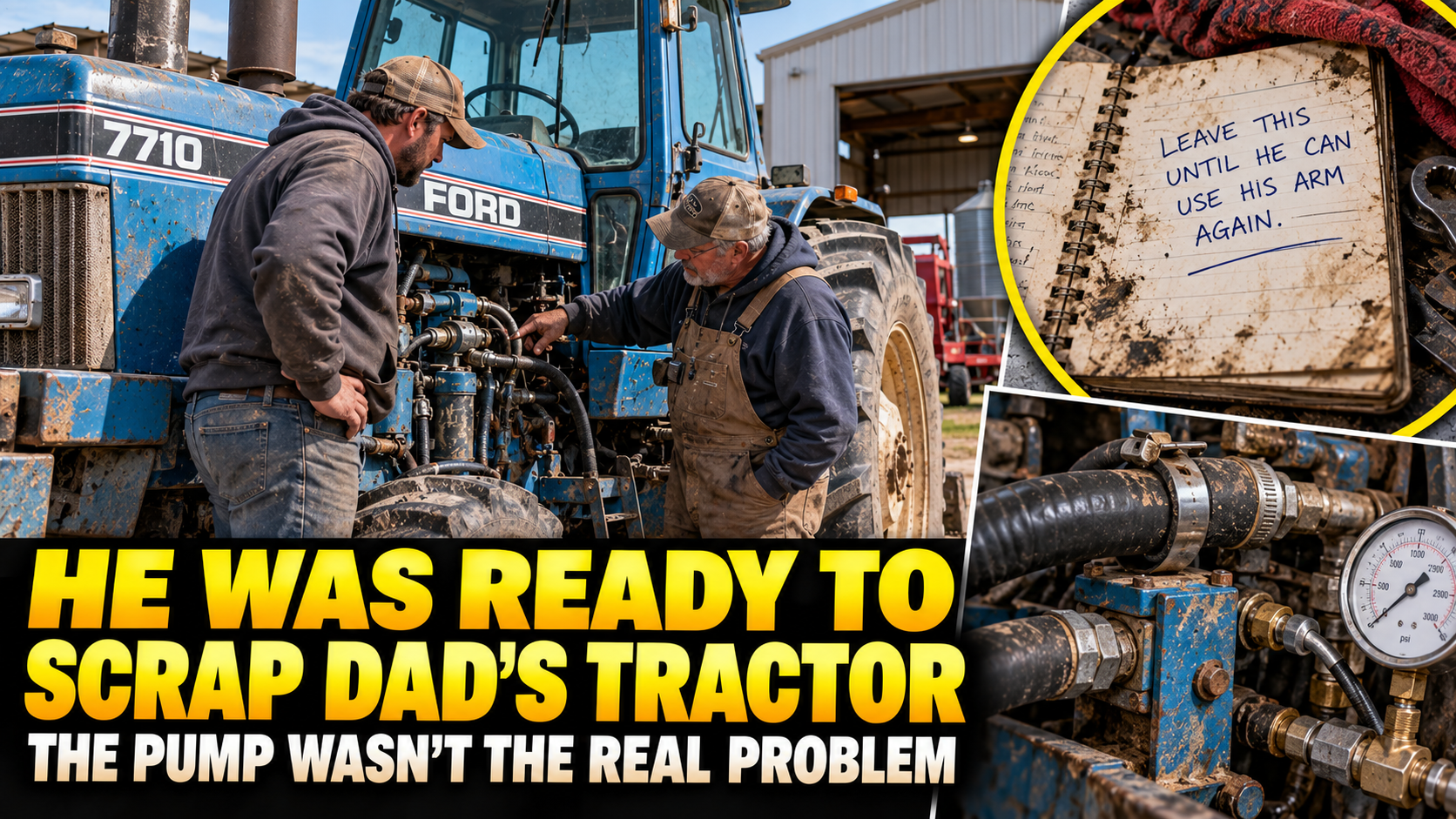
Tom Jensen had already decided the 1988 Ford 7710 was finished when he
called me.
The hydraulics got weaker after the tractor warmed up. The loader
responded slowly. An earlier opinion had put the hydraulic pump at the
top of the suspect list, and Tom did not want to pour serious money into
a tractor his father had bought decades earlier.
“I’m done fixing Dad’s old stuff just because it was Dad’s,” he told me.
That sounded reasonable.
Then I found a homemade bracket supporting a rerouted hydraulic line.
It was too carefully made to be a random patch, and the wear around it
told me it had been there for years.
Before we condemned the pump, I wanted to know why somebody had changed
the system in the first place.
Why Tom Wanted It Gone
By the time we reached this part of the story, I had stopped treating
the Ford as a single repair order. Old vehicles rarely give you that
luxury. One symptom can be mechanical, another electrical, and a third
can exist only because somebody made a reasonable decision twenty years
earlier and never wrote down why.
The first rule was to separate what we knew from what we assumed.
Flow/pressure testing showed the pump could still make useful pressure;
restriction and deteriorated return hose worsened hot operation.
That detail mattered because it gave us something testable. I have seen
too many old vehicles repaired by reputation. Somebody hears a familiar
symptom, names the expensive component everybody fears, and the
diagnosis slowly turns into a shopping list. I wanted measurements,
physical evidence, and a sequence that made sense.
We inspected the machine in the condition it arrived. We photographed
old repairs before disturbing them. We looked for witness marks, rubbed
paint, heat discoloration, loose fasteners, aged rubber, corrosion, and
anything that showed movement over time. When wiring was involved, we
checked circuit protection, voltage drop, grounds, routing, and what
changed when the cab or harness moved. When hydraulics or cooling were
involved, we compared the driver’s complaint with actual operating
measurements instead of trusting one gauge or one guess.
That process was slower than simply replacing the most obvious part.
It was also cheaper than being wrong.
The human side developed the same way.
At first, Tom Jensen wanted a simple answer. Keep it or sell it. Fix it
or scrap it. Blame the last person who touched it or prove them wrong.
Old family vehicles encourage those clean choices because the emotions
around them are messy.
Luke Jensen complicated that.
There was always one memory that did not match the story everybody had
been repeating.
A receipt had a date nobody remembered. A handwritten note used a phrase
only one person recognized. A photograph showed a bracket, dent, route,
or piece of equipment in the background. None of those clues was
dramatic by itself.
Together they changed the timeline.
I asked questions the same way I would during diagnosis.
“When did you first notice it?”
“Who was using it then?”
“What changed right before that?”
“Was this repair already here?”
“Do you remember why?”
The answers were imperfect.
That is normal.
People do not keep service histories in their heads. Families are even
worse at preserving context. One person remembers the argument. Another
remembers the weather. Somebody remembers the bill. Somebody else
remembers who was sitting in the passenger seat.
The machine keeps a different kind of record.
Threads show whether a fastener has been disturbed.
Paint lines show movement.
Old wire colors show where a circuit was added.
Wear patterns show load.
Receipts show what somebody believed at a particular moment, even if
that belief later turned out to be incomplete.
We kept bringing those two records together: the physical record and the
family record.
That was how the real story emerged.
There was a moment when Tom Jensen asked me the question people always
ask once an old vehicle becomes emotionally important.
“Would you keep it?”
I did not answer.
That decision did not belong to me.
I could explain condition. I could explain risk. I could estimate
repairs. I could say what I would inspect before a long trip or a heavy
load. I could point out where nostalgia was encouraging somebody to
ignore a safety problem, or where fear was making a repair sound worse
than the evidence supported.
But I could not assign meaning.
Instead I said, “Know what you have first. Decide second.”
That became the rule for the rest of the job.
We did not restore everything.
We did not erase every scar.
We did not turn ordinary old parts into sacred objects.
We fixed what needed to work.
We preserved the documentation that explained why unusual things had
been done.
And we made sure the next person would not have to rediscover the same
history from scratch.
The surprising part was how much tension disappeared once everybody had
facts.
A vague problem invites imagination.
A measured problem creates choices.
The same was true of the family conflict.
Once Tom Jensen and Luke Jensen understood what had actually happened,
they could stop arguing about the version they had invented to fill the
missing years.
That did not make every decision easy.
It made the decisions real.
Testing Before Replacing
By the time we reached this part of the story, I had stopped treating
the Ford as a single repair order. Old vehicles rarely give you that
luxury. One symptom can be mechanical, another electrical, and a third
can exist only because somebody made a reasonable decision twenty years
earlier and never wrote down why.
The first rule was to separate what we knew from what we assumed.
The bracket and rerouted line dated to the season luke injured his
shoulder and had limited arm movement.
That detail mattered because it gave us something testable. I have seen
too many old vehicles repaired by reputation. Somebody hears a familiar
symptom, names the expensive component everybody fears, and the
diagnosis slowly turns into a shopping list. I wanted measurements,
physical evidence, and a sequence that made sense.
We inspected the machine in the condition it arrived. We photographed
old repairs before disturbing them. We looked for witness marks, rubbed
paint, heat discoloration, loose fasteners, aged rubber, corrosion, and
anything that showed movement over time. When wiring was involved, we
checked circuit protection, voltage drop, grounds, routing, and what
changed when the cab or harness moved. When hydraulics or cooling were
involved, we compared the driver’s complaint with actual operating
measurements instead of trusting one gauge or one guess.
That process was slower than simply replacing the most obvious part.
It was also cheaper than being wrong.
The human side developed the same way.
At first, Tom Jensen wanted a simple answer. Keep it or sell it. Fix it
or scrap it. Blame the last person who touched it or prove them wrong.
Old family vehicles encourage those clean choices because the emotions
around them are messy.
Luke Jensen complicated that.
There was always one memory that did not match the story everybody had
been repeating.
A receipt had a date nobody remembered. A handwritten note used a phrase
only one person recognized. A photograph showed a bracket, dent, route,
or piece of equipment in the background. None of those clues was
dramatic by itself.
Together they changed the timeline.
I asked questions the same way I would during diagnosis.
“When did you first notice it?”
“Who was using it then?”
“What changed right before that?”
“Was this repair already here?”
“Do you remember why?”
The answers were imperfect.
That is normal.
People do not keep service histories in their heads. Families are even
worse at preserving context. One person remembers the argument. Another
remembers the weather. Somebody remembers the bill. Somebody else
remembers who was sitting in the passenger seat.
The machine keeps a different kind of record.
Threads show whether a fastener has been disturbed.
Paint lines show movement.
Old wire colors show where a circuit was added.
Wear patterns show load.
Receipts show what somebody believed at a particular moment, even if
that belief later turned out to be incomplete.
We kept bringing those two records together: the physical record and the
family record.
That was how the real story emerged.
There was a moment when Tom Jensen asked me the question people always
ask once an old vehicle becomes emotionally important.
“Would you keep it?”
I did not answer.
That decision did not belong to me.
I could explain condition. I could explain risk. I could estimate
repairs. I could say what I would inspect before a long trip or a heavy
load. I could point out where nostalgia was encouraging somebody to
ignore a safety problem, or where fear was making a repair sound worse
than the evidence supported.
But I could not assign meaning.
Instead I said, “Know what you have first. Decide second.”
That became the rule for the rest of the job.
We did not restore everything.
We did not erase every scar.
We did not turn ordinary old parts into sacred objects.
We fixed what needed to work.
We preserved the documentation that explained why unusual things had
been done.
And we made sure the next person would not have to rediscover the same
history from scratch.
The surprising part was how much tension disappeared once everybody had
facts.
A vague problem invites imagination.
A measured problem creates choices.
The same was true of the family conflict.
Once Tom Jensen and Luke Jensen understood what had actually happened,
they could stop arguing about the version they had invented to fill the
missing years.
That did not make every decision easy.
It made the decisions real.
The Homemade Bracket
By the time we reached this part of the story, I had stopped treating
the Ford as a single repair order. Old vehicles rarely give you that
luxury. One symptom can be mechanical, another electrical, and a third
can exist only because somebody made a reasonable decision twenty years
earlier and never wrote down why.
The first rule was to separate what we knew from what we assumed.
Tom’s father altered hose routing and control access so luke could keep
doing lighter farm work while recovering.
That detail mattered because it gave us something testable. I have seen
too many old vehicles repaired by reputation. Somebody hears a familiar
symptom, names the expensive component everybody fears, and the
diagnosis slowly turns into a shopping list. I wanted measurements,
physical evidence, and a sequence that made sense.
We inspected the machine in the condition it arrived. We photographed
old repairs before disturbing them. We looked for witness marks, rubbed
paint, heat discoloration, loose fasteners, aged rubber, corrosion, and
anything that showed movement over time. When wiring was involved, we
checked circuit protection, voltage drop, grounds, routing, and what
changed when the cab or harness moved. When hydraulics or cooling were
involved, we compared the driver’s complaint with actual operating
measurements instead of trusting one gauge or one guess.
That process was slower than simply replacing the most obvious part.
It was also cheaper than being wrong.
The human side developed the same way.
At first, Tom Jensen wanted a simple answer. Keep it or sell it. Fix it
or scrap it. Blame the last person who touched it or prove them wrong.
Old family vehicles encourage those clean choices because the emotions
around them are messy.
Luke Jensen complicated that.
There was always one memory that did not match the story everybody had
been repeating.
A receipt had a date nobody remembered. A handwritten note used a phrase
only one person recognized. A photograph showed a bracket, dent, route,
or piece of equipment in the background. None of those clues was
dramatic by itself.
Together they changed the timeline.
I asked questions the same way I would during diagnosis.
“When did you first notice it?”
“Who was using it then?”
“What changed right before that?”
“Was this repair already here?”
“Do you remember why?”
The answers were imperfect.
That is normal.
People do not keep service histories in their heads. Families are even
worse at preserving context. One person remembers the argument. Another
remembers the weather. Somebody remembers the bill. Somebody else
remembers who was sitting in the passenger seat.
The machine keeps a different kind of record.
Threads show whether a fastener has been disturbed.
Paint lines show movement.
Old wire colors show where a circuit was added.
Wear patterns show load.
Receipts show what somebody believed at a particular moment, even if
that belief later turned out to be incomplete.
We kept bringing those two records together: the physical record and the
family record.
That was how the real story emerged.
There was a moment when Tom Jensen asked me the question people always
ask once an old vehicle becomes emotionally important.
“Would you keep it?”
I did not answer.
That decision did not belong to me.
I could explain condition. I could explain risk. I could estimate
repairs. I could say what I would inspect before a long trip or a heavy
load. I could point out where nostalgia was encouraging somebody to
ignore a safety problem, or where fear was making a repair sound worse
than the evidence supported.
But I could not assign meaning.
Instead I said, “Know what you have first. Decide second.”
That became the rule for the rest of the job.
We did not restore everything.
We did not erase every scar.
We did not turn ordinary old parts into sacred objects.
We fixed what needed to work.
We preserved the documentation that explained why unusual things had
been done.
And we made sure the next person would not have to rediscover the same
history from scratch.
The surprising part was how much tension disappeared once everybody had
facts.
A vague problem invites imagination.
A measured problem creates choices.
The same was true of the family conflict.
Once Tom Jensen and Luke Jensen understood what had actually happened,
they could stop arguing about the version they had invented to fill the
missing years.
That did not make every decision easy.
It made the decisions real.
The Notebook in the Shed
By the time we reached this part of the story, I had stopped treating
the Ford as a single repair order. Old vehicles rarely give you that
luxury. One symptom can be mechanical, another electrical, and a third
can exist only because somebody made a reasonable decision twenty years
earlier and never wrote down why.
The first rule was to separate what we knew from what we assumed.
The temporary-looking modification had lasted 18 years, but age and
vibration shifted it until the hose began restricting return flow.
That detail mattered because it gave us something testable. I have seen
too many old vehicles repaired by reputation. Somebody hears a familiar
symptom, names the expensive component everybody fears, and the
diagnosis slowly turns into a shopping list. I wanted measurements,
physical evidence, and a sequence that made sense.
We inspected the machine in the condition it arrived. We photographed
old repairs before disturbing them. We looked for witness marks, rubbed
paint, heat discoloration, loose fasteners, aged rubber, corrosion, and
anything that showed movement over time. When wiring was involved, we
checked circuit protection, voltage drop, grounds, routing, and what
changed when the cab or harness moved. When hydraulics or cooling were
involved, we compared the driver’s complaint with actual operating
measurements instead of trusting one gauge or one guess.
That process was slower than simply replacing the most obvious part.
It was also cheaper than being wrong.
The human side developed the same way.
At first, Tom Jensen wanted a simple answer. Keep it or sell it. Fix it
or scrap it. Blame the last person who touched it or prove them wrong.
Old family vehicles encourage those clean choices because the emotions
around them are messy.
Luke Jensen complicated that.
There was always one memory that did not match the story everybody had
been repeating.
A receipt had a date nobody remembered. A handwritten note used a phrase
only one person recognized. A photograph showed a bracket, dent, route,
or piece of equipment in the background. None of those clues was
dramatic by itself.
Together they changed the timeline.
I asked questions the same way I would during diagnosis.
“When did you first notice it?”
“Who was using it then?”
“What changed right before that?”
“Was this repair already here?”
“Do you remember why?”
The answers were imperfect.
That is normal.
People do not keep service histories in their heads. Families are even
worse at preserving context. One person remembers the argument. Another
remembers the weather. Somebody remembers the bill. Somebody else
remembers who was sitting in the passenger seat.
The machine keeps a different kind of record.
Threads show whether a fastener has been disturbed.
Paint lines show movement.
Old wire colors show where a circuit was added.
Wear patterns show load.
Receipts show what somebody believed at a particular moment, even if
that belief later turned out to be incomplete.
We kept bringing those two records together: the physical record and the
family record.
That was how the real story emerged.
There was a moment when Tom Jensen asked me the question people always
ask once an old vehicle becomes emotionally important.
“Would you keep it?”
I did not answer.
That decision did not belong to me.
I could explain condition. I could explain risk. I could estimate
repairs. I could say what I would inspect before a long trip or a heavy
load. I could point out where nostalgia was encouraging somebody to
ignore a safety problem, or where fear was making a repair sound worse
than the evidence supported.
But I could not assign meaning.
Instead I said, “Know what you have first. Decide second.”
That became the rule for the rest of the job.
We did not restore everything.
We did not erase every scar.
We did not turn ordinary old parts into sacred objects.
We fixed what needed to work.
We preserved the documentation that explained why unusual things had
been done.
And we made sure the next person would not have to rediscover the same
history from scratch.
The surprising part was how much tension disappeared once everybody had
facts.
A vague problem invites imagination.
A measured problem creates choices.
The same was true of the family conflict.
Once Tom Jensen and Luke Jensen understood what had actually happened,
they could stop arguing about the version they had invented to fill the
missing years.
That did not make every decision easy.
It made the decisions real.
The Season Luke Got Hurt
By the time we reached this part of the story, I had stopped treating
the Ford as a single repair order. Old vehicles rarely give you that
luxury. One symptom can be mechanical, another electrical, and a third
can exist only because somebody made a reasonable decision twenty years
earlier and never wrote down why.
The first rule was to separate what we knew from what we assumed.
Repair restores correct routing/support, replaces aged hose, services
fluid/filter and verifies performance warm.
That detail mattered because it gave us something testable. I have seen
too many old vehicles repaired by reputation. Somebody hears a familiar
symptom, names the expensive component everybody fears, and the
diagnosis slowly turns into a shopping list. I wanted measurements,
physical evidence, and a sequence that made sense.
We inspected the machine in the condition it arrived. We photographed
old repairs before disturbing them. We looked for witness marks, rubbed
paint, heat discoloration, loose fasteners, aged rubber, corrosion, and
anything that showed movement over time. When wiring was involved, we
checked circuit protection, voltage drop, grounds, routing, and what
changed when the cab or harness moved. When hydraulics or cooling were
involved, we compared the driver’s complaint with actual operating
measurements instead of trusting one gauge or one guess.
That process was slower than simply replacing the most obvious part.
It was also cheaper than being wrong.
The human side developed the same way.
At first, Tom Jensen wanted a simple answer. Keep it or sell it. Fix it
or scrap it. Blame the last person who touched it or prove them wrong.
Old family vehicles encourage those clean choices because the emotions
around them are messy.
Luke Jensen complicated that.
There was always one memory that did not match the story everybody had
been repeating.
A receipt had a date nobody remembered. A handwritten note used a phrase
only one person recognized. A photograph showed a bracket, dent, route,
or piece of equipment in the background. None of those clues was
dramatic by itself.
Together they changed the timeline.
I asked questions the same way I would during diagnosis.
“When did you first notice it?”
“Who was using it then?”
“What changed right before that?”
“Was this repair already here?”
“Do you remember why?”
The answers were imperfect.
That is normal.
People do not keep service histories in their heads. Families are even
worse at preserving context. One person remembers the argument. Another
remembers the weather. Somebody remembers the bill. Somebody else
remembers who was sitting in the passenger seat.
The machine keeps a different kind of record.
Threads show whether a fastener has been disturbed.
Paint lines show movement.
Old wire colors show where a circuit was added.
Wear patterns show load.
Receipts show what somebody believed at a particular moment, even if
that belief later turned out to be incomplete.
We kept bringing those two records together: the physical record and the
family record.
That was how the real story emerged.
There was a moment when Tom Jensen asked me the question people always
ask once an old vehicle becomes emotionally important.
“Would you keep it?”
I did not answer.
That decision did not belong to me.
I could explain condition. I could explain risk. I could estimate
repairs. I could say what I would inspect before a long trip or a heavy
load. I could point out where nostalgia was encouraging somebody to
ignore a safety problem, or where fear was making a repair sound worse
than the evidence supported.
But I could not assign meaning.
Instead I said, “Know what you have first. Decide second.”
That became the rule for the rest of the job.
We did not restore everything.
We did not erase every scar.
We did not turn ordinary old parts into sacred objects.
We fixed what needed to work.
We preserved the documentation that explained why unusual things had
been done.
And we made sure the next person would not have to rediscover the same
history from scratch.
The surprising part was how much tension disappeared once everybody had
facts.
A vague problem invites imagination.
A measured problem creates choices.
The same was true of the family conflict.
Once Tom Jensen and Luke Jensen understood what had actually happened,
they could stop arguing about the version they had invented to fill the
missing years.
That did not make every decision easy.
It made the decisions real.
What Dad Changed
By the time we reached this part of the story, I had stopped treating
the Ford as a single repair order. Old vehicles rarely give you that
luxury. One symptom can be mechanical, another electrical, and a third
can exist only because somebody made a reasonable decision twenty years
earlier and never wrote down why.
The first rule was to separate what we knew from what we assumed.
Family keeps tractor for mowing, auger and chore work, documenting
modifications so the next person understands them.
That detail mattered because it gave us something testable. I have seen
too many old vehicles repaired by reputation. Somebody hears a familiar
symptom, names the expensive component everybody fears, and the
diagnosis slowly turns into a shopping list. I wanted measurements,
physical evidence, and a sequence that made sense.
We inspected the machine in the condition it arrived. We photographed
old repairs before disturbing them. We looked for witness marks, rubbed
paint, heat discoloration, loose fasteners, aged rubber, corrosion, and
anything that showed movement over time. When wiring was involved, we
checked circuit protection, voltage drop, grounds, routing, and what
changed when the cab or harness moved. When hydraulics or cooling were
involved, we compared the driver’s complaint with actual operating
measurements instead of trusting one gauge or one guess.
That process was slower than simply replacing the most obvious part.
It was also cheaper than being wrong.
The human side developed the same way.
At first, Tom Jensen wanted a simple answer. Keep it or sell it. Fix it
or scrap it. Blame the last person who touched it or prove them wrong.
Old family vehicles encourage those clean choices because the emotions
around them are messy.
Luke Jensen complicated that.
There was always one memory that did not match the story everybody had
been repeating.
A receipt had a date nobody remembered. A handwritten note used a phrase
only one person recognized. A photograph showed a bracket, dent, route,
or piece of equipment in the background. None of those clues was
dramatic by itself.
Together they changed the timeline.
I asked questions the same way I would during diagnosis.
“When did you first notice it?”
“Who was using it then?”
“What changed right before that?”
“Was this repair already here?”
“Do you remember why?”
The answers were imperfect.
That is normal.
People do not keep service histories in their heads. Families are even
worse at preserving context. One person remembers the argument. Another
remembers the weather. Somebody remembers the bill. Somebody else
remembers who was sitting in the passenger seat.
The machine keeps a different kind of record.
Threads show whether a fastener has been disturbed.
Paint lines show movement.
Old wire colors show where a circuit was added.
Wear patterns show load.
Receipts show what somebody believed at a particular moment, even if
that belief later turned out to be incomplete.
We kept bringing those two records together: the physical record and the
family record.
That was how the real story emerged.
There was a moment when Tom Jensen asked me the question people always
ask once an old vehicle becomes emotionally important.
“Would you keep it?”
I did not answer.
That decision did not belong to me.
I could explain condition. I could explain risk. I could estimate
repairs. I could say what I would inspect before a long trip or a heavy
load. I could point out where nostalgia was encouraging somebody to
ignore a safety problem, or where fear was making a repair sound worse
than the evidence supported.
But I could not assign meaning.
Instead I said, “Know what you have first. Decide second.”
That became the rule for the rest of the job.
We did not restore everything.
We did not erase every scar.
We did not turn ordinary old parts into sacred objects.
We fixed what needed to work.
We preserved the documentation that explained why unusual things had
been done.
And we made sure the next person would not have to rediscover the same
history from scratch.
The surprising part was how much tension disappeared once everybody had
facts.
A vague problem invites imagination.
A measured problem creates choices.
The same was true of the family conflict.
Once Tom Jensen and Luke Jensen understood what had actually happened,
they could stop arguing about the version they had invented to fill the
missing years.
That did not make every decision easy.
It made the decisions real.
The Real Hydraulic Fault
By the time we reached this part of the story, I had stopped treating
the Ford as a single repair order. Old vehicles rarely give you that
luxury. One symptom can be mechanical, another electrical, and a third
can exist only because somebody made a reasonable decision twenty years
earlier and never wrote down why.
The first rule was to separate what we knew from what we assumed.
Flow/pressure testing showed the pump could still make useful pressure;
restriction and deteriorated return hose worsened hot operation.
That detail mattered because it gave us something testable. I have seen
too many old vehicles repaired by reputation. Somebody hears a familiar
symptom, names the expensive component everybody fears, and the
diagnosis slowly turns into a shopping list. I wanted measurements,
physical evidence, and a sequence that made sense.
We inspected the machine in the condition it arrived. We photographed
old repairs before disturbing them. We looked for witness marks, rubbed
paint, heat discoloration, loose fasteners, aged rubber, corrosion, and
anything that showed movement over time. When wiring was involved, we
checked circuit protection, voltage drop, grounds, routing, and what
changed when the cab or harness moved. When hydraulics or cooling were
involved, we compared the driver’s complaint with actual operating
measurements instead of trusting one gauge or one guess.
That process was slower than simply replacing the most obvious part.
It was also cheaper than being wrong.
The human side developed the same way.
At first, Tom Jensen wanted a simple answer. Keep it or sell it. Fix it
or scrap it. Blame the last person who touched it or prove them wrong.
Old family vehicles encourage those clean choices because the emotions
around them are messy.
Luke Jensen complicated that.
There was always one memory that did not match the story everybody had
been repeating.
A receipt had a date nobody remembered. A handwritten note used a phrase
only one person recognized. A photograph showed a bracket, dent, route,
or piece of equipment in the background. None of those clues was
dramatic by itself.
Together they changed the timeline.
I asked questions the same way I would during diagnosis.
“When did you first notice it?”
“Who was using it then?”
“What changed right before that?”
“Was this repair already here?”
“Do you remember why?”
The answers were imperfect.
That is normal.
People do not keep service histories in their heads. Families are even
worse at preserving context. One person remembers the argument. Another
remembers the weather. Somebody remembers the bill. Somebody else
remembers who was sitting in the passenger seat.
The machine keeps a different kind of record.
Threads show whether a fastener has been disturbed.
Paint lines show movement.
Old wire colors show where a circuit was added.
Wear patterns show load.
Receipts show what somebody believed at a particular moment, even if
that belief later turned out to be incomplete.
We kept bringing those two records together: the physical record and the
family record.
That was how the real story emerged.
There was a moment when Tom Jensen asked me the question people always
ask once an old vehicle becomes emotionally important.
“Would you keep it?”
I did not answer.
That decision did not belong to me.
I could explain condition. I could explain risk. I could estimate
repairs. I could say what I would inspect before a long trip or a heavy
load. I could point out where nostalgia was encouraging somebody to
ignore a safety problem, or where fear was making a repair sound worse
than the evidence supported.
But I could not assign meaning.
Instead I said, “Know what you have first. Decide second.”
That became the rule for the rest of the job.
We did not restore everything.
We did not erase every scar.
We did not turn ordinary old parts into sacred objects.
We fixed what needed to work.
We preserved the documentation that explained why unusual things had
been done.
And we made sure the next person would not have to rediscover the same
history from scratch.
The surprising part was how much tension disappeared once everybody had
facts.
A vague problem invites imagination.
A measured problem creates choices.
The same was true of the family conflict.
Once Tom Jensen and Luke Jensen understood what had actually happened,
they could stop arguing about the version they had invented to fill the
missing years.
That did not make every decision easy.
It made the decisions real.
Repair Instead of Replacement
By the time we reached this part of the story, I had stopped treating
the Ford as a single repair order. Old vehicles rarely give you that
luxury. One symptom can be mechanical, another electrical, and a third
can exist only because somebody made a reasonable decision twenty years
earlier and never wrote down why.
The first rule was to separate what we knew from what we assumed.
The bracket and rerouted line dated to the season luke injured his
shoulder and had limited arm movement.
That detail mattered because it gave us something testable. I have seen
too many old vehicles repaired by reputation. Somebody hears a familiar
symptom, names the expensive component everybody fears, and the
diagnosis slowly turns into a shopping list. I wanted measurements,
physical evidence, and a sequence that made sense.
We inspected the machine in the condition it arrived. We photographed
old repairs before disturbing them. We looked for witness marks, rubbed
paint, heat discoloration, loose fasteners, aged rubber, corrosion, and
anything that showed movement over time. When wiring was involved, we
checked circuit protection, voltage drop, grounds, routing, and what
changed when the cab or harness moved. When hydraulics or cooling were
involved, we compared the driver’s complaint with actual operating
measurements instead of trusting one gauge or one guess.
That process was slower than simply replacing the most obvious part.
It was also cheaper than being wrong.
The human side developed the same way.
At first, Tom Jensen wanted a simple answer. Keep it or sell it. Fix it
or scrap it. Blame the last person who touched it or prove them wrong.
Old family vehicles encourage those clean choices because the emotions
around them are messy.
Luke Jensen complicated that.
There was always one memory that did not match the story everybody had
been repeating.
A receipt had a date nobody remembered. A handwritten note used a phrase
only one person recognized. A photograph showed a bracket, dent, route,
or piece of equipment in the background. None of those clues was
dramatic by itself.
Together they changed the timeline.
I asked questions the same way I would during diagnosis.
“When did you first notice it?”
“Who was using it then?”
“What changed right before that?”
“Was this repair already here?”
“Do you remember why?”
The answers were imperfect.
That is normal.
People do not keep service histories in their heads. Families are even
worse at preserving context. One person remembers the argument. Another
remembers the weather. Somebody remembers the bill. Somebody else
remembers who was sitting in the passenger seat.
The machine keeps a different kind of record.
Threads show whether a fastener has been disturbed.
Paint lines show movement.
Old wire colors show where a circuit was added.
Wear patterns show load.
Receipts show what somebody believed at a particular moment, even if
that belief later turned out to be incomplete.
We kept bringing those two records together: the physical record and the
family record.
That was how the real story emerged.
There was a moment when Tom Jensen asked me the question people always
ask once an old vehicle becomes emotionally important.
“Would you keep it?”
I did not answer.
That decision did not belong to me.
I could explain condition. I could explain risk. I could estimate
repairs. I could say what I would inspect before a long trip or a heavy
load. I could point out where nostalgia was encouraging somebody to
ignore a safety problem, or where fear was making a repair sound worse
than the evidence supported.
But I could not assign meaning.
Instead I said, “Know what you have first. Decide second.”
That became the rule for the rest of the job.
We did not restore everything.
We did not erase every scar.
We did not turn ordinary old parts into sacred objects.
We fixed what needed to work.
We preserved the documentation that explained why unusual things had
been done.
And we made sure the next person would not have to rediscover the same
history from scratch.
The surprising part was how much tension disappeared once everybody had
facts.
A vague problem invites imagination.
A measured problem creates choices.
The same was true of the family conflict.
Once Tom Jensen and Luke Jensen understood what had actually happened,
they could stop arguing about the version they had invented to fill the
missing years.
That did not make every decision easy.
It made the decisions real.
The First Day Back in the Field
By the time we reached this part of the story, I had stopped treating
the Ford as a single repair order. Old vehicles rarely give you that
luxury. One symptom can be mechanical, another electrical, and a third
can exist only because somebody made a reasonable decision twenty years
earlier and never wrote down why.
The first rule was to separate what we knew from what we assumed.
Tom’s father altered hose routing and control access so luke could keep
doing lighter farm work while recovering.
That detail mattered because it gave us something testable. I have seen
too many old vehicles repaired by reputation. Somebody hears a familiar
symptom, names the expensive component everybody fears, and the
diagnosis slowly turns into a shopping list. I wanted measurements,
physical evidence, and a sequence that made sense.
We inspected the machine in the condition it arrived. We photographed
old repairs before disturbing them. We looked for witness marks, rubbed
paint, heat discoloration, loose fasteners, aged rubber, corrosion, and
anything that showed movement over time. When wiring was involved, we
checked circuit protection, voltage drop, grounds, routing, and what
changed when the cab or harness moved. When hydraulics or cooling were
involved, we compared the driver’s complaint with actual operating
measurements instead of trusting one gauge or one guess.
That process was slower than simply replacing the most obvious part.
It was also cheaper than being wrong.
The human side developed the same way.
At first, Tom Jensen wanted a simple answer. Keep it or sell it. Fix it
or scrap it. Blame the last person who touched it or prove them wrong.
Old family vehicles encourage those clean choices because the emotions
around them are messy.
Luke Jensen complicated that.
There was always one memory that did not match the story everybody had
been repeating.
A receipt had a date nobody remembered. A handwritten note used a phrase
only one person recognized. A photograph showed a bracket, dent, route,
or piece of equipment in the background. None of those clues was
dramatic by itself.
Together they changed the timeline.
I asked questions the same way I would during diagnosis.
“When did you first notice it?”
“Who was using it then?”
“What changed right before that?”
“Was this repair already here?”
“Do you remember why?”
The answers were imperfect.
That is normal.
People do not keep service histories in their heads. Families are even
worse at preserving context. One person remembers the argument. Another
remembers the weather. Somebody remembers the bill. Somebody else
remembers who was sitting in the passenger seat.
The machine keeps a different kind of record.
Threads show whether a fastener has been disturbed.
Paint lines show movement.
Old wire colors show where a circuit was added.
Wear patterns show load.
Receipts show what somebody believed at a particular moment, even if
that belief later turned out to be incomplete.
We kept bringing those two records together: the physical record and the
family record.
That was how the real story emerged.
There was a moment when Tom Jensen asked me the question people always
ask once an old vehicle becomes emotionally important.
“Would you keep it?”
I did not answer.
That decision did not belong to me.
I could explain condition. I could explain risk. I could estimate
repairs. I could say what I would inspect before a long trip or a heavy
load. I could point out where nostalgia was encouraging somebody to
ignore a safety problem, or where fear was making a repair sound worse
than the evidence supported.
But I could not assign meaning.
Instead I said, “Know what you have first. Decide second.”
That became the rule for the rest of the job.
We did not restore everything.
We did not erase every scar.
We did not turn ordinary old parts into sacred objects.
We fixed what needed to work.
We preserved the documentation that explained why unusual things had
been done.
And we made sure the next person would not have to rediscover the same
history from scratch.
The surprising part was how much tension disappeared once everybody had
facts.
A vague problem invites imagination.
A measured problem creates choices.
The same was true of the family conflict.
Once Tom Jensen and Luke Jensen understood what had actually happened,
they could stop arguing about the version they had invented to fill the
missing years.
That did not make every decision easy.
It made the decisions real.
Why They Kept It
By the time we reached this part of the story, I had stopped treating
the Ford as a single repair order. Old vehicles rarely give you that
luxury. One symptom can be mechanical, another electrical, and a third
can exist only because somebody made a reasonable decision twenty years
earlier and never wrote down why.
The first rule was to separate what we knew from what we assumed.
The temporary-looking modification had lasted 18 years, but age and
vibration shifted it until the hose began restricting return flow.
That detail mattered because it gave us something testable. I have seen
too many old vehicles repaired by reputation. Somebody hears a familiar
symptom, names the expensive component everybody fears, and the
diagnosis slowly turns into a shopping list. I wanted measurements,
physical evidence, and a sequence that made sense.
We inspected the machine in the condition it arrived. We photographed
old repairs before disturbing them. We looked for witness marks, rubbed
paint, heat discoloration, loose fasteners, aged rubber, corrosion, and
anything that showed movement over time. When wiring was involved, we
checked circuit protection, voltage drop, grounds, routing, and what
changed when the cab or harness moved. When hydraulics or cooling were
involved, we compared the driver’s complaint with actual operating
measurements instead of trusting one gauge or one guess.
That process was slower than simply replacing the most obvious part.
It was also cheaper than being wrong.
The human side developed the same way.
At first, Tom Jensen wanted a simple answer. Keep it or sell it. Fix it
or scrap it. Blame the last person who touched it or prove them wrong.
Old family vehicles encourage those clean choices because the emotions
around them are messy.
Luke Jensen complicated that.
There was always one memory that did not match the story everybody had
been repeating.
A receipt had a date nobody remembered. A handwritten note used a phrase
only one person recognized. A photograph showed a bracket, dent, route,
or piece of equipment in the background. None of those clues was
dramatic by itself.
Together they changed the timeline.
I asked questions the same way I would during diagnosis.
“When did you first notice it?”
“Who was using it then?”
“What changed right before that?”
“Was this repair already here?”
“Do you remember why?”
The answers were imperfect.
That is normal.
People do not keep service histories in their heads. Families are even
worse at preserving context. One person remembers the argument. Another
remembers the weather. Somebody remembers the bill. Somebody else
remembers who was sitting in the passenger seat.
The machine keeps a different kind of record.
Threads show whether a fastener has been disturbed.
Paint lines show movement.
Old wire colors show where a circuit was added.
Wear patterns show load.
Receipts show what somebody believed at a particular moment, even if
that belief later turned out to be incomplete.
We kept bringing those two records together: the physical record and the
family record.
That was how the real story emerged.
There was a moment when Tom Jensen asked me the question people always
ask once an old vehicle becomes emotionally important.
“Would you keep it?”
I did not answer.
That decision did not belong to me.
I could explain condition. I could explain risk. I could estimate
repairs. I could say what I would inspect before a long trip or a heavy
load. I could point out where nostalgia was encouraging somebody to
ignore a safety problem, or where fear was making a repair sound worse
than the evidence supported.
But I could not assign meaning.
Instead I said, “Know what you have first. Decide second.”
That became the rule for the rest of the job.
We did not restore everything.
We did not erase every scar.
We did not turn ordinary old parts into sacred objects.
We fixed what needed to work.
We preserved the documentation that explained why unusual things had
been done.
And we made sure the next person would not have to rediscover the same
history from scratch.
The surprising part was how much tension disappeared once everybody had
facts.
A vague problem invites imagination.
A measured problem creates choices.
The same was true of the family conflict.
Once Tom Jensen and Luke Jensen understood what had actually happened,
they could stop arguing about the version they had invented to fill the
missing years.
That did not make every decision easy.
It made the decisions real.
The Next Note in the Book
By the time we reached this part of the story, I had stopped treating
the Ford as a single repair order. Old vehicles rarely give you that
luxury. One symptom can be mechanical, another electrical, and a third
can exist only because somebody made a reasonable decision twenty years
earlier and never wrote down why.
The first rule was to separate what we knew from what we assumed.
Repair restores correct routing/support, replaces aged hose, services
fluid/filter and verifies performance warm.
That detail mattered because it gave us something testable. I have seen
too many old vehicles repaired by reputation. Somebody hears a familiar
symptom, names the expensive component everybody fears, and the
diagnosis slowly turns into a shopping list. I wanted measurements,
physical evidence, and a sequence that made sense.
We inspected the machine in the condition it arrived. We photographed
old repairs before disturbing them. We looked for witness marks, rubbed
paint, heat discoloration, loose fasteners, aged rubber, corrosion, and
anything that showed movement over time. When wiring was involved, we
checked circuit protection, voltage drop, grounds, routing, and what
changed when the cab or harness moved. When hydraulics or cooling were
involved, we compared the driver’s complaint with actual operating
measurements instead of trusting one gauge or one guess.
That process was slower than simply replacing the most obvious part.
It was also cheaper than being wrong.
The human side developed the same way.
At first, Tom Jensen wanted a simple answer. Keep it or sell it. Fix it
or scrap it. Blame the last person who touched it or prove them wrong.
Old family vehicles encourage those clean choices because the emotions
around them are messy.
Luke Jensen complicated that.
There was always one memory that did not match the story everybody had
been repeating.
A receipt had a date nobody remembered. A handwritten note used a phrase
only one person recognized. A photograph showed a bracket, dent, route,
or piece of equipment in the background. None of those clues was
dramatic by itself.
Together they changed the timeline.
I asked questions the same way I would during diagnosis.
“When did you first notice it?”
“Who was using it then?”
“What changed right before that?”
“Was this repair already here?”
“Do you remember why?”
The answers were imperfect.
That is normal.
People do not keep service histories in their heads. Families are even
worse at preserving context. One person remembers the argument. Another
remembers the weather. Somebody remembers the bill. Somebody else
remembers who was sitting in the passenger seat.
The machine keeps a different kind of record.
Threads show whether a fastener has been disturbed.
Paint lines show movement.
Old wire colors show where a circuit was added.
Wear patterns show load.
Receipts show what somebody believed at a particular moment, even if
that belief later turned out to be incomplete.
We kept bringing those two records together: the physical record and the
family record.
That was how the real story emerged.
There was a moment when Tom Jensen asked me the question people always
ask once an old vehicle becomes emotionally important.
“Would you keep it?”
I did not answer.
That decision did not belong to me.
I could explain condition. I could explain risk. I could estimate
repairs. I could say what I would inspect before a long trip or a heavy
load. I could point out where nostalgia was encouraging somebody to
ignore a safety problem, or where fear was making a repair sound worse
than the evidence supported.
But I could not assign meaning.
Instead I said, “Know what you have first. Decide second.”
That became the rule for the rest of the job.
We did not restore everything.
We did not erase every scar.
We did not turn ordinary old parts into sacred objects.
We fixed what needed to work.
We preserved the documentation that explained why unusual things had
been done.
And we made sure the next person would not have to rediscover the same
history from scratch.
The surprising part was how much tension disappeared once everybody had
facts.
A vague problem invites imagination.
A measured problem creates choices.
The same was true of the family conflict.
Once Tom Jensen and Luke Jensen understood what had actually happened,
they could stop arguing about the version they had invented to fill the
missing years.
That did not make every decision easy.
It made the decisions real.
One More Thing the Records Explained
There was still one piece of the timeline that bothered me.
The temporary-looking modification had lasted 18 years, but age and
vibration shifted it until the hose began restricting return flow.
We went back through the records instead of guessing. Dates, mileage,
handwriting, old photographs, and the condition of the parts gave us
boundaries. We could not know every conversation that happened years
earlier, and I refused to invent one just because it would make the
story cleaner.
What we could say was more useful.
The modification or repair existed for a reason.
It had performed useful work.
Time changed its condition.
The present failure had to be diagnosed on present evidence.
That distinction kept us from turning an old owner’s decision into
either a legend or an accusation.
I explained that to Tom Jensen.
“People fix what is in front of them,” I said. “Sometimes they plan to
come back later. Sometimes later takes twenty years.”
That line landed harder than I expected.
Families do the same thing.
They postpone conversations.
They assume somebody else knows the story.
They think they will label the box, write down the part number, explain
the dent, or tell the kids why a machine matters.
Then life moves.
The reason disappears before the object does.
That is why documentation became part of our repair.
Not for resale value.
For the next person.
We wrote what we found, what we measured, what we changed, and why.
If somebody opens the same area ten years from now, I want that person
to begin with context instead of mystery.
A good repair should leave more than new parts.
It should leave the machine easier to understand.
One More Thing the Records Explained
There was still one piece of the timeline that bothered me.
Repair restores correct routing/support, replaces aged hose, services
fluid/filter and verifies performance warm.
We went back through the records instead of guessing. Dates, mileage,
handwriting, old photographs, and the condition of the parts gave us
boundaries. We could not know every conversation that happened years
earlier, and I refused to invent one just because it would make the
story cleaner.
What we could say was more useful.
The modification or repair existed for a reason.
It had performed useful work.
Time changed its condition.
The present failure had to be diagnosed on present evidence.
That distinction kept us from turning an old owner’s decision into
either a legend or an accusation.
I explained that to Tom Jensen.
“People fix what is in front of them,” I said. “Sometimes they plan to
come back later. Sometimes later takes twenty years.”
That line landed harder than I expected.
Families do the same thing.
They postpone conversations.
They assume somebody else knows the story.
They think they will label the box, write down the part number, explain
the dent, or tell the kids why a machine matters.
Then life moves.
The reason disappears before the object does.
That is why documentation became part of our repair.
Not for resale value.
For the next person.
We wrote what we found, what we measured, what we changed, and why.
If somebody opens the same area ten years from now, I want that person
to begin with context instead of mystery.
A good repair should leave more than new parts.
It should leave the machine easier to understand.
One More Thing the Records Explained
There was still one piece of the timeline that bothered me.
Family keeps tractor for mowing, auger and chore work, documenting
modifications so the next person understands them.
We went back through the records instead of guessing. Dates, mileage,
handwriting, old photographs, and the condition of the parts gave us
boundaries. We could not know every conversation that happened years
earlier, and I refused to invent one just because it would make the
story cleaner.
What we could say was more useful.
The modification or repair existed for a reason.
It had performed useful work.
Time changed its condition.
The present failure had to be diagnosed on present evidence.
That distinction kept us from turning an old owner’s decision into
either a legend or an accusation.
I explained that to Tom Jensen.
“People fix what is in front of them,” I said. “Sometimes they plan to
come back later. Sometimes later takes twenty years.”
That line landed harder than I expected.
Families do the same thing.
They postpone conversations.
They assume somebody else knows the story.
They think they will label the box, write down the part number, explain
the dent, or tell the kids why a machine matters.
Then life moves.
The reason disappears before the object does.
That is why documentation became part of our repair.
Not for resale value.
For the next person.
We wrote what we found, what we measured, what we changed, and why.
If somebody opens the same area ten years from now, I want that person
to begin with context instead of mystery.
A good repair should leave more than new parts.
It should leave the machine easier to understand.
The Next Note in the Book
The Ford 7710 did not become the main tractor again.
It did not need to.
After the hydraulic return problem was repaired correctly, warmed up,
tested under load, and verified, Tom kept it for lighter work: mowing,
auger duty, moving wagons, and jobs where a simple older tractor was
still useful.
The homemade bracket stayed only where it remained safe and useful;
anything compromised was repaired properly. The important part was not
preserving every piece of steel exactly as Dad had shaped it. It was
preserving the explanation.
Tom started a new service notebook.
On the first page he copied his father’s old note about Luke’s injured
arm.
Then he added:
2026 — RETURN RESTRICTION / AGED HOSE / SUPPORT CORRECTED. PUMP TESTED
BEFORE REPLACEMENT. PUMP STAYED.
Under that he wrote:
WRITE DOWN WHY WE CHANGE THINGS.
That may be the most valuable modification we made.
Old equipment often outlives the people who remember its repairs.
A strange bracket looks like bad workmanship if nobody knows the problem
it solved.
A rerouted hose looks random if nobody remembers the injury that made a
control difficult to use.
Context does not make an unsafe repair safe.
But it tells the next mechanic where to begin asking questions.
Tom had wanted to scrap the tractor because he thought keeping it meant
repeating his father’s habits.
In the end, he kept it for the opposite reason.
His father had adapted machinery to the needs of the family standing in
front of him.
Tom did the same.
The tractor went back to work.
Not because it was Dad’s.
Because, after a proper diagnosis, it still had useful work left.