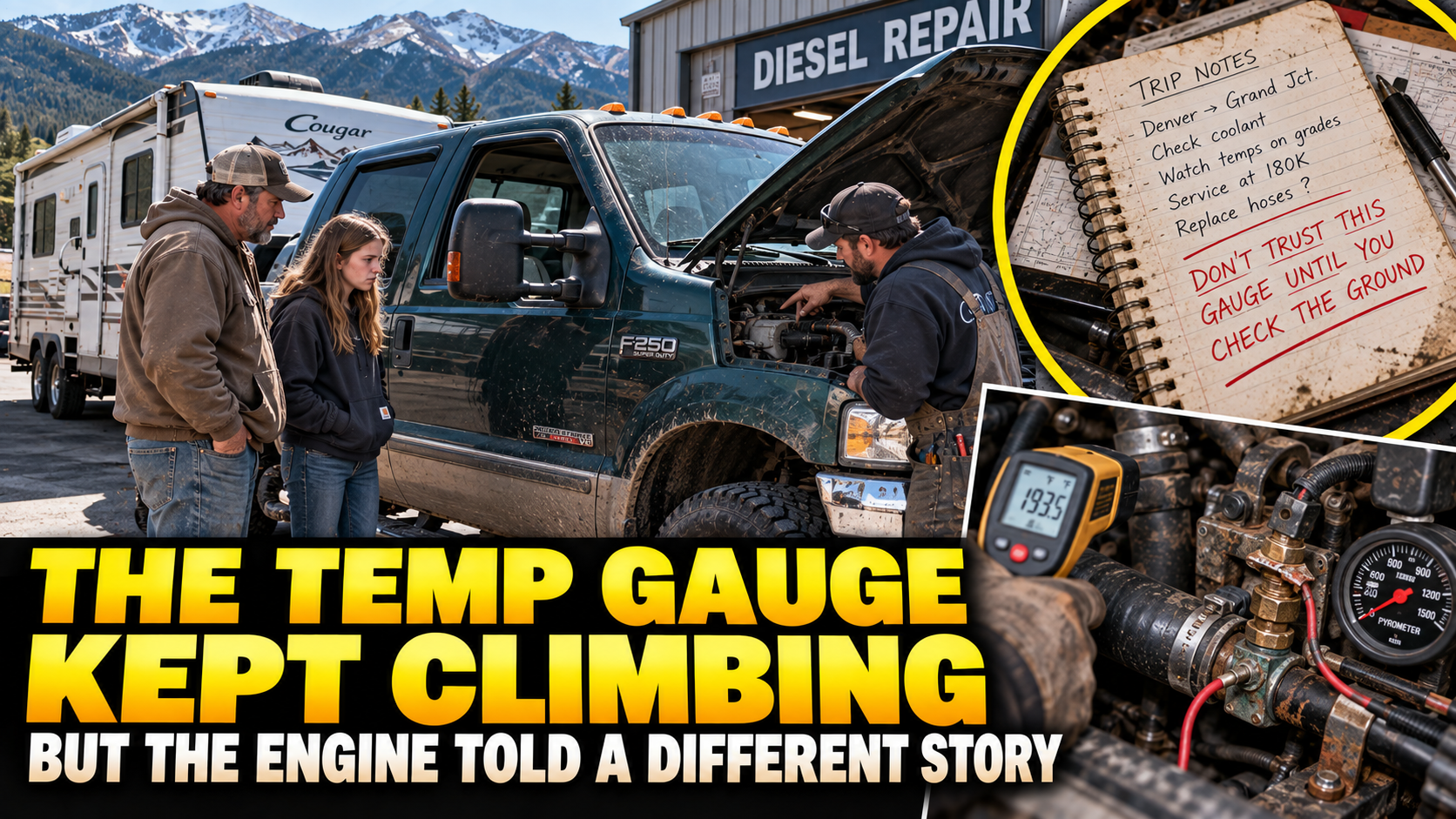
Matt Collins bought the 2001 F-250 because he had made his daughter a
promise.
Before Sophie left for college, they were going to tow the family’s
small travel trailer through Wyoming and spend a week in the mountains.
The truck was not pretty, but the 7.3 Power Stroke ran well and came
with a thick folder of receipts.
Then, on the first serious towing test, the aftermarket temperature
gauge climbed hard enough to scare him onto the shoulder.
He shut the engine down and called me.
By the time the truck reached my shop, Matt was convinced he had bought
somebody else’s overheating problem.
The strange part was that the engine and the gauge were not telling the
same story.
The Promise to Sophie
By the time we reached this part of the story, I had stopped treating
the F-250 as a single repair order. Old vehicles rarely give you that
luxury. One symptom can be mechanical, another electrical, and a third
can exist only because somebody made a reasonable decision twenty years
earlier and never wrote down why.
The first rule was to separate what we knew from what we assumed.
Scan/measurement with independent temperature tools shows actual coolant
temperature more stable than aftermarket gauge suggests.
That detail mattered because it gave us something testable. I have seen
too many old vehicles repaired by reputation. Somebody hears a familiar
symptom, names the expensive component everybody fears, and the
diagnosis slowly turns into a shopping list. I wanted measurements,
physical evidence, and a sequence that made sense.
We inspected the machine in the condition it arrived. We photographed
old repairs before disturbing them. We looked for witness marks, rubbed
paint, heat discoloration, loose fasteners, aged rubber, corrosion, and
anything that showed movement over time. When wiring was involved, we
checked circuit protection, voltage drop, grounds, routing, and what
changed when the cab or harness moved. When hydraulics or cooling were
involved, we compared the driver’s complaint with actual operating
measurements instead of trusting one gauge or one guess.
That process was slower than simply replacing the most obvious part.
It was also cheaper than being wrong.
The human side developed the same way.
At first, Matt Collins wanted a simple answer. Keep it or sell it. Fix
it or scrap it. Blame the last person who touched it or prove them
wrong. Old family vehicles encourage those clean choices because the
emotions around them are messy.
Sophie Collins complicated that.
There was always one memory that did not match the story everybody had
been repeating.
A receipt had a date nobody remembered. A handwritten note used a phrase
only one person recognized. A photograph showed a bracket, dent, route,
or piece of equipment in the background. None of those clues was
dramatic by itself.
Together they changed the timeline.
I asked questions the same way I would during diagnosis.
“When did you first notice it?”
“Who was using it then?”
“What changed right before that?”
“Was this repair already here?”
“Do you remember why?”
The answers were imperfect.
That is normal.
People do not keep service histories in their heads. Families are even
worse at preserving context. One person remembers the argument. Another
remembers the weather. Somebody remembers the bill. Somebody else
remembers who was sitting in the passenger seat.
The machine keeps a different kind of record.
Threads show whether a fastener has been disturbed.
Paint lines show movement.
Old wire colors show where a circuit was added.
Wear patterns show load.
Receipts show what somebody believed at a particular moment, even if
that belief later turned out to be incomplete.
We kept bringing those two records together: the physical record and the
family record.
That was how the real story emerged.
There was a moment when Matt Collins asked me the question people always
ask once an old vehicle becomes emotionally important.
“Would you keep it?”
I did not answer.
That decision did not belong to me.
I could explain condition. I could explain risk. I could estimate
repairs. I could say what I would inspect before a long trip or a heavy
load. I could point out where nostalgia was encouraging somebody to
ignore a safety problem, or where fear was making a repair sound worse
than the evidence supported.
But I could not assign meaning.
Instead I said, “Know what you have first. Decide second.”
That became the rule for the rest of the job.
We did not restore everything.
We did not erase every scar.
We did not turn ordinary old parts into sacred objects.
We fixed what needed to work.
We preserved the documentation that explained why unusual things had
been done.
And we made sure the next person would not have to rediscover the same
history from scratch.
The surprising part was how much tension disappeared once everybody had
facts.
A vague problem invites imagination.
A measured problem creates choices.
The same was true of the family conflict.
Once Matt Collins and Sophie Collins understood what had actually
happened, they could stop arguing about the version they had invented to
fill the missing years.
That did not make every decision easy.
It made the decisions real.
The Gauge That Climbed
By the time we reached this part of the story, I had stopped treating
the F-250 as a single repair order. Old vehicles rarely give you that
luxury. One symptom can be mechanical, another electrical, and a third
can exist only because somebody made a reasonable decision twenty years
earlier and never wrote down why.
The first rule was to separate what we knew from what we assumed.
Cooling system still needs legitimate maintenance: aging
thermostat/cap/flow-related service as supported, but no evidence of
catastrophic overheating.
That detail mattered because it gave us something testable. I have seen
too many old vehicles repaired by reputation. Somebody hears a familiar
symptom, names the expensive component everybody fears, and the
diagnosis slowly turns into a shopping list. I wanted measurements,
physical evidence, and a sequence that made sense.
We inspected the machine in the condition it arrived. We photographed
old repairs before disturbing them. We looked for witness marks, rubbed
paint, heat discoloration, loose fasteners, aged rubber, corrosion, and
anything that showed movement over time. When wiring was involved, we
checked circuit protection, voltage drop, grounds, routing, and what
changed when the cab or harness moved. When hydraulics or cooling were
involved, we compared the driver’s complaint with actual operating
measurements instead of trusting one gauge or one guess.
That process was slower than simply replacing the most obvious part.
It was also cheaper than being wrong.
The human side developed the same way.
At first, Matt Collins wanted a simple answer. Keep it or sell it. Fix
it or scrap it. Blame the last person who touched it or prove them
wrong. Old family vehicles encourage those clean choices because the
emotions around them are messy.
Sophie Collins complicated that.
There was always one memory that did not match the story everybody had
been repeating.
A receipt had a date nobody remembered. A handwritten note used a phrase
only one person recognized. A photograph showed a bracket, dent, route,
or piece of equipment in the background. None of those clues was
dramatic by itself.
Together they changed the timeline.
I asked questions the same way I would during diagnosis.
“When did you first notice it?”
“Who was using it then?”
“What changed right before that?”
“Was this repair already here?”
“Do you remember why?”
The answers were imperfect.
That is normal.
People do not keep service histories in their heads. Families are even
worse at preserving context. One person remembers the argument. Another
remembers the weather. Somebody remembers the bill. Somebody else
remembers who was sitting in the passenger seat.
The machine keeps a different kind of record.
Threads show whether a fastener has been disturbed.
Paint lines show movement.
Old wire colors show where a circuit was added.
Wear patterns show load.
Receipts show what somebody believed at a particular moment, even if
that belief later turned out to be incomplete.
We kept bringing those two records together: the physical record and the
family record.
That was how the real story emerged.
There was a moment when Matt Collins asked me the question people always
ask once an old vehicle becomes emotionally important.
“Would you keep it?”
I did not answer.
That decision did not belong to me.
I could explain condition. I could explain risk. I could estimate
repairs. I could say what I would inspect before a long trip or a heavy
load. I could point out where nostalgia was encouraging somebody to
ignore a safety problem, or where fear was making a repair sound worse
than the evidence supported.
But I could not assign meaning.
Instead I said, “Know what you have first. Decide second.”
That became the rule for the rest of the job.
We did not restore everything.
We did not erase every scar.
We did not turn ordinary old parts into sacred objects.
We fixed what needed to work.
We preserved the documentation that explained why unusual things had
been done.
And we made sure the next person would not have to rediscover the same
history from scratch.
The surprising part was how much tension disappeared once everybody had
facts.
A vague problem invites imagination.
A measured problem creates choices.
The same was true of the family conflict.
Once Matt Collins and Sophie Collins understood what had actually
happened, they could stop arguing about the version they had invented to
fill the missing years.
That did not make every decision easy.
It made the decisions real.
Measuring Actual Temperature
By the time we reached this part of the story, I had stopped treating
the F-250 as a single repair order. Old vehicles rarely give you that
luxury. One symptom can be mechanical, another electrical, and a third
can exist only because somebody made a reasonable decision twenty years
earlier and never wrote down why.
The first rule was to separate what we knew from what we assumed.
Aftermarket sender ground shares a poor/corroded connection whose
resistance changes with vibration/load.
That detail mattered because it gave us something testable. I have seen
too many old vehicles repaired by reputation. Somebody hears a familiar
symptom, names the expensive component everybody fears, and the
diagnosis slowly turns into a shopping list. I wanted measurements,
physical evidence, and a sequence that made sense.
We inspected the machine in the condition it arrived. We photographed
old repairs before disturbing them. We looked for witness marks, rubbed
paint, heat discoloration, loose fasteners, aged rubber, corrosion, and
anything that showed movement over time. When wiring was involved, we
checked circuit protection, voltage drop, grounds, routing, and what
changed when the cab or harness moved. When hydraulics or cooling were
involved, we compared the driver’s complaint with actual operating
measurements instead of trusting one gauge or one guess.
That process was slower than simply replacing the most obvious part.
It was also cheaper than being wrong.
The human side developed the same way.
At first, Matt Collins wanted a simple answer. Keep it or sell it. Fix
it or scrap it. Blame the last person who touched it or prove them
wrong. Old family vehicles encourage those clean choices because the
emotions around them are messy.
Sophie Collins complicated that.
There was always one memory that did not match the story everybody had
been repeating.
A receipt had a date nobody remembered. A handwritten note used a phrase
only one person recognized. A photograph showed a bracket, dent, route,
or piece of equipment in the background. None of those clues was
dramatic by itself.
Together they changed the timeline.
I asked questions the same way I would during diagnosis.
“When did you first notice it?”
“Who was using it then?”
“What changed right before that?”
“Was this repair already here?”
“Do you remember why?”
The answers were imperfect.
That is normal.
People do not keep service histories in their heads. Families are even
worse at preserving context. One person remembers the argument. Another
remembers the weather. Somebody remembers the bill. Somebody else
remembers who was sitting in the passenger seat.
The machine keeps a different kind of record.
Threads show whether a fastener has been disturbed.
Paint lines show movement.
Old wire colors show where a circuit was added.
Wear patterns show load.
Receipts show what somebody believed at a particular moment, even if
that belief later turned out to be incomplete.
We kept bringing those two records together: the physical record and the
family record.
That was how the real story emerged.
There was a moment when Matt Collins asked me the question people always
ask once an old vehicle becomes emotionally important.
“Would you keep it?”
I did not answer.
That decision did not belong to me.
I could explain condition. I could explain risk. I could estimate
repairs. I could say what I would inspect before a long trip or a heavy
load. I could point out where nostalgia was encouraging somebody to
ignore a safety problem, or where fear was making a repair sound worse
than the evidence supported.
But I could not assign meaning.
Instead I said, “Know what you have first. Decide second.”
That became the rule for the rest of the job.
We did not restore everything.
We did not erase every scar.
We did not turn ordinary old parts into sacred objects.
We fixed what needed to work.
We preserved the documentation that explained why unusual things had
been done.
And we made sure the next person would not have to rediscover the same
history from scratch.
The surprising part was how much tension disappeared once everybody had
facts.
A vague problem invites imagination.
A measured problem creates choices.
The same was true of the family conflict.
Once Matt Collins and Sophie Collins understood what had actually
happened, they could stop arguing about the version they had invented to
fill the missing years.
That did not make every decision easy.
It made the decisions real.
Two Problems at Once
By the time we reached this part of the story, I had stopped treating
the F-250 as a single repair order. Old vehicles rarely give you that
luxury. One symptom can be mechanical, another electrical, and a third
can exist only because somebody made a reasonable decision twenty years
earlier and never wrote down why.
The first rule was to separate what we knew from what we assumed.
Previous owner’s notebook warns about gauge ground and records real
towing temperatures on the same mountain corridor.
That detail mattered because it gave us something testable. I have seen
too many old vehicles repaired by reputation. Somebody hears a familiar
symptom, names the expensive component everybody fears, and the
diagnosis slowly turns into a shopping list. I wanted measurements,
physical evidence, and a sequence that made sense.
We inspected the machine in the condition it arrived. We photographed
old repairs before disturbing them. We looked for witness marks, rubbed
paint, heat discoloration, loose fasteners, aged rubber, corrosion, and
anything that showed movement over time. When wiring was involved, we
checked circuit protection, voltage drop, grounds, routing, and what
changed when the cab or harness moved. When hydraulics or cooling were
involved, we compared the driver’s complaint with actual operating
measurements instead of trusting one gauge or one guess.
That process was slower than simply replacing the most obvious part.
It was also cheaper than being wrong.
The human side developed the same way.
At first, Matt Collins wanted a simple answer. Keep it or sell it. Fix
it or scrap it. Blame the last person who touched it or prove them
wrong. Old family vehicles encourage those clean choices because the
emotions around them are messy.
Sophie Collins complicated that.
There was always one memory that did not match the story everybody had
been repeating.
A receipt had a date nobody remembered. A handwritten note used a phrase
only one person recognized. A photograph showed a bracket, dent, route,
or piece of equipment in the background. None of those clues was
dramatic by itself.
Together they changed the timeline.
I asked questions the same way I would during diagnosis.
“When did you first notice it?”
“Who was using it then?”
“What changed right before that?”
“Was this repair already here?”
“Do you remember why?”
The answers were imperfect.
That is normal.
People do not keep service histories in their heads. Families are even
worse at preserving context. One person remembers the argument. Another
remembers the weather. Somebody remembers the bill. Somebody else
remembers who was sitting in the passenger seat.
The machine keeps a different kind of record.
Threads show whether a fastener has been disturbed.
Paint lines show movement.
Old wire colors show where a circuit was added.
Wear patterns show load.
Receipts show what somebody believed at a particular moment, even if
that belief later turned out to be incomplete.
We kept bringing those two records together: the physical record and the
family record.
That was how the real story emerged.
There was a moment when Matt Collins asked me the question people always
ask once an old vehicle becomes emotionally important.
“Would you keep it?”
I did not answer.
That decision did not belong to me.
I could explain condition. I could explain risk. I could estimate
repairs. I could say what I would inspect before a long trip or a heavy
load. I could point out where nostalgia was encouraging somebody to
ignore a safety problem, or where fear was making a repair sound worse
than the evidence supported.
But I could not assign meaning.
Instead I said, “Know what you have first. Decide second.”
That became the rule for the rest of the job.
We did not restore everything.
We did not erase every scar.
We did not turn ordinary old parts into sacred objects.
We fixed what needed to work.
We preserved the documentation that explained why unusual things had
been done.
And we made sure the next person would not have to rediscover the same
history from scratch.
The surprising part was how much tension disappeared once everybody had
facts.
A vague problem invites imagination.
A measured problem creates choices.
The same was true of the family conflict.
Once Matt Collins and Sophie Collins understood what had actually
happened, they could stop arguing about the version they had invented to
fill the missing years.
That did not make every decision easy.
It made the decisions real.
The Notebook Behind the Seat
By the time we reached this part of the story, I had stopped treating
the F-250 as a single repair order. Old vehicles rarely give you that
luxury. One symptom can be mechanical, another electrical, and a third
can exist only because somebody made a reasonable decision twenty years
earlier and never wrote down why.
The first rule was to separate what we knew from what we assumed.
Repairs include correct sender ground/wiring plus needed cooling
maintenance, then a controlled loaded test.
That detail mattered because it gave us something testable. I have seen
too many old vehicles repaired by reputation. Somebody hears a familiar
symptom, names the expensive component everybody fears, and the
diagnosis slowly turns into a shopping list. I wanted measurements,
physical evidence, and a sequence that made sense.
We inspected the machine in the condition it arrived. We photographed
old repairs before disturbing them. We looked for witness marks, rubbed
paint, heat discoloration, loose fasteners, aged rubber, corrosion, and
anything that showed movement over time. When wiring was involved, we
checked circuit protection, voltage drop, grounds, routing, and what
changed when the cab or harness moved. When hydraulics or cooling were
involved, we compared the driver’s complaint with actual operating
measurements instead of trusting one gauge or one guess.
That process was slower than simply replacing the most obvious part.
It was also cheaper than being wrong.
The human side developed the same way.
At first, Matt Collins wanted a simple answer. Keep it or sell it. Fix
it or scrap it. Blame the last person who touched it or prove them
wrong. Old family vehicles encourage those clean choices because the
emotions around them are messy.
Sophie Collins complicated that.
There was always one memory that did not match the story everybody had
been repeating.
A receipt had a date nobody remembered. A handwritten note used a phrase
only one person recognized. A photograph showed a bracket, dent, route,
or piece of equipment in the background. None of those clues was
dramatic by itself.
Together they changed the timeline.
I asked questions the same way I would during diagnosis.
“When did you first notice it?”
“Who was using it then?”
“What changed right before that?”
“Was this repair already here?”
“Do you remember why?”
The answers were imperfect.
That is normal.
People do not keep service histories in their heads. Families are even
worse at preserving context. One person remembers the argument. Another
remembers the weather. Somebody remembers the bill. Somebody else
remembers who was sitting in the passenger seat.
The machine keeps a different kind of record.
Threads show whether a fastener has been disturbed.
Paint lines show movement.
Old wire colors show where a circuit was added.
Wear patterns show load.
Receipts show what somebody believed at a particular moment, even if
that belief later turned out to be incomplete.
We kept bringing those two records together: the physical record and the
family record.
That was how the real story emerged.
There was a moment when Matt Collins asked me the question people always
ask once an old vehicle becomes emotionally important.
“Would you keep it?”
I did not answer.
That decision did not belong to me.
I could explain condition. I could explain risk. I could estimate
repairs. I could say what I would inspect before a long trip or a heavy
load. I could point out where nostalgia was encouraging somebody to
ignore a safety problem, or where fear was making a repair sound worse
than the evidence supported.
But I could not assign meaning.
Instead I said, “Know what you have first. Decide second.”
That became the rule for the rest of the job.
We did not restore everything.
We did not erase every scar.
We did not turn ordinary old parts into sacred objects.
We fixed what needed to work.
We preserved the documentation that explained why unusual things had
been done.
And we made sure the next person would not have to rediscover the same
history from scratch.
The surprising part was how much tension disappeared once everybody had
facts.
A vague problem invites imagination.
A measured problem creates choices.
The same was true of the family conflict.
Once Matt Collins and Sophie Collins understood what had actually
happened, they could stop arguing about the version they had invented to
fill the missing years.
That did not make every decision easy.
It made the decisions real.
The Previous Owner’s Mountain Trip
By the time we reached this part of the story, I had stopped treating
the F-250 as a single repair order. Old vehicles rarely give you that
luxury. One symptom can be mechanical, another electrical, and a third
can exist only because somebody made a reasonable decision twenty years
earlier and never wrote down why.
The first rule was to separate what we knew from what we assumed.
Matt and sophie make the trip; story focuses on confidence based on
data, not pretending an old diesel cannot fail.
That detail mattered because it gave us something testable. I have seen
too many old vehicles repaired by reputation. Somebody hears a familiar
symptom, names the expensive component everybody fears, and the
diagnosis slowly turns into a shopping list. I wanted measurements,
physical evidence, and a sequence that made sense.
We inspected the machine in the condition it arrived. We photographed
old repairs before disturbing them. We looked for witness marks, rubbed
paint, heat discoloration, loose fasteners, aged rubber, corrosion, and
anything that showed movement over time. When wiring was involved, we
checked circuit protection, voltage drop, grounds, routing, and what
changed when the cab or harness moved. When hydraulics or cooling were
involved, we compared the driver’s complaint with actual operating
measurements instead of trusting one gauge or one guess.
That process was slower than simply replacing the most obvious part.
It was also cheaper than being wrong.
The human side developed the same way.
At first, Matt Collins wanted a simple answer. Keep it or sell it. Fix
it or scrap it. Blame the last person who touched it or prove them
wrong. Old family vehicles encourage those clean choices because the
emotions around them are messy.
Sophie Collins complicated that.
There was always one memory that did not match the story everybody had
been repeating.
A receipt had a date nobody remembered. A handwritten note used a phrase
only one person recognized. A photograph showed a bracket, dent, route,
or piece of equipment in the background. None of those clues was
dramatic by itself.
Together they changed the timeline.
I asked questions the same way I would during diagnosis.
“When did you first notice it?”
“Who was using it then?”
“What changed right before that?”
“Was this repair already here?”
“Do you remember why?”
The answers were imperfect.
That is normal.
People do not keep service histories in their heads. Families are even
worse at preserving context. One person remembers the argument. Another
remembers the weather. Somebody remembers the bill. Somebody else
remembers who was sitting in the passenger seat.
The machine keeps a different kind of record.
Threads show whether a fastener has been disturbed.
Paint lines show movement.
Old wire colors show where a circuit was added.
Wear patterns show load.
Receipts show what somebody believed at a particular moment, even if
that belief later turned out to be incomplete.
We kept bringing those two records together: the physical record and the
family record.
That was how the real story emerged.
There was a moment when Matt Collins asked me the question people always
ask once an old vehicle becomes emotionally important.
“Would you keep it?”
I did not answer.
That decision did not belong to me.
I could explain condition. I could explain risk. I could estimate
repairs. I could say what I would inspect before a long trip or a heavy
load. I could point out where nostalgia was encouraging somebody to
ignore a safety problem, or where fear was making a repair sound worse
than the evidence supported.
But I could not assign meaning.
Instead I said, “Know what you have first. Decide second.”
That became the rule for the rest of the job.
We did not restore everything.
We did not erase every scar.
We did not turn ordinary old parts into sacred objects.
We fixed what needed to work.
We preserved the documentation that explained why unusual things had
been done.
And we made sure the next person would not have to rediscover the same
history from scratch.
The surprising part was how much tension disappeared once everybody had
facts.
A vague problem invites imagination.
A measured problem creates choices.
The same was true of the family conflict.
Once Matt Collins and Sophie Collins understood what had actually
happened, they could stop arguing about the version they had invented to
fill the missing years.
That did not make every decision easy.
It made the decisions real.
Fixing What Was Actually Wrong
By the time we reached this part of the story, I had stopped treating
the F-250 as a single repair order. Old vehicles rarely give you that
luxury. One symptom can be mechanical, another electrical, and a third
can exist only because somebody made a reasonable decision twenty years
earlier and never wrote down why.
The first rule was to separate what we knew from what we assumed.
Scan/measurement with independent temperature tools shows actual coolant
temperature more stable than aftermarket gauge suggests.
That detail mattered because it gave us something testable. I have seen
too many old vehicles repaired by reputation. Somebody hears a familiar
symptom, names the expensive component everybody fears, and the
diagnosis slowly turns into a shopping list. I wanted measurements,
physical evidence, and a sequence that made sense.
We inspected the machine in the condition it arrived. We photographed
old repairs before disturbing them. We looked for witness marks, rubbed
paint, heat discoloration, loose fasteners, aged rubber, corrosion, and
anything that showed movement over time. When wiring was involved, we
checked circuit protection, voltage drop, grounds, routing, and what
changed when the cab or harness moved. When hydraulics or cooling were
involved, we compared the driver’s complaint with actual operating
measurements instead of trusting one gauge or one guess.
That process was slower than simply replacing the most obvious part.
It was also cheaper than being wrong.
The human side developed the same way.
At first, Matt Collins wanted a simple answer. Keep it or sell it. Fix
it or scrap it. Blame the last person who touched it or prove them
wrong. Old family vehicles encourage those clean choices because the
emotions around them are messy.
Sophie Collins complicated that.
There was always one memory that did not match the story everybody had
been repeating.
A receipt had a date nobody remembered. A handwritten note used a phrase
only one person recognized. A photograph showed a bracket, dent, route,
or piece of equipment in the background. None of those clues was
dramatic by itself.
Together they changed the timeline.
I asked questions the same way I would during diagnosis.
“When did you first notice it?”
“Who was using it then?”
“What changed right before that?”
“Was this repair already here?”
“Do you remember why?”
The answers were imperfect.
That is normal.
People do not keep service histories in their heads. Families are even
worse at preserving context. One person remembers the argument. Another
remembers the weather. Somebody remembers the bill. Somebody else
remembers who was sitting in the passenger seat.
The machine keeps a different kind of record.
Threads show whether a fastener has been disturbed.
Paint lines show movement.
Old wire colors show where a circuit was added.
Wear patterns show load.
Receipts show what somebody believed at a particular moment, even if
that belief later turned out to be incomplete.
We kept bringing those two records together: the physical record and the
family record.
That was how the real story emerged.
There was a moment when Matt Collins asked me the question people always
ask once an old vehicle becomes emotionally important.
“Would you keep it?”
I did not answer.
That decision did not belong to me.
I could explain condition. I could explain risk. I could estimate
repairs. I could say what I would inspect before a long trip or a heavy
load. I could point out where nostalgia was encouraging somebody to
ignore a safety problem, or where fear was making a repair sound worse
than the evidence supported.
But I could not assign meaning.
Instead I said, “Know what you have first. Decide second.”
That became the rule for the rest of the job.
We did not restore everything.
We did not erase every scar.
We did not turn ordinary old parts into sacred objects.
We fixed what needed to work.
We preserved the documentation that explained why unusual things had
been done.
And we made sure the next person would not have to rediscover the same
history from scratch.
The surprising part was how much tension disappeared once everybody had
facts.
A vague problem invites imagination.
A measured problem creates choices.
The same was true of the family conflict.
Once Matt Collins and Sophie Collins understood what had actually
happened, they could stop arguing about the version they had invented to
fill the missing years.
That did not make every decision easy.
It made the decisions real.
The Loaded Test
By the time we reached this part of the story, I had stopped treating
the F-250 as a single repair order. Old vehicles rarely give you that
luxury. One symptom can be mechanical, another electrical, and a third
can exist only because somebody made a reasonable decision twenty years
earlier and never wrote down why.
The first rule was to separate what we knew from what we assumed.
Cooling system still needs legitimate maintenance: aging
thermostat/cap/flow-related service as supported, but no evidence of
catastrophic overheating.
That detail mattered because it gave us something testable. I have seen
too many old vehicles repaired by reputation. Somebody hears a familiar
symptom, names the expensive component everybody fears, and the
diagnosis slowly turns into a shopping list. I wanted measurements,
physical evidence, and a sequence that made sense.
We inspected the machine in the condition it arrived. We photographed
old repairs before disturbing them. We looked for witness marks, rubbed
paint, heat discoloration, loose fasteners, aged rubber, corrosion, and
anything that showed movement over time. When wiring was involved, we
checked circuit protection, voltage drop, grounds, routing, and what
changed when the cab or harness moved. When hydraulics or cooling were
involved, we compared the driver’s complaint with actual operating
measurements instead of trusting one gauge or one guess.
That process was slower than simply replacing the most obvious part.
It was also cheaper than being wrong.
The human side developed the same way.
At first, Matt Collins wanted a simple answer. Keep it or sell it. Fix
it or scrap it. Blame the last person who touched it or prove them
wrong. Old family vehicles encourage those clean choices because the
emotions around them are messy.
Sophie Collins complicated that.
There was always one memory that did not match the story everybody had
been repeating.
A receipt had a date nobody remembered. A handwritten note used a phrase
only one person recognized. A photograph showed a bracket, dent, route,
or piece of equipment in the background. None of those clues was
dramatic by itself.
Together they changed the timeline.
I asked questions the same way I would during diagnosis.
“When did you first notice it?”
“Who was using it then?”
“What changed right before that?”
“Was this repair already here?”
“Do you remember why?”
The answers were imperfect.
That is normal.
People do not keep service histories in their heads. Families are even
worse at preserving context. One person remembers the argument. Another
remembers the weather. Somebody remembers the bill. Somebody else
remembers who was sitting in the passenger seat.
The machine keeps a different kind of record.
Threads show whether a fastener has been disturbed.
Paint lines show movement.
Old wire colors show where a circuit was added.
Wear patterns show load.
Receipts show what somebody believed at a particular moment, even if
that belief later turned out to be incomplete.
We kept bringing those two records together: the physical record and the
family record.
That was how the real story emerged.
There was a moment when Matt Collins asked me the question people always
ask once an old vehicle becomes emotionally important.
“Would you keep it?”
I did not answer.
That decision did not belong to me.
I could explain condition. I could explain risk. I could estimate
repairs. I could say what I would inspect before a long trip or a heavy
load. I could point out where nostalgia was encouraging somebody to
ignore a safety problem, or where fear was making a repair sound worse
than the evidence supported.
But I could not assign meaning.
Instead I said, “Know what you have first. Decide second.”
That became the rule for the rest of the job.
We did not restore everything.
We did not erase every scar.
We did not turn ordinary old parts into sacred objects.
We fixed what needed to work.
We preserved the documentation that explained why unusual things had
been done.
And we made sure the next person would not have to rediscover the same
history from scratch.
The surprising part was how much tension disappeared once everybody had
facts.
A vague problem invites imagination.
A measured problem creates choices.
The same was true of the family conflict.
Once Matt Collins and Sophie Collins understood what had actually
happened, they could stop arguing about the version they had invented to
fill the missing years.
That did not make every decision easy.
It made the decisions real.
The Trip They Almost Canceled
By the time we reached this part of the story, I had stopped treating
the F-250 as a single repair order. Old vehicles rarely give you that
luxury. One symptom can be mechanical, another electrical, and a third
can exist only because somebody made a reasonable decision twenty years
earlier and never wrote down why.
The first rule was to separate what we knew from what we assumed.
Aftermarket sender ground shares a poor/corroded connection whose
resistance changes with vibration/load.
That detail mattered because it gave us something testable. I have seen
too many old vehicles repaired by reputation. Somebody hears a familiar
symptom, names the expensive component everybody fears, and the
diagnosis slowly turns into a shopping list. I wanted measurements,
physical evidence, and a sequence that made sense.
We inspected the machine in the condition it arrived. We photographed
old repairs before disturbing them. We looked for witness marks, rubbed
paint, heat discoloration, loose fasteners, aged rubber, corrosion, and
anything that showed movement over time. When wiring was involved, we
checked circuit protection, voltage drop, grounds, routing, and what
changed when the cab or harness moved. When hydraulics or cooling were
involved, we compared the driver’s complaint with actual operating
measurements instead of trusting one gauge or one guess.
That process was slower than simply replacing the most obvious part.
It was also cheaper than being wrong.
The human side developed the same way.
At first, Matt Collins wanted a simple answer. Keep it or sell it. Fix
it or scrap it. Blame the last person who touched it or prove them
wrong. Old family vehicles encourage those clean choices because the
emotions around them are messy.
Sophie Collins complicated that.
There was always one memory that did not match the story everybody had
been repeating.
A receipt had a date nobody remembered. A handwritten note used a phrase
only one person recognized. A photograph showed a bracket, dent, route,
or piece of equipment in the background. None of those clues was
dramatic by itself.
Together they changed the timeline.
I asked questions the same way I would during diagnosis.
“When did you first notice it?”
“Who was using it then?”
“What changed right before that?”
“Was this repair already here?”
“Do you remember why?”
The answers were imperfect.
That is normal.
People do not keep service histories in their heads. Families are even
worse at preserving context. One person remembers the argument. Another
remembers the weather. Somebody remembers the bill. Somebody else
remembers who was sitting in the passenger seat.
The machine keeps a different kind of record.
Threads show whether a fastener has been disturbed.
Paint lines show movement.
Old wire colors show where a circuit was added.
Wear patterns show load.
Receipts show what somebody believed at a particular moment, even if
that belief later turned out to be incomplete.
We kept bringing those two records together: the physical record and the
family record.
That was how the real story emerged.
There was a moment when Matt Collins asked me the question people always
ask once an old vehicle becomes emotionally important.
“Would you keep it?”
I did not answer.
That decision did not belong to me.
I could explain condition. I could explain risk. I could estimate
repairs. I could say what I would inspect before a long trip or a heavy
load. I could point out where nostalgia was encouraging somebody to
ignore a safety problem, or where fear was making a repair sound worse
than the evidence supported.
But I could not assign meaning.
Instead I said, “Know what you have first. Decide second.”
That became the rule for the rest of the job.
We did not restore everything.
We did not erase every scar.
We did not turn ordinary old parts into sacred objects.
We fixed what needed to work.
We preserved the documentation that explained why unusual things had
been done.
And we made sure the next person would not have to rediscover the same
history from scratch.
The surprising part was how much tension disappeared once everybody had
facts.
A vague problem invites imagination.
A measured problem creates choices.
The same was true of the family conflict.
Once Matt Collins and Sophie Collins understood what had actually
happened, they could stop arguing about the version they had invented to
fill the missing years.
That did not make every decision easy.
It made the decisions real.
Crossing the Pass
By the time we reached this part of the story, I had stopped treating
the F-250 as a single repair order. Old vehicles rarely give you that
luxury. One symptom can be mechanical, another electrical, and a third
can exist only because somebody made a reasonable decision twenty years
earlier and never wrote down why.
The first rule was to separate what we knew from what we assumed.
Previous owner’s notebook warns about gauge ground and records real
towing temperatures on the same mountain corridor.
That detail mattered because it gave us something testable. I have seen
too many old vehicles repaired by reputation. Somebody hears a familiar
symptom, names the expensive component everybody fears, and the
diagnosis slowly turns into a shopping list. I wanted measurements,
physical evidence, and a sequence that made sense.
We inspected the machine in the condition it arrived. We photographed
old repairs before disturbing them. We looked for witness marks, rubbed
paint, heat discoloration, loose fasteners, aged rubber, corrosion, and
anything that showed movement over time. When wiring was involved, we
checked circuit protection, voltage drop, grounds, routing, and what
changed when the cab or harness moved. When hydraulics or cooling were
involved, we compared the driver’s complaint with actual operating
measurements instead of trusting one gauge or one guess.
That process was slower than simply replacing the most obvious part.
It was also cheaper than being wrong.
The human side developed the same way.
At first, Matt Collins wanted a simple answer. Keep it or sell it. Fix
it or scrap it. Blame the last person who touched it or prove them
wrong. Old family vehicles encourage those clean choices because the
emotions around them are messy.
Sophie Collins complicated that.
There was always one memory that did not match the story everybody had
been repeating.
A receipt had a date nobody remembered. A handwritten note used a phrase
only one person recognized. A photograph showed a bracket, dent, route,
or piece of equipment in the background. None of those clues was
dramatic by itself.
Together they changed the timeline.
I asked questions the same way I would during diagnosis.
“When did you first notice it?”
“Who was using it then?”
“What changed right before that?”
“Was this repair already here?”
“Do you remember why?”
The answers were imperfect.
That is normal.
People do not keep service histories in their heads. Families are even
worse at preserving context. One person remembers the argument. Another
remembers the weather. Somebody remembers the bill. Somebody else
remembers who was sitting in the passenger seat.
The machine keeps a different kind of record.
Threads show whether a fastener has been disturbed.
Paint lines show movement.
Old wire colors show where a circuit was added.
Wear patterns show load.
Receipts show what somebody believed at a particular moment, even if
that belief later turned out to be incomplete.
We kept bringing those two records together: the physical record and the
family record.
That was how the real story emerged.
There was a moment when Matt Collins asked me the question people always
ask once an old vehicle becomes emotionally important.
“Would you keep it?”
I did not answer.
That decision did not belong to me.
I could explain condition. I could explain risk. I could estimate
repairs. I could say what I would inspect before a long trip or a heavy
load. I could point out where nostalgia was encouraging somebody to
ignore a safety problem, or where fear was making a repair sound worse
than the evidence supported.
But I could not assign meaning.
Instead I said, “Know what you have first. Decide second.”
That became the rule for the rest of the job.
We did not restore everything.
We did not erase every scar.
We did not turn ordinary old parts into sacred objects.
We fixed what needed to work.
We preserved the documentation that explained why unusual things had
been done.
And we made sure the next person would not have to rediscover the same
history from scratch.
The surprising part was how much tension disappeared once everybody had
facts.
A vague problem invites imagination.
A measured problem creates choices.
The same was true of the family conflict.
Once Matt Collins and Sophie Collins understood what had actually
happened, they could stop arguing about the version they had invented to
fill the missing years.
That did not make every decision easy.
It made the decisions real.
Trusting Evidence, Not Fear
By the time we reached this part of the story, I had stopped treating
the F-250 as a single repair order. Old vehicles rarely give you that
luxury. One symptom can be mechanical, another electrical, and a third
can exist only because somebody made a reasonable decision twenty years
earlier and never wrote down why.
The first rule was to separate what we knew from what we assumed.
Repairs include correct sender ground/wiring plus needed cooling
maintenance, then a controlled loaded test.
That detail mattered because it gave us something testable. I have seen
too many old vehicles repaired by reputation. Somebody hears a familiar
symptom, names the expensive component everybody fears, and the
diagnosis slowly turns into a shopping list. I wanted measurements,
physical evidence, and a sequence that made sense.
We inspected the machine in the condition it arrived. We photographed
old repairs before disturbing them. We looked for witness marks, rubbed
paint, heat discoloration, loose fasteners, aged rubber, corrosion, and
anything that showed movement over time. When wiring was involved, we
checked circuit protection, voltage drop, grounds, routing, and what
changed when the cab or harness moved. When hydraulics or cooling were
involved, we compared the driver’s complaint with actual operating
measurements instead of trusting one gauge or one guess.
That process was slower than simply replacing the most obvious part.
It was also cheaper than being wrong.
The human side developed the same way.
At first, Matt Collins wanted a simple answer. Keep it or sell it. Fix
it or scrap it. Blame the last person who touched it or prove them
wrong. Old family vehicles encourage those clean choices because the
emotions around them are messy.
Sophie Collins complicated that.
There was always one memory that did not match the story everybody had
been repeating.
A receipt had a date nobody remembered. A handwritten note used a phrase
only one person recognized. A photograph showed a bracket, dent, route,
or piece of equipment in the background. None of those clues was
dramatic by itself.
Together they changed the timeline.
I asked questions the same way I would during diagnosis.
“When did you first notice it?”
“Who was using it then?”
“What changed right before that?”
“Was this repair already here?”
“Do you remember why?”
The answers were imperfect.
That is normal.
People do not keep service histories in their heads. Families are even
worse at preserving context. One person remembers the argument. Another
remembers the weather. Somebody remembers the bill. Somebody else
remembers who was sitting in the passenger seat.
The machine keeps a different kind of record.
Threads show whether a fastener has been disturbed.
Paint lines show movement.
Old wire colors show where a circuit was added.
Wear patterns show load.
Receipts show what somebody believed at a particular moment, even if
that belief later turned out to be incomplete.
We kept bringing those two records together: the physical record and the
family record.
That was how the real story emerged.
There was a moment when Matt Collins asked me the question people always
ask once an old vehicle becomes emotionally important.
“Would you keep it?”
I did not answer.
That decision did not belong to me.
I could explain condition. I could explain risk. I could estimate
repairs. I could say what I would inspect before a long trip or a heavy
load. I could point out where nostalgia was encouraging somebody to
ignore a safety problem, or where fear was making a repair sound worse
than the evidence supported.
But I could not assign meaning.
Instead I said, “Know what you have first. Decide second.”
That became the rule for the rest of the job.
We did not restore everything.
We did not erase every scar.
We did not turn ordinary old parts into sacred objects.
We fixed what needed to work.
We preserved the documentation that explained why unusual things had
been done.
And we made sure the next person would not have to rediscover the same
history from scratch.
The surprising part was how much tension disappeared once everybody had
facts.
A vague problem invites imagination.
A measured problem creates choices.
The same was true of the family conflict.
Once Matt Collins and Sophie Collins understood what had actually
happened, they could stop arguing about the version they had invented to
fill the missing years.
That did not make every decision easy.
It made the decisions real.
One More Thing the Records Explained
There was still one piece of the timeline that bothered me.
Previous owner’s notebook warns about gauge ground and records real
towing temperatures on the same mountain corridor.
We went back through the records instead of guessing. Dates, mileage,
handwriting, old photographs, and the condition of the parts gave us
boundaries. We could not know every conversation that happened years
earlier, and I refused to invent one just because it would make the
story cleaner.
What we could say was more useful.
The modification or repair existed for a reason.
It had performed useful work.
Time changed its condition.
The present failure had to be diagnosed on present evidence.
That distinction kept us from turning an old owner’s decision into
either a legend or an accusation.
I explained that to Matt Collins.
“People fix what is in front of them,” I said. “Sometimes they plan to
come back later. Sometimes later takes twenty years.”
That line landed harder than I expected.
Families do the same thing.
They postpone conversations.
They assume somebody else knows the story.
They think they will label the box, write down the part number, explain
the dent, or tell the kids why a machine matters.
Then life moves.
The reason disappears before the object does.
That is why documentation became part of our repair.
Not for resale value.
For the next person.
We wrote what we found, what we measured, what we changed, and why.
If somebody opens the same area ten years from now, I want that person
to begin with context instead of mystery.
A good repair should leave more than new parts.
It should leave the machine easier to understand.
One More Thing the Records Explained
There was still one piece of the timeline that bothered me.
Repairs include correct sender ground/wiring plus needed cooling
maintenance, then a controlled loaded test.
We went back through the records instead of guessing. Dates, mileage,
handwriting, old photographs, and the condition of the parts gave us
boundaries. We could not know every conversation that happened years
earlier, and I refused to invent one just because it would make the
story cleaner.
What we could say was more useful.
The modification or repair existed for a reason.
It had performed useful work.
Time changed its condition.
The present failure had to be diagnosed on present evidence.
That distinction kept us from turning an old owner’s decision into
either a legend or an accusation.
I explained that to Matt Collins.
“People fix what is in front of them,” I said. “Sometimes they plan to
come back later. Sometimes later takes twenty years.”
That line landed harder than I expected.
Families do the same thing.
They postpone conversations.
They assume somebody else knows the story.
They think they will label the box, write down the part number, explain
the dent, or tell the kids why a machine matters.
Then life moves.
The reason disappears before the object does.
That is why documentation became part of our repair.
Not for resale value.
For the next person.
We wrote what we found, what we measured, what we changed, and why.
If somebody opens the same area ten years from now, I want that person
to begin with context instead of mystery.
A good repair should leave more than new parts.
It should leave the machine easier to understand.
One More Thing the Records Explained
There was still one piece of the timeline that bothered me.
Matt and sophie make the trip; story focuses on confidence based on
data, not pretending an old diesel cannot fail.
We went back through the records instead of guessing. Dates, mileage,
handwriting, old photographs, and the condition of the parts gave us
boundaries. We could not know every conversation that happened years
earlier, and I refused to invent one just because it would make the
story cleaner.
What we could say was more useful.
The modification or repair existed for a reason.
It had performed useful work.
Time changed its condition.
The present failure had to be diagnosed on present evidence.
That distinction kept us from turning an old owner’s decision into
either a legend or an accusation.
I explained that to Matt Collins.
“People fix what is in front of them,” I said. “Sometimes they plan to
come back later. Sometimes later takes twenty years.”
That line landed harder than I expected.
Families do the same thing.
They postpone conversations.
They assume somebody else knows the story.
They think they will label the box, write down the part number, explain
the dent, or tell the kids why a machine matters.
Then life moves.
The reason disappears before the object does.
That is why documentation became part of our repair.
Not for resale value.
For the next person.
We wrote what we found, what we measured, what we changed, and why.
If somebody opens the same area ten years from now, I want that person
to begin with context instead of mystery.
A good repair should leave more than new parts.
It should leave the machine easier to understand.
Trusting Evidence, Not Fear
Matt and Sophie made the trip.
I did not promise them the F-250 could not break.
Nobody can honestly promise that about a twenty-five-year-old diesel
towing through mountains.
What I could give them was a truck whose known cooling-system needs had
been addressed, whose aftermarket temperature circuit had been repaired
correctly, and whose behavior had been verified under controlled load.
Matt learned to watch trends instead of panicking at one needle.
Sophie learned more about cooling systems than she had ever wanted to
know.
On the pass that had worried him most, Matt sent me a photograph from a
turnout.
The truck and trailer were in the background.
Sophie was holding the old towing notebook.
Her text said:
DAD HAS CHECKED THE TEMPERATURE 400 TIMES.
A second message arrived from Matt.
THIS IS FALSE. MAYBE 40.
The important part was that they were there.
Financial stress had made Matt afraid the cheap truck was another bad
decision. The frightening gauge gave that fear a number to stare at.
Diagnosis separated the real maintenance from the false signal.
That did not make the truck perfect.
It made the risk understandable.
Months later, Matt wrote his own note beneath the previous owner’s
warning:
GROUND REPAIRED. COOLING SYSTEM SERVICED. VERIFY WITH DATA BEFORE PANIC.
Then Sophie added:
ALSO LET YOUR DAUGHTER PICK THE MUSIC.
That was probably the more important correction.