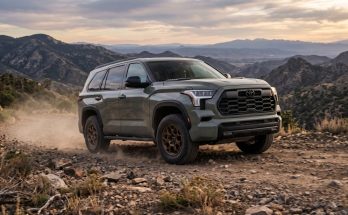
Toyota Motor North America has officially revealed the 2027 Sequoia, ushering in a significant mid-cycle update for the brand’s flagship three-row body-on-frame SUV. Scheduled to arrive at dealerships in the fall of 2026 with a starting base price of $69,900, the 2027 lineup introduces the first-ever Sequoia Trailhunter package, revisions to the desert-oriented TRD Pro model, a standardized interior tech overhaul, and an extensive suite of active towing assist systems designed to simplify heavy-duty hauling.
Aesthetically, the 2027 Sequoia incorporates subtle exterior refinements aimed at broadening the SUV’s stance. Toyota’s design team adjusted the front-end geometry, reshaping the lower fascia to incorporate integrated rectangular fog lamps alongside distinct hexagonal grille patterns that vary by trim level. While the foundational silhouette carries over, the functional hardware differences between grades have widened significantly, catering to distinct off-road, towing, and luxury demographics.
Factory Overlanding: Unpacking the All-New Sequoia Trailhunter
The most prominent addition to the 2027 lineup is the introduction of the Trailhunter package. Originally conceived as an overlanding platform on Toyota’s mid-size and light-duty truck platforms, the Trailhunter nameplate now expands to the full-size three-row market. Rather than functioning as a standalone high-tier luxury grade, the Sequoia Trailhunter package is configured directly on the foundational SR5 trim, establishing a factory-built platform tailored specifically for remote expedition travel.
Mechanical hardware upgrades form the core of the Trailhunter specification. Toyota equips the vehicle with a purpose-tuned Old Man Emu suspension setup designed to handle extended off-pavement trails and vehicle loads. Additional trail armor includes underbody skid plating to guard critical drivetrain components, complemented by frame-mounted front recovery hooks. Traction is addressed through standard Michelin LTX Trail tires wrapped around grade-exclusive bronze-finished alloy wheels, supported by dedicated Trailhunter exterior badging.
To assist with low-speed technical terrain navigation, Toyota equips the Trailhunter with a standard electronically locking rear differential, providing equal power distribution across the rear axle when traction is compromised. Drivers also receive standard access to Toyota’s multi-mode off-road management systems, including Multi-Terrain Select—which calibrates wheel spin across various terrain surfaces—and Crawl Control, an automated low-speed off-road cruise control system managing throttle and braking over rough obstacles.
FOX QS3 Dampers and TRD Pro Off-Road Evolution
While the Trailhunter focuses on backcountry camping and low-speed trail traversing, the TRD Pro model retains its focus on high-speed trail running and aggressive terrain capability. For the 2027 model year, Toyota has overhauled the TRD Pro’s damping system, replacing previous components with Sequoia-specific FOX Quick Switch 3 (QS3) adjustable internal bypass shocks.
The FOX QS3 system allows drivers to select distinct damping levels, enabling quick adjustments between compliance for on-road commuting and firmer damping required to control suspension rebound during high-speed desert washes or severe rocky terrain. Visual and functional updates to the 2027 TRD Pro also include high-visibility red front tow hooks, the model’s signature heritage front grille, and an exclusive exterior paint option dubbed Honeycomb.
Standard i-FORCE MAX Hybrid Power and 9,120-Pound Towing Capacity
Across the entire 2027 Sequoia portfolio, mechanical propulsion remains unified. Every model comes standard with Toyota’s i-FORCE MAX hybrid powertrain. The setup pairs a 3.4-liter twin-turbocharged V6 combustion engine with an electric motor-generator positioned between the engine and the transmission, drawing energy from a dedicated hybrid battery system.
Total output for the hybrid system is rated at 437 horsepower and 583 pound-feet of torque. The immediate low-end torque delivery provided by the electric motor assists off-the-line acceleration and heavy pulling, giving the 2027 Sequoia an official maximum tow rating of up to 9,120 pounds when properly equipped. This capacity places the vehicle in direct competition with traditional domestic full-size V8-powered SUVs for hauling campers, vehicle trailers, and recreational boats.
Trailer ADAS and TSS 4.0: Expanding Driver Assistance
To support its 9,120-pound towing threshold, Toyota integrated a specialized suite of Trailer Advanced Driver Assistance Systems (TADAS) into the 2027 Sequoia. These systems leverage exterior sensors and cameras to mitigate the stress associated with hitching, highway hauling, and reversing large loads.
Central to this suite is Automated Trailer Detection. Utilizing rear-facing radar and exterior cameras, the system measures the length and physical dimensions of a connected trailer without requiring manual driver inputs. This dimensional data automatically syncs with Toyota’s redesigned Trailer Garage software, which has been relocated from the instrument cluster directly into the central infotainment display for expanded visibility.
Additional active trailering systems include:
- Trailer Blind Spot Monitor: Automatically extends the detection perimeter behind the vehicle to account for the exact length of the connected trailer, warning the driver of adjacent vehicles alongside both the SUV and the towed cargo.
- Trailer Lane Trace Assist: An adaptation of Toyota’s lane-centering technology that accounts for the added mass and wind drag of a trailer, providing steering inputs to help manage highway lane splits, uneven road crowns, and sudden crosswind turbulence.
- Trailer Backup Guide: Upgraded for 2027, this tool features dynamic path lines, a touch-based slider interface, and semi-automated steering intervention designed to guide the trailer along a selected trajectory while monitoring for impending jackknife angles.
On-road safety is governed by the standard Toyota Safety Sense 4.0 (TSS 4.0) suite. Hardware and software revisions expand the operational window of features including the Pre-Collision System with Pedestrian Detection, Full-Speed Range Dynamic Radar Cruise Control, Lane Departure Alert with Steering Assist, Safe Exit Alert, and Rear Camera Detection. The suite also incorporates an Emergency Driving Stop System, which continuously monitors driver inputs when Lane Trace Assist is engaged and can bring the SUV to a controlled stop within its lane if driver unresponsiveness is detected.
Cabin Technology: Standard 14-Inch Screen, Arene Software, and Radar Monitoring
Inside the cabin, the 2027 Sequoia standardizes technology that was previously optional on lower grades. All trims now feature a 14-inch Toyota Audio Multimedia touchscreen paired with a standard 12.3-inch digital instrument cluster. Developed by Toyota Connected North America, the multimedia interface incorporates AT&T 5G network hardware, configurable screen layouts, and a persistent Quick Control menu for frequently accessed vehicle settings.
The updated infotainment setup integrates Toyota’s first built-in Drive Recorder Dash Cam featuring on-screen video playback. Utilizing the vehicle’s exterior camera infrastructure, the system records 20-second video segments triggered manually or automatically by specific vehicle dynamics events, allowing playback directly on the central 14-inch screen. Software processing and vehicle security logic are supported by Arene, a software platform developed by Toyota’s software subsidiary, Woven by Toyota, which facilitates over-the-air (OTA) programming capabilities.
For family safety, Toyota introduced an Advanced Rear Seat Reminder system that utilizes a high-frequency millimeter-wave radar unit concealed within the interior headliner. Unlike basic reminder systems that merely monitor rear door openings prior to departure, this radar sensor detects subtle movement across the second and third rows after the vehicle is parked, the ignition turned off, and the driver departs. Upon detection, the vehicle initiates escalating warnings, beginning with exterior hazard flashes and horn alerts, followed by push notifications, SMS texts, and automated telephone calls routed through the vehicle’s 5G network connection.
Cabin utility remains centered around the Sequoia’s sliding third-row seat mechanism. Paired with an adjustable multi-level cargo shelf system, the rear compartment allows owners to alter legroom and cargo storage volume depending on passenger configurations.
Lineup Architecture, Trim Progression, and Ownership Coverage
The 2027 Sequoia family spans six core trim grades, providing distinct feature structures across various price points:
- SR5: The entry tier equipped standard with the 14-inch display, 12.3-inch digital gauge cluster, i-FORCE MAX hybrid powertrain, and availability of the new Trailhunter overlanding package.
- Limited: Adds SofTex upholstery, heated and ventilated front seating, and additional interior power-convenience equipment.
- Platinum: Emphasizes luxury amenities, incorporating genuine leather-trimmed seats, second-row captain’s chairs, a panoramic glass roof, and a 14-speaker premium audio system developed by JBL.
- 1794 Edition: Features a Southwestern design theme highlighted by saddle-brown leather upholstery, genuine open-pore wood cabin trim accents, and distinct exterior brightwork and badging.
- TRD Pro: The dedicated performance off-road model fitted with FOX QS3 dampers, front red tow hooks, standard four-wheel drive, and the heritage front grille.
- Capstone: Serves as the luxury flagship, featuring semi-aniline leather seating, real acoustic laminate glass, power-deployable running boards, and 22-inch dark chrome machine-finished wheels.
Warranty coverage adheres to standard Toyota commercial terms. The vehicle includes a 36-month/36,000-mile comprehensive limited warranty alongside a 60-month/60,000-mile powertrain warranty and 60-month corrosion perforation protection. Drivetrain hybrid components carry an 8-year/100,000-mile warranty, while the hybrid traction battery is backed by a 10-year/150,000-mile warranty. ToyotaCare factory-scheduled maintenance is included for one year or 10,000 miles, accompanied by two years of unlimited-mileage roadside assistance.
Sources: Toyota Motor North America