I have learned that the most expensive diagnosis on an old vehicle is
often the one made before anybody measures anything.
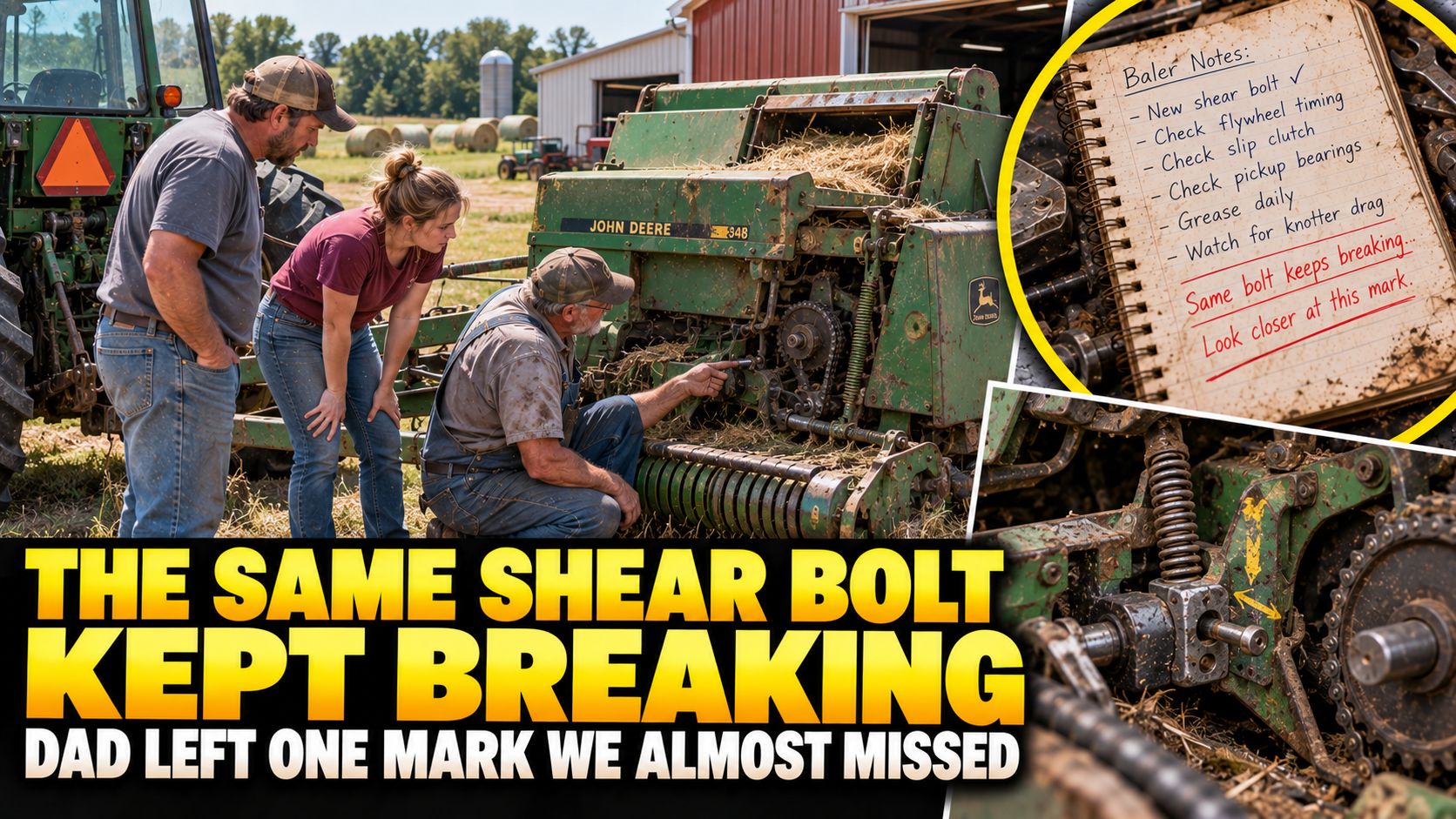
This story started with older John Deere small square baler pulled by a
well-used farm tractor in a family hay farm in southern Wisconsin.
The people around it were farmer narrator Ben, his older sister Rachel,
and neighbor mechanic/farmer Carl.
The complaint sounded simple enough: the baler repeatedly breaks the
same protective shear bolt after warming up and feeding several dozen
bales; family suspects gearbox damage.
What made it difficult was that the machine had history.
Old repairs. Old assumptions. Missing context.
And one family disagreement that had almost nothing to do with the part
everybody wanted to replace.
The actual mechanical direction was this: timing/load problem caused by
wear and a slightly shifted component in the plunger/feeder drive
relationship; inspection finds an old reference chalk/paint mark and
service note that helps identify how Dad had been monitoring the wear.
But we did not know that on the first morning.
We had to earn that answer.
Why It Came to Me
The first thing I wrote on the work order was the symptom, not the
suspected part.
That sounds minor, but it changes the way you think.
If the top of the page says “bad injection pump,” “bad brakes,” “bad
gearbox,” “rod knock,” or “unsafe truck,” every observation starts
trying to prove that sentence. If the page says what the driver actually
experienced, you leave room for the machine to disagree.
A shear bolt is a protective device. Replacing it with a harder fastener
can move the failure somewhere far more expensive.
I asked the owner to walk me through the failure from the beginning.
Where was the vehicle? Was it hot or cold? Empty or loaded? Turning,
braking, climbing, idling, or starting? What had changed immediately
before the first event? Which repairs had already been attempted? Did
any repair change the symptom even temporarily?
Those questions produced details that the earlier shorthand had erased.
We then inspected before disassembly.
On old equipment, evidence disappears quickly once parts come off. A
shiny witness mark can tell you two components touched. Dust patterns
can show movement. Heat discoloration can show resistance. A clean ring
around a bracket can reveal that it shifted. A rubbed hose or wire can
explain why a problem appears only when the engine torques over or the
chassis flexes.
I photographed those things.
Not because every repair needs a courtroom file.
Because memory is unreliable once the job gets complicated.
The family history was even less reliable.
Dad knew the machine was approaching the limit of an old adjustment and
had ordered parts before becoming ill. His note says not to substitute a
harder bolt because the shear bolt is protecting the baler.
At first, that history felt separate from the repair.
It wasn’t.
It did not magically diagnose the machine, but it told us why a
non-factory part or unusual setup existed. That let us inspect it
intelligently instead of immediately calling it wrong.
There is a difference between understanding an old repair and approving
it.
Temporary repairs can become unsafe.
Clever modifications can age badly.
A decision that made sense on the side of a road or in the middle of
harvest can become the next owner’s mystery twenty years later.
Context tells you why.
Testing tells you whether it can stay.
That distinction became important when Ben wants to finish hay before
rain and is tempted to use a stronger bolt; Rachel remembers their
father refusing exactly that shortcut.
Nobody in the shop needed a lecture.
They needed facts.
So we separated the job into three questions.
First: what is unsafe right now?
Second: what is causing the reported symptom?
Third: what else is worn but not responsible for this complaint?
That third category saves people money.
Old machines always contain worn things.
If you replace every aged component you can point at, eventually you may
make the symptom disappear without ever knowing what fixed it.
That is not diagnosis.
It is expensive coincidence.
We measured the system in the condition that mattered as closely and
safely as we could reproduce it.
When electrical supply was involved, we looked for voltage drop under
load instead of trusting static voltage.
When alignment or suspension movement was involved, we looked at
relationships under the load that produced the complaint.
When farm machinery timing was involved, we respected protective devices
and verified movement before applying power.
When a noise was involved, we changed one condition at a time and
followed where the sound transmitted.
When towing stability was involved, we treated the truck and trailer as
one system.
The evidence began to form a sequence.
The sequence mattered more than any one dramatic clue.
One part showed wear.
Another showed why the wear mattered.
The records explained when a change had been made.
The owner’s memory explained what happened around that time.
And eventually the current failure lined up with the physical evidence.
That was the point where the job stopped being a mystery.
It became a repair.
But before we ordered anything, I explained the findings in plain
language.
I showed the worn or damaged area.
I showed the measurement.
I showed what had been ruled out.
And I made one thing clear: an old note can point us in a direction, but
it does not get to overrule the machine sitting in front of us.
The machine gets the final vote.
That approach also changed the family argument.
Once the expensive assumption lost its grip, everybody had room to talk
about what they actually wanted.
Not what Dad would supposedly demand.
Not what a stranger online said the vehicle was worth.
Not what fear said after one bad drive.
What they wanted now.
That is where this chapter of the story really moved forward.
The First Inspection
The first thing I wrote on the work order was the symptom, not the
suspected part.
That sounds minor, but it changes the way you think.
If the top of the page says “bad injection pump,” “bad brakes,” “bad
gearbox,” “rod knock,” or “unsafe truck,” every observation starts
trying to prove that sentence. If the page says what the driver actually
experienced, you leave room for the machine to disagree.
The baler worked for dozens of bales because heat, wear and repeated
loading slowly changed the relationship enough to push the drive past
its safe margin.
I asked the owner to walk me through the failure from the beginning.
Where was the vehicle? Was it hot or cold? Empty or loaded? Turning,
braking, climbing, idling, or starting? What had changed immediately
before the first event? Which repairs had already been attempted? Did
any repair change the symptom even temporarily?
Those questions produced details that the earlier shorthand had erased.
We then inspected before disassembly.
On old equipment, evidence disappears quickly once parts come off. A
shiny witness mark can tell you two components touched. Dust patterns
can show movement. Heat discoloration can show resistance. A clean ring
around a bracket can reveal that it shifted. A rubbed hose or wire can
explain why a problem appears only when the engine torques over or the
chassis flexes.
I photographed those things.
Not because every repair needs a courtroom file.
Because memory is unreliable once the job gets complicated.
The family history was even less reliable.
Dad knew the machine was approaching the limit of an old adjustment and
had ordered parts before becoming ill. His note says not to substitute a
harder bolt because the shear bolt is protecting the baler.
At first, that history felt separate from the repair.
It wasn’t.
It did not magically diagnose the machine, but it told us why a
non-factory part or unusual setup existed. That let us inspect it
intelligently instead of immediately calling it wrong.
There is a difference between understanding an old repair and approving
it.
Temporary repairs can become unsafe.
Clever modifications can age badly.
A decision that made sense on the side of a road or in the middle of
harvest can become the next owner’s mystery twenty years later.
Context tells you why.
Testing tells you whether it can stay.
That distinction became important when Ben wants to finish hay before
rain and is tempted to use a stronger bolt; Rachel remembers their
father refusing exactly that shortcut.
Nobody in the shop needed a lecture.
They needed facts.
So we separated the job into three questions.
First: what is unsafe right now?
Second: what is causing the reported symptom?
Third: what else is worn but not responsible for this complaint?
That third category saves people money.
Old machines always contain worn things.
If you replace every aged component you can point at, eventually you may
make the symptom disappear without ever knowing what fixed it.
That is not diagnosis.
It is expensive coincidence.
We measured the system in the condition that mattered as closely and
safely as we could reproduce it.
When electrical supply was involved, we looked for voltage drop under
load instead of trusting static voltage.
When alignment or suspension movement was involved, we looked at
relationships under the load that produced the complaint.
When farm machinery timing was involved, we respected protective devices
and verified movement before applying power.
When a noise was involved, we changed one condition at a time and
followed where the sound transmitted.
When towing stability was involved, we treated the truck and trailer as
one system.
The evidence began to form a sequence.
The sequence mattered more than any one dramatic clue.
One part showed wear.
Another showed why the wear mattered.
The records explained when a change had been made.
The owner’s memory explained what happened around that time.
And eventually the current failure lined up with the physical evidence.
That was the point where the job stopped being a mystery.
It became a repair.
But before we ordered anything, I explained the findings in plain
language.
I showed the worn or damaged area.
I showed the measurement.
I showed what had been ruled out.
And I made one thing clear: an old note can point us in a direction, but
it does not get to overrule the machine sitting in front of us.
The machine gets the final vote.
That approach also changed the family argument.
Once the expensive assumption lost its grip, everybody had room to talk
about what they actually wanted.
Not what Dad would supposedly demand.
Not what a stranger online said the vehicle was worth.
Not what fear said after one bad drive.
What they wanted now.
That is where this chapter of the story really moved forward.
What the Previous Repairs Missed
The first thing I wrote on the work order was the symptom, not the
suspected part.
That sounds minor, but it changes the way you think.
If the top of the page says “bad injection pump,” “bad brakes,” “bad
gearbox,” “rod knock,” or “unsafe truck,” every observation starts
trying to prove that sentence. If the page says what the driver actually
experienced, you leave room for the machine to disagree.
Dad’s faded reference mark helped us see that a component had shifted
from the position he had been monitoring.
I asked the owner to walk me through the failure from the beginning.
Where was the vehicle? Was it hot or cold? Empty or loaded? Turning,
braking, climbing, idling, or starting? What had changed immediately
before the first event? Which repairs had already been attempted? Did
any repair change the symptom even temporarily?
Those questions produced details that the earlier shorthand had erased.
We then inspected before disassembly.
On old equipment, evidence disappears quickly once parts come off. A
shiny witness mark can tell you two components touched. Dust patterns
can show movement. Heat discoloration can show resistance. A clean ring
around a bracket can reveal that it shifted. A rubbed hose or wire can
explain why a problem appears only when the engine torques over or the
chassis flexes.
I photographed those things.
Not because every repair needs a courtroom file.
Because memory is unreliable once the job gets complicated.
The family history was even less reliable.
Dad knew the machine was approaching the limit of an old adjustment and
had ordered parts before becoming ill. His note says not to substitute a
harder bolt because the shear bolt is protecting the baler.
At first, that history felt separate from the repair.
It wasn’t.
It did not magically diagnose the machine, but it told us why a
non-factory part or unusual setup existed. That let us inspect it
intelligently instead of immediately calling it wrong.
There is a difference between understanding an old repair and approving
it.
Temporary repairs can become unsafe.
Clever modifications can age badly.
A decision that made sense on the side of a road or in the middle of
harvest can become the next owner’s mystery twenty years later.
Context tells you why.
Testing tells you whether it can stay.
That distinction became important when Ben wants to finish hay before
rain and is tempted to use a stronger bolt; Rachel remembers their
father refusing exactly that shortcut.
Nobody in the shop needed a lecture.
They needed facts.
So we separated the job into three questions.
First: what is unsafe right now?
Second: what is causing the reported symptom?
Third: what else is worn but not responsible for this complaint?
That third category saves people money.
Old machines always contain worn things.
If you replace every aged component you can point at, eventually you may
make the symptom disappear without ever knowing what fixed it.
That is not diagnosis.
It is expensive coincidence.
We measured the system in the condition that mattered as closely and
safely as we could reproduce it.
When electrical supply was involved, we looked for voltage drop under
load instead of trusting static voltage.
When alignment or suspension movement was involved, we looked at
relationships under the load that produced the complaint.
When farm machinery timing was involved, we respected protective devices
and verified movement before applying power.
When a noise was involved, we changed one condition at a time and
followed where the sound transmitted.
When towing stability was involved, we treated the truck and trailer as
one system.
The evidence began to form a sequence.
The sequence mattered more than any one dramatic clue.
One part showed wear.
Another showed why the wear mattered.
The records explained when a change had been made.
The owner’s memory explained what happened around that time.
And eventually the current failure lined up with the physical evidence.
That was the point where the job stopped being a mystery.
It became a repair.
But before we ordered anything, I explained the findings in plain
language.
I showed the worn or damaged area.
I showed the measurement.
I showed what had been ruled out.
And I made one thing clear: an old note can point us in a direction, but
it does not get to overrule the machine sitting in front of us.
The machine gets the final vote.
That approach also changed the family argument.
Once the expensive assumption lost its grip, everybody had room to talk
about what they actually wanted.
Not what Dad would supposedly demand.
Not what a stranger online said the vehicle was worth.
Not what fear said after one bad drive.
What they wanted now.
That is where this chapter of the story really moved forward.
The Clue That Changed the Direction
The first thing I wrote on the work order was the symptom, not the
suspected part.
That sounds minor, but it changes the way you think.
If the top of the page says “bad injection pump,” “bad brakes,” “bad
gearbox,” “rod knock,” or “unsafe truck,” every observation starts
trying to prove that sentence. If the page says what the driver actually
experienced, you leave room for the machine to disagree.
His notebook listed the correct protection and the parts he intended to
install. The note was not mystical; it was practical service history.
I asked the owner to walk me through the failure from the beginning.
Where was the vehicle? Was it hot or cold? Empty or loaded? Turning,
braking, climbing, idling, or starting? What had changed immediately
before the first event? Which repairs had already been attempted? Did
any repair change the symptom even temporarily?
Those questions produced details that the earlier shorthand had erased.
We then inspected before disassembly.
On old equipment, evidence disappears quickly once parts come off. A
shiny witness mark can tell you two components touched. Dust patterns
can show movement. Heat discoloration can show resistance. A clean ring
around a bracket can reveal that it shifted. A rubbed hose or wire can
explain why a problem appears only when the engine torques over or the
chassis flexes.
I photographed those things.
Not because every repair needs a courtroom file.
Because memory is unreliable once the job gets complicated.
The family history was even less reliable.
Dad knew the machine was approaching the limit of an old adjustment and
had ordered parts before becoming ill. His note says not to substitute a
harder bolt because the shear bolt is protecting the baler.
At first, that history felt separate from the repair.
It wasn’t.
It did not magically diagnose the machine, but it told us why a
non-factory part or unusual setup existed. That let us inspect it
intelligently instead of immediately calling it wrong.
There is a difference between understanding an old repair and approving
it.
Temporary repairs can become unsafe.
Clever modifications can age badly.
A decision that made sense on the side of a road or in the middle of
harvest can become the next owner’s mystery twenty years later.
Context tells you why.
Testing tells you whether it can stay.
That distinction became important when Ben wants to finish hay before
rain and is tempted to use a stronger bolt; Rachel remembers their
father refusing exactly that shortcut.
Nobody in the shop needed a lecture.
They needed facts.
So we separated the job into three questions.
First: what is unsafe right now?
Second: what is causing the reported symptom?
Third: what else is worn but not responsible for this complaint?
That third category saves people money.
Old machines always contain worn things.
If you replace every aged component you can point at, eventually you may
make the symptom disappear without ever knowing what fixed it.
That is not diagnosis.
It is expensive coincidence.
We measured the system in the condition that mattered as closely and
safely as we could reproduce it.
When electrical supply was involved, we looked for voltage drop under
load instead of trusting static voltage.
When alignment or suspension movement was involved, we looked at
relationships under the load that produced the complaint.
When farm machinery timing was involved, we respected protective devices
and verified movement before applying power.
When a noise was involved, we changed one condition at a time and
followed where the sound transmitted.
When towing stability was involved, we treated the truck and trailer as
one system.
The evidence began to form a sequence.
The sequence mattered more than any one dramatic clue.
One part showed wear.
Another showed why the wear mattered.
The records explained when a change had been made.
The owner’s memory explained what happened around that time.
And eventually the current failure lined up with the physical evidence.
That was the point where the job stopped being a mystery.
It became a repair.
But before we ordered anything, I explained the findings in plain
language.
I showed the worn or damaged area.
I showed the measurement.
I showed what had been ruled out.
And I made one thing clear: an old note can point us in a direction, but
it does not get to overrule the machine sitting in front of us.
The machine gets the final vote.
That approach also changed the family argument.
Once the expensive assumption lost its grip, everybody had room to talk
about what they actually wanted.
Not what Dad would supposedly demand.
Not what a stranger online said the vehicle was worth.
Not what fear said after one bad drive.
What they wanted now.
That is where this chapter of the story really moved forward.
Reading the Old Records
The first thing I wrote on the work order was the symptom, not the
suspected part.
That sounds minor, but it changes the way you think.
If the top of the page says “bad injection pump,” “bad brakes,” “bad
gearbox,” “rod knock,” or “unsafe truck,” every observation starts
trying to prove that sentence. If the page says what the driver actually
experienced, you leave room for the machine to disagree.
Ben’s urgency came from weather. Rachel’s resistance came from
remembering their father stopping work rather than defeating a safety
device.
I asked the owner to walk me through the failure from the beginning.
Where was the vehicle? Was it hot or cold? Empty or loaded? Turning,
braking, climbing, idling, or starting? What had changed immediately
before the first event? Which repairs had already been attempted? Did
any repair change the symptom even temporarily?
Those questions produced details that the earlier shorthand had erased.
We then inspected before disassembly.
On old equipment, evidence disappears quickly once parts come off. A
shiny witness mark can tell you two components touched. Dust patterns
can show movement. Heat discoloration can show resistance. A clean ring
around a bracket can reveal that it shifted. A rubbed hose or wire can
explain why a problem appears only when the engine torques over or the
chassis flexes.
I photographed those things.
Not because every repair needs a courtroom file.
Because memory is unreliable once the job gets complicated.
The family history was even less reliable.
Dad knew the machine was approaching the limit of an old adjustment and
had ordered parts before becoming ill. His note says not to substitute a
harder bolt because the shear bolt is protecting the baler.
At first, that history felt separate from the repair.
It wasn’t.
It did not magically diagnose the machine, but it told us why a
non-factory part or unusual setup existed. That let us inspect it
intelligently instead of immediately calling it wrong.
There is a difference between understanding an old repair and approving
it.
Temporary repairs can become unsafe.
Clever modifications can age badly.
A decision that made sense on the side of a road or in the middle of
harvest can become the next owner’s mystery twenty years later.
Context tells you why.
Testing tells you whether it can stay.
That distinction became important when Ben wants to finish hay before
rain and is tempted to use a stronger bolt; Rachel remembers their
father refusing exactly that shortcut.
Nobody in the shop needed a lecture.
They needed facts.
So we separated the job into three questions.
First: what is unsafe right now?
Second: what is causing the reported symptom?
Third: what else is worn but not responsible for this complaint?
That third category saves people money.
Old machines always contain worn things.
If you replace every aged component you can point at, eventually you may
make the symptom disappear without ever knowing what fixed it.
That is not diagnosis.
It is expensive coincidence.
We measured the system in the condition that mattered as closely and
safely as we could reproduce it.
When electrical supply was involved, we looked for voltage drop under
load instead of trusting static voltage.
When alignment or suspension movement was involved, we looked at
relationships under the load that produced the complaint.
When farm machinery timing was involved, we respected protective devices
and verified movement before applying power.
When a noise was involved, we changed one condition at a time and
followed where the sound transmitted.
When towing stability was involved, we treated the truck and trailer as
one system.
The evidence began to form a sequence.
The sequence mattered more than any one dramatic clue.
One part showed wear.
Another showed why the wear mattered.
The records explained when a change had been made.
The owner’s memory explained what happened around that time.
And eventually the current failure lined up with the physical evidence.
That was the point where the job stopped being a mystery.
It became a repair.
But before we ordered anything, I explained the findings in plain
language.
I showed the worn or damaged area.
I showed the measurement.
I showed what had been ruled out.
And I made one thing clear: an old note can point us in a direction, but
it does not get to overrule the machine sitting in front of us.
The machine gets the final vote.
That approach also changed the family argument.
Once the expensive assumption lost its grip, everybody had room to talk
about what they actually wanted.
Not what Dad would supposedly demand.
Not what a stranger online said the vehicle was worth.
Not what fear said after one bad drive.
What they wanted now.
That is where this chapter of the story really moved forward.
The Family Version of the Story
The first thing I wrote on the work order was the symptom, not the
suspected part.
That sounds minor, but it changes the way you think.
If the top of the page says “bad injection pump,” “bad brakes,” “bad
gearbox,” “rod knock,” or “unsafe truck,” every observation starts
trying to prove that sentence. If the page says what the driver actually
experienced, you leave room for the machine to disagree.
We repaired the worn/timing-related components, verified operation by
hand and at low speed before returning to hay, and kept the specified
shear protection.
I asked the owner to walk me through the failure from the beginning.
Where was the vehicle? Was it hot or cold? Empty or loaded? Turning,
braking, climbing, idling, or starting? What had changed immediately
before the first event? Which repairs had already been attempted? Did
any repair change the symptom even temporarily?
Those questions produced details that the earlier shorthand had erased.
We then inspected before disassembly.
On old equipment, evidence disappears quickly once parts come off. A
shiny witness mark can tell you two components touched. Dust patterns
can show movement. Heat discoloration can show resistance. A clean ring
around a bracket can reveal that it shifted. A rubbed hose or wire can
explain why a problem appears only when the engine torques over or the
chassis flexes.
I photographed those things.
Not because every repair needs a courtroom file.
Because memory is unreliable once the job gets complicated.
The family history was even less reliable.
Dad knew the machine was approaching the limit of an old adjustment and
had ordered parts before becoming ill. His note says not to substitute a
harder bolt because the shear bolt is protecting the baler.
At first, that history felt separate from the repair.
It wasn’t.
It did not magically diagnose the machine, but it told us why a
non-factory part or unusual setup existed. That let us inspect it
intelligently instead of immediately calling it wrong.
There is a difference between understanding an old repair and approving
it.
Temporary repairs can become unsafe.
Clever modifications can age badly.
A decision that made sense on the side of a road or in the middle of
harvest can become the next owner’s mystery twenty years later.
Context tells you why.
Testing tells you whether it can stay.
That distinction became important when Ben wants to finish hay before
rain and is tempted to use a stronger bolt; Rachel remembers their
father refusing exactly that shortcut.
Nobody in the shop needed a lecture.
They needed facts.
So we separated the job into three questions.
First: what is unsafe right now?
Second: what is causing the reported symptom?
Third: what else is worn but not responsible for this complaint?
That third category saves people money.
Old machines always contain worn things.
If you replace every aged component you can point at, eventually you may
make the symptom disappear without ever knowing what fixed it.
That is not diagnosis.
It is expensive coincidence.
We measured the system in the condition that mattered as closely and
safely as we could reproduce it.
When electrical supply was involved, we looked for voltage drop under
load instead of trusting static voltage.
When alignment or suspension movement was involved, we looked at
relationships under the load that produced the complaint.
When farm machinery timing was involved, we respected protective devices
and verified movement before applying power.
When a noise was involved, we changed one condition at a time and
followed where the sound transmitted.
When towing stability was involved, we treated the truck and trailer as
one system.
The evidence began to form a sequence.
The sequence mattered more than any one dramatic clue.
One part showed wear.
Another showed why the wear mattered.
The records explained when a change had been made.
The owner’s memory explained what happened around that time.
And eventually the current failure lined up with the physical evidence.
That was the point where the job stopped being a mystery.
It became a repair.
But before we ordered anything, I explained the findings in plain
language.
I showed the worn or damaged area.
I showed the measurement.
I showed what had been ruled out.
And I made one thing clear: an old note can point us in a direction, but
it does not get to overrule the machine sitting in front of us.
The machine gets the final vote.
That approach also changed the family argument.
Once the expensive assumption lost its grip, everybody had room to talk
about what they actually wanted.
Not what Dad would supposedly demand.
Not what a stranger online said the vehicle was worth.
Not what fear said after one bad drive.
What they wanted now.
That is where this chapter of the story really moved forward.
Testing the Expensive Assumption
The first thing I wrote on the work order was the symptom, not the
suspected part.
That sounds minor, but it changes the way you think.
If the top of the page says “bad injection pump,” “bad brakes,” “bad
gearbox,” “rod knock,” or “unsafe truck,” every observation starts
trying to prove that sentence. If the page says what the driver actually
experienced, you leave room for the machine to disagree.
A shear bolt is a protective device. Replacing it with a harder fastener
can move the failure somewhere far more expensive.
I asked the owner to walk me through the failure from the beginning.
Where was the vehicle? Was it hot or cold? Empty or loaded? Turning,
braking, climbing, idling, or starting? What had changed immediately
before the first event? Which repairs had already been attempted? Did
any repair change the symptom even temporarily?
Those questions produced details that the earlier shorthand had erased.
We then inspected before disassembly.
On old equipment, evidence disappears quickly once parts come off. A
shiny witness mark can tell you two components touched. Dust patterns
can show movement. Heat discoloration can show resistance. A clean ring
around a bracket can reveal that it shifted. A rubbed hose or wire can
explain why a problem appears only when the engine torques over or the
chassis flexes.
I photographed those things.
Not because every repair needs a courtroom file.
Because memory is unreliable once the job gets complicated.
The family history was even less reliable.
Dad knew the machine was approaching the limit of an old adjustment and
had ordered parts before becoming ill. His note says not to substitute a
harder bolt because the shear bolt is protecting the baler.
At first, that history felt separate from the repair.
It wasn’t.
It did not magically diagnose the machine, but it told us why a
non-factory part or unusual setup existed. That let us inspect it
intelligently instead of immediately calling it wrong.
There is a difference between understanding an old repair and approving
it.
Temporary repairs can become unsafe.
Clever modifications can age badly.
A decision that made sense on the side of a road or in the middle of
harvest can become the next owner’s mystery twenty years later.
Context tells you why.
Testing tells you whether it can stay.
That distinction became important when Ben wants to finish hay before
rain and is tempted to use a stronger bolt; Rachel remembers their
father refusing exactly that shortcut.
Nobody in the shop needed a lecture.
They needed facts.
So we separated the job into three questions.
First: what is unsafe right now?
Second: what is causing the reported symptom?
Third: what else is worn but not responsible for this complaint?
That third category saves people money.
Old machines always contain worn things.
If you replace every aged component you can point at, eventually you may
make the symptom disappear without ever knowing what fixed it.
That is not diagnosis.
It is expensive coincidence.
We measured the system in the condition that mattered as closely and
safely as we could reproduce it.
When electrical supply was involved, we looked for voltage drop under
load instead of trusting static voltage.
When alignment or suspension movement was involved, we looked at
relationships under the load that produced the complaint.
When farm machinery timing was involved, we respected protective devices
and verified movement before applying power.
When a noise was involved, we changed one condition at a time and
followed where the sound transmitted.
When towing stability was involved, we treated the truck and trailer as
one system.
The evidence began to form a sequence.
The sequence mattered more than any one dramatic clue.
One part showed wear.
Another showed why the wear mattered.
The records explained when a change had been made.
The owner’s memory explained what happened around that time.
And eventually the current failure lined up with the physical evidence.
That was the point where the job stopped being a mystery.
It became a repair.
But before we ordered anything, I explained the findings in plain
language.
I showed the worn or damaged area.
I showed the measurement.
I showed what had been ruled out.
And I made one thing clear: an old note can point us in a direction, but
it does not get to overrule the machine sitting in front of us.
The machine gets the final vote.
That approach also changed the family argument.
Once the expensive assumption lost its grip, everybody had room to talk
about what they actually wanted.
Not what Dad would supposedly demand.
Not what a stranger online said the vehicle was worth.
Not what fear said after one bad drive.
What they wanted now.
That is where this chapter of the story really moved forward.
What Actually Failed
The first thing I wrote on the work order was the symptom, not the
suspected part.
That sounds minor, but it changes the way you think.
If the top of the page says “bad injection pump,” “bad brakes,” “bad
gearbox,” “rod knock,” or “unsafe truck,” every observation starts
trying to prove that sentence. If the page says what the driver actually
experienced, you leave room for the machine to disagree.
The baler worked for dozens of bales because heat, wear and repeated
loading slowly changed the relationship enough to push the drive past
its safe margin.
I asked the owner to walk me through the failure from the beginning.
Where was the vehicle? Was it hot or cold? Empty or loaded? Turning,
braking, climbing, idling, or starting? What had changed immediately
before the first event? Which repairs had already been attempted? Did
any repair change the symptom even temporarily?
Those questions produced details that the earlier shorthand had erased.
We then inspected before disassembly.
On old equipment, evidence disappears quickly once parts come off. A
shiny witness mark can tell you two components touched. Dust patterns
can show movement. Heat discoloration can show resistance. A clean ring
around a bracket can reveal that it shifted. A rubbed hose or wire can
explain why a problem appears only when the engine torques over or the
chassis flexes.
I photographed those things.
Not because every repair needs a courtroom file.
Because memory is unreliable once the job gets complicated.
The family history was even less reliable.
Dad knew the machine was approaching the limit of an old adjustment and
had ordered parts before becoming ill. His note says not to substitute a
harder bolt because the shear bolt is protecting the baler.
At first, that history felt separate from the repair.
It wasn’t.
It did not magically diagnose the machine, but it told us why a
non-factory part or unusual setup existed. That let us inspect it
intelligently instead of immediately calling it wrong.
There is a difference between understanding an old repair and approving
it.
Temporary repairs can become unsafe.
Clever modifications can age badly.
A decision that made sense on the side of a road or in the middle of
harvest can become the next owner’s mystery twenty years later.
Context tells you why.
Testing tells you whether it can stay.
That distinction became important when Ben wants to finish hay before
rain and is tempted to use a stronger bolt; Rachel remembers their
father refusing exactly that shortcut.
Nobody in the shop needed a lecture.
They needed facts.
So we separated the job into three questions.
First: what is unsafe right now?
Second: what is causing the reported symptom?
Third: what else is worn but not responsible for this complaint?
That third category saves people money.
Old machines always contain worn things.
If you replace every aged component you can point at, eventually you may
make the symptom disappear without ever knowing what fixed it.
That is not diagnosis.
It is expensive coincidence.
We measured the system in the condition that mattered as closely and
safely as we could reproduce it.
When electrical supply was involved, we looked for voltage drop under
load instead of trusting static voltage.
When alignment or suspension movement was involved, we looked at
relationships under the load that produced the complaint.
When farm machinery timing was involved, we respected protective devices
and verified movement before applying power.
When a noise was involved, we changed one condition at a time and
followed where the sound transmitted.
When towing stability was involved, we treated the truck and trailer as
one system.
The evidence began to form a sequence.
The sequence mattered more than any one dramatic clue.
One part showed wear.
Another showed why the wear mattered.
The records explained when a change had been made.
The owner’s memory explained what happened around that time.
And eventually the current failure lined up with the physical evidence.
That was the point where the job stopped being a mystery.
It became a repair.
But before we ordered anything, I explained the findings in plain
language.
I showed the worn or damaged area.
I showed the measurement.
I showed what had been ruled out.
And I made one thing clear: an old note can point us in a direction, but
it does not get to overrule the machine sitting in front of us.
The machine gets the final vote.
That approach also changed the family argument.
Once the expensive assumption lost its grip, everybody had room to talk
about what they actually wanted.
Not what Dad would supposedly demand.
Not what a stranger online said the vehicle was worth.
Not what fear said after one bad drive.
What they wanted now.
That is where this chapter of the story really moved forward.
Fixing It Without Erasing Its History
The first thing I wrote on the work order was the symptom, not the
suspected part.
That sounds minor, but it changes the way you think.
If the top of the page says “bad injection pump,” “bad brakes,” “bad
gearbox,” “rod knock,” or “unsafe truck,” every observation starts
trying to prove that sentence. If the page says what the driver actually
experienced, you leave room for the machine to disagree.
Dad’s faded reference mark helped us see that a component had shifted
from the position he had been monitoring.
I asked the owner to walk me through the failure from the beginning.
Where was the vehicle? Was it hot or cold? Empty or loaded? Turning,
braking, climbing, idling, or starting? What had changed immediately
before the first event? Which repairs had already been attempted? Did
any repair change the symptom even temporarily?
Those questions produced details that the earlier shorthand had erased.
We then inspected before disassembly.
On old equipment, evidence disappears quickly once parts come off. A
shiny witness mark can tell you two components touched. Dust patterns
can show movement. Heat discoloration can show resistance. A clean ring
around a bracket can reveal that it shifted. A rubbed hose or wire can
explain why a problem appears only when the engine torques over or the
chassis flexes.
I photographed those things.
Not because every repair needs a courtroom file.
Because memory is unreliable once the job gets complicated.
The family history was even less reliable.
Dad knew the machine was approaching the limit of an old adjustment and
had ordered parts before becoming ill. His note says not to substitute a
harder bolt because the shear bolt is protecting the baler.
At first, that history felt separate from the repair.
It wasn’t.
It did not magically diagnose the machine, but it told us why a
non-factory part or unusual setup existed. That let us inspect it
intelligently instead of immediately calling it wrong.
There is a difference between understanding an old repair and approving
it.
Temporary repairs can become unsafe.
Clever modifications can age badly.
A decision that made sense on the side of a road or in the middle of
harvest can become the next owner’s mystery twenty years later.
Context tells you why.
Testing tells you whether it can stay.
That distinction became important when Ben wants to finish hay before
rain and is tempted to use a stronger bolt; Rachel remembers their
father refusing exactly that shortcut.
Nobody in the shop needed a lecture.
They needed facts.
So we separated the job into three questions.
First: what is unsafe right now?
Second: what is causing the reported symptom?
Third: what else is worn but not responsible for this complaint?
That third category saves people money.
Old machines always contain worn things.
If you replace every aged component you can point at, eventually you may
make the symptom disappear without ever knowing what fixed it.
That is not diagnosis.
It is expensive coincidence.
We measured the system in the condition that mattered as closely and
safely as we could reproduce it.
When electrical supply was involved, we looked for voltage drop under
load instead of trusting static voltage.
When alignment or suspension movement was involved, we looked at
relationships under the load that produced the complaint.
When farm machinery timing was involved, we respected protective devices
and verified movement before applying power.
When a noise was involved, we changed one condition at a time and
followed where the sound transmitted.
When towing stability was involved, we treated the truck and trailer as
one system.
The evidence began to form a sequence.
The sequence mattered more than any one dramatic clue.
One part showed wear.
Another showed why the wear mattered.
The records explained when a change had been made.
The owner’s memory explained what happened around that time.
And eventually the current failure lined up with the physical evidence.
That was the point where the job stopped being a mystery.
It became a repair.
But before we ordered anything, I explained the findings in plain
language.
I showed the worn or damaged area.
I showed the measurement.
I showed what had been ruled out.
And I made one thing clear: an old note can point us in a direction, but
it does not get to overrule the machine sitting in front of us.
The machine gets the final vote.
That approach also changed the family argument.
Once the expensive assumption lost its grip, everybody had room to talk
about what they actually wanted.
Not what Dad would supposedly demand.
Not what a stranger online said the vehicle was worth.
Not what fear said after one bad drive.
What they wanted now.
That is where this chapter of the story really moved forward.
The Argument Nobody Was Really Having
The first thing I wrote on the work order was the symptom, not the
suspected part.
That sounds minor, but it changes the way you think.
If the top of the page says “bad injection pump,” “bad brakes,” “bad
gearbox,” “rod knock,” or “unsafe truck,” every observation starts
trying to prove that sentence. If the page says what the driver actually
experienced, you leave room for the machine to disagree.
His notebook listed the correct protection and the parts he intended to
install. The note was not mystical; it was practical service history.
I asked the owner to walk me through the failure from the beginning.
Where was the vehicle? Was it hot or cold? Empty or loaded? Turning,
braking, climbing, idling, or starting? What had changed immediately
before the first event? Which repairs had already been attempted? Did
any repair change the symptom even temporarily?
Those questions produced details that the earlier shorthand had erased.
We then inspected before disassembly.
On old equipment, evidence disappears quickly once parts come off. A
shiny witness mark can tell you two components touched. Dust patterns
can show movement. Heat discoloration can show resistance. A clean ring
around a bracket can reveal that it shifted. A rubbed hose or wire can
explain why a problem appears only when the engine torques over or the
chassis flexes.
I photographed those things.
Not because every repair needs a courtroom file.
Because memory is unreliable once the job gets complicated.
The family history was even less reliable.
Dad knew the machine was approaching the limit of an old adjustment and
had ordered parts before becoming ill. His note says not to substitute a
harder bolt because the shear bolt is protecting the baler.
At first, that history felt separate from the repair.
It wasn’t.
It did not magically diagnose the machine, but it told us why a
non-factory part or unusual setup existed. That let us inspect it
intelligently instead of immediately calling it wrong.
There is a difference between understanding an old repair and approving
it.
Temporary repairs can become unsafe.
Clever modifications can age badly.
A decision that made sense on the side of a road or in the middle of
harvest can become the next owner’s mystery twenty years later.
Context tells you why.
Testing tells you whether it can stay.
That distinction became important when Ben wants to finish hay before
rain and is tempted to use a stronger bolt; Rachel remembers their
father refusing exactly that shortcut.
Nobody in the shop needed a lecture.
They needed facts.
So we separated the job into three questions.
First: what is unsafe right now?
Second: what is causing the reported symptom?
Third: what else is worn but not responsible for this complaint?
That third category saves people money.
Old machines always contain worn things.
If you replace every aged component you can point at, eventually you may
make the symptom disappear without ever knowing what fixed it.
That is not diagnosis.
It is expensive coincidence.
We measured the system in the condition that mattered as closely and
safely as we could reproduce it.
When electrical supply was involved, we looked for voltage drop under
load instead of trusting static voltage.
When alignment or suspension movement was involved, we looked at
relationships under the load that produced the complaint.
When farm machinery timing was involved, we respected protective devices
and verified movement before applying power.
When a noise was involved, we changed one condition at a time and
followed where the sound transmitted.
When towing stability was involved, we treated the truck and trailer as
one system.
The evidence began to form a sequence.
The sequence mattered more than any one dramatic clue.
One part showed wear.
Another showed why the wear mattered.
The records explained when a change had been made.
The owner’s memory explained what happened around that time.
And eventually the current failure lined up with the physical evidence.
That was the point where the job stopped being a mystery.
It became a repair.
But before we ordered anything, I explained the findings in plain
language.
I showed the worn or damaged area.
I showed the measurement.
I showed what had been ruled out.
And I made one thing clear: an old note can point us in a direction, but
it does not get to overrule the machine sitting in front of us.
The machine gets the final vote.
That approach also changed the family argument.
Once the expensive assumption lost its grip, everybody had room to talk
about what they actually wanted.
Not what Dad would supposedly demand.
Not what a stranger online said the vehicle was worth.
Not what fear said after one bad drive.
What they wanted now.
That is where this chapter of the story really moved forward.
The First Real Test
The first thing I wrote on the work order was the symptom, not the
suspected part.
That sounds minor, but it changes the way you think.
If the top of the page says “bad injection pump,” “bad brakes,” “bad
gearbox,” “rod knock,” or “unsafe truck,” every observation starts
trying to prove that sentence. If the page says what the driver actually
experienced, you leave room for the machine to disagree.
Ben’s urgency came from weather. Rachel’s resistance came from
remembering their father stopping work rather than defeating a safety
device.
I asked the owner to walk me through the failure from the beginning.
Where was the vehicle? Was it hot or cold? Empty or loaded? Turning,
braking, climbing, idling, or starting? What had changed immediately
before the first event? Which repairs had already been attempted? Did
any repair change the symptom even temporarily?
Those questions produced details that the earlier shorthand had erased.
We then inspected before disassembly.
On old equipment, evidence disappears quickly once parts come off. A
shiny witness mark can tell you two components touched. Dust patterns
can show movement. Heat discoloration can show resistance. A clean ring
around a bracket can reveal that it shifted. A rubbed hose or wire can
explain why a problem appears only when the engine torques over or the
chassis flexes.
I photographed those things.
Not because every repair needs a courtroom file.
Because memory is unreliable once the job gets complicated.
The family history was even less reliable.
Dad knew the machine was approaching the limit of an old adjustment and
had ordered parts before becoming ill. His note says not to substitute a
harder bolt because the shear bolt is protecting the baler.
At first, that history felt separate from the repair.
It wasn’t.
It did not magically diagnose the machine, but it told us why a
non-factory part or unusual setup existed. That let us inspect it
intelligently instead of immediately calling it wrong.
There is a difference between understanding an old repair and approving
it.
Temporary repairs can become unsafe.
Clever modifications can age badly.
A decision that made sense on the side of a road or in the middle of
harvest can become the next owner’s mystery twenty years later.
Context tells you why.
Testing tells you whether it can stay.
That distinction became important when Ben wants to finish hay before
rain and is tempted to use a stronger bolt; Rachel remembers their
father refusing exactly that shortcut.
Nobody in the shop needed a lecture.
They needed facts.
So we separated the job into three questions.
First: what is unsafe right now?
Second: what is causing the reported symptom?
Third: what else is worn but not responsible for this complaint?
That third category saves people money.
Old machines always contain worn things.
If you replace every aged component you can point at, eventually you may
make the symptom disappear without ever knowing what fixed it.
That is not diagnosis.
It is expensive coincidence.
We measured the system in the condition that mattered as closely and
safely as we could reproduce it.
When electrical supply was involved, we looked for voltage drop under
load instead of trusting static voltage.
When alignment or suspension movement was involved, we looked at
relationships under the load that produced the complaint.
When farm machinery timing was involved, we respected protective devices
and verified movement before applying power.
When a noise was involved, we changed one condition at a time and
followed where the sound transmitted.
When towing stability was involved, we treated the truck and trailer as
one system.
The evidence began to form a sequence.
The sequence mattered more than any one dramatic clue.
One part showed wear.
Another showed why the wear mattered.
The records explained when a change had been made.
The owner’s memory explained what happened around that time.
And eventually the current failure lined up with the physical evidence.
That was the point where the job stopped being a mystery.
It became a repair.
But before we ordered anything, I explained the findings in plain
language.
I showed the worn or damaged area.
I showed the measurement.
I showed what had been ruled out.
And I made one thing clear: an old note can point us in a direction, but
it does not get to overrule the machine sitting in front of us.
The machine gets the final vote.
That approach also changed the family argument.
Once the expensive assumption lost its grip, everybody had room to talk
about what they actually wanted.
Not what Dad would supposedly demand.
Not what a stranger online said the vehicle was worth.
Not what fear said after one bad drive.
What they wanted now.
That is where this chapter of the story really moved forward.
What Changed After the Repair
The first thing I wrote on the work order was the symptom, not the
suspected part.
That sounds minor, but it changes the way you think.
If the top of the page says “bad injection pump,” “bad brakes,” “bad
gearbox,” “rod knock,” or “unsafe truck,” every observation starts
trying to prove that sentence. If the page says what the driver actually
experienced, you leave room for the machine to disagree.
We repaired the worn/timing-related components, verified operation by
hand and at low speed before returning to hay, and kept the specified
shear protection.
I asked the owner to walk me through the failure from the beginning.
Where was the vehicle? Was it hot or cold? Empty or loaded? Turning,
braking, climbing, idling, or starting? What had changed immediately
before the first event? Which repairs had already been attempted? Did
any repair change the symptom even temporarily?
Those questions produced details that the earlier shorthand had erased.
We then inspected before disassembly.
On old equipment, evidence disappears quickly once parts come off. A
shiny witness mark can tell you two components touched. Dust patterns
can show movement. Heat discoloration can show resistance. A clean ring
around a bracket can reveal that it shifted. A rubbed hose or wire can
explain why a problem appears only when the engine torques over or the
chassis flexes.
I photographed those things.
Not because every repair needs a courtroom file.
Because memory is unreliable once the job gets complicated.
The family history was even less reliable.
Dad knew the machine was approaching the limit of an old adjustment and
had ordered parts before becoming ill. His note says not to substitute a
harder bolt because the shear bolt is protecting the baler.
At first, that history felt separate from the repair.
It wasn’t.
It did not magically diagnose the machine, but it told us why a
non-factory part or unusual setup existed. That let us inspect it
intelligently instead of immediately calling it wrong.
There is a difference between understanding an old repair and approving
it.
Temporary repairs can become unsafe.
Clever modifications can age badly.
A decision that made sense on the side of a road or in the middle of
harvest can become the next owner’s mystery twenty years later.
Context tells you why.
Testing tells you whether it can stay.
That distinction became important when Ben wants to finish hay before
rain and is tempted to use a stronger bolt; Rachel remembers their
father refusing exactly that shortcut.
Nobody in the shop needed a lecture.
They needed facts.
So we separated the job into three questions.
First: what is unsafe right now?
Second: what is causing the reported symptom?
Third: what else is worn but not responsible for this complaint?
That third category saves people money.
Old machines always contain worn things.
If you replace every aged component you can point at, eventually you may
make the symptom disappear without ever knowing what fixed it.
That is not diagnosis.
It is expensive coincidence.
We measured the system in the condition that mattered as closely and
safely as we could reproduce it.
When electrical supply was involved, we looked for voltage drop under
load instead of trusting static voltage.
When alignment or suspension movement was involved, we looked at
relationships under the load that produced the complaint.
When farm machinery timing was involved, we respected protective devices
and verified movement before applying power.
When a noise was involved, we changed one condition at a time and
followed where the sound transmitted.
When towing stability was involved, we treated the truck and trailer as
one system.
The evidence began to form a sequence.
The sequence mattered more than any one dramatic clue.
One part showed wear.
Another showed why the wear mattered.
The records explained when a change had been made.
The owner’s memory explained what happened around that time.
And eventually the current failure lined up with the physical evidence.
That was the point where the job stopped being a mystery.
It became a repair.
But before we ordered anything, I explained the findings in plain
language.
I showed the worn or damaged area.
I showed the measurement.
I showed what had been ruled out.
And I made one thing clear: an old note can point us in a direction, but
it does not get to overrule the machine sitting in front of us.
The machine gets the final vote.
That approach also changed the family argument.
Once the expensive assumption lost its grip, everybody had room to talk
about what they actually wanted.
Not what Dad would supposedly demand.
Not what a stranger online said the vehicle was worth.
Not what fear said after one bad drive.
What they wanted now.
That is where this chapter of the story really moved forward.
What the Machine Was Really Teaching Us
The first thing I wrote on the work order was the symptom, not the
suspected part.
That sounds minor, but it changes the way you think.
If the top of the page says “bad injection pump,” “bad brakes,” “bad
gearbox,” “rod knock,” or “unsafe truck,” every observation starts
trying to prove that sentence. If the page says what the driver actually
experienced, you leave room for the machine to disagree.
A shear bolt is a protective device. Replacing it with a harder fastener
can move the failure somewhere far more expensive.
I asked the owner to walk me through the failure from the beginning.
Where was the vehicle? Was it hot or cold? Empty or loaded? Turning,
braking, climbing, idling, or starting? What had changed immediately
before the first event? Which repairs had already been attempted? Did
any repair change the symptom even temporarily?
Those questions produced details that the earlier shorthand had erased.
We then inspected before disassembly.
On old equipment, evidence disappears quickly once parts come off. A
shiny witness mark can tell you two components touched. Dust patterns
can show movement. Heat discoloration can show resistance. A clean ring
around a bracket can reveal that it shifted. A rubbed hose or wire can
explain why a problem appears only when the engine torques over or the
chassis flexes.
I photographed those things.
Not because every repair needs a courtroom file.
Because memory is unreliable once the job gets complicated.
The family history was even less reliable.
Dad knew the machine was approaching the limit of an old adjustment and
had ordered parts before becoming ill. His note says not to substitute a
harder bolt because the shear bolt is protecting the baler.
At first, that history felt separate from the repair.
It wasn’t.
It did not magically diagnose the machine, but it told us why a
non-factory part or unusual setup existed. That let us inspect it
intelligently instead of immediately calling it wrong.
There is a difference between understanding an old repair and approving
it.
Temporary repairs can become unsafe.
Clever modifications can age badly.
A decision that made sense on the side of a road or in the middle of
harvest can become the next owner’s mystery twenty years later.
Context tells you why.
Testing tells you whether it can stay.
That distinction became important when Ben wants to finish hay before
rain and is tempted to use a stronger bolt; Rachel remembers their
father refusing exactly that shortcut.
Nobody in the shop needed a lecture.
They needed facts.
So we separated the job into three questions.
First: what is unsafe right now?
Second: what is causing the reported symptom?
Third: what else is worn but not responsible for this complaint?
That third category saves people money.
Old machines always contain worn things.
If you replace every aged component you can point at, eventually you may
make the symptom disappear without ever knowing what fixed it.
That is not diagnosis.
It is expensive coincidence.
We measured the system in the condition that mattered as closely and
safely as we could reproduce it.
When electrical supply was involved, we looked for voltage drop under
load instead of trusting static voltage.
When alignment or suspension movement was involved, we looked at
relationships under the load that produced the complaint.
When farm machinery timing was involved, we respected protective devices
and verified movement before applying power.
When a noise was involved, we changed one condition at a time and
followed where the sound transmitted.
When towing stability was involved, we treated the truck and trailer as
one system.
The evidence began to form a sequence.
The sequence mattered more than any one dramatic clue.
One part showed wear.
Another showed why the wear mattered.
The records explained when a change had been made.
The owner’s memory explained what happened around that time.
And eventually the current failure lined up with the physical evidence.
That was the point where the job stopped being a mystery.
It became a repair.
But before we ordered anything, I explained the findings in plain
language.
I showed the worn or damaged area.
I showed the measurement.
I showed what had been ruled out.
And I made one thing clear: an old note can point us in a direction, but
it does not get to overrule the machine sitting in front of us.
The machine gets the final vote.
That approach also changed the family argument.
Once the expensive assumption lost its grip, everybody had room to talk
about what they actually wanted.
Not what Dad would supposedly demand.
Not what a stranger online said the vehicle was worth.
Not what fear said after one bad drive.
What they wanted now.
That is where this chapter of the story really moved forward.
The Complete Ending
The final repair was not the dramatic part.
The dramatic part had been uncertainty.
Once the evidence was clear, the work became ordinary professional
repair: timing/load problem caused by wear and a slightly shifted
component in the plunger/feeder drive relationship; inspection finds an
old reference chalk/paint mark and service note that helps identify how
Dad had been monitoring the wear.
We replaced or corrected only what the inspection and testing supported.
We documented the non-factory history. We made the system easier for the
next person to understand. Then we verified the result in the operating
condition that had produced the complaint.
The outcome was simple.
They repair the worn timing/drive components correctly, use the
specified protection, finish hay later than planned, and hang the bent
old bolt beside Dad’s note as a reminder that a fuse is supposed to fail
first.
That did not erase the past.
It put it in the correct place.
The old repair had a reason.
The current failure had a cause.
The family conflict had a different cause entirely.
Those three things had been tangled together because nobody had enough
context to separate them.
By the end, they did.
I kept thinking about the old records.
Dad knew the machine was approaching the limit of an old adjustment and
had ordered parts before becoming ill. His note says not to substitute a
harder bolt because the shear bolt is protecting the baler.
The person who wrote those notes was not leaving behind a treasure map.
He was doing something more useful.
He was leaving context.
That may be the most valuable thing you can leave with an old machine.
Write down why you changed the wiring.
Write down why a bracket is different.
Write down the loaded weight.
Write down the part number.
Write down the symptom that made you stop.
Write down what you tested before replacing something expensive.
The next owner may be your son.
Your daughter.
A stranger.
Or a mechanic who has never met you.
They do not need a legend.
They need enough information to begin in the right place.
That is what happened here.
The machine was not saved by nostalgia.
It was saved from a bad decision by diagnosis.
And the people around it learned something that applies far beyond old
trucks, tractors, cars, and trailers:
A symptom can be frightening without being a verdict.
A temporary repair can be understandable without being permanent.
And an old machine can carry history without forcing the next generation
to repeat every decision exactly the same way.
Sometimes the best way to respect the person who worked on it before you
is not to preserve every old part.
It is to understand what they were trying to solve, fix what time has
changed, and leave better information for whoever comes next.