The first time I heard the clunk, I understood why Wade Parker thought
the rear end was coming apart.
It did not sound small.
It sounded like somebody had swung a sledgehammer into the frame of his
2002 Ford F-350 Super Duty.
The truck was an extended-cab long-bed four-wheel-drive with the
7.3-liter Power Stroke, an automatic transmission, a steel ranch bumper,
faded white paint, and enough dents in the bed to prove nobody had
bought it for decoration.
Wade’s father, Harold, had bought it used in 2006.
For the next sixteen years, it hauled cattle, feed, fencing supplies,
mineral tubs, tractors that were probably heavier than they should have
been, and a twenty-four-foot gooseneck stock trailer that seemed
permanently attached during calving season.
Harold died three years before the truck came to me.
Wade inherited the Ford.
He also inherited every old repair nobody else fully understood.
The clunk appeared only when the truck was working hard.
Empty, Wade could drive all week and barely hear it.
Hook the stock trailer behind it, put cattle inside, ease away from a
stop on an incline, and the noise came from somewhere behind the cab
with enough force to make him lift his foot.
Two shops had already looked at it.
One suspected excessive differential backlash and recommended opening
the rear axle.
Another told him the transmission and driveline had enough mileage that
he should prepare for expensive work.
Neither answer was impossible.
The truck had more than 300,000 miles.
But neither answer explained one detail I could not ignore.
The noise changed dramatically with trailer load.
That meant I wanted to know what was moving.
The Complaint Nobody Could Reproduce
Wade arrived without the trailer, and the F-350 behaved almost
perfectly. We inspected universal joints, carrier-bearing condition
where applicable, driveshaft slip, axle mounts, spring hardware,
transmission mount, engine mounts, differential play, and obvious frame
damage. Nothing justified a differential rebuild on sight. The important
lesson was simple: if a complaint happens under load, an empty test can
only tell you so much.
That was the factual center of this part of the job, but the details
around it mattered.
Old working trucks are layered machines. The factory built the first
version. Owners, welders, hitch installers, ranch hands, tire shops,
transmission shops, and weather build the versions that come afterward.
By the time a truck reaches three hundred thousand miles, the service
history can matter as much as the original specification.
I try to approach those trucks without insulting the people who worked
on them before me.
It is easy to point at an old repair and call it wrong.
Sometimes it is wrong.
Sometimes it was the best repair somebody could make at ten at night
with cattle waiting, weather moving in, and the nearest open parts
counter an hour away.
The important question is not whether I would have made the same
decision.
The important questions are what the repair was intended to do, what
condition it is in now, and whether it remains safe for the load being
asked of it.
Wade understood that distinction slowly.
At first, every strange bracket or old weld felt personal to him.
“Dad did everything this way,” he said.
“What way?”
“Good enough.”
I pointed at the notebook.
“He wrote temporary.”
“That didn’t stop him from leaving it there fifteen years.”
“No,” I said. “But those are two different accusations.”
He did not answer.
The truck sat between us.
Harold was not there to defend himself, and I was not interested in
doing it for him. A dead owner can become either a saint or a villain
depending on what the family needs that day. Neither version helps
diagnose a truck.
We stayed with the evidence.
We marked positions before loosening anything.
We looked at which surfaces had been moving.
We compared the left and right sides.
We checked whether deformation was old or active.
We inspected for cracking, corrosion, damaged fasteners, and places
where load was entering the structure differently than intended.
Every observation narrowed the problem.
That is the part of diagnosis people rarely see online.
The dramatic moment is finding the bad piece.
The real work is proving that piece explains the complaint.
A worn part can exist without causing the symptom.
A scary noise can come from something inexpensive.
An expensive component can be worn and still not be the reason the
customer came in.
If I had opened the differential first, I might have found normal
high-mileage wear.
Then Wade would have paid for a rear-end repair.
The truck might still have clunked with the trailer.
That is how parts get blamed for crimes they did not commit.
Wade asked me what I thought of the truck overall.
I told him the truth.
It was old.
It had worked hard.
It would need more repairs.
The 7.3 Power Stroke had a reputation people loved to romanticize, but
reputation does not replace maintenance. Hoses age. Wiring corrodes.
transmissions wear. steering components loosen. brake systems need
attention. frames and hitch systems deserve inspection when they spend
their lives carrying and towing.
“You telling me to sell it?” he asked.
“No.”
“You telling me to keep it?”
“No.”
He laughed once.
“You’re not very helpful.”
“I’ll tell you what condition it’s in. You decide what that condition is
worth to you.”
That answer mattered because Wade had been looking for permission.
Permission to keep Dad’s truck.
Permission to sell it.
Permission to be tired of fixing it.
A mechanic cannot give him that.
We can give him information.
The rest belongs to him.
As the repair developed, Wade’s attitude changed from defending or
criticizing Harold to asking better questions.
Why was the access hole there?
What had happened in 2011?
How much weight had the truck been carrying?
Why had Harold chosen that plate thickness?
Did the trailer setup change later?
Were there other temporary repairs in the notebook?
Those questions were useful.
They also gave Wade a version of his father that was more complicated
than “the guy who never finished anything.”
Harold had noticed the movement.
He had reduced it enough to finish urgent work.
He had documented it.
He had intended to revisit it.
Then he had not.
All four statements could be true.
Machines are full of unfinished intentions.
So are families.
By the end of this stage, the clunk no longer felt mysterious.
We could explain when it happened, why load made it worse, where the
movement occurred, and why the noise seemed to come from somewhere else.
That is the point where I become comfortable discussing a repair plan.
Not before.
Bringing the Trailer Back
The next morning Wade returned with the gooseneck stock trailer. We did
not need cattle to create a meaningful test; controlled ballast and
careful low-speed loading let us reproduce the clunk without abusing the
truck. The sound occurred when torque and vertical hitch load acted
together. It was strongest during initial pull on an incline and almost
absent during gentle unloaded acceleration.
That was the factual center of this part of the job, but the details
around it mattered.
Old working trucks are layered machines. The factory built the first
version. Owners, welders, hitch installers, ranch hands, tire shops,
transmission shops, and weather build the versions that come afterward.
By the time a truck reaches three hundred thousand miles, the service
history can matter as much as the original specification.
I try to approach those trucks without insulting the people who worked
on them before me.
It is easy to point at an old repair and call it wrong.
Sometimes it is wrong.
Sometimes it was the best repair somebody could make at ten at night
with cattle waiting, weather moving in, and the nearest open parts
counter an hour away.
The important question is not whether I would have made the same
decision.
The important questions are what the repair was intended to do, what
condition it is in now, and whether it remains safe for the load being
asked of it.
Wade understood that distinction slowly.
At first, every strange bracket or old weld felt personal to him.
“Dad did everything this way,” he said.
“What way?”
“Good enough.”
I pointed at the notebook.
“He wrote temporary.”
“That didn’t stop him from leaving it there fifteen years.”
“No,” I said. “But those are two different accusations.”
He did not answer.
The truck sat between us.
Harold was not there to defend himself, and I was not interested in
doing it for him. A dead owner can become either a saint or a villain
depending on what the family needs that day. Neither version helps
diagnose a truck.
We stayed with the evidence.
We marked positions before loosening anything.
We looked at which surfaces had been moving.
We compared the left and right sides.
We checked whether deformation was old or active.
We inspected for cracking, corrosion, damaged fasteners, and places
where load was entering the structure differently than intended.
Every observation narrowed the problem.
That is the part of diagnosis people rarely see online.
The dramatic moment is finding the bad piece.
The real work is proving that piece explains the complaint.
A worn part can exist without causing the symptom.
A scary noise can come from something inexpensive.
An expensive component can be worn and still not be the reason the
customer came in.
If I had opened the differential first, I might have found normal
high-mileage wear.
Then Wade would have paid for a rear-end repair.
The truck might still have clunked with the trailer.
That is how parts get blamed for crimes they did not commit.
Wade asked me what I thought of the truck overall.
I told him the truth.
It was old.
It had worked hard.
It would need more repairs.
The 7.3 Power Stroke had a reputation people loved to romanticize, but
reputation does not replace maintenance. Hoses age. Wiring corrodes.
transmissions wear. steering components loosen. brake systems need
attention. frames and hitch systems deserve inspection when they spend
their lives carrying and towing.
“You telling me to sell it?” he asked.
“No.”
“You telling me to keep it?”
“No.”
He laughed once.
“You’re not very helpful.”
“I’ll tell you what condition it’s in. You decide what that condition is
worth to you.”
That answer mattered because Wade had been looking for permission.
Permission to keep Dad’s truck.
Permission to sell it.
Permission to be tired of fixing it.
A mechanic cannot give him that.
We can give him information.
The rest belongs to him.
As the repair developed, Wade’s attitude changed from defending or
criticizing Harold to asking better questions.
Why was the access hole there?
What had happened in 2011?
How much weight had the truck been carrying?
Why had Harold chosen that plate thickness?
Did the trailer setup change later?
Were there other temporary repairs in the notebook?
Those questions were useful.
They also gave Wade a version of his father that was more complicated
than “the guy who never finished anything.”
Harold had noticed the movement.
He had reduced it enough to finish urgent work.
He had documented it.
He had intended to revisit it.
Then he had not.
All four statements could be true.
Machines are full of unfinished intentions.
So are families.
By the end of this stage, the clunk no longer felt mysterious.
We could explain when it happened, why load made it worse, where the
movement occurred, and why the noise seemed to come from somewhere else.
That is the point where I become comfortable discussing a repair plan.
Not before.
Watching Instead of Guessing
I used paint marks, reference measurements, and a helper watching from a
safe position while the combination was loaded statically and moved only
as needed. A clean witness line appeared near one portion of the
gooseneck hitch structure. Dust and old paint had been disturbed.
Something had been shifting.
That was the factual center of this part of the job, but the details
around it mattered.
Old working trucks are layered machines. The factory built the first
version. Owners, welders, hitch installers, ranch hands, tire shops,
transmission shops, and weather build the versions that come afterward.
By the time a truck reaches three hundred thousand miles, the service
history can matter as much as the original specification.
I try to approach those trucks without insulting the people who worked
on them before me.
It is easy to point at an old repair and call it wrong.
Sometimes it is wrong.
Sometimes it was the best repair somebody could make at ten at night
with cattle waiting, weather moving in, and the nearest open parts
counter an hour away.
The important question is not whether I would have made the same
decision.
The important questions are what the repair was intended to do, what
condition it is in now, and whether it remains safe for the load being
asked of it.
Wade understood that distinction slowly.
At first, every strange bracket or old weld felt personal to him.
“Dad did everything this way,” he said.
“What way?”
“Good enough.”
I pointed at the notebook.
“He wrote temporary.”
“That didn’t stop him from leaving it there fifteen years.”
“No,” I said. “But those are two different accusations.”
He did not answer.
The truck sat between us.
Harold was not there to defend himself, and I was not interested in
doing it for him. A dead owner can become either a saint or a villain
depending on what the family needs that day. Neither version helps
diagnose a truck.
We stayed with the evidence.
We marked positions before loosening anything.
We looked at which surfaces had been moving.
We compared the left and right sides.
We checked whether deformation was old or active.
We inspected for cracking, corrosion, damaged fasteners, and places
where load was entering the structure differently than intended.
Every observation narrowed the problem.
That is the part of diagnosis people rarely see online.
The dramatic moment is finding the bad piece.
The real work is proving that piece explains the complaint.
A worn part can exist without causing the symptom.
A scary noise can come from something inexpensive.
An expensive component can be worn and still not be the reason the
customer came in.
If I had opened the differential first, I might have found normal
high-mileage wear.
Then Wade would have paid for a rear-end repair.
The truck might still have clunked with the trailer.
That is how parts get blamed for crimes they did not commit.
Wade asked me what I thought of the truck overall.
I told him the truth.
It was old.
It had worked hard.
It would need more repairs.
The 7.3 Power Stroke had a reputation people loved to romanticize, but
reputation does not replace maintenance. Hoses age. Wiring corrodes.
transmissions wear. steering components loosen. brake systems need
attention. frames and hitch systems deserve inspection when they spend
their lives carrying and towing.
“You telling me to sell it?” he asked.
“No.”
“You telling me to keep it?”
“No.”
He laughed once.
“You’re not very helpful.”
“I’ll tell you what condition it’s in. You decide what that condition is
worth to you.”
That answer mattered because Wade had been looking for permission.
Permission to keep Dad’s truck.
Permission to sell it.
Permission to be tired of fixing it.
A mechanic cannot give him that.
We can give him information.
The rest belongs to him.
As the repair developed, Wade’s attitude changed from defending or
criticizing Harold to asking better questions.
Why was the access hole there?
What had happened in 2011?
How much weight had the truck been carrying?
Why had Harold chosen that plate thickness?
Did the trailer setup change later?
Were there other temporary repairs in the notebook?
Those questions were useful.
They also gave Wade a version of his father that was more complicated
than “the guy who never finished anything.”
Harold had noticed the movement.
He had reduced it enough to finish urgent work.
He had documented it.
He had intended to revisit it.
Then he had not.
All four statements could be true.
Machines are full of unfinished intentions.
So are families.
By the end of this stage, the clunk no longer felt mysterious.
We could explain when it happened, why load made it worse, where the
movement occurred, and why the noise seemed to come from somewhere else.
That is the point where I become comfortable discussing a repair plan.
Not before.
Under the Bed Mat
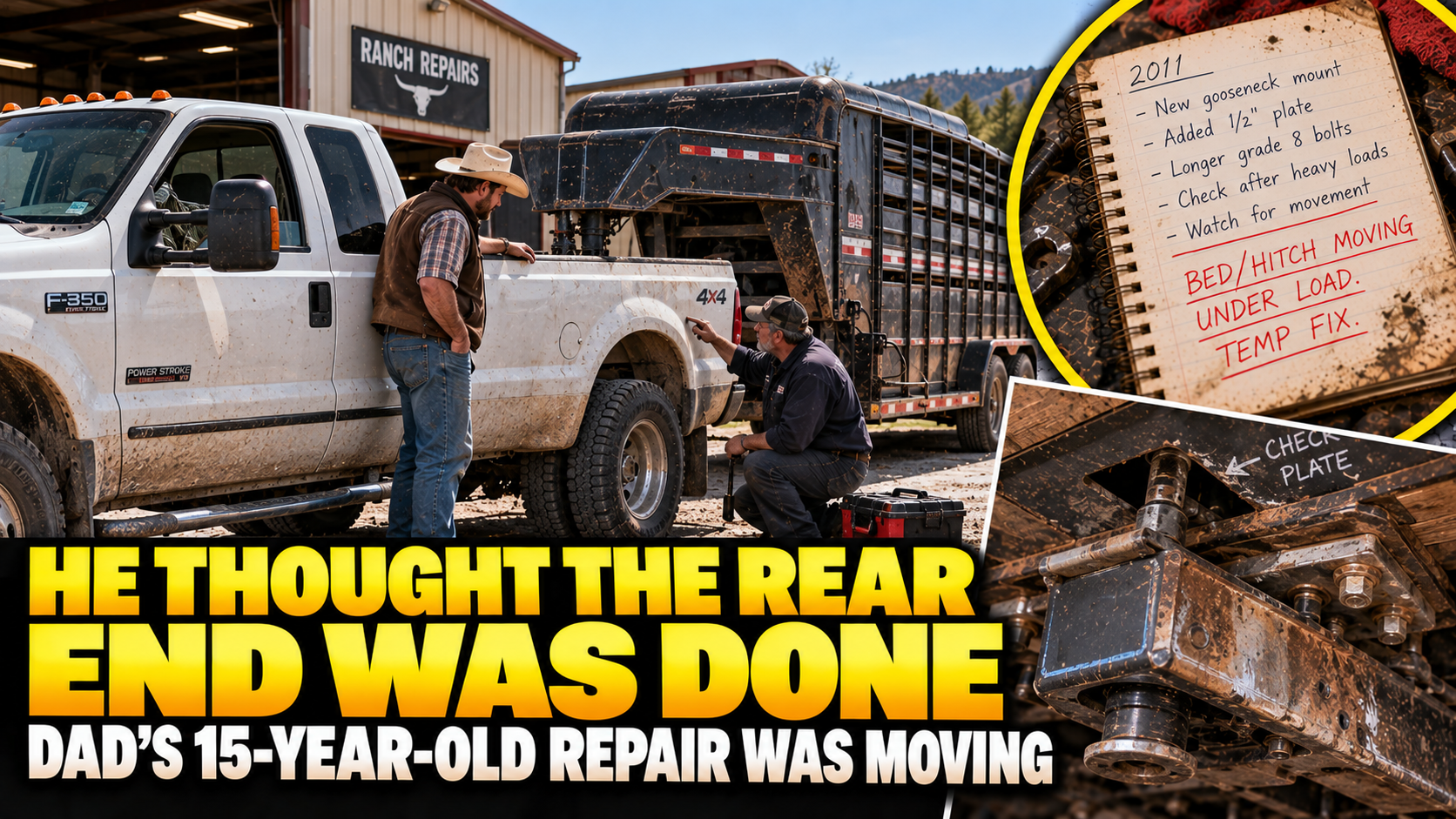
Wade lifted the heavy rubber bed mat and found a small old access
opening he had forgotten existed. Beside it, in faded paint marker, were
the words CHECK PLATE. The handwriting looked like Harold’s. That turned
an unexplained witness mark into a piece of history, but it still did
not prove the current cause.
That was the factual center of this part of the job, but the details
around it mattered.
Old working trucks are layered machines. The factory built the first
version. Owners, welders, hitch installers, ranch hands, tire shops,
transmission shops, and weather build the versions that come afterward.
By the time a truck reaches three hundred thousand miles, the service
history can matter as much as the original specification.
I try to approach those trucks without insulting the people who worked
on them before me.
It is easy to point at an old repair and call it wrong.
Sometimes it is wrong.
Sometimes it was the best repair somebody could make at ten at night
with cattle waiting, weather moving in, and the nearest open parts
counter an hour away.
The important question is not whether I would have made the same
decision.
The important questions are what the repair was intended to do, what
condition it is in now, and whether it remains safe for the load being
asked of it.
Wade understood that distinction slowly.
At first, every strange bracket or old weld felt personal to him.
“Dad did everything this way,” he said.
“What way?”
“Good enough.”
I pointed at the notebook.
“He wrote temporary.”
“That didn’t stop him from leaving it there fifteen years.”
“No,” I said. “But those are two different accusations.”
He did not answer.
The truck sat between us.
Harold was not there to defend himself, and I was not interested in
doing it for him. A dead owner can become either a saint or a villain
depending on what the family needs that day. Neither version helps
diagnose a truck.
We stayed with the evidence.
We marked positions before loosening anything.
We looked at which surfaces had been moving.
We compared the left and right sides.
We checked whether deformation was old or active.
We inspected for cracking, corrosion, damaged fasteners, and places
where load was entering the structure differently than intended.
Every observation narrowed the problem.
That is the part of diagnosis people rarely see online.
The dramatic moment is finding the bad piece.
The real work is proving that piece explains the complaint.
A worn part can exist without causing the symptom.
A scary noise can come from something inexpensive.
An expensive component can be worn and still not be the reason the
customer came in.
If I had opened the differential first, I might have found normal
high-mileage wear.
Then Wade would have paid for a rear-end repair.
The truck might still have clunked with the trailer.
That is how parts get blamed for crimes they did not commit.
Wade asked me what I thought of the truck overall.
I told him the truth.
It was old.
It had worked hard.
It would need more repairs.
The 7.3 Power Stroke had a reputation people loved to romanticize, but
reputation does not replace maintenance. Hoses age. Wiring corrodes.
transmissions wear. steering components loosen. brake systems need
attention. frames and hitch systems deserve inspection when they spend
their lives carrying and towing.
“You telling me to sell it?” he asked.
“No.”
“You telling me to keep it?”
“No.”
He laughed once.
“You’re not very helpful.”
“I’ll tell you what condition it’s in. You decide what that condition is
worth to you.”
That answer mattered because Wade had been looking for permission.
Permission to keep Dad’s truck.
Permission to sell it.
Permission to be tired of fixing it.
A mechanic cannot give him that.
We can give him information.
The rest belongs to him.
As the repair developed, Wade’s attitude changed from defending or
criticizing Harold to asking better questions.
Why was the access hole there?
What had happened in 2011?
How much weight had the truck been carrying?
Why had Harold chosen that plate thickness?
Did the trailer setup change later?
Were there other temporary repairs in the notebook?
Those questions were useful.
They also gave Wade a version of his father that was more complicated
than “the guy who never finished anything.”
Harold had noticed the movement.
He had reduced it enough to finish urgent work.
He had documented it.
He had intended to revisit it.
Then he had not.
All four statements could be true.
Machines are full of unfinished intentions.
So are families.
By the end of this stage, the clunk no longer felt mysterious.
We could explain when it happened, why load made it worse, where the
movement occurred, and why the noise seemed to come from somewhere else.
That is the point where I become comfortable discussing a repair plan.
Not before.
Dad’s Ranch Notebook
Behind the rear seat was a spiral notebook full of fuel totals, calf
numbers, fence measurements, filter numbers, and repairs. A 2011 entry
mentioned a hitch clunk after a brutal calving season. Harold had
written BED/HITCH MOVING UNDER LOAD. TEMP FIX. BUILD NEW PLATE AFTER
CALVING. Wade read the sentence twice.
That was the factual center of this part of the job, but the details
around it mattered.
Old working trucks are layered machines. The factory built the first
version. Owners, welders, hitch installers, ranch hands, tire shops,
transmission shops, and weather build the versions that come afterward.
By the time a truck reaches three hundred thousand miles, the service
history can matter as much as the original specification.
I try to approach those trucks without insulting the people who worked
on them before me.
It is easy to point at an old repair and call it wrong.
Sometimes it is wrong.
Sometimes it was the best repair somebody could make at ten at night
with cattle waiting, weather moving in, and the nearest open parts
counter an hour away.
The important question is not whether I would have made the same
decision.
The important questions are what the repair was intended to do, what
condition it is in now, and whether it remains safe for the load being
asked of it.
Wade understood that distinction slowly.
At first, every strange bracket or old weld felt personal to him.
“Dad did everything this way,” he said.
“What way?”
“Good enough.”
I pointed at the notebook.
“He wrote temporary.”
“That didn’t stop him from leaving it there fifteen years.”
“No,” I said. “But those are two different accusations.”
He did not answer.
The truck sat between us.
Harold was not there to defend himself, and I was not interested in
doing it for him. A dead owner can become either a saint or a villain
depending on what the family needs that day. Neither version helps
diagnose a truck.
We stayed with the evidence.
We marked positions before loosening anything.
We looked at which surfaces had been moving.
We compared the left and right sides.
We checked whether deformation was old or active.
We inspected for cracking, corrosion, damaged fasteners, and places
where load was entering the structure differently than intended.
Every observation narrowed the problem.
That is the part of diagnosis people rarely see online.
The dramatic moment is finding the bad piece.
The real work is proving that piece explains the complaint.
A worn part can exist without causing the symptom.
A scary noise can come from something inexpensive.
An expensive component can be worn and still not be the reason the
customer came in.
If I had opened the differential first, I might have found normal
high-mileage wear.
Then Wade would have paid for a rear-end repair.
The truck might still have clunked with the trailer.
That is how parts get blamed for crimes they did not commit.
Wade asked me what I thought of the truck overall.
I told him the truth.
It was old.
It had worked hard.
It would need more repairs.
The 7.3 Power Stroke had a reputation people loved to romanticize, but
reputation does not replace maintenance. Hoses age. Wiring corrodes.
transmissions wear. steering components loosen. brake systems need
attention. frames and hitch systems deserve inspection when they spend
their lives carrying and towing.
“You telling me to sell it?” he asked.
“No.”
“You telling me to keep it?”
“No.”
He laughed once.
“You’re not very helpful.”
“I’ll tell you what condition it’s in. You decide what that condition is
worth to you.”
That answer mattered because Wade had been looking for permission.
Permission to keep Dad’s truck.
Permission to sell it.
Permission to be tired of fixing it.
A mechanic cannot give him that.
We can give him information.
The rest belongs to him.
As the repair developed, Wade’s attitude changed from defending or
criticizing Harold to asking better questions.
Why was the access hole there?
What had happened in 2011?
How much weight had the truck been carrying?
Why had Harold chosen that plate thickness?
Did the trailer setup change later?
Were there other temporary repairs in the notebook?
Those questions were useful.
They also gave Wade a version of his father that was more complicated
than “the guy who never finished anything.”
Harold had noticed the movement.
He had reduced it enough to finish urgent work.
He had documented it.
He had intended to revisit it.
Then he had not.
All four statements could be true.
Machines are full of unfinished intentions.
So are families.
By the end of this stage, the clunk no longer felt mysterious.
We could explain when it happened, why load made it worse, where the
movement occurred, and why the noise seemed to come from somewhere else.
That is the point where I become comfortable discussing a repair plan.
Not before.
What the Temporary Repair Was
Harold had reinforced the mounting area enough to finish urgent ranch
work. The fabrication was not random, and it had clearly carried load
for years, but corrosion, repeated stress, and slight movement had
elongated part of the mounting interface. The result was not a loose
hitch ball bouncing visibly in the bed. It was structural movement small
enough to hide empty and large enough to hammer under tongue load.
That was the factual center of this part of the job, but the details
around it mattered.
Old working trucks are layered machines. The factory built the first
version. Owners, welders, hitch installers, ranch hands, tire shops,
transmission shops, and weather build the versions that come afterward.
By the time a truck reaches three hundred thousand miles, the service
history can matter as much as the original specification.
I try to approach those trucks without insulting the people who worked
on them before me.
It is easy to point at an old repair and call it wrong.
Sometimes it is wrong.
Sometimes it was the best repair somebody could make at ten at night
with cattle waiting, weather moving in, and the nearest open parts
counter an hour away.
The important question is not whether I would have made the same
decision.
The important questions are what the repair was intended to do, what
condition it is in now, and whether it remains safe for the load being
asked of it.
Wade understood that distinction slowly.
At first, every strange bracket or old weld felt personal to him.
“Dad did everything this way,” he said.
“What way?”
“Good enough.”
I pointed at the notebook.
“He wrote temporary.”
“That didn’t stop him from leaving it there fifteen years.”
“No,” I said. “But those are two different accusations.”
He did not answer.
The truck sat between us.
Harold was not there to defend himself, and I was not interested in
doing it for him. A dead owner can become either a saint or a villain
depending on what the family needs that day. Neither version helps
diagnose a truck.
We stayed with the evidence.
We marked positions before loosening anything.
We looked at which surfaces had been moving.
We compared the left and right sides.
We checked whether deformation was old or active.
We inspected for cracking, corrosion, damaged fasteners, and places
where load was entering the structure differently than intended.
Every observation narrowed the problem.
That is the part of diagnosis people rarely see online.
The dramatic moment is finding the bad piece.
The real work is proving that piece explains the complaint.
A worn part can exist without causing the symptom.
A scary noise can come from something inexpensive.
An expensive component can be worn and still not be the reason the
customer came in.
If I had opened the differential first, I might have found normal
high-mileage wear.
Then Wade would have paid for a rear-end repair.
The truck might still have clunked with the trailer.
That is how parts get blamed for crimes they did not commit.
Wade asked me what I thought of the truck overall.
I told him the truth.
It was old.
It had worked hard.
It would need more repairs.
The 7.3 Power Stroke had a reputation people loved to romanticize, but
reputation does not replace maintenance. Hoses age. Wiring corrodes.
transmissions wear. steering components loosen. brake systems need
attention. frames and hitch systems deserve inspection when they spend
their lives carrying and towing.
“You telling me to sell it?” he asked.
“No.”
“You telling me to keep it?”
“No.”
He laughed once.
“You’re not very helpful.”
“I’ll tell you what condition it’s in. You decide what that condition is
worth to you.”
That answer mattered because Wade had been looking for permission.
Permission to keep Dad’s truck.
Permission to sell it.
Permission to be tired of fixing it.
A mechanic cannot give him that.
We can give him information.
The rest belongs to him.
As the repair developed, Wade’s attitude changed from defending or
criticizing Harold to asking better questions.
Why was the access hole there?
What had happened in 2011?
How much weight had the truck been carrying?
Why had Harold chosen that plate thickness?
Did the trailer setup change later?
Were there other temporary repairs in the notebook?
Those questions were useful.
They also gave Wade a version of his father that was more complicated
than “the guy who never finished anything.”
Harold had noticed the movement.
He had reduced it enough to finish urgent work.
He had documented it.
He had intended to revisit it.
Then he had not.
All four statements could be true.
Machines are full of unfinished intentions.
So are families.
By the end of this stage, the clunk no longer felt mysterious.
We could explain when it happened, why load made it worse, where the
movement occurred, and why the noise seemed to come from somewhere else.
That is the point where I become comfortable discussing a repair plan.
Not before.
Why the Rear End Sounded Guilty
Noise travels through frames. A sharp movement near the hitch can
transmit through the bed, frame rails, suspension, driveshaft area, and
cab floor. From the driver’s seat, Wade felt it behind him and
associated it with torque application. That made the differential a
believable suspect even though the evidence did not support opening it
first.
That was the factual center of this part of the job, but the details
around it mattered.
Old working trucks are layered machines. The factory built the first
version. Owners, welders, hitch installers, ranch hands, tire shops,
transmission shops, and weather build the versions that come afterward.
By the time a truck reaches three hundred thousand miles, the service
history can matter as much as the original specification.
I try to approach those trucks without insulting the people who worked
on them before me.
It is easy to point at an old repair and call it wrong.
Sometimes it is wrong.
Sometimes it was the best repair somebody could make at ten at night
with cattle waiting, weather moving in, and the nearest open parts
counter an hour away.
The important question is not whether I would have made the same
decision.
The important questions are what the repair was intended to do, what
condition it is in now, and whether it remains safe for the load being
asked of it.
Wade understood that distinction slowly.
At first, every strange bracket or old weld felt personal to him.
“Dad did everything this way,” he said.
“What way?”
“Good enough.”
I pointed at the notebook.
“He wrote temporary.”
“That didn’t stop him from leaving it there fifteen years.”
“No,” I said. “But those are two different accusations.”
He did not answer.
The truck sat between us.
Harold was not there to defend himself, and I was not interested in
doing it for him. A dead owner can become either a saint or a villain
depending on what the family needs that day. Neither version helps
diagnose a truck.
We stayed with the evidence.
We marked positions before loosening anything.
We looked at which surfaces had been moving.
We compared the left and right sides.
We checked whether deformation was old or active.
We inspected for cracking, corrosion, damaged fasteners, and places
where load was entering the structure differently than intended.
Every observation narrowed the problem.
That is the part of diagnosis people rarely see online.
The dramatic moment is finding the bad piece.
The real work is proving that piece explains the complaint.
A worn part can exist without causing the symptom.
A scary noise can come from something inexpensive.
An expensive component can be worn and still not be the reason the
customer came in.
If I had opened the differential first, I might have found normal
high-mileage wear.
Then Wade would have paid for a rear-end repair.
The truck might still have clunked with the trailer.
That is how parts get blamed for crimes they did not commit.
Wade asked me what I thought of the truck overall.
I told him the truth.
It was old.
It had worked hard.
It would need more repairs.
The 7.3 Power Stroke had a reputation people loved to romanticize, but
reputation does not replace maintenance. Hoses age. Wiring corrodes.
transmissions wear. steering components loosen. brake systems need
attention. frames and hitch systems deserve inspection when they spend
their lives carrying and towing.
“You telling me to sell it?” he asked.
“No.”
“You telling me to keep it?”
“No.”
He laughed once.
“You’re not very helpful.”
“I’ll tell you what condition it’s in. You decide what that condition is
worth to you.”
That answer mattered because Wade had been looking for permission.
Permission to keep Dad’s truck.
Permission to sell it.
Permission to be tired of fixing it.
A mechanic cannot give him that.
We can give him information.
The rest belongs to him.
As the repair developed, Wade’s attitude changed from defending or
criticizing Harold to asking better questions.
Why was the access hole there?
What had happened in 2011?
How much weight had the truck been carrying?
Why had Harold chosen that plate thickness?
Did the trailer setup change later?
Were there other temporary repairs in the notebook?
Those questions were useful.
They also gave Wade a version of his father that was more complicated
than “the guy who never finished anything.”
Harold had noticed the movement.
He had reduced it enough to finish urgent work.
He had documented it.
He had intended to revisit it.
Then he had not.
All four statements could be true.
Machines are full of unfinished intentions.
So are families.
By the end of this stage, the clunk no longer felt mysterious.
We could explain when it happened, why load made it worse, where the
movement occurred, and why the noise seemed to come from somewhere else.
That is the point where I become comfortable discussing a repair plan.
Not before.
The Line Harold Never Finished
Below the temporary-repair note Harold had written: AFTER CALVING—MAYBE
WITH WADE. Wade had been living two states away then, working
construction and arguing with his father about whether he would ever
come back to the ranch. He never saw the note.
That was the factual center of this part of the job, but the details
around it mattered.
Old working trucks are layered machines. The factory built the first
version. Owners, welders, hitch installers, ranch hands, tire shops,
transmission shops, and weather build the versions that come afterward.
By the time a truck reaches three hundred thousand miles, the service
history can matter as much as the original specification.
I try to approach those trucks without insulting the people who worked
on them before me.
It is easy to point at an old repair and call it wrong.
Sometimes it is wrong.
Sometimes it was the best repair somebody could make at ten at night
with cattle waiting, weather moving in, and the nearest open parts
counter an hour away.
The important question is not whether I would have made the same
decision.
The important questions are what the repair was intended to do, what
condition it is in now, and whether it remains safe for the load being
asked of it.
Wade understood that distinction slowly.
At first, every strange bracket or old weld felt personal to him.
“Dad did everything this way,” he said.
“What way?”
“Good enough.”
I pointed at the notebook.
“He wrote temporary.”
“That didn’t stop him from leaving it there fifteen years.”
“No,” I said. “But those are two different accusations.”
He did not answer.
The truck sat between us.
Harold was not there to defend himself, and I was not interested in
doing it for him. A dead owner can become either a saint or a villain
depending on what the family needs that day. Neither version helps
diagnose a truck.
We stayed with the evidence.
We marked positions before loosening anything.
We looked at which surfaces had been moving.
We compared the left and right sides.
We checked whether deformation was old or active.
We inspected for cracking, corrosion, damaged fasteners, and places
where load was entering the structure differently than intended.
Every observation narrowed the problem.
That is the part of diagnosis people rarely see online.
The dramatic moment is finding the bad piece.
The real work is proving that piece explains the complaint.
A worn part can exist without causing the symptom.
A scary noise can come from something inexpensive.
An expensive component can be worn and still not be the reason the
customer came in.
If I had opened the differential first, I might have found normal
high-mileage wear.
Then Wade would have paid for a rear-end repair.
The truck might still have clunked with the trailer.
That is how parts get blamed for crimes they did not commit.
Wade asked me what I thought of the truck overall.
I told him the truth.
It was old.
It had worked hard.
It would need more repairs.
The 7.3 Power Stroke had a reputation people loved to romanticize, but
reputation does not replace maintenance. Hoses age. Wiring corrodes.
transmissions wear. steering components loosen. brake systems need
attention. frames and hitch systems deserve inspection when they spend
their lives carrying and towing.
“You telling me to sell it?” he asked.
“No.”
“You telling me to keep it?”
“No.”
He laughed once.
“You’re not very helpful.”
“I’ll tell you what condition it’s in. You decide what that condition is
worth to you.”
That answer mattered because Wade had been looking for permission.
Permission to keep Dad’s truck.
Permission to sell it.
Permission to be tired of fixing it.
A mechanic cannot give him that.
We can give him information.
The rest belongs to him.
As the repair developed, Wade’s attitude changed from defending or
criticizing Harold to asking better questions.
Why was the access hole there?
What had happened in 2011?
How much weight had the truck been carrying?
Why had Harold chosen that plate thickness?
Did the trailer setup change later?
Were there other temporary repairs in the notebook?
Those questions were useful.
They also gave Wade a version of his father that was more complicated
than “the guy who never finished anything.”
Harold had noticed the movement.
He had reduced it enough to finish urgent work.
He had documented it.
He had intended to revisit it.
Then he had not.
All four statements could be true.
Machines are full of unfinished intentions.
So are families.
By the end of this stage, the clunk no longer felt mysterious.
We could explain when it happened, why load made it worse, where the
movement occurred, and why the noise seemed to come from somewhere else.
That is the point where I become comfortable discussing a repair plan.
Not before.
The Argument Behind the Truck
Wade admitted he had resented inheriting the F-350 because every old
repair felt like another job Harold had left for him. His wife wanted
him to replace the truck. Wade wanted to prove he could keep it going.
Neither position had much to do with the clunk. The repair forced him to
separate the machine from the argument he was still having with his
father.
That was the factual center of this part of the job, but the details
around it mattered.
Old working trucks are layered machines. The factory built the first
version. Owners, welders, hitch installers, ranch hands, tire shops,
transmission shops, and weather build the versions that come afterward.
By the time a truck reaches three hundred thousand miles, the service
history can matter as much as the original specification.
I try to approach those trucks without insulting the people who worked
on them before me.
It is easy to point at an old repair and call it wrong.
Sometimes it is wrong.
Sometimes it was the best repair somebody could make at ten at night
with cattle waiting, weather moving in, and the nearest open parts
counter an hour away.
The important question is not whether I would have made the same
decision.
The important questions are what the repair was intended to do, what
condition it is in now, and whether it remains safe for the load being
asked of it.
Wade understood that distinction slowly.
At first, every strange bracket or old weld felt personal to him.
“Dad did everything this way,” he said.
“What way?”
“Good enough.”
I pointed at the notebook.
“He wrote temporary.”
“That didn’t stop him from leaving it there fifteen years.”
“No,” I said. “But those are two different accusations.”
He did not answer.
The truck sat between us.
Harold was not there to defend himself, and I was not interested in
doing it for him. A dead owner can become either a saint or a villain
depending on what the family needs that day. Neither version helps
diagnose a truck.
We stayed with the evidence.
We marked positions before loosening anything.
We looked at which surfaces had been moving.
We compared the left and right sides.
We checked whether deformation was old or active.
We inspected for cracking, corrosion, damaged fasteners, and places
where load was entering the structure differently than intended.
Every observation narrowed the problem.
That is the part of diagnosis people rarely see online.
The dramatic moment is finding the bad piece.
The real work is proving that piece explains the complaint.
A worn part can exist without causing the symptom.
A scary noise can come from something inexpensive.
An expensive component can be worn and still not be the reason the
customer came in.
If I had opened the differential first, I might have found normal
high-mileage wear.
Then Wade would have paid for a rear-end repair.
The truck might still have clunked with the trailer.
That is how parts get blamed for crimes they did not commit.
Wade asked me what I thought of the truck overall.
I told him the truth.
It was old.
It had worked hard.
It would need more repairs.
The 7.3 Power Stroke had a reputation people loved to romanticize, but
reputation does not replace maintenance. Hoses age. Wiring corrodes.
transmissions wear. steering components loosen. brake systems need
attention. frames and hitch systems deserve inspection when they spend
their lives carrying and towing.
“You telling me to sell it?” he asked.
“No.”
“You telling me to keep it?”
“No.”
He laughed once.
“You’re not very helpful.”
“I’ll tell you what condition it’s in. You decide what that condition is
worth to you.”
That answer mattered because Wade had been looking for permission.
Permission to keep Dad’s truck.
Permission to sell it.
Permission to be tired of fixing it.
A mechanic cannot give him that.
We can give him information.
The rest belongs to him.
As the repair developed, Wade’s attitude changed from defending or
criticizing Harold to asking better questions.
Why was the access hole there?
What had happened in 2011?
How much weight had the truck been carrying?
Why had Harold chosen that plate thickness?
Did the trailer setup change later?
Were there other temporary repairs in the notebook?
Those questions were useful.
They also gave Wade a version of his father that was more complicated
than “the guy who never finished anything.”
Harold had noticed the movement.
He had reduced it enough to finish urgent work.
He had documented it.
He had intended to revisit it.
Then he had not.
All four statements could be true.
Machines are full of unfinished intentions.
So are families.
By the end of this stage, the clunk no longer felt mysterious.
We could explain when it happened, why load made it worse, where the
movement occurred, and why the noise seemed to come from somewhere else.
That is the point where I become comfortable discussing a repair plan.
Not before.
Repairing the Structure Correctly
We did not simply tighten old hardware and send it out. The hitch and
mounting area were unloaded and inspected properly. Compromised mounting
material and hardware were addressed with a correctly engineered repair
appropriate to the hitch system and frame/bed structure. Corrosion and
elongated interfaces were not hidden under new paint. The goal was to
restore secure load transfer, not preserve Harold’s temporary fix as a
relic.
That was the factual center of this part of the job, but the details
around it mattered.
Old working trucks are layered machines. The factory built the first
version. Owners, welders, hitch installers, ranch hands, tire shops,
transmission shops, and weather build the versions that come afterward.
By the time a truck reaches three hundred thousand miles, the service
history can matter as much as the original specification.
I try to approach those trucks without insulting the people who worked
on them before me.
It is easy to point at an old repair and call it wrong.
Sometimes it is wrong.
Sometimes it was the best repair somebody could make at ten at night
with cattle waiting, weather moving in, and the nearest open parts
counter an hour away.
The important question is not whether I would have made the same
decision.
The important questions are what the repair was intended to do, what
condition it is in now, and whether it remains safe for the load being
asked of it.
Wade understood that distinction slowly.
At first, every strange bracket or old weld felt personal to him.
“Dad did everything this way,” he said.
“What way?”
“Good enough.”
I pointed at the notebook.
“He wrote temporary.”
“That didn’t stop him from leaving it there fifteen years.”
“No,” I said. “But those are two different accusations.”
He did not answer.
The truck sat between us.
Harold was not there to defend himself, and I was not interested in
doing it for him. A dead owner can become either a saint or a villain
depending on what the family needs that day. Neither version helps
diagnose a truck.
We stayed with the evidence.
We marked positions before loosening anything.
We looked at which surfaces had been moving.
We compared the left and right sides.
We checked whether deformation was old or active.
We inspected for cracking, corrosion, damaged fasteners, and places
where load was entering the structure differently than intended.
Every observation narrowed the problem.
That is the part of diagnosis people rarely see online.
The dramatic moment is finding the bad piece.
The real work is proving that piece explains the complaint.
A worn part can exist without causing the symptom.
A scary noise can come from something inexpensive.
An expensive component can be worn and still not be the reason the
customer came in.
If I had opened the differential first, I might have found normal
high-mileage wear.
Then Wade would have paid for a rear-end repair.
The truck might still have clunked with the trailer.
That is how parts get blamed for crimes they did not commit.
Wade asked me what I thought of the truck overall.
I told him the truth.
It was old.
It had worked hard.
It would need more repairs.
The 7.3 Power Stroke had a reputation people loved to romanticize, but
reputation does not replace maintenance. Hoses age. Wiring corrodes.
transmissions wear. steering components loosen. brake systems need
attention. frames and hitch systems deserve inspection when they spend
their lives carrying and towing.
“You telling me to sell it?” he asked.
“No.”
“You telling me to keep it?”
“No.”
He laughed once.
“You’re not very helpful.”
“I’ll tell you what condition it’s in. You decide what that condition is
worth to you.”
That answer mattered because Wade had been looking for permission.
Permission to keep Dad’s truck.
Permission to sell it.
Permission to be tired of fixing it.
A mechanic cannot give him that.
We can give him information.
The rest belongs to him.
As the repair developed, Wade’s attitude changed from defending or
criticizing Harold to asking better questions.
Why was the access hole there?
What had happened in 2011?
How much weight had the truck been carrying?
Why had Harold chosen that plate thickness?
Did the trailer setup change later?
Were there other temporary repairs in the notebook?
Those questions were useful.
They also gave Wade a version of his father that was more complicated
than “the guy who never finished anything.”
Harold had noticed the movement.
He had reduced it enough to finish urgent work.
He had documented it.
He had intended to revisit it.
Then he had not.
All four statements could be true.
Machines are full of unfinished intentions.
So are families.
By the end of this stage, the clunk no longer felt mysterious.
We could explain when it happened, why load made it worse, where the
movement occurred, and why the noise seemed to come from somewhere else.
That is the point where I become comfortable discussing a repair plan.
Not before.
What Else We Checked
A heavy towing truck deserves a whole-system inspection. We checked
hitch components, safety-chain attachment, trailer coupler condition,
breakaway system, trailer brakes, tires, wheel bearings, truck brakes,
suspension and visible frame areas. Finding one cause is not permission
to ignore everything else carrying the load.
That was the factual center of this part of the job, but the details
around it mattered.
Old working trucks are layered machines. The factory built the first
version. Owners, welders, hitch installers, ranch hands, tire shops,
transmission shops, and weather build the versions that come afterward.
By the time a truck reaches three hundred thousand miles, the service
history can matter as much as the original specification.
I try to approach those trucks without insulting the people who worked
on them before me.
It is easy to point at an old repair and call it wrong.
Sometimes it is wrong.
Sometimes it was the best repair somebody could make at ten at night
with cattle waiting, weather moving in, and the nearest open parts
counter an hour away.
The important question is not whether I would have made the same
decision.
The important questions are what the repair was intended to do, what
condition it is in now, and whether it remains safe for the load being
asked of it.
Wade understood that distinction slowly.
At first, every strange bracket or old weld felt personal to him.
“Dad did everything this way,” he said.
“What way?”
“Good enough.”
I pointed at the notebook.
“He wrote temporary.”
“That didn’t stop him from leaving it there fifteen years.”
“No,” I said. “But those are two different accusations.”
He did not answer.
The truck sat between us.
Harold was not there to defend himself, and I was not interested in
doing it for him. A dead owner can become either a saint or a villain
depending on what the family needs that day. Neither version helps
diagnose a truck.
We stayed with the evidence.
We marked positions before loosening anything.
We looked at which surfaces had been moving.
We compared the left and right sides.
We checked whether deformation was old or active.
We inspected for cracking, corrosion, damaged fasteners, and places
where load was entering the structure differently than intended.
Every observation narrowed the problem.
That is the part of diagnosis people rarely see online.
The dramatic moment is finding the bad piece.
The real work is proving that piece explains the complaint.
A worn part can exist without causing the symptom.
A scary noise can come from something inexpensive.
An expensive component can be worn and still not be the reason the
customer came in.
If I had opened the differential first, I might have found normal
high-mileage wear.
Then Wade would have paid for a rear-end repair.
The truck might still have clunked with the trailer.
That is how parts get blamed for crimes they did not commit.
Wade asked me what I thought of the truck overall.
I told him the truth.
It was old.
It had worked hard.
It would need more repairs.
The 7.3 Power Stroke had a reputation people loved to romanticize, but
reputation does not replace maintenance. Hoses age. Wiring corrodes.
transmissions wear. steering components loosen. brake systems need
attention. frames and hitch systems deserve inspection when they spend
their lives carrying and towing.
“You telling me to sell it?” he asked.
“No.”
“You telling me to keep it?”
“No.”
He laughed once.
“You’re not very helpful.”
“I’ll tell you what condition it’s in. You decide what that condition is
worth to you.”
That answer mattered because Wade had been looking for permission.
Permission to keep Dad’s truck.
Permission to sell it.
Permission to be tired of fixing it.
A mechanic cannot give him that.
We can give him information.
The rest belongs to him.
As the repair developed, Wade’s attitude changed from defending or
criticizing Harold to asking better questions.
Why was the access hole there?
What had happened in 2011?
How much weight had the truck been carrying?
Why had Harold chosen that plate thickness?
Did the trailer setup change later?
Were there other temporary repairs in the notebook?
Those questions were useful.
They also gave Wade a version of his father that was more complicated
than “the guy who never finished anything.”
Harold had noticed the movement.
He had reduced it enough to finish urgent work.
He had documented it.
He had intended to revisit it.
Then he had not.
All four statements could be true.
Machines are full of unfinished intentions.
So are families.
By the end of this stage, the clunk no longer felt mysterious.
We could explain when it happened, why load made it worse, where the
movement occurred, and why the noise seemed to come from somewhere else.
That is the point where I become comfortable discussing a repair plan.
Not before.
The Loaded Test
After repair, we repeated the same controlled condition that had
produced the clunk. Same trailer. Comparable loading. Same incline. The
violent movement was gone. We did not call it fixed because it was quiet
in the parking lot; we called it fixed after the original complaint
could no longer be reproduced and the mounting structure remained
stable.
That was the factual center of this part of the job, but the details
around it mattered.
Old working trucks are layered machines. The factory built the first
version. Owners, welders, hitch installers, ranch hands, tire shops,
transmission shops, and weather build the versions that come afterward.
By the time a truck reaches three hundred thousand miles, the service
history can matter as much as the original specification.
I try to approach those trucks without insulting the people who worked
on them before me.
It is easy to point at an old repair and call it wrong.
Sometimes it is wrong.
Sometimes it was the best repair somebody could make at ten at night
with cattle waiting, weather moving in, and the nearest open parts
counter an hour away.
The important question is not whether I would have made the same
decision.
The important questions are what the repair was intended to do, what
condition it is in now, and whether it remains safe for the load being
asked of it.
Wade understood that distinction slowly.
At first, every strange bracket or old weld felt personal to him.
“Dad did everything this way,” he said.
“What way?”
“Good enough.”
I pointed at the notebook.
“He wrote temporary.”
“That didn’t stop him from leaving it there fifteen years.”
“No,” I said. “But those are two different accusations.”
He did not answer.
The truck sat between us.
Harold was not there to defend himself, and I was not interested in
doing it for him. A dead owner can become either a saint or a villain
depending on what the family needs that day. Neither version helps
diagnose a truck.
We stayed with the evidence.
We marked positions before loosening anything.
We looked at which surfaces had been moving.
We compared the left and right sides.
We checked whether deformation was old or active.
We inspected for cracking, corrosion, damaged fasteners, and places
where load was entering the structure differently than intended.
Every observation narrowed the problem.
That is the part of diagnosis people rarely see online.
The dramatic moment is finding the bad piece.
The real work is proving that piece explains the complaint.
A worn part can exist without causing the symptom.
A scary noise can come from something inexpensive.
An expensive component can be worn and still not be the reason the
customer came in.
If I had opened the differential first, I might have found normal
high-mileage wear.
Then Wade would have paid for a rear-end repair.
The truck might still have clunked with the trailer.
That is how parts get blamed for crimes they did not commit.
Wade asked me what I thought of the truck overall.
I told him the truth.
It was old.
It had worked hard.
It would need more repairs.
The 7.3 Power Stroke had a reputation people loved to romanticize, but
reputation does not replace maintenance. Hoses age. Wiring corrodes.
transmissions wear. steering components loosen. brake systems need
attention. frames and hitch systems deserve inspection when they spend
their lives carrying and towing.
“You telling me to sell it?” he asked.
“No.”
“You telling me to keep it?”
“No.”
He laughed once.
“You’re not very helpful.”
“I’ll tell you what condition it’s in. You decide what that condition is
worth to you.”
That answer mattered because Wade had been looking for permission.
Permission to keep Dad’s truck.
Permission to sell it.
Permission to be tired of fixing it.
A mechanic cannot give him that.
We can give him information.
The rest belongs to him.
As the repair developed, Wade’s attitude changed from defending or
criticizing Harold to asking better questions.
Why was the access hole there?
What had happened in 2011?
How much weight had the truck been carrying?
Why had Harold chosen that plate thickness?
Did the trailer setup change later?
Were there other temporary repairs in the notebook?
Those questions were useful.
They also gave Wade a version of his father that was more complicated
than “the guy who never finished anything.”
Harold had noticed the movement.
He had reduced it enough to finish urgent work.
He had documented it.
He had intended to revisit it.
Then he had not.
All four statements could be true.
Machines are full of unfinished intentions.
So are families.
By the end of this stage, the clunk no longer felt mysterious.
We could explain when it happened, why load made it worse, where the
movement occurred, and why the noise seemed to come from somewhere else.
That is the point where I become comfortable discussing a repair plan.
Not before.
Why Harold Never Came Back to It
The notebook dates told the rest. Calving ended, but Harold’s wife had
surgery that spring. Ranch priorities changed. The temporary hitch
repair kept working, so the permanent job slid down the list. A month
became a year. A year became a decade. The repair did not become
permanent because Harold believed it was perfect. It became permanent
because life kept happening.
That was the factual center of this part of the job, but the details
around it mattered.
Old working trucks are layered machines. The factory built the first
version. Owners, welders, hitch installers, ranch hands, tire shops,
transmission shops, and weather build the versions that come afterward.
By the time a truck reaches three hundred thousand miles, the service
history can matter as much as the original specification.
I try to approach those trucks without insulting the people who worked
on them before me.
It is easy to point at an old repair and call it wrong.
Sometimes it is wrong.
Sometimes it was the best repair somebody could make at ten at night
with cattle waiting, weather moving in, and the nearest open parts
counter an hour away.
The important question is not whether I would have made the same
decision.
The important questions are what the repair was intended to do, what
condition it is in now, and whether it remains safe for the load being
asked of it.
Wade understood that distinction slowly.
At first, every strange bracket or old weld felt personal to him.
“Dad did everything this way,” he said.
“What way?”
“Good enough.”
I pointed at the notebook.
“He wrote temporary.”
“That didn’t stop him from leaving it there fifteen years.”
“No,” I said. “But those are two different accusations.”
He did not answer.
The truck sat between us.
Harold was not there to defend himself, and I was not interested in
doing it for him. A dead owner can become either a saint or a villain
depending on what the family needs that day. Neither version helps
diagnose a truck.
We stayed with the evidence.
We marked positions before loosening anything.
We looked at which surfaces had been moving.
We compared the left and right sides.
We checked whether deformation was old or active.
We inspected for cracking, corrosion, damaged fasteners, and places
where load was entering the structure differently than intended.
Every observation narrowed the problem.
That is the part of diagnosis people rarely see online.
The dramatic moment is finding the bad piece.
The real work is proving that piece explains the complaint.
A worn part can exist without causing the symptom.
A scary noise can come from something inexpensive.
An expensive component can be worn and still not be the reason the
customer came in.
If I had opened the differential first, I might have found normal
high-mileage wear.
Then Wade would have paid for a rear-end repair.
The truck might still have clunked with the trailer.
That is how parts get blamed for crimes they did not commit.
Wade asked me what I thought of the truck overall.
I told him the truth.
It was old.
It had worked hard.
It would need more repairs.
The 7.3 Power Stroke had a reputation people loved to romanticize, but
reputation does not replace maintenance. Hoses age. Wiring corrodes.
transmissions wear. steering components loosen. brake systems need
attention. frames and hitch systems deserve inspection when they spend
their lives carrying and towing.
“You telling me to sell it?” he asked.
“No.”
“You telling me to keep it?”
“No.”
He laughed once.
“You’re not very helpful.”
“I’ll tell you what condition it’s in. You decide what that condition is
worth to you.”
That answer mattered because Wade had been looking for permission.
Permission to keep Dad’s truck.
Permission to sell it.
Permission to be tired of fixing it.
A mechanic cannot give him that.
We can give him information.
The rest belongs to him.
As the repair developed, Wade’s attitude changed from defending or
criticizing Harold to asking better questions.
Why was the access hole there?
What had happened in 2011?
How much weight had the truck been carrying?
Why had Harold chosen that plate thickness?
Did the trailer setup change later?
Were there other temporary repairs in the notebook?
Those questions were useful.
They also gave Wade a version of his father that was more complicated
than “the guy who never finished anything.”
Harold had noticed the movement.
He had reduced it enough to finish urgent work.
He had documented it.
He had intended to revisit it.
Then he had not.
All four statements could be true.
Machines are full of unfinished intentions.
So are families.
By the end of this stage, the clunk no longer felt mysterious.
We could explain when it happened, why load made it worse, where the
movement occurred, and why the noise seemed to come from somewhere else.
That is the point where I become comfortable discussing a repair plan.
Not before.
The First Haul Afterward
Wade’s first real trip was a short cattle haul he had made hundreds of
times with his father. He told me he spent the first mile waiting for
the clunk. It never came. At the sale barn he opened the notebook and
added his own entry under Harold’s old one: 2026—PLATE/MOUNTING REPAIRED
CORRECTLY. SHOULD HAVE DONE IT WITH YOU.
That was the factual center of this part of the job, but the details
around it mattered.
Old working trucks are layered machines. The factory built the first
version. Owners, welders, hitch installers, ranch hands, tire shops,
transmission shops, and weather build the versions that come afterward.
By the time a truck reaches three hundred thousand miles, the service
history can matter as much as the original specification.
I try to approach those trucks without insulting the people who worked
on them before me.
It is easy to point at an old repair and call it wrong.
Sometimes it is wrong.
Sometimes it was the best repair somebody could make at ten at night
with cattle waiting, weather moving in, and the nearest open parts
counter an hour away.
The important question is not whether I would have made the same
decision.
The important questions are what the repair was intended to do, what
condition it is in now, and whether it remains safe for the load being
asked of it.
Wade understood that distinction slowly.
At first, every strange bracket or old weld felt personal to him.
“Dad did everything this way,” he said.
“What way?”
“Good enough.”
I pointed at the notebook.
“He wrote temporary.”
“That didn’t stop him from leaving it there fifteen years.”
“No,” I said. “But those are two different accusations.”
He did not answer.
The truck sat between us.
Harold was not there to defend himself, and I was not interested in
doing it for him. A dead owner can become either a saint or a villain
depending on what the family needs that day. Neither version helps
diagnose a truck.
We stayed with the evidence.
We marked positions before loosening anything.
We looked at which surfaces had been moving.
We compared the left and right sides.
We checked whether deformation was old or active.
We inspected for cracking, corrosion, damaged fasteners, and places
where load was entering the structure differently than intended.
Every observation narrowed the problem.
That is the part of diagnosis people rarely see online.
The dramatic moment is finding the bad piece.
The real work is proving that piece explains the complaint.
A worn part can exist without causing the symptom.
A scary noise can come from something inexpensive.
An expensive component can be worn and still not be the reason the
customer came in.
If I had opened the differential first, I might have found normal
high-mileage wear.
Then Wade would have paid for a rear-end repair.
The truck might still have clunked with the trailer.
That is how parts get blamed for crimes they did not commit.
Wade asked me what I thought of the truck overall.
I told him the truth.
It was old.
It had worked hard.
It would need more repairs.
The 7.3 Power Stroke had a reputation people loved to romanticize, but
reputation does not replace maintenance. Hoses age. Wiring corrodes.
transmissions wear. steering components loosen. brake systems need
attention. frames and hitch systems deserve inspection when they spend
their lives carrying and towing.
“You telling me to sell it?” he asked.
“No.”
“You telling me to keep it?”
“No.”
He laughed once.
“You’re not very helpful.”
“I’ll tell you what condition it’s in. You decide what that condition is
worth to you.”
That answer mattered because Wade had been looking for permission.
Permission to keep Dad’s truck.
Permission to sell it.
Permission to be tired of fixing it.
A mechanic cannot give him that.
We can give him information.
The rest belongs to him.
As the repair developed, Wade’s attitude changed from defending or
criticizing Harold to asking better questions.
Why was the access hole there?
What had happened in 2011?
How much weight had the truck been carrying?
Why had Harold chosen that plate thickness?
Did the trailer setup change later?
Were there other temporary repairs in the notebook?
Those questions were useful.
They also gave Wade a version of his father that was more complicated
than “the guy who never finished anything.”
Harold had noticed the movement.
He had reduced it enough to finish urgent work.
He had documented it.
He had intended to revisit it.
Then he had not.
All four statements could be true.
Machines are full of unfinished intentions.
So are families.
By the end of this stage, the clunk no longer felt mysterious.
We could explain when it happened, why load made it worse, where the
movement occurred, and why the noise seemed to come from somewhere else.
That is the point where I become comfortable discussing a repair plan.
Not before.
What Wade Did With the Truck
He kept the F-350, but not because he believed selling it would betray
his father. He kept it because it still fit the ranch and because the
inspection gave him a realistic understanding of its condition. He also
started a separate maintenance binder with invoices, measurements, part
information, and explanations of non-factory work.
That was the factual center of this part of the job, but the details
around it mattered.
Old working trucks are layered machines. The factory built the first
version. Owners, welders, hitch installers, ranch hands, tire shops,
transmission shops, and weather build the versions that come afterward.
By the time a truck reaches three hundred thousand miles, the service
history can matter as much as the original specification.
I try to approach those trucks without insulting the people who worked
on them before me.
It is easy to point at an old repair and call it wrong.
Sometimes it is wrong.
Sometimes it was the best repair somebody could make at ten at night
with cattle waiting, weather moving in, and the nearest open parts
counter an hour away.
The important question is not whether I would have made the same
decision.
The important questions are what the repair was intended to do, what
condition it is in now, and whether it remains safe for the load being
asked of it.
Wade understood that distinction slowly.
At first, every strange bracket or old weld felt personal to him.
“Dad did everything this way,” he said.
“What way?”
“Good enough.”
I pointed at the notebook.
“He wrote temporary.”
“That didn’t stop him from leaving it there fifteen years.”
“No,” I said. “But those are two different accusations.”
He did not answer.
The truck sat between us.
Harold was not there to defend himself, and I was not interested in
doing it for him. A dead owner can become either a saint or a villain
depending on what the family needs that day. Neither version helps
diagnose a truck.
We stayed with the evidence.
We marked positions before loosening anything.
We looked at which surfaces had been moving.
We compared the left and right sides.
We checked whether deformation was old or active.
We inspected for cracking, corrosion, damaged fasteners, and places
where load was entering the structure differently than intended.
Every observation narrowed the problem.
That is the part of diagnosis people rarely see online.
The dramatic moment is finding the bad piece.
The real work is proving that piece explains the complaint.
A worn part can exist without causing the symptom.
A scary noise can come from something inexpensive.
An expensive component can be worn and still not be the reason the
customer came in.
If I had opened the differential first, I might have found normal
high-mileage wear.
Then Wade would have paid for a rear-end repair.
The truck might still have clunked with the trailer.
That is how parts get blamed for crimes they did not commit.
Wade asked me what I thought of the truck overall.
I told him the truth.
It was old.
It had worked hard.
It would need more repairs.
The 7.3 Power Stroke had a reputation people loved to romanticize, but
reputation does not replace maintenance. Hoses age. Wiring corrodes.
transmissions wear. steering components loosen. brake systems need
attention. frames and hitch systems deserve inspection when they spend
their lives carrying and towing.
“You telling me to sell it?” he asked.
“No.”
“You telling me to keep it?”
“No.”
He laughed once.
“You’re not very helpful.”
“I’ll tell you what condition it’s in. You decide what that condition is
worth to you.”
That answer mattered because Wade had been looking for permission.
Permission to keep Dad’s truck.
Permission to sell it.
Permission to be tired of fixing it.
A mechanic cannot give him that.
We can give him information.
The rest belongs to him.
As the repair developed, Wade’s attitude changed from defending or
criticizing Harold to asking better questions.
Why was the access hole there?
What had happened in 2011?
How much weight had the truck been carrying?
Why had Harold chosen that plate thickness?
Did the trailer setup change later?
Were there other temporary repairs in the notebook?
Those questions were useful.
They also gave Wade a version of his father that was more complicated
than “the guy who never finished anything.”
Harold had noticed the movement.
He had reduced it enough to finish urgent work.
He had documented it.
He had intended to revisit it.
Then he had not.
All four statements could be true.
Machines are full of unfinished intentions.
So are families.
By the end of this stage, the clunk no longer felt mysterious.
We could explain when it happened, why load made it worse, where the
movement occurred, and why the noise seemed to come from somewhere else.
That is the point where I become comfortable discussing a repair plan.
Not before.
The Note Wade Added
Three months after the repair, Wade stopped by the shop without an
appointment.
The F-350 was dirty.
That was a good sign.
Working trucks look wrong when they stay clean too long.
He had the stock trailer behind him, empty that day, and a new black
binder on the passenger seat.
“I brought you something,” he said.
He handed me a photocopy of Harold’s 2011 notebook page.
At the bottom, beneath his father’s handwriting, Wade had added his own
entry.
2026 — HITCH MOUNTING REBUILT. OLD MOVEMENT FOUND AT PLATE/MOUNT.
CHECKED LOADED. NO CLUNK.
Below that:
DON’T WAIT FIFTEEN YEARS.
Then one more line:
COLE KNOWS WHERE THIS BOOK IS.
Cole was Wade’s seventeen-year-old son.
I handed the copy back.
“That last line is probably the most important one.”
Wade nodded.
He had spent years thinking the problem with his father’s repairs was
workmanship.
Sometimes it was communication.
Harold knew why the plate existed.
Harold knew it was temporary.
Harold knew where to look if the clunk returned.
But knowledge that lives in one person is temporary too.
Eventually the person is gone.
The truck remains.
That is why I like service notes.
Not romantic letters hidden under seats.
Not treasure maps.
Plain notes.
What failed.
What you measured.
What you changed.
Why you changed it.
What still needs attention.
That information can save the next owner hundreds or thousands of
dollars.
Sometimes it can keep a dangerous shortcut from being repeated.
Wade did not restore the F-350.
He did not repaint it.
He did not remove every dent Harold had put in the bed.
He fixed the hitch structure.
He serviced what needed service.
He kept towing with it within a setup he understood.
And when something new happened, he wrote it down.
The truck still belonged to the ranch.
But the repair history no longer belonged to one dead man.
It belonged to whoever had to make the next decision.
A few weeks later, Wade texted me a photograph.
The Ford was parked beside a fence line with the gooseneck behind it.
Cole was standing on the trailer, rolling up a strap.
The message underneath said:
HE HEARD A LITTLE NOISE TODAY AND MADE ME STOP TO CHECK IT.
Then another message arrived.
DAD WOULD HAVE LIKED THAT.
I think he would have too.
Not because the boy was afraid of the truck.
Because he had learned the right lesson.
A noise is information.
A broken bolt is information.
A witness mark is information.
An old notebook is information.
None of them tells you the whole answer by itself.
You inspect.
You measure.
You understand the load.
You understand what changed.
Then you decide.
Harold’s temporary repair had lasted much longer than he intended.
Wade’s repair was better.
But the best thing Wade added to the truck was not steel.
It was context.
The next person will not have to guess.