FICTIONAL STORY
This original story is fictional. Its people and events are invented and are not presented as real news.
Part 1: The Money on the Driver’s Seat
Every December, someone left a twenty-dollar bill inside my father’s old truck.
The doors were always locked. The windows were closed. And Dad had been dead for four years.
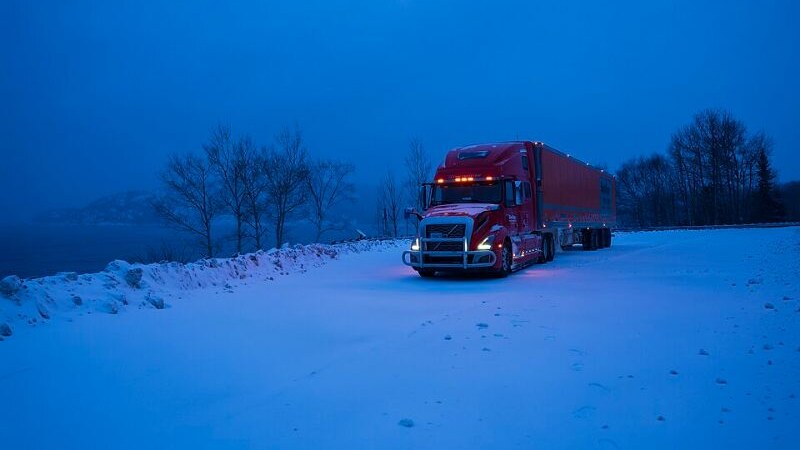
The truck was a faded red 1998 long-haul rig with almost 1.4 million miles on the odometer. Dad called it Ruby, although there was not much red left beneath the road salt, rust, and diesel soot.
After his funeral, everyone told me to sell it. My uncle said the engine was tired. My wife said we needed the money. Even Dad’s old dispatcher told me the truck had probably hauled its final load.
But I could not do it. Some of my earliest memories were inside that cab—sleeping beneath an old army blanket while Dad drove through Kansas, eating gas-station sandwiches, and listening to truckers argue over the CB.
So I rented a parking space behind Miller’s Truck Stop and kept Ruby there.
On December 17, exactly one year after Dad died, I opened the cab to start the engine. A crisp twenty-dollar bill was lying on the driver’s seat. There was no envelope and no note.
I asked the truck-stop manager if someone had requested access. He shook his head. “The cameras don’t cover that back corner,” he said. “Probably one of your dad’s old friends.”
I put the money in the glove compartment and forgot about it.
The following December, it happened again. Another twenty-dollar bill. Same date. Same seat. This time, someone had written three words across the edge: FOR MILE 214.
I called Dad’s old dispatcher. “Does Mile 214 mean anything to you?”
The line became quiet. Then he said, “Your dad drove millions of miles. It could mean anything.” He ended the call before I could ask another question.
During the third winter, I changed Ruby’s door locks. I kept both keys. On December 17, a third twenty-dollar bill appeared on the seat.
FOR MILE 214.
That was when the mystery stopped feeling harmless.
I searched the sleeper, dashboard, tool compartments, and engine bay. Nothing was missing. But when I reached beneath the passenger seat, my fingers touched a small brass key.
A strip of masking tape was wrapped around it. In Dad’s handwriting, one word was written across the tape: BUNK.
I lifted the sleeper mattress and found a narrow metal box bolted to the cab floor. I had slept above it hundreds of times as a kid. I had never known it existed.
The brass key opened it. Inside were 36 twenty-dollar bills, an old road atlas, a stack of Polaroid photographs, and a black notebook.
Every photograph showed Dad beside someone I did not recognize: a young couple with a baby, an elderly man beside a broken-down pickup, a trucker with his arm in a sling, and a woman wrapped in Dad’s winter coat beside a wrecked station wagon.
The last photograph was different. Dad stood beside Ruby during a heavy snowstorm. Next to him was a frightened woman holding a little girl.
On the back, he had written: MILE 214 — DECEMBER 17. PROMISE KEPT. ONE STILL OWED.
I opened the notebook. The first page contained only one sentence: “If Jake ever finds this, tell him I’m sorry.”
Before I could turn the page, Ruby’s CB radio crackled. The truck was not running. The key was not in the ignition.
But a man’s voice came through the speaker clearly.
“Ray’s boy,” he said. “If you found the box, don’t call the police.”
Part 2: Mile 214
I grabbed the microphone. “Who is this?”
Static filled the cab. Then the voice returned. “Your father didn’t die where they told you he died.”
I knew Dad had died in a hospital because I had been there. But the voice said that was not where the final trip had started. He told me to drive to Mile 214.
Ruby had not moved in almost four years. The batteries were weak, the air tanks were empty, and everyone had warned me the old engine might never run again.
Still, I turned the key. The starter groaned twice. Then the diesel came alive, shaking the entire cab.
At Mile 214, I found an abandoned service station buried beneath snow. One vehicle waited beside it—a blue pickup with Ohio plates.
An older woman stepped out holding a Polaroid photograph. She was the woman from Dad’s picture.
“My name is Ellen,” she said. “Your father saved my daughter here 27 years ago.”
During a blizzard, Ellen’s station wagon had slid off the highway. Her daughter was badly injured, and emergency crews could not reach them. Dad stopped Ruby across two lanes, used the truck’s lights to guide rescuers through the snow, and stayed until a helicopter arrived.
“He missed a delivery and nearly lost his job,” Ellen said. “But he refused every dollar I offered him.”
Instead, Dad asked her to make one promise. Every December 17, she had to place twenty dollars inside Ruby. The money was not for him. It was supposed to help the next stranded person.
“Then why hide it?” I asked.
Ellen handed me a sealed envelope. Inside was a photograph of Dad standing beside another trucker. I recognized the second man immediately. He had attended Dad’s funeral. He had hugged my mother. And he was the person who told us Dad’s final trip had been an accident.
Across the bottom of the photograph, Dad had written: IF ANYTHING HAPPENS TO ME, CHECK HIS LOGBOOK.
The blue pickup’s radio suddenly came alive. The same man’s voice filled the cab.
“You should have sold the truck, Jake.”
Then headlights appeared behind us.
Part 3: The Logbook
The black semi stopped across the entrance to the abandoned service station. The driver climbed down slowly.
His name was Warren Hale—Dad’s former driving partner and the man who had spoken at his funeral. Warren was not carrying a weapon. He was carrying another notebook.
“I didn’t kill your father,” he said before I could speak. “But I helped him hide the truth.”
Twenty-seven years earlier, Dad and Warren had started an unofficial roadside fund. Whenever Dad helped a stranded driver, repaired a truck, bought someone fuel, or paid for a motel room, he recorded it in the black notebook.
Most people tried to repay him. Dad asked each person to give only twenty dollars, then use another twenty to help someone else. Mile 214 was where the promise began.
Over the years, hundreds of drivers quietly participated. Some mailed money. Others left it inside Ruby whenever they found the truck parked overnight. The money beneath Dad’s bunk was emergency fuel, food, and repair money for stranded motorists.
But several months before Dad died, he discovered that part of the fund was disappearing. Warren had borrowed from it after medical bills and a failed trucking business pushed him toward bankruptcy.
“I planned to repay everything,” Warren said. “Your father found out before I could.”
They argued during Dad’s final trip. Dad ordered Warren to bring him every record and tell the other drivers what he had done. Before that could happen, Dad suffered chest pain at a rest area. Warren drove him to the hospital, but Dad made him promise not to tell the family about the missing money until it had been replaced.
The notebook in Warren’s hands contained every dollar he had taken and every repayment he had made. The final entry was dated December 17.
Balance owed: $0.
Ellen opened Dad’s envelope. Inside was a short letter addressed to me:
Jake, a truck isn’t remembered because of how many miles it traveled. It’s remembered because of who it carried home. If Ruby still runs, the promise is yours now.
The following morning, I returned to Miller’s Truck Stop. I took the 39 twenty-dollar bills from Dad’s metal box and placed them in an envelope behind Ruby’s seat. Then I painted a small number on the sleeper door: 214.
Ruby does not haul freight anymore. But every December, I start the engine and drive until I find someone who needs help—a dead battery, an empty fuel tank, a blown tire, or simply a warm place to wait.
Some trucks carry freight. Some carry memories. Ruby carries a promise.
Featured image: “Snowy morning — Algoma, Ontario, Hwy-17,” via Wikimedia Commons, licensed CC BY 2.0.