The waitress stopped pouring coffee when she saw my Peterbilt through the diner window.
I was sitting in a booth at the Red Lantern outside Joplin, Missouri, waiting for a plate of eggs and trying not to think about the squeal coming from my left steer brake.
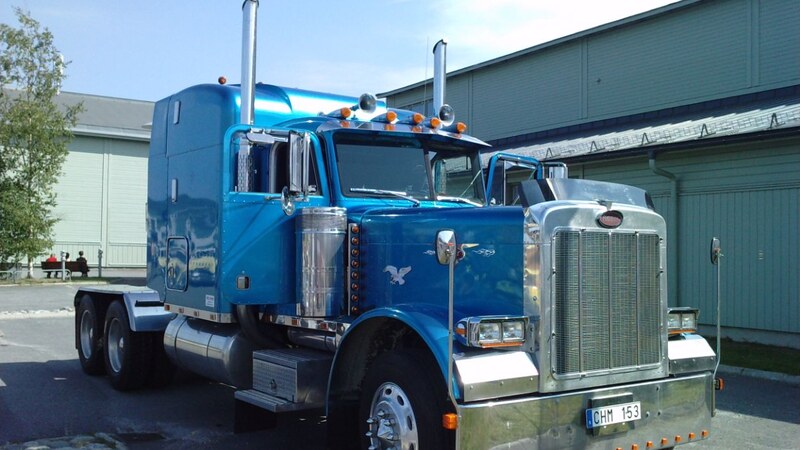
She stared past me at the blue 379 parked beneath the floodlights.
“Where did you get that truck?” she asked.
Her name tag said Maria.
“Estate sale near Des Moines,” I said. “Why?”
She put the coffee pot down carefully.
“Does it have a dent behind the sleeper on the passenger side?”
I felt the hair rise on my arms.
The dent was small and almost invisible beneath the blue paint. I had found it while replacing an air-line bracket, but it could not be seen from the parking lot.
“Who are you?” I asked.
Maria pulled out her phone. The photograph she showed me was faded and grainy. A younger version of her stood on the Peterbilt’s step wearing pink snow boots. A lean man in a denim jacket held her around the waist.
“That was my dad’s truck,” she said.
I had owned it for eight months.
The estate paperwork listed the previous owner as Douglas Wade, a retired farmer in Iowa. The title history went back only ten years. Before that, I knew nothing.
Maria’s father, Luis Alvarez, had bought the Peterbilt used in 1997 and hauled refrigerated freight from Texas to Chicago. He named it Blue Sunday after an old song Maria’s mother liked.
The dent happened at a loading dock in Tulsa when a forklift backed into the sleeper.
“Dad refused to fix it,” Maria said. “He said every working truck needed one honest scar.”
She had ridden with him during summer breaks, doing homework at the little fold-down table and collecting state magnets on the refrigerator door.
Then, when Maria was sixteen, Luis sold the truck without warning.
“He told us freight was slow,” she said. “A month later, he moved out.”
Her parents divorced. Luis took company-driving jobs and died of a heart attack twelve years later. Maria always believed he sold the truck because he was tired of being a husband and father.
“Can I see the sleeper?” she asked.
I looked around the diner. Three customers sat at the counter. A cook watched us through the pass-through window.
“When your shift ends,” I said.
At 7:15, Maria walked into the parking lot wearing a gray coat over her uniform. She circled the truck slowly and touched the dent with two fingers.
Inside the cab, she knew everything.
She knew the passenger vent stuck halfway open. She knew one screw in the overhead console had a square head because her father lost the original. She knew there had once been a small compass glued above the CB.
Then she knelt beside the lower bunk and ran her hand underneath the plywood frame.
“There was a compartment,” she said.
“There still is.”
I lifted the mattress and opened the narrow storage lid. It held spare belts, an old rain jacket, and the emergency food I hoped never to eat.
Maria shook her head.
“Not that one.”
She reached behind the passenger-side cabinet and pressed a section of carpet. The panel moved.
I had cleaned that sleeper twice. I had run new wires behind the cabinet. I had never noticed the narrow seam.
We removed four screws and pulled out a shallow wooden box.
Inside were twenty-seven envelopes tied with a faded red shoelace.
Every envelope had Maria’s name on it.
The first was dated June 1999. The last was dated March 2003.
She opened one with shaking hands.
It contained a motel receipt, a photograph of a snow-covered truck stop, and a page written in Spanish and English.
Maria read quietly for nearly a minute.
Then she sat on the edge of the bunk.
“He didn’t sell it because freight was slow,” she said.
Luis had sold the Peterbilt to pay the first year of Maria’s nursing-school tuition.
Her mother had lost her job at a printing plant. The family was behind on the mortgage. Maria had already decided she would skip college and work at the diner where her aunt managed.
Luis sold the only valuable thing he owned, paid the school directly, and told Maria the money came from a small inheritance.
He wrote letters from company trucks afterward, but he never mailed them.
In one, he admitted he was ashamed that selling the Peterbilt had not been enough to save the marriage.
In another, he described watching Maria graduate from the back row because her mother had asked him not to create an argument.
The final envelope held a thin brass key and a note:
If Blue Sunday ever finds you again, take one more ride. Some roads come back.
The key no longer fit the ignition. At some point, the switch had been replaced.
But the old key still opened the driver-side storage box.
Maria laughed when it turned.
My load did not pick up until noon. At sunrise, we drove the Peterbilt ten miles west on Interstate 44 and back.
Maria sat in the passenger seat with the letters on her lap. She found the spot where the compass had been and rested one hand on the dash.
“He used to tap twice before changing lanes,” she said.
I tapped the turn-signal stalk twice.
When we returned, she gave me the brass key but kept the letters.
“The key is part of the truck,” she said.
I attached it to the same ring as my ignition key.
Blue Sunday still hauls freight. The dent is still behind the sleeper. And whenever I stop near Joplin, Maria leaves a booth open by the window.
She says she likes to make sure the old truck is still finding its way back.
Story note: This is an original dramatized automotive story created for entertainment.
Featured image: “Peterbilt 379,” photographed by Impale, via Wikimedia Commons (CC0 1.0). Image cropped for display.