Denise had replaced three alternators in eleven months before her Chevrolet Tahoe reached my shop.
The first shop blamed a bad remanufactured unit.
The second blamed the battery.
The third installed another alternator and told her to stop using the phone charger in the console.
Two weeks later, the Tahoe died in the pickup line outside her son’s elementary school.
By the time the tow truck dropped it at my garage in Chattanooga, she was angry enough to leave the keys on my counter and walk back outside.
“I’m not buying another alternator,” she said.
“I’m not selling you one yet.”
The Tahoe was a 2008 model with 214,000 miles, peeling clearcoat on the hood, and a third-row seat that had not been upright in years. Denise used it to clean rental houses and carry two kids, three vacuum cleaners, and enough supplies to stock a janitor’s closet.
She had already spent $1,460 on the charging problem.
“I have sixty dollars until Friday,” she told me. “If it’s more than that, just tell me before you touch it.”
I promised one hour of diagnosis and no parts without a call.
The battery measured 11.8 volts. After a jump, the alternator produced 14.4 volts at its output stud.
At the battery, I measured 12.6.
That difference mattered.
An alternator can work perfectly and still fail to charge the battery if resistance in the cable steals the voltage between them.
I loaded the system with the headlights, blower motor, and rear defroster. The voltage drop across the positive cable climbed above 1.5 volts.
It should have been a small fraction of that.
From the outside, the cable looked normal. The terminals were clean. The insulation was not melted. Someone had even wrapped the first six inches in fresh black heat-shrink.
My apprentice, Cole, pointed at the alternator.
“Could still be a weak diode.”
“Could be,” I said. “But a diode doesn’t put voltage inside a cable.”
I called Denise and asked permission to open the heat-shrink.
“Does that cost money?”
“It costs the same diagnostic hour.”
“Cut it.”
Under the black covering was a crimp connector joining two sections of cable. The copper around it had turned green and powdery. Several strands broke when I bent them.
The connection could carry enough current when cold. After twenty minutes, resistance created heat, voltage dropped, and the truck began running from the battery until it died.
Every previous alternator had been replacing the part that was still working.
I photographed the corrosion beside the meter reading and called Denise.
She was silent when I gave her the estimate: $186 for a new cable assembly, hardware, and labor.
“I can pick it up Friday,” she said.
“There’s something else.”
The crimp was not factory. Whoever made it had used a short section of welding cable and sealed it carefully.
Scratched into the copper lug were two small letters: T.R.
Denise came back to the shop before closing.
When I showed her the cable, she sat down in the plastic chair beside my toolbox.
“My brother’s name was Travis Reed,” she said.
Eight years earlier, the Tahoe had developed a no-start problem while Denise was pregnant with her youngest son. Travis repaired it in her driveway during a thunderstorm.
He told her he replaced a damaged battery cable.
Six weeks later, he was killed when a distracted driver crossed the center line.
“I thought that repair had disappeared years ago,” she said.
It had lasted longer than many factory cables. The problem was not that Travis had done careless work. Moisture eventually entered where the heat-shrink had split beneath a retaining clip.
Denise ran her thumb over the scratched initials.
“Can I keep this part?”
“It’s yours.”
We installed the correct full-length cable the next morning. Charging voltage at the alternator and battery matched within 0.08 volts under load.
The battery passed a conductance test after a slow charge. The newest alternator was healthy.
I billed Denise for the cable and one diagnostic hour.
Cole cleaned the old lug and cut the section with Travis’s initials into a small rectangle. He drilled one hole in it and added a key ring.
When Denise picked up the Tahoe, her bill folder contained the voltage-drop readings, the photographs, and the little copper tag.
She held it in her palm for a long time.
“He always signed things nobody would see,” she said.
The Tahoe returned six months later for front brakes. It had not needed another jump.
The copper tag was hanging from Denise’s keychain, polished bright from her thumb.
The lesson from that Tahoe was simple: a charging-system test should include the entire circuit, not only the alternator.
But the part Denise carried away taught me something else.
Sometimes the failed piece is still worth saving.
Story note: This is an original dramatized automotive story created for entertainment.
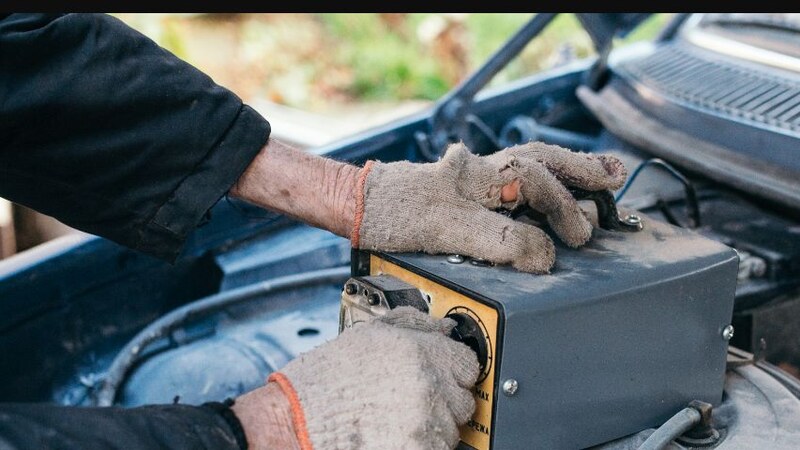
Featured image: “Auto mechanic checking old car battery voltage,” photographed by Shixart1985, via Wikimedia Commons (CC BY 2.0). Image cropped for display.