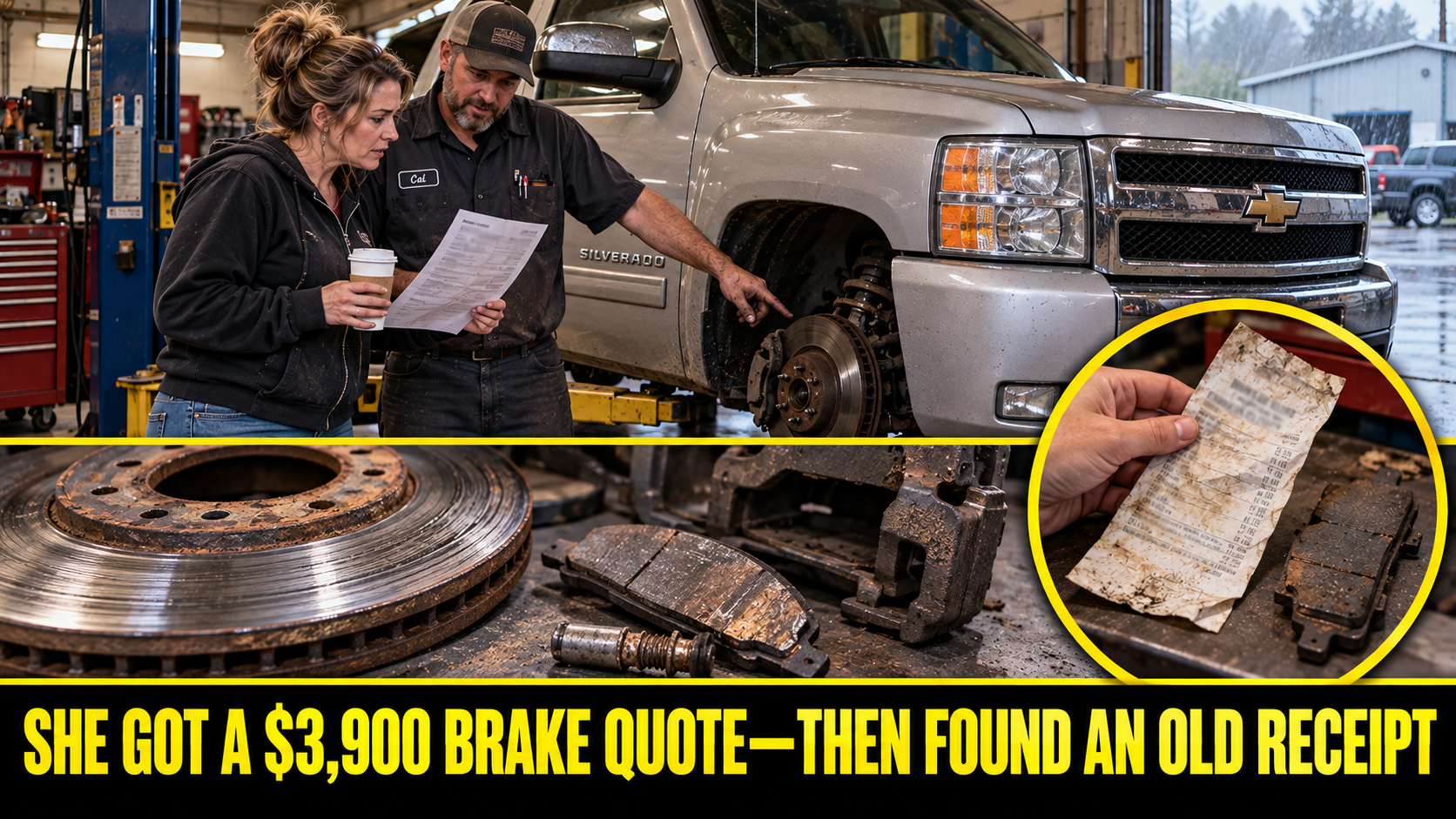
The woman who walked into my repair shop on a rainy Tuesday had a $3,900 brake estimate in one hand and a gas-station coffee in the other. She said the dealership had told her that her truck needed everything. Then she asked whether I could make it safe for less than the price of a used motorcycle.
My name is Cal Mercer, and I run a three-bay garage outside Dayton, Ohio. I’ve been turning wrenches long enough to know that the price on a repair estimate doesn’t tell the whole story. Sometimes it includes work a vehicle genuinely needs. Sometimes it includes maintenance that can wait. Sometimes a customer has heard a total but never had anyone explain the individual lines.
The truck was a 2011 Chevrolet Silverado 1500, silver under a generous layer of road grime. Its owner, Dana Ellis, used it to haul tables and folding chairs for her weekend event-rental business. She was forty-two, quick with a joke, and very serious about making rent on her storage unit.
“I can afford brakes,” she told me. “I cannot afford brakes with a college degree.”
I smiled, but I didn’t promise her a cheaper repair. I asked permission to inspect the truck, and she signed a diagnostic authorization with the inspection charge written clearly on it. She watched me write the amount and said, “Good. A number I can pronounce without getting dizzy.”
She described a scraping noise from the front passenger side and a brake pedal that felt normal. The noise started three days earlier, shortly after she picked up a load of banquet chairs. She had stopped driving the truck except for the trip to my shop. That was the right call: a grinding brake can mean metal contacting metal, and nobody can judge its severity from a phone call.
I pulled the truck into the bay and took off the front wheels. The passenger-side outer pad had worn down to its backing plate. Its rotor was deeply scored. The inner pad had more material left, but not enough to call the wear even. The driver’s side still had usable pad material, though both front rotors would need proper measurement before I could say what belonged on the estimate.
Dana stood behind the yellow safety line, holding her coffee with both hands. “So is it bad?”
“Bad enough that I’m glad you brought it in,” I said. “Not enough information yet to quote the whole job.”
I checked the caliper slides and hardware, then measured the rotors and inspected the hoses. The passenger-side lower slide pin was seized in its bracket. That explained the uneven pad wear better than any dramatic story about a truck trying to bankrupt its owner. The caliper piston moved correctly during the checks I could perform, and I saw no external fluid leak. I still wanted to inspect the rear brakes before discussing the complete scope.
The rear brakes were worn but not at their replacement limit. The parking brake held in a controlled test. The fluid looked dark, which was worth discussing as maintenance, but its appearance alone was not proof that the entire hydraulic system had failed. The tires, steering, and suspension also got a basic visual check because Dana used the truck for work.
I wrote up a repair plan for the front axle: pads and rotors, replacement of the damaged bracket hardware as appropriate, service of the slide-pin assemblies, and a follow-up road test. I included the inspection fee and tax in the total. The estimate came to $740. It was not a promise that every future brake expense had vanished; it was the documented cost of the work I believed the truck needed now.
Dana stared at the paper. “Did you forget a zero?”
“Nope. I checked twice.”
“Then what did the other shop put in my truck? A swimming pool?”
I asked to see the dealership’s estimate. It included all four rotors and pads, both front calipers, a brake-fluid service, two rear hoses, and several unrelated maintenance items. Some of those items might have been recommended based on findings I hadn’t seen, and I wasn’t going to accuse another technician of inventing work from a piece of paper. But the estimate did not separate urgent repairs from scheduled maintenance in a way Dana could understand.
“Can you tell me which line is the emergency?” she asked.
“I can tell you what I found on your truck today,” I said. “And I can show you the measurements.”
I brought her the worn passenger-side pad and pointed out the bare backing plate. I showed her the rotor’s scoring and the seized slide pin. Then I showed her the rear measurements on the inspection sheet. She photographed the parts, not because she distrusted me, but because she wanted to understand what she was paying for.
She had another question. “If the rear brakes aren’t due yet, why did the dealership list them?”
“They may have been quoting a full brake overhaul or planning ahead,” I said. “Their technician might also have seen something I didn’t. Ask them for their measurements and the reason for each item. You deserve the same explanation from me.”
Dana nodded. Then she pointed at the brake-fluid service and asked whether it mattered. I explained that fluid absorbs moisture over time and that its service interval and condition should be considered separately from the metal-on-metal front brake problem. I recommended checking her owner’s manual and service history and scheduling the service if it was due. She appreciated being able to make two decisions instead of one enormous one.
I expected that to be the end of the mystery. Then Dana took a crumpled receipt from her jacket and set it beside my estimate. She had paid $310 at a tire shop just six weeks earlier for a front brake inspection and “noise correction.” The receipt listed a cleaning service and a small charge for lubricating the caliper hardware.
“They said the squeak was gone,” she told me. “It was, for about a month.”
That changed the conversation. I couldn’t prove what had happened six weeks earlier, and I had no reason to assume anyone had acted dishonestly. But the seized slide pin was exactly the kind of component that should have been checked during a brake-noise investigation. I asked whether she had an inspection report from that visit. She didn’t.
I suggested she call the tire shop and ask what they had inspected, what parts they had serviced, and whether they offered any warranty on the work. I offered to give her photographs and my measurements so she could have a specific conversation rather than a shouting match. Dana said she was too tired to argue with anyone that day. She just wanted a safe truck and an invoice she could explain to her accountant.
We ordered the parts from a local supplier. While we waited, she sat in the customer area and answered calls about a Saturday wedding setup. A bride needed twelve extra chairs. A caterer wanted to know whether the delivery entrance had stairs. Dana answered each call with the patience of somebody whose livelihood depends on solving other people’s emergencies before breakfast.
At lunch, she asked whether I ever got tired of telling customers that repairs cost money. I told her I got tired of surprises, not prices. A clear estimate lets a person decide whether to repair, postpone nonurgent maintenance, seek another opinion, or replace the vehicle. A mystery total just makes everyone defensive.
“My customers are the same,” she said. “They’ll pay for twenty extra chairs if I tell them why. They get mad if I hand them a bill labeled ‘chair situation.'”
I laughed hard enough to spill a little coffee on my own work order. She pointed at the stain. “There. Add a beverage-disposal fee.”
By midafternoon, the front brakes were assembled and torqued according to the service information. I checked pedal feel before moving the truck, then carried out a careful road test and rechecked for abnormal heat, noise, and leaks. The scraping was gone. The pedal felt consistent. The truck stopped smoothly in the controlled conditions I tested.
Dana met me at the counter with her card out. I gave her the final invoice, which matched the authorized estimate. I also gave her the old pad and photographs, along with a note about the rear brake measurements and the separate maintenance items she should review later. She looked at the total and grinned.
“I was prepared to sell the espresso machine at my office,” she said. “Now I can keep making terrible coffee for my employees.”
Before she left, I asked whether she wanted the worn parts back. She picked up the bare brake pad, turned it over, and said, “This looks like something my nephew made in metal shop.”
“Except your nephew probably wouldn’t use it to stop a pickup.”
She put it down very carefully.
Two days later, Dana called. The truck had made its deliveries without a noise, and she’d spoken to the tire shop. They had reviewed their old invoice and agreed to refund the earlier cleaning charge as a goodwill gesture. She said she hadn’t needed to raise her voice once. The photographs and specific questions had done the talking.
Then she told me something I hadn’t expected. Her late father had taught her to keep every receipt in a folder in the glovebox. He’d been a delivery driver and believed that paperwork was cheaper than an argument. She had rolled her eyes at that advice for years. Now the old receipt had helped her ask the right questions and recover some money.
“He would have loved this,” she said. “Especially the part where I made a mechanic explain himself.”
“He sounds like my kind of customer.”
The following Saturday, a small paper bag appeared on my counter. Inside were two cinnamon rolls and a note from Dana: “For the shop that fixed my brakes without charging me for a swimming pool.” I shared the rolls with my technician, who said we should add cinnamon to the official diagnostic procedure. I told him not to give the insurance company any ideas.
I still think about that Silverado whenever someone walks in holding a frightening estimate. The useful question isn’t whether a high quote is automatically wrong or a low quote is automatically right. It’s what was inspected, which repairs are necessary now, which are recommendations, and what evidence supports each line. A customer should understand the work before approving it, even if the explanation takes longer than the coffee stays hot.
Dana didn’t get a miracle discount. She got a specific diagnosis, a written scope, and the chance to decide what to do with her money. And I got a reminder that a good repair shop isn’t just a place that fixes cars. It’s a place where people can ask questions without feeling foolish for not already knowing the answers.
Story note: This is an original dramatized automotive story created for entertainment.