My late father’s 2001 Kenworth W900 had been sitting behind our shop for
almost four years when I decided to put it back on the road.
Not permanently.
One trip.
That was the plan.
Dad, Ray Morgan, bought the W900 used and drove it for nearly twenty
years. By the time he parked it, we estimated the truck had covered
about 1.8 million miles.
It wasn’t pretty. The black paint had faded on the hood. The driver’s
seat had been repaired twice. The sleeper cabinets carried scratches
from decades of real trucking.
But Dad maintained the important parts.
After he died, I couldn’t bring myself to sell it.
My daughter Rachel was the reason it moved again.
She was twenty-two and had recently earned her CDL. She had spent years
hearing stories about Grandpa’s Kenworth and finally asked why it was
still sitting.
I told her it needed work.
So we worked.
For eleven months we went through brakes, air system, steering,
suspension, cooling system, belts, hoses, lighting, tires, fluids and
electrical connections.
We weren’t trying to make an old truck new. We were trying to make it
safe and dependable enough for a carefully planned regional run.
The first trip started normally.
Rachel rode passenger. I wanted her watching because Dad taught me that
mountains don’t care how long you’ve been driving.
Several hours into the trip, the road began dropping.
I selected the gear before the grade and switched on the engine brake.
Nothing.
No familiar change in exhaust note. No meaningful retarding force.
Rachel looked at me.
“Dad?”
“I know.”
The service brakes were functioning properly, and I had entered the
grade conservatively. I reduced speed, selected a lower gear and managed
the descent without abusing the brakes.
A safe pull-off appeared ahead.
I used it.
Once stopped, I checked brake temperatures carefully. Nothing alarming.
Now we needed to understand why the Jake controls had stopped working.
We inspected rather than guessed.
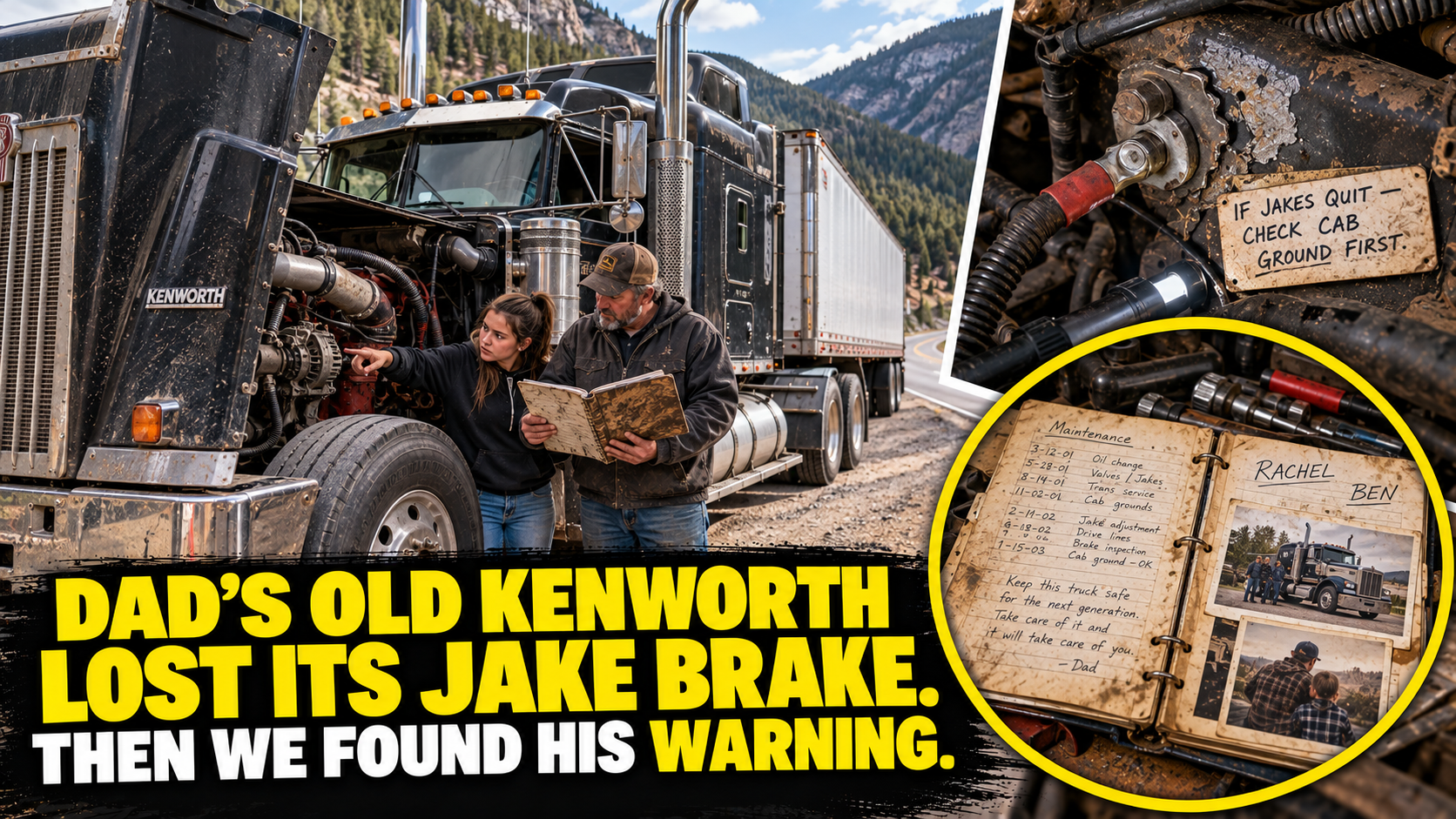
Rachel was leaning into the driver’s side of the engine bay when she
found a faded handwritten label wrapped around old wiring near the
firewall.
IF JAKES QUIT — CHECK CAB GROUND FIRST.
Dad’s handwriting.
We followed the wiring and inspected the grounds.
One mounting point looked wrong. The metal around an older repair had
begun to crack and move. Under vibration, the connection could become
unreliable.
We had tools, but I wasn’t going to pretend a roadside patch was the
same as a permanent repair. We stabilized only what was necessary for
diagnosis and arranged proper shop access.
Then we opened Dad’s old service binder.
He kept records on paper because he trusted a notebook that didn’t need
a password.
Years earlier, he had experienced intermittent engine-brake operation
and traced it to the same ground area. He repaired the mounting point
during a winter trip, then reinforced it later.
His note said:
MOVE THIS GROUND NEXT TIME CAB IS APART. DON’T TRUST OLD LOCATION
FOREVER.
He never moved it.
Life got busy. The truck kept working. Then he retired it.
We relocated the ground to sound metal, prepared the connection
correctly, protected it from corrosion and inspected the related wiring.
The Jake brake returned.
Rachel smiled when the exhaust note changed.
“There it is.”
But I was still reading.
Below the repair note was a paragraph added later.
TOM WILL WANT TO SELL THIS TRUCK AFTER I’M DONE. THAT’S FINE.
Tom is me.
Then:
IF RACHEL OR BEN EVER WANT TO LEARN, LET THEM DRIVE IT ONCE BEFORE IT
GOES. THEY SHOULD KNOW WHAT WORK FELT LIKE BEFORE EVERYTHING BECAME A
SCREEN.
Rachel read over my shoulder.
“Grandpa wrote my name?”
He had written it eight years earlier, when she was fourteen.
Dad hadn’t ordered me to keep the truck. He specifically said selling it
was fine.
He only wanted his grandchildren to experience it first.
That was Dad—practical even when sentimental.
We completed the load after verifying the repair.
Rachel drove part of the return trip.
Not the mountain section. Not yet.
She listened to the truck instead of fighting it.
“This thing makes you work,” she said.
“Yes.”
“I like it.”
“Don’t tell your mother.”
Over the next few months Rachel drove the W900 several more times with
me.
We used it selectively and kept repairing normal old-truck problems as
they appeared.
Then my son Ben came home from college.
Rachel handed him Dad’s binder.
“Your turn.”
Ben didn’t want to become a trucker, but he rode with us once.
That was enough.
The following spring, I listed the Kenworth for sale.
Rachel surprised me by agreeing.
“I want Grandpa’s truck to keep being a truck,” she said.
A small owner-operator bought it. He understood exactly what it was:
high mileage, old, maintained, full of history but not magically immune
to wear.
Before he drove away, I removed Dad’s original service binder. I made a
copy of the mechanical records for the new owner.
Rachel keeps the original now.
The cracked ground mount may have been one of the least valuable things
Dad left behind.
But it taught my daughter something no polished truck show could.
Old equipment doesn’t survive because it is indestructible.
It survives because somebody pays attention.
Somebody remembers the weak points.
Somebody writes down what happened.
And when a familiar system suddenly goes silent on a mountain grade,
somebody knows enough to slow down instead of pretending everything is
fine.
Dad’s Kenworth is working somewhere else now.
That’s okay.
Rachel got the drive he wanted her to have.
And I finally understood that he wasn’t trying to preserve the machine
forever.
He was trying to pass on the judgment required to operate one.