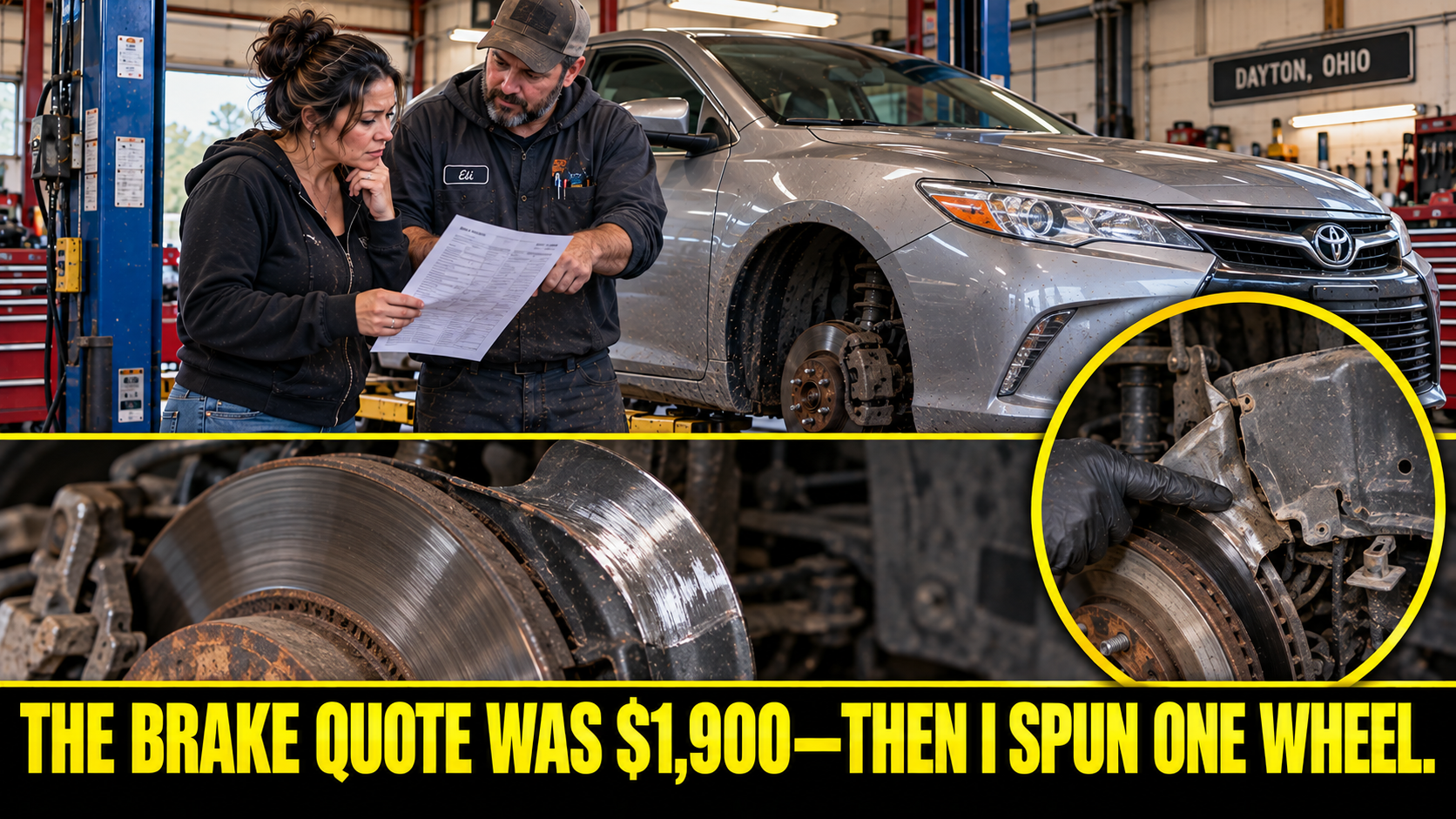
The woman at my counter was holding a repair estimate the way people hold a parking ticket: between two fingers, as if touching it any longer might make the number go up.
“My name is Marisol,” she said. “Before you say anything, can you tell me whether my 2015 Toyota Camry is worth saving?”
I looked at the total on the page. $1,900. Then I looked at her. She wasn’t smiling.
I own a small independent repair shop in Dayton, Ohio. I see a lot of estimates, and I have no interest in declaring another shop wrong because a customer is unhappy with a price. Sometimes a large repair really is necessary. Sometimes the quote includes work that is optional, preventative, or based on a diagnosis that still needs to be confirmed.
“What does it actually do?” I asked.
She told me: a grinding noise from the front right wheel that appeared only when turning left. She’d been thinking about the repair for two nights. Every time she opened her banking app, she felt a little worse.
I told her that a second opinion would cost money too. Diagnosis takes time, and I wasn’t going to promise a bargain before I had touched the car. We agreed on the diagnostic fee and the tests I would perform. I wrote that amount down, so there would be no surprise when she came back.
She handed me the keys and said, “Please don’t tell me I need a whole new car. I just figured out how to pay off this one.”
I laughed, but not at her. There was a time when my own car had broken down on the same day the rent was due. I knew how a mechanical problem could turn a normal week into a math problem nobody wanted to solve.
Before moving the vehicle, I checked the existing estimate for the exact parts and labor it covered. I asked whether the earlier shop had provided test results or photographs. She had only the printed quote. That didn’t mean the work was unnecessary, but it meant I couldn’t verify the reasoning behind it.
We talked about the symptoms again, slowly. I wanted to know when they started, whether they were getting worse, and what the vehicle did when the problem appeared. She remembered a detail she hadn’t thought was important: her daughter had driven over a chunk of road debris during a rainstorm.
That wasn’t a diagnosis. It was context. The easiest way to waste a customer’s money is to hear one familiar symptom, pick your favorite expensive part, and stop asking questions.
I started with the basic safety checks and looked for anything that would make a road test inappropriate. I checked for obvious leaks, loose components, damaged wiring, and warning lights. I also verified that the tires were safe and that nothing had been left unsecured under the hood.
When it was safe, I reproduced the complaint under controlled conditions. I wrote down exactly what happened instead of relying on the customer’s description alone. People use the same words for very different noises, smells, and sensations. “It shakes” can mean a tire problem, an engine misfire, a warped rotor, or simply a loose item in the trunk.
Back in the bay, I reviewed the results with the technician helping me that day. We had both seen the earlier estimate. Neither of us wanted to make the opposite mistake of choosing the cheapest possible answer just to look clever.
Then I found the clue that changed the direction of the job: a fresh shiny rub mark on the thin metal shield.
I asked my technician to repeat the check without telling him what result I expected. He got the same result. That mattered. A single strange reading can come from a poor test connection, an instrument problem, or a part that happens to behave normally once and fail the next time.
I measured pad thickness, rotor condition, caliper operation, and wheel-bearing play rather than assuming every grinding sound was a failed brake assembly. The shield was close enough to touch the rotor as the suspension moved. I reshaped it to the proper clearance, secured the splash panel, and repeated the road test.
I called Marisol before touching anything beyond the authorized diagnosis. “I found something that may explain the complaint,” I said. “I want to show you the test results, and I want your approval before we do the repair.”
She arrived during lunch, still wearing her work badge. She asked whether she should sit down. I told her she could, but only because our waiting-room chairs were more comfortable than standing next to the printer.
I showed her the original estimate, the tests we had performed, and the specific fault we had found. The likely repair was a bent brake dust shield rubbing the rotor and a loose plastic splash-panel fastener. The written estimate for the work was $128.
She read it twice.
“Did you forget a zero?” she asked.
“No. And if I discover anything else while doing the work, I’ll stop and call you. This estimate covers what we’ve diagnosed so far.”
She put her hand over her mouth, then laughed. I understood the relief, but I didn’t want her to confuse a lower quote with a finished repair. A car isn’t fixed by a number on a page. It is fixed when the actual problem is corrected and the result is verified.
We went over what the new estimate included: parts, labor, the diagnostic work, and the final checks. I also told her what it did not include. There were ordinary maintenance items she might need later, and an older vehicle could develop a different fault next month. I wasn’t selling her a lifetime guarantee.
She authorized the work. I recorded her approval and the amount, then had the technician proceed.
While we worked, I thought about the way people talk about repair prices online. One person says every shop is ripping customers off. Another says every cheap repair is a shortcut. Neither statement helps a driver standing at a counter with a broken car and a limited budget.
A useful estimate has a scope. It says what symptom was verified, what testing supports the diagnosis, which parts are being replaced, and what the customer will owe. Two prices are not comparable unless they cover the same work. A lower number can be a real saving, or it can leave out half the job.
In this case, our findings did not support authorizing the entire earlier repair. I couldn’t tell Marisol what the first technician had seen or why that shop chose its recommendation. I could only explain our results and document our work.
When the repair was complete, I repeated the checks that had revealed the problem. I also performed the appropriate follow-up test under the conditions in which the complaint had appeared. The symptom did not return.
That was encouraging, but I wanted to be precise. I told her what we had verified today and which warning signs should bring her back. I asked her to keep the invoice and the earlier estimate together. If the problem returned, those records would save time and prevent another round of guessing.
She walked outside with me and looked at the vehicle as if it had personally apologized.
“Can I ask you something embarrassing?” she said.
“Only if I can answer without charging another diagnostic fee.”
She smiled. “I was ready to put that whole $1,900 on a credit card. I had the application open on my phone.”
I asked what she had planned to do if the card wasn’t approved.
She looked down at her shoes. “I was going to put off something important.”
I didn’t press. Customers don’t owe me their life stories to get an honest repair. But she wanted to tell me, and I listened.
She explained that Marisol kept the remaining money for her daughter’s community-college textbooks and scheduled ordinary brake maintenance for later. The money had already been spoken for before the car developed its problem. The original estimate had made her feel as if she had to choose between transportation and everything else.
I told her not to spend the difference just because it felt like a windfall. A cheaper repair is good news, but it doesn’t make the rest of life free. She laughed and said that sounded exactly like something her dad would tell her.
Then she asked whether I could show her how to read the next estimate she received. I grabbed a blank sheet of paper and wrote down four questions: What symptom did you confirm? What test points to this repair? Which items are urgent, and which can wait? What is the full price, including fees and taxes?
I told her she could ask those questions at my shop, too. A customer doesn’t need to know how to rebuild an engine to ask for evidence and a clear explanation.
She asked whether getting a second opinion always saved money. I said no. Sometimes the second shop confirms the expensive diagnosis, and the customer has paid for two inspections. But that confirmation can still be valuable when the repair costs more than the vehicle is worth or when the first explanation doesn’t match the symptoms.
Before she left, I asked her to take a short drive and tell me how it felt. She returned with the kind of grin you usually see when someone has found a forgotten twenty-dollar bill in a winter coat.
“It’s acting normal,” she said. “I almost forgot to listen for the problem.”
I handed her the invoice, and she checked the amount against the estimate. It matched. She paid, thanked the technician, and promised to bring the car back for its next scheduled service.
A few days later she called, not because the problem had returned, but because she wanted to tell me the vehicle was still behaving normally. She had also done something with the money she hadn’t spent: Marisol kept the remaining money for her daughter’s community-college textbooks and scheduled ordinary brake maintenance for later.
That phone call made my afternoon. Not because it proved I was smarter than anyone else, and not because every expensive quote hides a tiny repair. It reminded me why careful diagnosis matters. A mechanic’s job is to find the fault, explain the options, and give the customer enough information to make a decision.
The next time someone asks me why I charge for diagnosis, I tell them about Marisol. The tests cost her money. They also gave us a reason to repair a bent brake dust shield rubbing the rotor and a loose plastic splash-panel fastener instead of approving a job we couldn’t justify from the evidence in front of us.
I still have her first estimate filed with the work order. The big number is circled in blue pen. Under it, I wrote the final repair total: $128.
Not every story ends with a cheaper bill. This one ended with a working vehicle, an understandable invoice, and a customer who knew what she had paid for.
Story note: This is an original dramatized automotive story created for entertainment.