Troy didn’t argue about the $2,950 repair. He argued about whether I could prove the truck would pull his $4,600 Monday load.
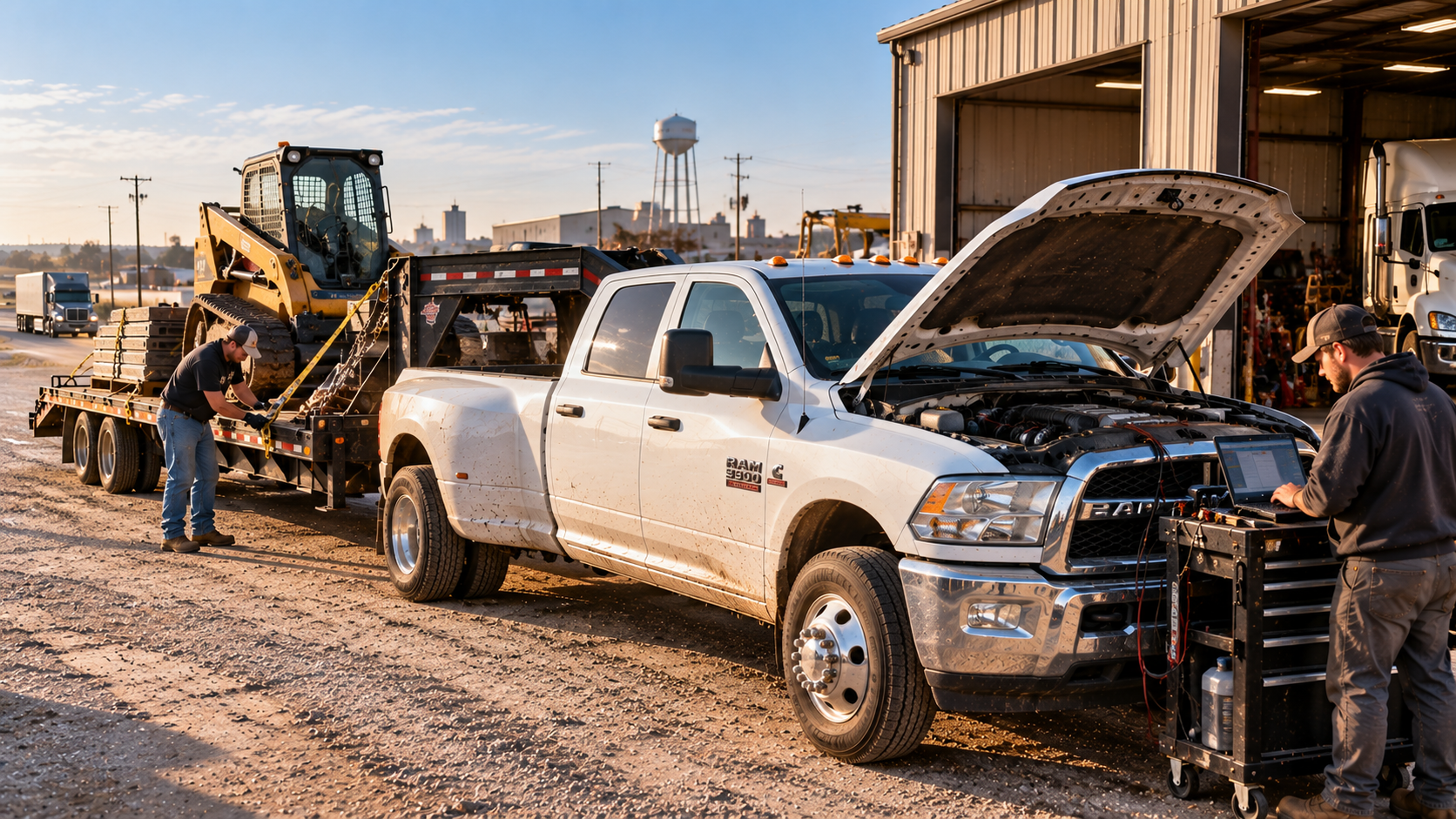
Troy Maddox, a 36-year-old hotshot driver depended on a 2018 Ram 3500 Cummins dually used for hotshot hauling near Abilene, Texas. What brought the vehicle to the shop was fuel-pressure drop and limp mode while towing. On paper, that sounds like a mechanical complaint. In real life, it was also a money problem.
The final shop bill was $2,950. Troy’s booked Monday load would gross about $4,600, though gross revenue was not profit. Getting the truck safely verified by Sunday mattered more than chasing the cheapest possible parts.
That distinction mattered from the beginning. Customers often hear one large number and naturally treat it as a verdict. A shop may be discussing a possible repair path, an authorization ceiling, a diagnostic plan, or a confirmed job. Those are not interchangeable. I wanted the owner to understand which number we were talking about before another dollar was spent.
I also didn’t want to turn the previous shop, dealer, seller, or technician into a villain. A broad estimate can be reasonable when the failure has not yet been isolated. Some systems are expensive, access can be difficult, contamination can widen the repair, and labor adds up quickly. The useful question is not, “Who gave the scariest number?” It is, “What evidence supports the next step?”
So we started by reproducing the original complaint instead of guessing. The key symptom was fuel-pressure drop and limp mode while towing. We checked basic condition, service history, visible damage, connectors or plumbing relevant to the system, fluid condition where appropriate, and any stored data available from the machine.
The first round of testing was intentionally boring. Good diagnosis often is. There was no dramatic shower of sparks and no mechanic pointing at a broken part after thirty seconds. We were trying to separate a symptom from a cause.
Then the pattern became useful: pressure was acceptable unloaded but the supply side fell behind only under sustained demand. That observation changed the order of the tests. Instead of replacing the most expensive component associated with the complaint, we concentrated on the circuit or mechanical path that could create that exact behavior.
I called the owner before going farther. Diagnostic time is still billable time. A technician can easily spend hours proving that an expensive component is healthy, and the customer deserves to know why that work has value. We reviewed what had been ruled out, what remained possible, and how much additional testing I recommended.
The owner approved the next stage because uncertainty was now costing money too. That is easy to miss in repair stories. The cheapest invoice is not always the cheapest outcome. A truck that cannot haul, a combine that cannot harvest, a work car that cannot reach jobs, or a project car that damages an engine can make waiting or guessing expensive.
The next stage confirmed restriction and contamination on the low-pressure supply side plus a weakened lift pump, confirmed under demand without condemning the high-pressure system. The result mattered because it tied the complaint to evidence rather than to a hunch. It also prevented us from pretending that one convenient clue automatically explained everything.
We inspected the related components before writing the final repair plan. Anything that was genuinely worn, damaged, contaminated, unsafe, or likely to compromise the repair went on the list with an explanation. Anything that was merely old but still serviceable did not automatically become an emergency.
That is where the estimate became a real decision instead of a scary number. I separated confirmed work from optional or future work. I also explained which items shared labor and which could reasonably wait. The owner could now approve the job knowing what the money was buying.
The repair itself involved cleaning the contaminated supply side, replacing the lift pump and filters, inspecting fuel quality, and verifying rail supply under a loaded trailer test. None of it was treated as a magic reset button. We followed the service procedure, inspected what we removed, corrected the actual fault, and paid attention to the surrounding system so the same conditions would not immediately recreate the complaint.
During the work, we documented what we found. That is especially important when a bill changes. A revised estimate should have a reason: hidden corrosion, a second leak, a failed test, a damaged connector, worn hardware discovered during disassembly, or another concrete condition. “We found more stuff” is not a useful explanation.
Once the repair was assembled, verification began. This step is where rushed jobs often fail. Clearing a code, starting an engine, or seeing a warning light disappear is not always proof that the original complaint is gone. The machine needed to experience the same heat, load, vibration, pressure, road condition, or work cycle that had produced the problem before.
We repeated the relevant test and watched for the original symptom. The repaired system behaved normally. The condition that had led us toward restriction and contamination on the low-pressure supply side plus a weakened lift pump, confirmed under demand without condemning the high-pressure system no longer appeared. Only then was I comfortable calling the repair verified.
Then we returned to the financial side, because that was never separate from the mechanical side. The owner now had a final bill attached to a specific diagnosis and a verified result. That is a much different conversation from asking someone to authorize thousands of dollars because a component “might” be bad.
The final shop bill was $2,950. Troy’s booked Monday load would gross about $4,600, though gross revenue was not profit. Getting the truck safely verified by Sunday mattered more than chasing the cheapest possible parts. Those figures were not used as decoration for a viral story. They affected the decision. The owner had to consider cash on hand, the value and condition of the vehicle, upcoming work, downtime, and the cost of choosing the wrong path.
There is another detail people often miss when discussing commercial vehicles or equipment: gross revenue is not profit. A driver may say a load pays several thousand dollars, but fuel, insurance, truck payments, maintenance, taxes, permits, and other costs still exist. Likewise, a farmer may have enormous crop value in the field without that number being take-home income. The point is that downtime has value, not that every missed job equals pure lost profit.
For personal vehicles, the calculation is different but still real. A used performance car can be cheap to buy and expensive to sort. A classic truck can have emotional value far beyond book value. A daily driver can be worth repairing because replacing it means another payment. Money in automotive repair is rarely just “repair price versus vehicle price.”
The biggest lesson from this job was simple: Loaded testing matters, and business revenue should not be confused with profit when judging downtime.
A second lesson was that diagnostic labor deserves to be visible. Customers understandably like buying parts because parts are tangible. A new pump, sensor, bearing, hose, clutch, or module can be held in your hand. Diagnostic time often produces information instead. But good information can prevent a customer from buying the wrong expensive part.
A third lesson was to separate three numbers in every repair conversation. The first is the possible or preliminary estimate. The second is the confirmed repair authorization after testing. The third is the final invoice after the approved work is completed. When those numbers change, the customer should understand why.
The owner also learned not to chase the smallest possible bill at the expense of the original complaint. There is a difference between saving money and postponing a verified failure. Sometimes a repair can be staged. Sometimes delaying it risks a tow, secondary damage, lost work, or a safety problem. The evidence should decide which situation you are in.
When the vehicle left, there was no miracle ending and no five-dollar part that made every expensive possibility disappear. There was a diagnosis, a repair plan, an authorization, a completed job, and a verification. That may be less sensational, but it is much closer to how responsible repair work actually happens.
A few weeks later, I checked in. The original complaint had not returned. The owner had gone back to using the vehicle for the job it was supposed to do, with a much clearer understanding of what had failed and what the repair money had accomplished.
That follow-up matters to me because a successful invoice is not the same thing as a successful repair. The real test happens after the customer leaves the parking lot.
Money will always be part of automotive work. Parts cost money. Skilled labor costs money. Diagnostic equipment costs money. Downtime costs money. And replacing a vehicle costs money too.
The goal is not always to produce the smallest number. It is to make the number defensible.
When a customer can see the symptom, the testing, the confirmed cause, the approved repair, and the verification as one connected chain, a large bill may still hurt—but at least it makes sense.
That is what changed this job. The final decision was not based on fear of the biggest possible repair or excitement over the cheapest possible shortcut. It was based on evidence, the owner’s real financial situation, and what the vehicle needed to return to service reliably.
In the end, the mechanical answer solved only half the problem. The other half was deciding what that answer was worth.
The owner kept the paperwork. That may sound minor, but service records change future decisions. The next technician can see what was tested, what was replaced, and why. The owner can also compare future recommendations against actual history instead of memory. On an older working vehicle, that information can be worth real money.
The owner kept the paperwork. That may sound minor, but service records change future decisions. The next technician can see what was tested, what was replaced, and why. The owner can also compare future recommendations against actual history instead of memory. On an older working vehicle, that information can be worth real money.
The owner kept the paperwork. That may sound minor, but service records change future decisions. The next technician can see what was tested, what was replaced, and why. The owner can also compare future recommendations against actual history instead of memory. On an older working vehicle, that information can be worth real money.
The owner kept the paperwork. That may sound minor, but service records change future decisions. The next technician can see what was tested, what was replaced, and why. The owner can also compare future recommendations against actual history instead of memory. On an older working vehicle, that information can be worth real money.
The owner kept the paperwork. That may sound minor, but service records change future decisions. The next technician can see what was tested, what was replaced, and why. The owner can also compare future recommendations against actual history instead of memory. On an older working vehicle, that information can be worth real money.
The owner kept the paperwork. That may sound minor, but service records change future decisions. The next technician can see what was tested, what was replaced, and why. The owner can also compare future recommendations against actual history instead of memory. On an older working vehicle, that information can be worth real money.
The owner kept the paperwork. That may sound minor, but service records change future decisions. The next technician can see what was tested, what was replaced, and why. The owner can also compare future recommendations against actual history instead of memory. On an older working vehicle, that information can be worth real money.
The owner kept the paperwork. That may sound minor, but service records change future decisions. The next technician can see what was tested, what was replaced, and why. The owner can also compare future recommendations against actual history instead of memory. On an older working vehicle, that information can be worth real money.