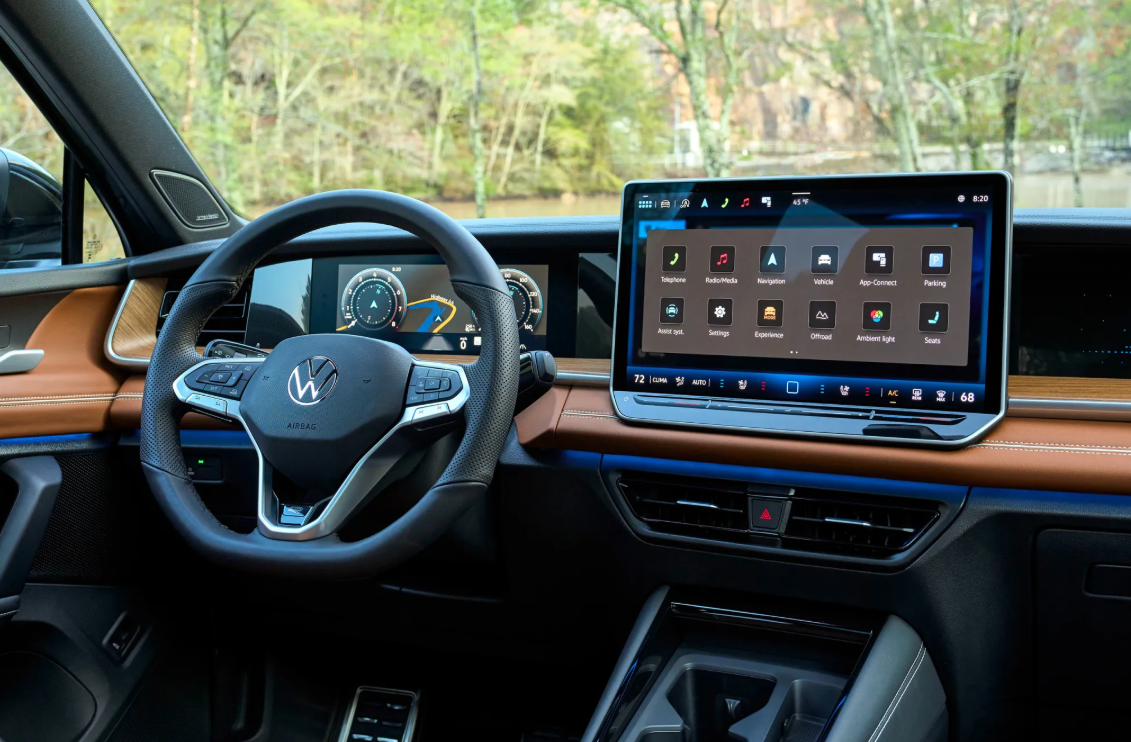
A modern SUV does not need to be electric for a software problem to create a serious drivability issue.
Volkswagen is recalling 49,958 model-year 2025 Tiguan SUVs in the United States because faulty Body Control Module software may reset unexpectedly while the vehicle is moving. If that happens, the ignition can switch off and the engine can stall.
The same failure may also knock out certain controls, warning indicators, exterior lighting and the rearview camera system.
For owners, the important part is straightforward: this is an official safety recall, Volkswagen has a software fix, and affected vehicles can be repaired at an authorized dealer at no charge.
WHAT EXACTLY IS GOING WRONG?
The problem centers on the Tiguan’s Body Control Module, commonly shortened to BCM.
A BCM manages a wide range of electrical functions in a modern vehicle. In this case, the consequences of a reset can extend beyond a minor convenience feature.
According to Volkswagen’s recall filing with the National Highway Traffic Safety Administration, the fault control unit manager inside the BCM is not configured correctly. Certain error-correcting-code errors can trigger a reset because of the way the software handles system errors.
If the module resets while the Tiguan is being driven, the ignition may switch off.
That can cause the engine to stall and the vehicle to lose motive power. Volkswagen’s filing also says certain controls, telltales, exterior lighting and the rearview camera system may be lost.
Those failures can increase the risk of a crash, which is why Volkswagen initiated recall 57KL, listed by NHTSA as campaign 26V587.
WHICH TIGUANS ARE INCLUDED?
The U.S. recall covers certain 2025 Volkswagen Tiguan SUVs.
NHTSA’s recall report lists 49,958 potentially affected vehicles. The recalled vehicles were produced from March 24 through August 30, 2025 and were built with specific BCM software.
That does not mean every Tiguan on the road is affected.
Recall eligibility is determined by VIN, so owners should check their individual vehicle rather than assuming it is included based only on the model name.
Volkswagen has a recall lookup on its owner website, and NHTSA also allows owners to check open recalls using a 17-character VIN.
HOW VOLKSWAGEN FOUND THE PROBLEM
The timeline in Volkswagen’s federal filing shows why software defects can be difficult to diagnose.
In January 2025, the ignition switched off while a test vehicle was being driven. Volkswagen and its supplier began investigating.
Between March and June 2025, the investigation found that certain error-correcting-code errors could cause the BCM to reset because of software coding associated with system error handling.
Volkswagen continued reviewing the issue and monitoring vehicles in the field.
From October 2025 through April 2026, the automaker identified a small number of potential cases in other markets. The filing says none had been identified in the United States.
There was another complication: Volkswagen says there is no specific diagnostic trouble code for this failure mode.
That is significant from a repair perspective. Mechanics often depend on stored trouble codes as an important starting point when diagnosing an electronic fault. A problem that does not leave a dedicated DTC can require deeper analysis to determine exactly what occurred.
On September 2, 2026, Volkswagen’s Brand Product Safety Committee reviewed the issue and decided to conduct a noncompliance recall because the possibility of failures could not be ruled out.
At the time of the federal filing, Volkswagen said it was not aware of crashes, fires, injuries or deaths associated with the defect. It also reported no warranty claims related to the issue.
THE REPAIR IS A SOFTWARE UPDATE
The remedy does not call for replacing the engine, ignition system or entire BCM.
Authorized Volkswagen dealers will update the Body Control Module software free of charge.
The recalled modules use affected software versions, while Volkswagen identifies version 0326 as the remedy software.
Owner notification letters are scheduled to be mailed November 6, 2026.
Owners do not necessarily have to wait for a letter to investigate whether their vehicle is involved. Volkswagen and NHTSA both provide VIN-based recall lookup tools.
If the VIN shows an open recall, owners can contact an authorized Volkswagen dealer about the repair.
WHY THIS RECALL MATTERS BEYOND ONE SUV
The Tiguan is gasoline-powered, but the recall illustrates how dependent virtually all new vehicles have become on software.
Modern cars use interconnected electronic modules to control or coordinate systems that once depended much more heavily on mechanical switches, relays and isolated controllers.
That brings major benefits. Software can enable sophisticated safety features, improve diagnostics, coordinate powertrain operation and allow manufacturers to correct some problems without redesigning hardware.
But it also means software errors can affect functions drivers might not immediately associate with computer code.
A Body Control Module sounds as if it should handle things such as lights, locks and convenience electronics. In this Tiguan recall, however, a BCM reset can ultimately result in the ignition switching off and the engine stalling.
For mechanics, that is another reminder that diagnosing a modern no-start, intermittent stall or electrical complaint may require understanding networked modules and software behavior in addition to checking traditional mechanical components.
For owners, it is a reminder that recall notices involving software should not be dismissed as minor updates.
WHAT SHOULD A 2025 TIGUAN OWNER DO?
First, check the VIN.
A VIN-specific lookup is more reliable than assuming that every 2025 Tiguan is recalled. The VIN can typically be found through the lower corner of the windshield on the driver’s side, on the driver’s door-jamb label, or on registration and insurance documents.
Owners can enter that VIN into Volkswagen’s recall lookup or NHTSA’s official recall database.
If recall 57KL/26V587 applies to the vehicle and remains open, contact an authorized Volkswagen dealer to arrange the BCM software update.
Recall repairs are performed free of charge.
Drivers should also pay attention to any instructions supplied directly by Volkswagen or the dealer. If a vehicle behaves abnormally while driving, safety comes first; move out of traffic when it is safe to do so and seek appropriate assistance.
THE BOTTOM LINE
The 2025 Tiguan recall is not about a battery-electric drivetrain or an experimental technology.
It is a conventional gasoline SUV with a software-controlled module capable of affecting critical vehicle functions.
Volkswagen’s official filing says an unexpected BCM reset can switch off the ignition, stall the engine and interfere with other systems. Nearly 50,000 U.S. vehicles are potentially involved.
The good news is that the remedy is defined: affected Tiguans need updated BCM software, and Volkswagen dealers will perform the repair for free.
For 2025 Tiguan owners, checking the VIN is the simplest way to find out whether that update belongs on the to-do list.