The man who sold me his 2005 Peterbilt 379 gave me one strange warning before I drove it home.
“If you ever replace the sleeper floor, don’t throw away the aluminum plate under the passenger bunk.”
Then he handed me the keys.
I waited for him to explain.
He didn’t.
Instead, he slapped the side of the sleeper twice, looked at the truck for a long moment, and said, “She’s got more stories than miles.”
Considering the odometer showed a little over 1.4 million miles, that was saying something.
My name is Tom Mercer.
I’m forty-seven, and I’ve spent most of my adult life around trucks.
My father drove when I was growing up.
I started riding with him during summers before I was old enough to understand why anybody would voluntarily sleep in a box behind an engine.
By twenty-four, I had my CDL.
I’ve driven company trucks, leased trucks, and one owner-operator disaster that taught me more about debt than trucking.
These days I haul regional freight and try not to pretend I know everything.
My nineteen-year-old son, Caleb, had recently started talking seriously about trucking.
That worried me.
Not because I hated the business.
Because I knew it.
He saw the chrome, the big engines and the independence.
I saw fuel bills, breakdowns, missed birthdays, icy roads, bad docks and the kind of fatigue that can make a decent driver dangerous.
So I made him a deal.
Before he made any big decisions, we’d rebuild an old truck together.
If he still loved trucks after spending his Saturdays underneath one, then we’d talk about driving.
That’s how we found the Peterbilt.
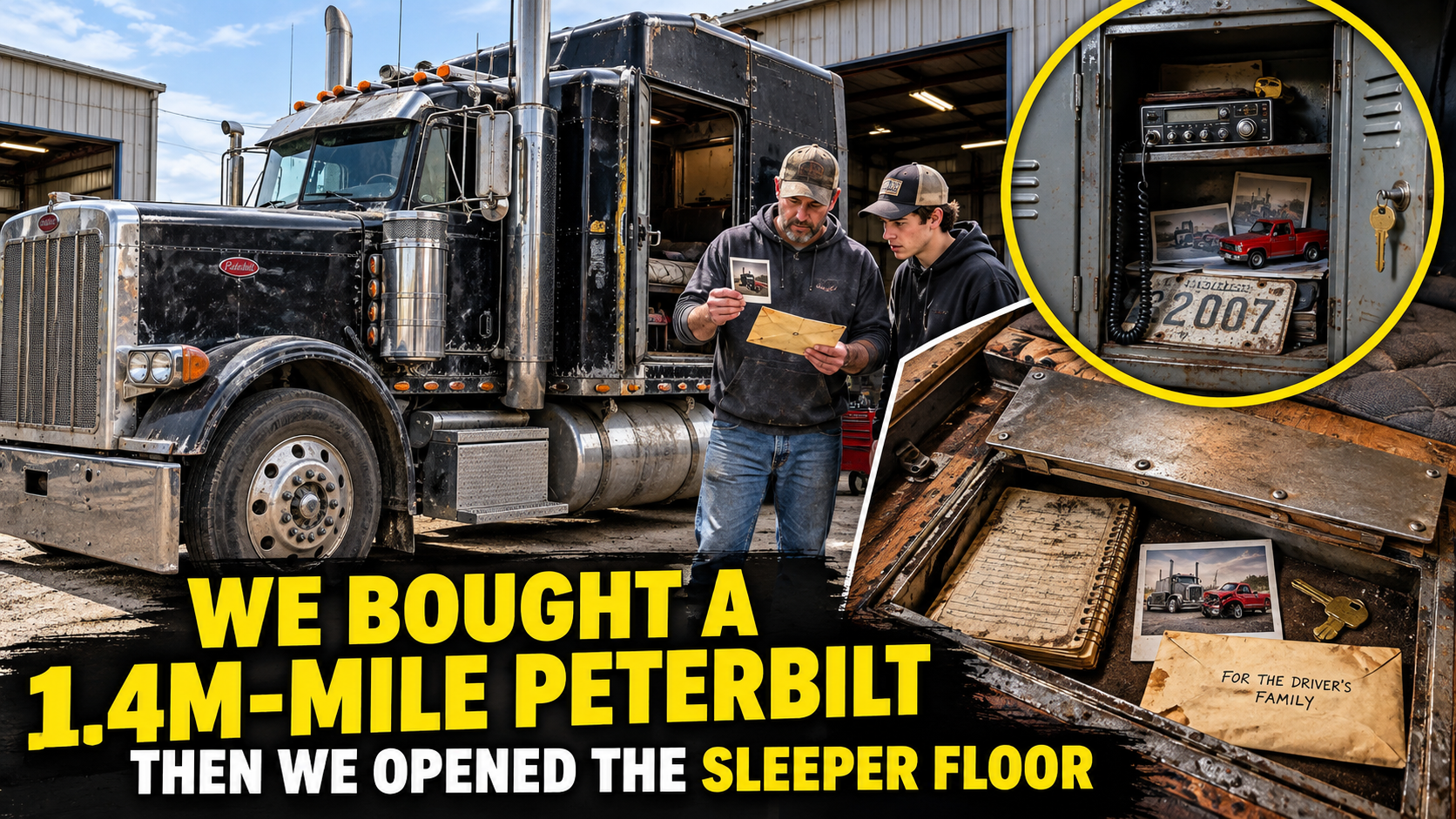
It was sitting behind a small shop outside Joplin, Missouri.
Long hood.
Black paint faded almost gray across the top.
Flat-top sleeper.
Twin stacks.
18-speed.
CAT C15.
The chrome wasn’t perfect.
Neither was anything else.
The driver’s seat was worn through on one edge.
The hood had stone chips.
One fuel tank had a shallow dent.
The sleeper smelled like old coffee, vinyl and twenty years of truck stops.
I loved it immediately.
Caleb loved it faster.
The owner was a sixty-eight-year-old retired driver named Frank Dalton.
He had bought the truck nearly new and run it for most of its life.
“Why sell it now?” I asked.
“My knees voted before I did.”
He smiled when he said it, but I could tell selling the truck wasn’t easy.
We spent almost two hours inspecting it.
The engine started cold without much drama.
There was some blow-by, but nothing that frightened me for the mileage.
Oil pressure looked respectable.
The transmission shifted.
The rear suspension needed bushings.
Several air lines were old.
The sleeper had evidence of a water leak.
The air-conditioning worked when it felt like it.
In other words, it was exactly the kind of truck I wanted Caleb to learn on.
Not dead.
Not perfect.
Honest.
Frank wanted $34,000.
I offered $30,000.
We settled at $31,500.
As we finished the paperwork, Frank became quiet.
Then he gave me the warning about the aluminum plate beneath the passenger bunk.
I asked him what was under it.
“You’ll see if you ever get that far.”
“Why not show me now?”
He shook his head.
“Because if I open it, I’ll probably change my mind about selling the truck.”
I assumed he was talking about something sentimental.
Old photographs.
Maybe paperwork.
Maybe a keepsake from his years on the road.
I didn’t push.
Caleb drove my pickup home.
I drove the Peterbilt.
For the first thirty miles, every squeak made me wonder whether I’d made a terrible financial decision.
Then the road opened.
The CAT settled into a steady pull.
I found the rhythm of the 18-speed.
And for a little while, I remembered why old trucks get under people’s skin.
They don’t isolate you from the work.
You hear everything.
Feel everything.
Every shift matters.
Every vibration tells you something.
When I pulled into our driveway, Caleb was already outside waiting.
“Worth it?” he asked.
“Ask me after we price the parts.”
That became our joke.
Every repair started with optimism and ended with a receipt.
We replaced worn suspension bushings.
Fixed two air leaks.
Changed belts and hoses.
Serviced the driveline.
Repaired a marker-light wiring mess that looked like three different owners had attacked it with whatever wire happened to be nearby.
Caleb learned quickly.
More importantly, he learned patience.
Then we found the sleeper-floor damage.
The old water leak had softened plywood near the passenger side.
We removed the mattress.
Pulled trim.
Lifted the bunk structure.
That’s when Caleb noticed the plate.
It was rectangular aluminum, maybe ten inches by fourteen.
Six rivets held it down.
Three were one type.
Three were another.
“Factory?” he asked.
“No chance.”
Then I remembered Frank’s warning.
Don’t throw away the aluminum plate.
Caleb looked at me.
“You think something’s under it?”
“There better be after that setup.”
We drilled the rivets carefully.
The plate lifted.
Underneath was a shallow homemade compartment between structural members.
Inside was a plastic document pouch.
Caleb reached for it.
“Wait.”
“What?”
“I’ve seen enough movies to know the young guy always grabs the mystery package first.”
He laughed.
“That’s not how movies work.”
“It is in my garage.”
I pulled the pouch out.
Inside was an old paper logbook.
A Polaroid photograph.
A small brass key.
And a sealed envelope.
The photograph showed the Peterbilt.
Same black paint.
Same sleeper.
But it looked much newer.
The truck was parked crooked on the shoulder of a highway.
Behind it was a badly damaged red pickup.
The pickup’s front end was crushed.
An ambulance was visible in the background.
On the back of the photograph, someone had written:
November 18, 2007.
I opened the logbook.
Frank’s name was inside.
Several pages had been marked.
The entries placed him in Missouri that night.
Then I looked at the envelope.
Four words were written across the front.
FOR THE DRIVER’S FAMILY.
Caleb stopped smiling.
“Call Frank.”
I did.
He answered after several rings.
“Already broke something?”
“Not exactly.”
“What’d you find?”
“The compartment.”
Silence.
“The photograph too?”
“Yes.”
Another pause.
Then he exhaled.
“I was hoping somebody decent would buy that Pete.”
“What happened?”
Frank didn’t answer immediately.
Instead he asked whether the brass key was still taped to the envelope.
“Yes.”
“There’s an old truck stop west of Springfield. Used to be called Miller’s. Different name now.”
I knew the place.
“What about it?”
“They’ve got rental lockers in the back hallway. At least they used to.”
I looked at the key.
“Which locker?”
“Seventeen.”
“What’s inside?”
“You should see it before I tell you.”
“Frank, you’re making this sound like a crime.”
He laughed softly.
“No crime.”
“Then what?”
“Something I should’ve finished a long time ago.”
The next Saturday, Caleb and I drove the Peterbilt to the truck stop.
The place had been remodeled, but the old rear hallway remained.
So did the lockers.
Locker 17 was near the floor.
The brass key turned.
Inside was an old CB radio wrapped in a towel.
A bent Missouri license plate.
Several photographs.
A small plastic toy truck.
And another envelope.
This one had a name.
Rebecca Hale.
There was also a phone number, but it had been crossed out.
Caleb picked up the toy truck.
“What happened here?”
I called Frank again.
This time, he told us.
On November 18, 2007, Frank had been hauling west through Missouri in heavy rain.
Traffic was light.
Visibility was bad.
A red Ford pickup passed him.
Several miles later, he saw taillights sideways across the shoulder.
The pickup had left the road, struck the end of a guardrail and rolled partially into a ditch.
Frank stopped.
The driver was a man in his thirties.
His wife was in the passenger seat.
Their young son was in the back.
The father was badly injured.
The mother was trapped.
The boy was conscious and terrified.
Frank called emergency services.
Then he stayed.
He used tools from the Peterbilt to help clear damaged material near one door.
He kept the boy talking.
The little plastic truck in locker 17 belonged to the child.
“He kept dropping it,” Frank told me. “I put it in my coat pocket so he wouldn’t lose it.”
Emergency crews arrived.
The family was taken away.
Frank gave a statement and eventually continued his run.
“Why keep all this?”
“I tried to find them.”
The driver’s name was Aaron Hale.
His wife was Rebecca.
Their son was Luke.
Frank later learned Aaron died from his injuries.
Rebecca and Luke survived.
He found that out through a local newspaper article.
Frank clipped the article.
It was inside the second envelope.
I felt my stomach tighten.
“Did Rebecca know you stopped?”
“I don’t know.”
“You never contacted her?”
“I tried once.”
Frank’s voice changed.
“I drove to the hospital. By the time I got there, she’d been moved. Then life kept moving. I had loads. Bills. A divorce. My mother got sick.”
He paused.
“Every year I told myself I’d find them.”
“Why the hidden compartment?”
“Because I couldn’t stand looking at it every day, and I couldn’t throw it away.”
That made sense in a way I wished it didn’t.
Sometimes people hide things not because they’re secrets.
Because they’re unfinished.
Caleb was studying the newspaper clipping.
Then he pointed at a photograph.
“Dad.”
“What?”
“Look at the kid.”
Luke Hale appeared in the article beside his mother.
He was holding a toy semi.
Not the plastic pickup from the locker.
A toy semi.
Painted black.
The caption said the truck had been given to him by an unidentified driver who stayed with him after the crash.
I put the phone back to my ear.
“Frank, did you give the boy a toy truck?”
He went quiet.
“Yeah.”
“What kind?”
“Little black Peterbilt. Had it on my dash.”
Caleb and I looked at each other.
The story had suddenly become much more personal.
Frank hadn’t simply called for help.
He had sat beside a frightened child and given him something from his own truck to keep him calm.
“Why didn’t you tell me this when I bought the Pete?”
“Because I wasn’t selling you a hero story.”
His answer came quickly.
“I stopped because anybody should’ve stopped.”
I respected him more for that sentence than anything else he’d said.
We took the documents home.
I did not publish names online.
I didn’t post photographs.
I didn’t turn it into some internet search.
Instead, I started with public records and old information Frank already had.
Eventually I found a possible contact for Rebecca.
I wrote a letter.
I explained who I was.
I explained that I had purchased Frank’s Peterbilt.
I included no dramatic claims.
I simply said I had found several items connected to the 2007 crash and would return them if she wanted them.
Three weeks passed.
Then my phone rang.
“Is this Tom Mercer?”
“Yes.”
“My name is Rebecca Hale.”
I sat down.
She remembered Frank.
Not his last name.
Not the trucking company.
But she remembered the black Peterbilt.
More importantly, Luke remembered him.
“He talked about that driver for years,” she said.
Luke was twenty-seven now.
He worked as a heavy-equipment mechanic.
That surprised me.
Then Rebecca laughed.
“It gets stranger.”
Luke still had the toy Peterbilt.
She sent me a photograph.
The paint was scratched.
One stack was missing.
But it was unmistakably a black long-hood toy truck.
Frank’s toy.
I called him.
For once, Frank had nothing to say.
Then his voice cracked.
“He kept it?”
“Yeah.”
I asked whether he wanted Rebecca’s number.
He said yes.
Then no.
Then yes again.
I didn’t listen to their first conversation.
It wasn’t mine to hear.
But several weeks later, Frank called me.
“Luke wants to see the truck.”
“The Peterbilt?”
“Yeah.”
So we arranged it.
On a clear Saturday morning, Caleb and I drove the old 379 to a diner outside Springfield.
Frank met us there.
He looked nervous.
More nervous than he’d been selling a truck he’d owned for two decades.
A white service pickup pulled in.
A tall man stepped out.
Luke.
Rebecca was with him.
Nobody made a speech.
Luke walked directly to Frank.
“You the guy who gave me the truck?”
Frank nodded.
Luke hugged him.
That was it.
Twenty years reduced to one question and one hug.
Later, Luke climbed into the Peterbilt.
He sat in the passenger seat.
Looked around the sleeper.
Touched the dash.
Then he pulled something from his jacket pocket.
The toy Peterbilt.
Frank laughed.
Then cried.
Caleb stood beside me.
He didn’t say anything for a while.
Finally he asked, “You think that’s why Frank couldn’t sell this truck sooner?”
“Probably part of it.”
We gave Rebecca the photographs.
Luke took back the little plastic pickup.
Frank kept the damaged license plate only after Rebecca told him to.
“It belongs with the truck,” she said.
Then Luke asked about the restoration.
That turned into two hours in the parking lot with four grown men discussing air systems, engines, transmissions and everything the Peterbilt still needed.
Luke offered to help.
He lived almost two hours away.
I assumed he was just being polite.
He wasn’t.
A month later, he showed up at our garage with tools.
Then again.
Caleb learned more from Luke about diesel troubleshooting than he had from me in months.
Frank came too, mostly to criticize how slowly we worked.
The sleeper floor was replaced.
We repaired the old hidden compartment but didn’t hide anything in it.
Instead, we mounted the aluminum plate on the inside wall of my garage.
Beside it, I framed a copy of the photograph showing the Peterbilt and the red pickup.
I asked Rebecca first.
She said yes.
The old truck eventually went back on the road.
Not full-time.
I wasn’t trying to build a fleet around a 1.4-million-mile project.
But I used it for occasional local and regional work.
Caleb rode with me.
Then he earned his CDL.
The rebuild didn’t scare him away from trucking.
It did something better.
It stripped away the fantasy.
He learned that trucks are machines.
Machines break.
Loads run late.
Drivers make mistakes.
Money disappears into repairs.
And sometimes the most important thing a truck ever carries isn’t freight.
A year after we bought the Peterbilt, Frank rode with us to a small truck show.
Luke brought Rebecca.
Caleb polished more chrome that week than I thought one teenager could survive.
Someone at the show asked Frank how many miles were on the truck.
“Too many,” he said.
Then the man asked why he’d kept it so long.
Frank looked toward Luke.
“Had one delivery I never finished.”
Luke heard him.
“So you finished it.”
Frank shook his head.
“No. Tom and his boy did.”
I disagreed.
The delivery had started on a rainy Missouri highway in 2007.
Frank had already done the important part.
He stopped.
He called for help.
He stayed with a frightened kid when continuing down the road would’ve been easier.
All Caleb and I did was drill out six mismatched rivets.
I bought that Peterbilt because I wanted to teach my son about trucks.
I thought I’d show him how to inspect air lines, diagnose leaks, service a driveline and respect an old diesel with more miles than either of us could imagine.
We learned those things.
But the best lesson was hidden under a rotten sleeper floor.
A trucker’s life gets measured in miles because miles are easy to count.
The people you helped along the way aren’t.
Frank never put the 2007 rescue on the side of his truck.
He never asked for attention.
He hid the reminder beneath a bunk because he couldn’t bring himself to throw it away.
And twenty years later, that old Peterbilt finally carried one last piece of unfinished freight.
Not across a state line.
Back to the family it belonged to.