The young man at my counter wanted more power from a truck he’d owned
for three days.
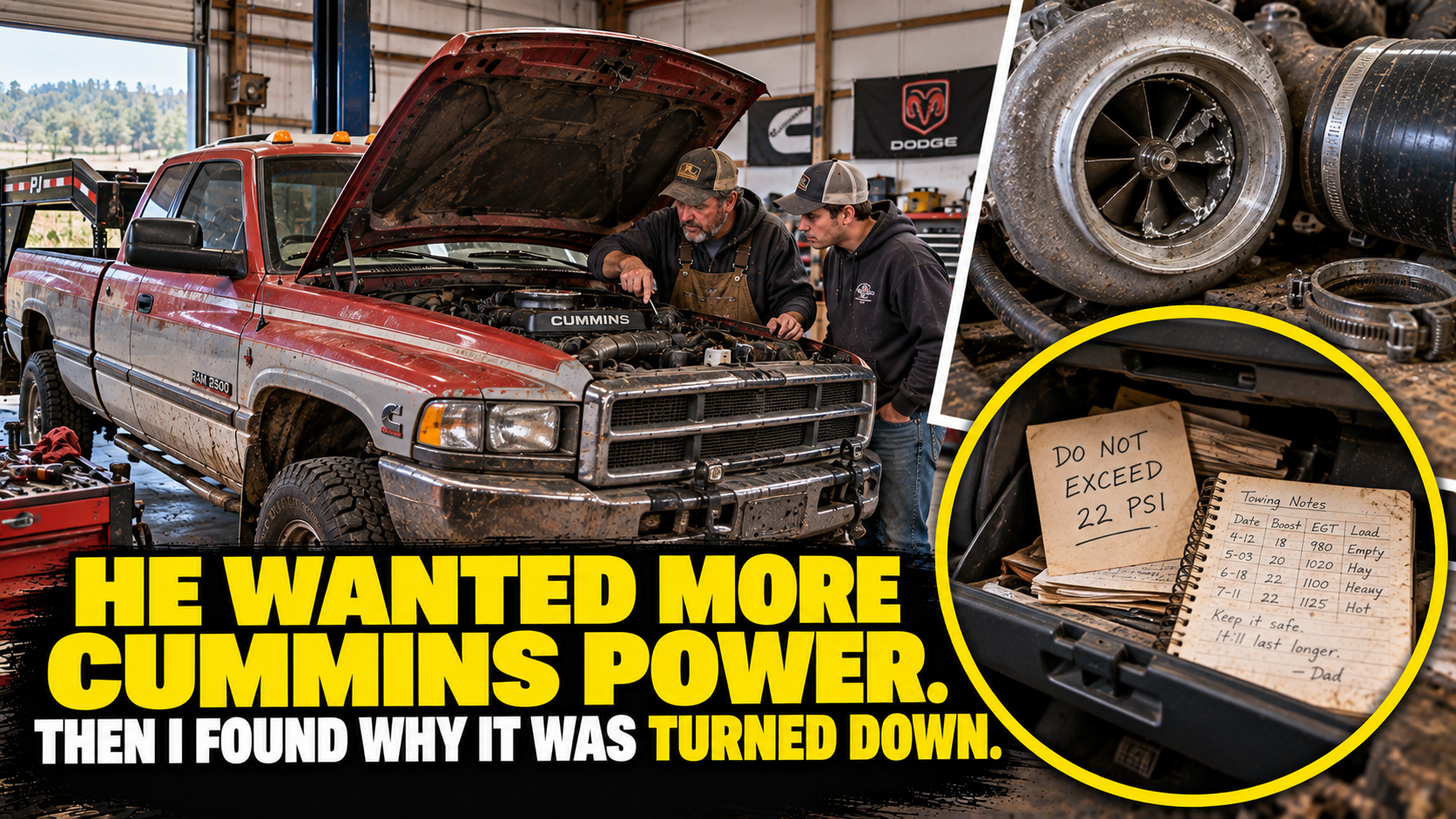
The truck was a worn second-generation Dodge Ram with a 5.9-liter
Cummins diesel, manual transmission, faded paint and more than 340,000
miles.
“My seller said he turned it down for fuel mileage,” Cody told me.
“What do you want?”
“Make it pull harder. Less smoke would be nice.”
My name is Travis Cole.
I work on diesel pickups, farm trucks and enough modified vehicles to
know adding fuel is often the first idea and should rarely be the first
action.
Before increasing power on an old diesel, I want to know what condition
the engine and supporting systems are actually in.
Cody had bought the Ram cheaply from an older man.
The truck had spent years pulling trailers.
Gooseneck hitch. Trailer-brake controller. Extra temperature gauge. Old
accessory wiring.
It had lived a working life.
The engine started well, but under load it felt lazy.
It also produced more smoke than it should for the power it made.
That’s not impressive. That’s inefficient.
We checked fuel supply, intake path, exhaust, boost control and
charge-air plumbing.
Then my technician found an old mechanical boost gauge tucked under the
dash.
The hose had been disconnected and plugged.
Inside the glovebox, somebody had written:
DO NOT EXCEED 22 PSI.
Cody laughed.
“Twenty-two? Guys online run way more.”
“Guys online aren’t paying for your engine.”
The number wasn’t a factory specification.
It was a clue.
We connected proper diagnostic instrumentation and tested carefully.
Boost response wasn’t right.
Pressure-testing the charge-air system revealed a leak.
Then another.
Old boots and connections had seen better days.
That explained part of the smoke and poor response.
But not the warning.
Then we inspected the turbocharger.
The compressor wheel showed damage.
Not catastrophic, but enough that I wasn’t going to add fuel and send
the truck out.
Cody stared.
“So I need a turbo.”
“You need to stop thinking about power until the air system is healthy.”
“I bought this because it was cheap.”
“Cheap purchase price and cheap ownership are different things.”
We contacted the seller, Frank.
Cody expected denial.
Instead Frank explained that the truck had been mildly modified for
towing years earlier.
Later, the turbo ingested debris after an intake problem.
The damage wasn’t immediately fatal, but Frank no longer trusted it
under higher sustained load.
He reduced fueling and drove conservatively while planning a repair.
Then his health changed.
The truck sat more.
Eventually he sold it.
“Why didn’t you replace it before selling?” Cody asked.
“Because I priced the truck like it needed work.”
That was true.
Cody had paid far less than comparable clean trucks.
Frank mentioned a notebook behind the rear seat.
We found it.
Towing records. Maintenance. Fuel mileage. Temperature notes.
After the turbo damage, the entries became conservative:
LESS FUEL. WATCH EGT. KEEP BOOST DOWN UNTIL TURBO REPLACED.
The truck hadn’t been detuned for fuel economy.
It had been detuned as a survival strategy.
We built a repair plan.
Charge-air leaks first.
Appropriate replacement turbo.
Inspect the intake so the new turbo didn’t ingest whatever damaged the
old one.
Verify fuel supply and gauges.
Baseline the truck.
Then decide whether tuning changes were necessary.
Cody used the truck to tow a small equipment trailer.
He didn’t need a dyno number.
He needed predictable power and temperature control.
After repairing the air system and installing a healthy turbo, the truck
pulled substantially better without chasing aggressive fueling.
Smoke decreased.
Boost response became predictable.
Temperature behavior improved.
“That’s it?” he asked.
“For now.”
“You didn’t turn it up?”
“Not much point fixing a truck and immediately asking it to prove
something.”
A month later he returned.
I assumed he wanted more power.
Instead he wanted the brakes and front end inspected.
“Who are you?” I asked.
“You ruined the internet for me.”
Good.
Over the next year Cody gradually repaired the Ram.
Steering. Shocks. Cooling maintenance. Clutch hydraulics. Electrical
cleanup.
He spent more than expected.
He also ended up with a dependable old truck instead of a smoky project
built around one impressive pull.
Frank visited once.
Cody invited him.
The older man smiled when he saw the new turbo.
“Finally fixed that.”
“You could’ve warned me better.”
Frank nodded.
“I should have.”
Then Frank gave Cody the original boost gauge he had removed.
Cody mounted it properly.
He kept the glovebox warning too.
Not because 22 psi remained a magic limit. The setup was different now.
He kept it because it reminded him of the question he should’ve asked
when he bought the truck.
Why?
Why is this disconnected?
Why is that adjusted?
Why did somebody turn the fuel down?
Sometimes the answer is bad workmanship.
Sometimes it is a shortcut.
Sometimes it is the last owner’s attempt to keep a damaged machine alive
until he can repair it.
Cody came in wanting more power.
What he needed first was information.
Once we had that, the truck didn’t need to prove anything.
It just needed to work.