My mother wanted my late father’s 1968 Camaro repainted before we sold
it.
The body man called after beginning work and told me not to let anybody
touch the left rear quarter until I arrived.
I expected rust.
What we found was a repair my father had intentionally preserved for
almost fifty years.
My name is Kevin Brooks.
Dad owned the Camaro before he owned a house, before he married Mom,
before I existed.
He bought it used in 1972.
It was already four years old and nobody treated it as collectible.
To Dad, it was simply a fast used Chevrolet he could barely afford.
He kept it through marriage, kids, job changes, broken transmissions, an
engine rebuild and several paint jobs.
When Dad died at seventy-six, Mom inherited it.
She didn’t want to drive it.
I had my own cars.
My sister had no interest.
Eventually Mom said, “Let’s sell it.”
The car was mechanically sound but cosmetically tired.
Mom thought fresh paint would make it easier to sell.
We took it to a local body shop run by Scott.
The plan was modest: address corrosion, straighten what needed
straightening and paint it correctly.
The call came the first day.
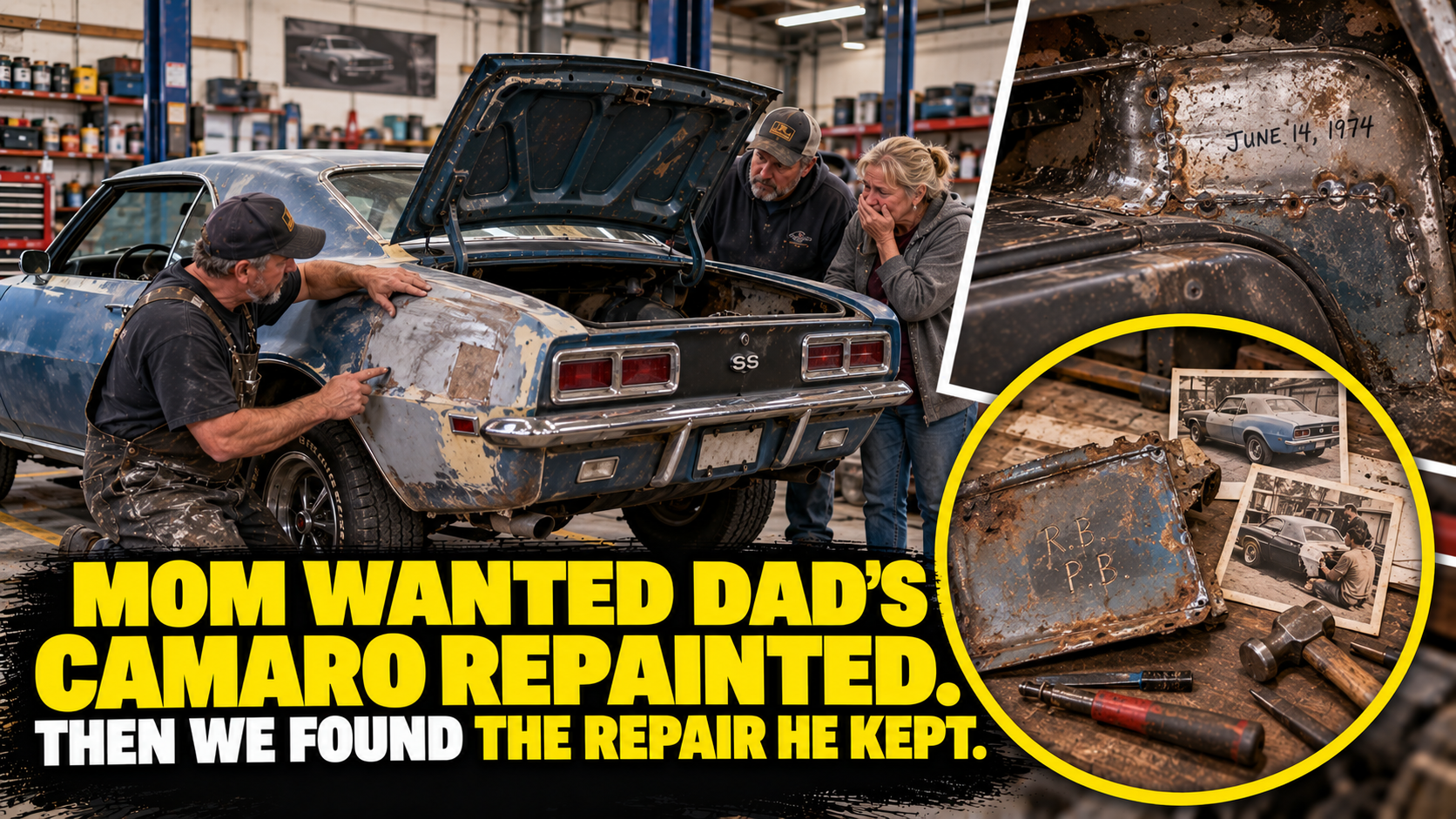
When I arrived, the Camaro was partially disassembled.
From outside, the left rear quarter had looked acceptable.
From inside the trunk, after trim and old coating were removed, the
repair was obvious.
Hammer marks.
A welded patch.
Old finishing work.
Not pretty. Not dangerous. Just old-fashioned body repair.
Beside it, written in faded marker:
JUNE 14, 1974.
Mom arrived.
She saw the date and sat down.
“That’s the night your father proposed.”
The story came out.
Dad and Mom had taken the Camaro on a long drive.
Dad planned to propose at a scenic overlook.
Before they reached it, another vehicle crowded them toward the
shoulder.
Dad avoided a more serious collision but clipped a roadside post.
The left rear quarter was damaged.
Nobody was hurt.
Dad was devastated because he loved the Camaro and had no money for
bodywork.
Mom thought the trip was ruined.
Then Dad proposed beside the damaged car.
She said yes.
The following weekend, Dad repaired the Camaro with his younger brother,
Paul.
They couldn’t afford a body shop.
Paul knew more about metalwork.
They hammered, cut, welded, filled and sanded.
Eventually the outside looked presentable.
The inside remained ugly.
Years later, Dad had opportunities to redo it properly.
He never did.
“Why?” I asked.
Mom smiled.
“I told him not to.”
She wanted one part of the car to stay exactly like that weekend.
Scott asked what we wanted done.
Mom answered immediately.
“Don’t erase it.”
The outer panel could be repaired appropriately while preserving the
historic inner evidence if it remained sound.
Then Scott noticed a loose sliver of original sheet metal behind part of
the patch.
Two sets of initials were scratched into it.
R.B.
P.B.
Dad was Richard Brooks.
Mom was Linda.
“Who’s P.B.?” Scott asked.
“Paul,” Mom said.
Dad’s younger brother.
I hadn’t seen him in almost twenty years.
Dad and Paul had fallen out after their mother’s estate was settled.
The disagreement began over property and money.
Like many family fights, the original issue became less important than
everything said afterward.
They stopped speaking.
Birthdays passed.
Holidays separated.
Pride did the rest.
“Dad kept Paul’s initials?”
Mom nodded.
“He never hated his brother.”
“He acted like it.”
“Your father acted like a lot of things.”
Mom told me Dad considered calling Paul several times.
He never did.
Paul apparently did the same.
Two brothers waiting for the other one to move first.
Then Dad got sick.
Paul came to the funeral but left before I could speak to him.
Mom picked up the metal.
“Find him.”
I found Paul through my cousin.
He answered on the fourth ring.
“This is Kevin.”
“Richard’s boy?”
“Yeah.”
I told him about the quarter panel.
The date.
The initials.
“He kept that?” Paul asked.
Then he told me his version of 1974.
Dad had called him after the crash.
Paul drove out with tools.
They worked until sunrise getting damaged metal away from the tire.
The following weekend they repaired it.
Dad was broke.
Paul bought some materials.
“He paid me back,” Paul said.
“When?”
“Never.”
He laughed.
Then his voice changed.
“I didn’t care.”
I asked if he wanted to see the car before paint.
He arrived three days later.
Paul was seventy-two.
He walked around the Camaro slowly.
At the left rear quarter, he just looked.
“Rich always hated my welds.”
Scott said, “They’re still holding.”
“That would’ve annoyed him.”
For the first time, I understood why Dad preserved the repair.
It wasn’t only about Mom and the proposal.
It was about a time before the brothers became strangers.
We changed the restoration plan.
Scott repaired the exterior correctly.
He treated and protected the inside against corrosion but preserved the
visible old workmanship, date and initials as much as practical.
No grinding away history just because it wasn’t pretty.
When the paint was finished, Mom came to see it.
“So now we sell?” I asked.
She looked at Paul.
Then handed him the keys.
“No.”
Paul stepped backward.
“Linda, I can’t take Rich’s car.”
“You helped save it before I married him.”
“That was fifty years ago.”
“Then you’re overdue.”
Paul refused for almost a month.
Eventually they reached an arrangement.
It wasn’t a gift.
It wasn’t full market price either.
Paul bought the Camaro for an amount they both considered fair.
My sister and I agreed.
I didn’t need Dad’s car.
I needed the story not to disappear.
Paul drives it now.
Not often.
Enough.
Recently he sent me a photograph.
The Camaro was parked beside his garage.
In the trunk, the old inner-quarter repair was still visible.
He had added one removable card:
RICH + PAUL 1974 STILL HOLDING
I showed Mom.
She cried, then laughed.
“Your father would say Paul’s handwriting is terrible.”
Probably.
People restoring old cars often talk about removing evidence of previous
repairs.
Sometimes that’s right.
Bad structural work should be corrected. Unsafe modifications shouldn’t
be preserved for nostalgia.
But not every imperfect repair is meaningless.
That quarter panel had survived decades.
More importantly, it held the fingerprints of a relationship our family
had almost forgotten.
Mom wanted the Camaro painted so we could sell it.
We did paint it.
We did sell it.
But the part that mattered most was the one section we decided not to
make perfect.
Sometimes the ugliest piece of an old car is the piece that tells you
who was there when the family was still together.