
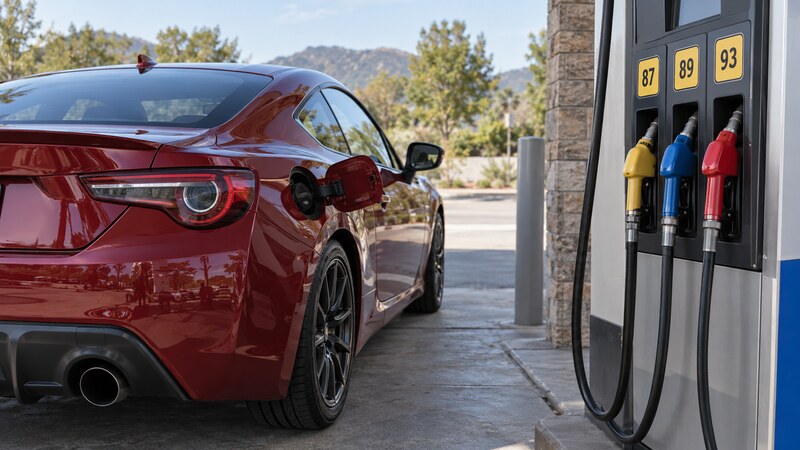
A Japanese badge does not tell you which gasoline to buy. Neither does a turbocharger, a sporty exhaust, or what another owner puts in a different model. The starting point is the fuel specification for your exact engine and market.
For American owners, there is another trap: the number in an overseas manual may use a different octane scale from the number on a U.S. pump. Matching digits without matching the measurement can create the wrong answer.
What the pump number measures
Octane describes a gasoline’s resistance to engine knock. It is not a simple ranking of fuel quality or a promise of extra horsepower. The U.S. Energy Information Administration explains that American pump labels use the average of the Research Octane Number and Motor Octane Number: (R+M)/2.
That average is commonly called AKI. A specification written as RON is not the same measurement. If an imported Japanese car’s manual gives RON, do not read that figure directly as an American pump requirement. Obtain the correct fuel guidance for that engine and calibration rather than relying on a universal conversion shortcut.
Read the whole requirement
FuelEconomy.gov advises using the octane required by the manufacturer. If the manual requires premium, a cheaper grade is not an equivalent substitute. Lower-than-required octane can reduce performance and may cause damage.
A recommendation is different from a requirement, but the distinction must come from the manual—not a forum headline. Some vehicles permit a lower grade while recommending higher octane for better performance. Read any conditions, minimum rating, and temporary-use instructions before deciding.
Higher octane is not automatically a money-saving upgrade. FuelEconomy.gov notes that when premium is optional, its additional cost commonly exceeds the fuel savings. Do not buy it solely because the pump calls it “super.”
A practical checklist before filling up
- Confirm the model year, engine, and original sales market.
- Find the fuel section in the matching owner’s manual and compare it with the fuel-door label.
- Check whether the specified number is RON or the U.S. (R+M)/2 rating.
- Read fuel-composition restrictions as well as octane requirements.
- If the engine has been tuned, ask the calibrator for its documented fuel requirement. A stock manual cannot describe an unknown aftermarket calibration.
For a used import, missing documentation is a question to resolve before routine driving—not an invitation to test progressively cheaper fuel. Keep a copy of the confirmed specification with the car’s service records so the next fill-up is straightforward.
The best choice is the fuel the actual engine requires. Nationality and enthusiast reputation are not substitutes for that specification.
Sources
Featured image: original AI-generated illustration created for MechanicCarWorld using OpenAI image generation. The generic coupe does not represent a particular model’s fuel requirement.