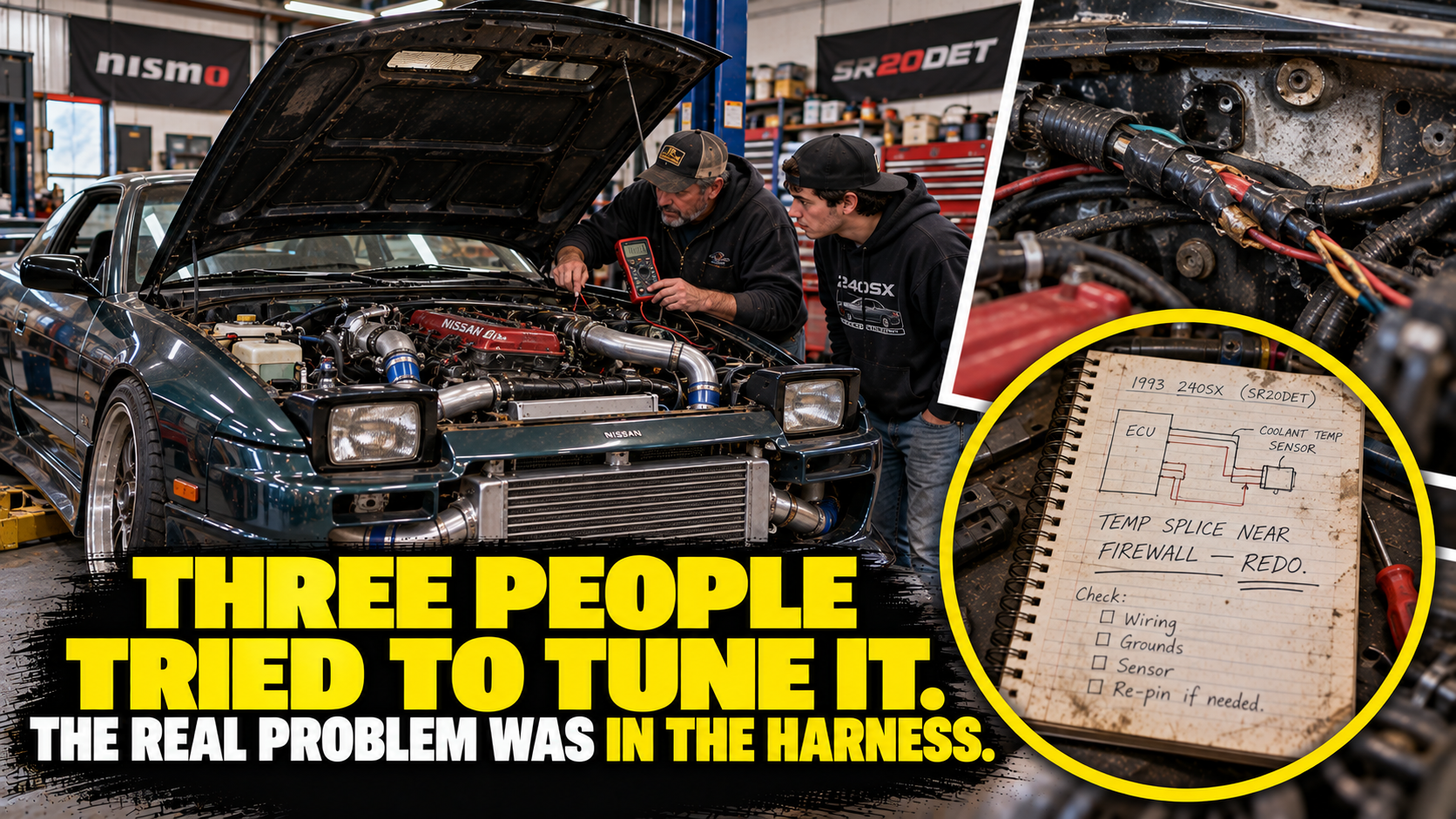
The 1993 Nissan 240SX arrived with a box of parts in the passenger seat
and three different tuning opinions.
The owner, Eli, was twenty-one.
The car had an SR20DET swap, front-mount intercooler, aftermarket
exhaust, upgraded injectors and old modifications from several previous
owners.
His complaint sounded simple.
It wouldn’t stay tuned.
Cold start was decent.
Warm, it could run rich.
Under certain loads it went lean.
Restart it later and the behavior changed again.
Different people had adjusted fuel settings.
One suggested a larger pump.
Another blamed injectors.
Someone else suspected the ECU.
Eli was ready to buy more parts.
I wasn’t.
A modified car needs a stable mechanical and electrical baseline before
tuning becomes meaningful.
We checked fuel pressure.
Vacuum and boost leaks.
Sensor data.
Charging voltage.
Grounds.
Ignition.
Then I noticed the ECU-reported coolant temperature didn’t always agree
with reality.
The value moved in ways an actual engine temperature couldn’t.
An engine doesn’t instantly cool twenty degrees because somebody touched
the throttle.
We checked the coolant-temperature sensor and then its wiring.
The harness disappeared into old loom near the firewall.
When we carefully manipulated one section, the reading changed.
We opened the loom.
Two different wire colors had been joined beneath heat shrink.
Twisted conductors.
No quality crimp.
No proper soldered repair.
One portion barely maintained contact.
As the engine moved on its mounts under load, resistance changed.
The ECU interpreted that as changing coolant temperature.
Fuel strategy changed with it.
Eli stared at the splice.
“So the tune wasn’t the problem?”
“Some calibration may still need work. But you can’t tune around a
sensor signal that lies differently every time the engine moves.”
We repaired the harness correctly.
Then inspected related wiring, grounds and old splices.
Afterward, coolant-temperature data became stable and believable.
We rechecked the fuel system.
Then the car went to a competent tuner with a reliable baseline.
Before that appointment, Eli found a notebook in the paperwork that came
with the swapped engine.
The original builder, Aaron, had recorded wiring notes, pinouts and part
numbers.
One page said:
TEMP SENSOR HARNESS TOO SHORT. TEMP SPLICE NEAR FIREWALL. REDO WHEN
ENGINE COMES OUT.
The engine apparently never came out.
The temporary splice stayed.
Owners changed.
Modifications accumulated.
Context disappeared.
Eli found Aaron through an old enthusiast account.
He sent him a photo.
Aaron replied:
“That thing still exists?”
Then Eli sent the splice.
Aaron answered:
“I KNEW IT.”
He remembered making the temporary connection late at night because he
wanted the swap running for an event.
He planned to redo it later.
Later never happened.
After the proper electrical repairs and conservative calibration, the
240SX became boring in the best way.
Cold start.
Warm idle.
Traffic.
Boost.
Restart.
Predictable.
Months later Eli returned for an exhaust rattle.
The box of unnecessary parts was gone.
“What’d you buy instead?” I asked.
“Tires.”
“Good answer.”
He kept Aaron’s notebook and added his own entry:
2026 — COOLANT TEMP HARNESS FINALLY FIXED.
Underneath:
ONLY TOOK ABOUT 15 YEARS.
Modified cars often get blamed for being unreliable.
Sometimes that’s deserved.
Sometimes the real problem is unfinished work whose history disappeared
when the car changed hands.
A temporary wire.
A rushed bracket.
An unlabeled vacuum line.
The next owner sees only the symptom.
Eli’s 240SX didn’t need a fourth person guessing at the fuel table.
It needed one old splice to stop pretending it was a temperature sensor.
Once the information became trustworthy, the tuning finally could be
too.