Editor’s note: This is an original fictional story created for entertainment. The characters and events are not real.
Part 1: The $4,900 Diagnosis
She was ready to scrap her father’s old Ford after two shops said the engine was finished.
Then my smoke machine found a seven-dollar problem—and a note addressed to me.
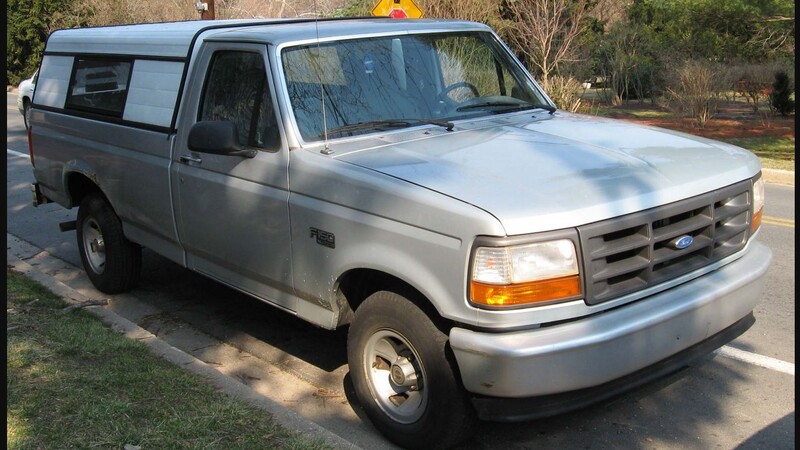
The truck arrived on a flatbed during a cold February rain in Pikeville, Kentucky. It was a blue 1995 Ford F-150 with a 5.0-liter V8, rusty wheel arches, and 241,000 miles on the odometer.
The owner, Hannah Cole, climbed out of the tow truck wearing navy hospital scrubs beneath a wet coat.
“It starts, shakes, and dies,” she said. “The last shop said it needs an engine.”
She handed me an estimate for $4,917.
“I can’t do that,” she continued. “A salvage yard offered six hundred for the truck. I just wanted one more opinion before I signed it over.”
I asked why the truck mattered.
Hannah looked at the peeling pinstripe. “Dad drove me to nursing school in it every morning after his night shift. He died in November.”
I pushed the estimate aside. “Give me one hour.”
The Ford started immediately. The idle hunted between 400 and 1,100 rpm, the exhaust smelled rich, and the brake pedal trembled whenever the engine nearly stalled.
The previous shop had already installed plugs, wires, a distributor cap, an idle-air valve, and a remanufactured mass-airflow sensor. None of the new parts had solved the problem.
I connected a vacuum gauge. The needle was low but steady—not what I expected from an engine with destroyed rings or burned valves.
Compression was even across all eight cylinders. Oil pressure was healthy. The coolant was clean.
“That engine is tired,” my technician Rob said, “but it isn’t dead.”
I agreed.
We checked the obvious vacuum hoses. Most had been replaced. Somebody had even sprayed cleaner around the intake searching for leaks.
Then I noticed a line in the old estimate: internal intake leak suspected—engine replacement recommended due mileage.
I rolled our smoke machine beside the truck, plugged the intake, and fed low-pressure smoke into the system.
For nearly a minute, nothing appeared.
Then a thin white ribbon curled from behind the upper intake, in a spot hidden beneath the wiring harness.
Rob aimed his flashlight.
“There,” he said. “PCV elbow.”
The rubber elbow had split along its underside. From above, it looked perfect. Under vacuum, the crack opened wide enough to make the engine run terribly.
The replacement cost $7.46.
As I reached behind the intake to remove it, my fingers touched something taped to the firewall.
It was a small plastic bag containing a folded index card.
Across the front, in handwriting I recognized immediately, were six words:
JOE—BEFORE HANNAH SELLS BLUE, CALL ME.
The note was signed by her father.
And it was dated three days after his funeral.
Part 2: The Date That Could Not Be Right
Hannah’s father, Walter Cole, had taught automotive classes at the county vocational school. Twenty-eight years earlier, I had been the kid in his back row who arrived late, talked too much, and could not afford his own tools.
Walter let me stay after class. He taught me voltage drop, fuel trim, and the difference between diagnosing a failure and throwing parts at it.
“A customer doesn’t owe you money for your guesses,” he used to say.
I had not seen him in years.
The impossible date was not Walter’s handwriting. Hannah recognized it as her mother’s.
When we opened the card, a second note was folded inside. This one was Walter’s.
Joe, Blue has one hidden vacuum elbow that fooled me twice. Smoke it before anybody condemns the engine. If the frame is still safe, help Hannah decide with facts—not grief.
His wife had found the note after the funeral, added the date, and taped it beneath the hood. She knew Hannah would eventually bring the truck to my shop because Walter had written my name on every maintenance receipt.
I installed the new elbow and started the engine.
The idle settled at 650 rpm.
Hannah covered her mouth with both hands.
Then Rob called from beneath the lift.
“Joe, you need to see the left frame rail.”
The truck’s engine was saved, but the rust near the rear spring hanger was worse than it looked from outside.
Hannah stared at the flaking steel. “So Dad’s note was wrong.”
“No,” I said. “He told us to decide with facts.”
Part 3: What Saving a Truck Really Means
The cracked elbow was a seven-dollar repair. Making the truck safe was not.
The left frame rail needed a professional section repair, the rear brake lines were badly corroded, and both front tires were dry-rotted. My written estimate came to $2,160—far less than an engine, but still more than Hannah could pay.
She sat in the waiting room holding Walter’s note.
“He would tell me to let it go,” she said.
“Maybe,” I replied. “Or he would ask what you need it to do.”
Hannah needed dependable transportation for twelve-hour hospital shifts. She did not need a perfect restoration. She also did not want the truck crushed while grief was making every decision feel permanent.
We built a practical plan.
A certified frame shop repaired the spring-hanger area. I replaced the brake lines and two tires at cost. Rob donated a Saturday’s labor. Walter’s former students heard what happened and quietly covered the remaining parts through a shop fund we used for local families.
Hannah paid what she could over six months.
Before the truck left, I returned every unnecessary part the previous shop had installed and explained what each test had shown. She kept the old split elbow in the glovebox beside her father’s note.
“Seven dollars,” she said, turning the rubber piece in her hand. “That’s all it was?”
“That was the reason it ran badly,” I said. “The rest was the reason we had to slow down and do it right.”
A year later, Hannah came back for an oil change. Blue had another 18,000 miles on it and a fresh nursing-school decal in the rear window.
She handed me a small wooden box. Inside was Walter’s old analog vacuum gauge, the same model he had used in class.
“Mom found this in his garage,” she said. “He would want you to have it.”
I still use that gauge when a young technician wants to replace an expensive part before finishing the diagnosis.
Sometimes I point to the split elbow above my workbench and repeat Walter’s rule:
A customer doesn’t owe you money for your guesses.
We did not save an old Ford by pretending it had no problems.
We saved it by finding the real ones.
Featured image: “1992–1996 Ford F-150,” photographed by IFCAR, via Wikimedia Commons (public domain). Image cropped for display.