The first time I drove the Freightliner without Ben, I kept reaching toward the passenger seat whenever the cab got quiet.
His thermos was gone. His paperback road atlas was gone. Even the little bag of sunflower seeds he kept wedged beside the air-brake knobs was gone.
But the dent in the sleeper wall was still there, right where his boot had kicked it during a January skid outside Rawlins.
I left North Platte at 4:40 on a gray Tuesday morning with 38,000 pounds of canned soup bound for a grocery warehouse in Cheyenne. It was my first solo run since Ben died eight months earlier.
“You don’t have to prove anything,” my sister told me the night before.
“I’m not proving it,” I said. “I’m paying for it.”
The truck payment was $2,180 a month. Insurance had jumped after I became the primary driver. The house needed a water heater, and our daughter, Kelsey, had started community college in August.
Selling the truck would have been easier.
Every time I pictured a stranger driving it away, though, I heard Ben say the same thing he used to tell nervous trainees: “A rig doesn’t know who’s scared. It only knows who’s paying attention.”
So I paid attention.
I checked the weather twice. I thumped every tire at the Love’s in Sutherland. I drained the air tanks, checked the fifth-wheel jaws with a flashlight, and ran my hand along the trailer airlines even though the wind cut through my gloves.
By sunrise, freezing mist had started collecting on the mirrors.
Near Ogallala, the CB cracked with the usual chatter—road conditions, a trooper in the median, somebody complaining about a four-wheeler camping in the left lane.
Then a man’s voice said, “Coyote Six, you still running that green box?”
My hands tightened on the wheel.
Coyote Six had been Ben’s handle.
He had used it for twenty-two years, but almost nobody had called him that near the end. Most drivers knew him as Ben or simply “the old man in the Freightliner.”
I waited, thinking I had misheard.
The voice came again.
“Coyote Six, this is Redline. You need to back her down.”
I lifted the microphone.
“This isn’t Coyote Six.”
There was a pause long enough for the windshield wipers to make two passes.
Then the man said, “Bluebird?”
No one on the highway knew that name.
Ben had called me Bluebird because of the blue waitress uniform I wore when we met at a diner in Lexington, Nebraska, in 1999.
“Who is this?” I asked.
“You’re coming up on Mile 61. Pull onto the shoulder where it widens. Don’t touch the trailer brakes any more than you have to.”
I looked in both mirrors. A white pickup was half a mile behind me. Farther back, through the mist, I could make out the lights of a dark tractor-trailer.
“Tell me who you are.”
“Pull over first.”
The tone of his voice reminded me of Ben during a bad downhill grade—quiet, clipped, leaving no room for argument.
I eased out of the throttle and let the truck slow. At Mile 61, the shoulder widened near an old maintenance turnout.
The moment I stopped, the man said, “Stay in the cab.”
That was when fear finally caught up with me.
I locked both doors and called Kelsey.
“Mom?” she answered, half asleep.
“I’m pulled over east of Big Springs. Keep your phone close.”
“Are you okay?”
Before I could answer, the dark truck stopped behind me with its flashers on. A man in a reflective coat climbed down carrying an infrared thermometer and a small extinguisher.
He walked along my trailer, stopped at the right rear axle, and immediately stepped back.
Even through the mist, I could see a thin curl of smoke.
He keyed his microphone.
“Bluebird, you’ve got a hub cooking. If you’d made it another ten miles, you might have lost the wheel—or the whole trailer.”
I sat completely still.
The hub seal had failed. Oil had spread across the inside dual, and the bearing was hot enough to blister paint. I had checked the hub sight glass before leaving. It had looked normal.
The stranger placed warning triangles behind us, then called a mobile repair truck out of Julesburg. He never asked me for money. He never even came near my door until the service mechanic arrived.
When I finally climbed down, I saw a faded red stripe across his cab and the words RUIZ FAMILY TRANSPORT on the door.
The driver removed his cap.
“Name’s Miguel Ruiz,” he said. “Your husband saved my life in 2007.”
I stared at him.
Miguel told me he had been twenty-three, hauling produce west through Wyoming with six months of experience. A spring storm closed the interstate near Elk Mountain. He ignored the closure, tried an access road, and slid his trailer sideways across a drainage ditch.
The temperature dropped to nine degrees.
His phone had no signal.
Ben found him by following a broken mirror marker and tire tracks in fresh snow.
“He stayed six hours,” Miguel said. “Gave me his coat and half the fuel from his reefer tank. When the wrecker finally came, he made me promise I’d never pass a stranded driver without looking twice.”
“Ben never told me.”
“He said good deeds get smaller when you drag them home for applause.”
That sounded exactly like him.
But it did not explain the private nickname.
Miguel opened his glovebox and handed me a weathered envelope. Ben’s handwriting covered the front.
If Anna ever takes the green box west by herself.
Inside was a short note dated three weeks before Ben’s final hospital stay.
He had written that I was stubborn enough to keep the truck and careful enough to do the job. He had also written that the first solo run would be the hardest because every sound in the cab would feel wrong.
At the bottom, he had added:
Her name on the radio is Bluebird. Don’t use it unless she needs to know the message is from me.
Miguel had been watching load boards and asking drivers about the old green Freightliner for months. That morning, he recognized the cracked left mudflap and the silver tape around the CB antenna mount.
He also noticed the faint smoke before I could see it in my mirror.
The mobile mechanic replaced the bearing, races, seal, and brake shoes. The repair cost $1,186 and put me five hours behind schedule.
The warehouse in Cheyenne waived the late fee after Miguel called the receiving manager and explained the roadside failure.
Before we split at the state line, he handed me Ben’s envelope.
“I think this belongs in your truck now.”
I taped the note inside the sleeper cabinet where Ben kept his logbooks.
I still drive the Freightliner.
Miguel and I do not run together often, but every few weeks one of us hears the other on the radio.
He calls me Bluebird.
And when a driver is stopped on the shoulder, we both look twice.
Story note: This is an original dramatized automotive story created for entertainment.
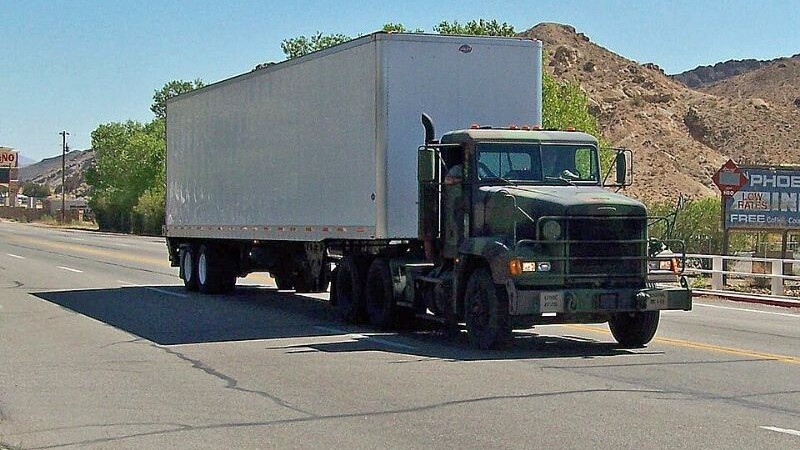
Featured image: “US Army Freightliner FLD120,” photographed by D’oh Boy (Mark Holloway), via Wikimedia Commons (CC BY 2.0). Image cropped for display.