The customer brought the old Ford in because the heater smelled like antifreeze.
That was all.
No mysterious noise. No warning light. No dramatic roadside failure.
Just a 1978 F-150 Ranger with a leaking heater core and a passenger-side carpet that felt damp under my thumb.
The owner, Eric Malloy, stood at my counter in a faded Tennessee Volunteers jacket while I wrote the estimate.
“How bad?” he asked.
“The part is cheap. Getting to it is where the labor goes.”
I quoted him $684, including hoses, coolant, and shop supplies.
He winced, then looked through the office window at the truck.
“Do it right,” he said. “That’s the last thing I’ve got from Dad.”
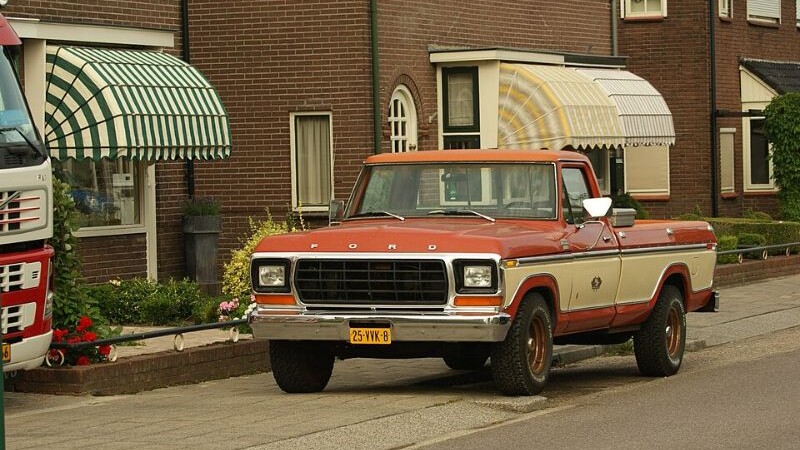
The Ford was two-tone red and cream, with a long bed, factory steel wheels, and enough rust along the wheel arches to make any body man sigh. Eric’s father, Ray, had bought it used in 1981 and driven it to construction jobs around Knoxville for more than thirty years.
Ray died the previous spring.
Eric had spent six weekends making the truck roadworthy. He replaced the fuel pump, rebuilt the front brakes, and installed a carburetor kit at his kitchen table while watching repair videos on his phone.
“Dad would’ve hated that,” he told me.
“The phone?”
“Taking advice from strangers.”
I laughed. “Most mechanics do that. We just call the strangers service manuals.”
The job should have taken most of a morning.
By noon, the glovebox was out, the lower dash was loosened, and the heater case was open. The core had a green crust along the lower seam exactly where I expected.
What I did not expect was the metallic tap inside the plastic case when I tilted it toward the drain pan.
I shook it again.
Something small rolled behind the blend door.
My apprentice, Darnell, aimed a flashlight through the opening.
“Looks like a washer,” he said.
I reached in with a flexible claw tool and pulled out a gold wedding band blackened by dust and thirty years of heat cycles.
Darnell whistled.
“That’s not a washer.”
The ring was scratched but heavy. Inside, beneath a thin layer of corrosion, was an inscription:
M.L. to R.J. — 6-14-79 — Still here.
I photographed it on the clean blue shop towel and called Eric.
He arrived twenty minutes later with his fourteen-year-old daughter, Sadie.
At first, he did not touch the ring.
He stared at the inscription, then sat down on the rolling stool beside my toolbox.
“M.L. is my mother,” he said.
“Was this your dad’s ring?”
Eric shook his head slowly.
“Dad told everybody he lost it in the Clinch River in 1987.”
Sadie looked from him to the ring.
“Why would he lie?”
Eric did not answer.
His parents had separated that summer after years of fighting about money. Ray moved into a rented room near Oak Ridge. Eric, who was nine, stayed with his mother.
For the next eleven months, Ray picked him up every other Saturday in the Ford. They ate biscuits at a diner on Clinton Highway and spent afternoons fishing beneath the Solway Bridge.
Then, without much explanation, his parents got back together.
They remained married until Ray died.
“Mom still talks about that year like it was a bad storm,” Eric said. “Something you survive and don’t discuss.”
He called her from the shop.
Marilyn Malloy was seventy-two and lived in Maryville. When Eric read the inscription, she became silent.
“Where did you find it?” she finally asked.
“Inside Dad’s heater box.”
Marilyn let out a small sound—not quite a laugh, not quite a sob.
Then she told us what happened.
On June 14, 1979, their tenth anniversary, she gave Ray a replacement wedding ring. His original had been crushed between a concrete form and a hammer handle at work.
She chose the words Still here because their marriage had already survived layoffs, a miscarriage, and Ray’s first attempt at sobriety.
Eight years later, during their separation, Marilyn asked him to return it.
“I was angry,” she said through the speakerphone. “I wanted him to feel what it meant to take it off.”
Ray drove to her house with the ring in his shirt pocket.
He sat in the Ford for nearly an hour but never went inside.
At some point, he set the ring on top of the dashboard while writing a note. When he turned sharply out of the driveway, it slid into the open defroster vent.
He removed the speaker grille, tried a magnet, and even took apart part of the dash. Gold is not magnetic, and the ring had fallen all the way into the heater case.
“He came back the next day without it,” Marilyn said. “I thought he’d pawned it.”
Ray was too embarrassed to tell the truth.
That lie nearly ended the marriage.
The note he had been writing was never delivered either.
Eric found it later that afternoon, folded behind the ashtray bracket while Darnell reassembled the dash.
The paper was brittle and stained brown around the edges. Most of the pencil had faded, but three lines were readable:
I know saying sorry is not the same as changing.
I am going to the meeting tonight whether you believe me or not.
If you let me come home, I’ll spend the rest of my life proving it.
Marilyn asked Eric to bring the ring and note to her house.
We finished the heater-core job by closing time. I polished the ring with a cloth—nothing aggressive, just enough to make the inscription legible—and placed it in a small parts box.
Two days later, Eric sent me a photograph.
His mother sat on her porch wearing the ring on a chain around her neck. The old Ford was parked behind her, heater blowing clear air against the windshield.
Eric included one sentence beneath the picture:
She said Dad finally returned it.
I have found coins, sockets, pencils, dead mice, and one petrified french fry inside heater boxes.
That was the first time a cooling-system repair finished a conversation that had been waiting thirty-nine years.
Story note: This is an original dramatized automotive story created for entertainment.
Featured image: “1978 Ford F150,” photographed by Niels de Wit, via Wikimedia Commons (CC BY 2.0). Image cropped for display.