She walked into my shop with a $5,800 estimate and said, “If the rear end is really dying, I’m selling the truck.”
Her name was Rebecca Cole.
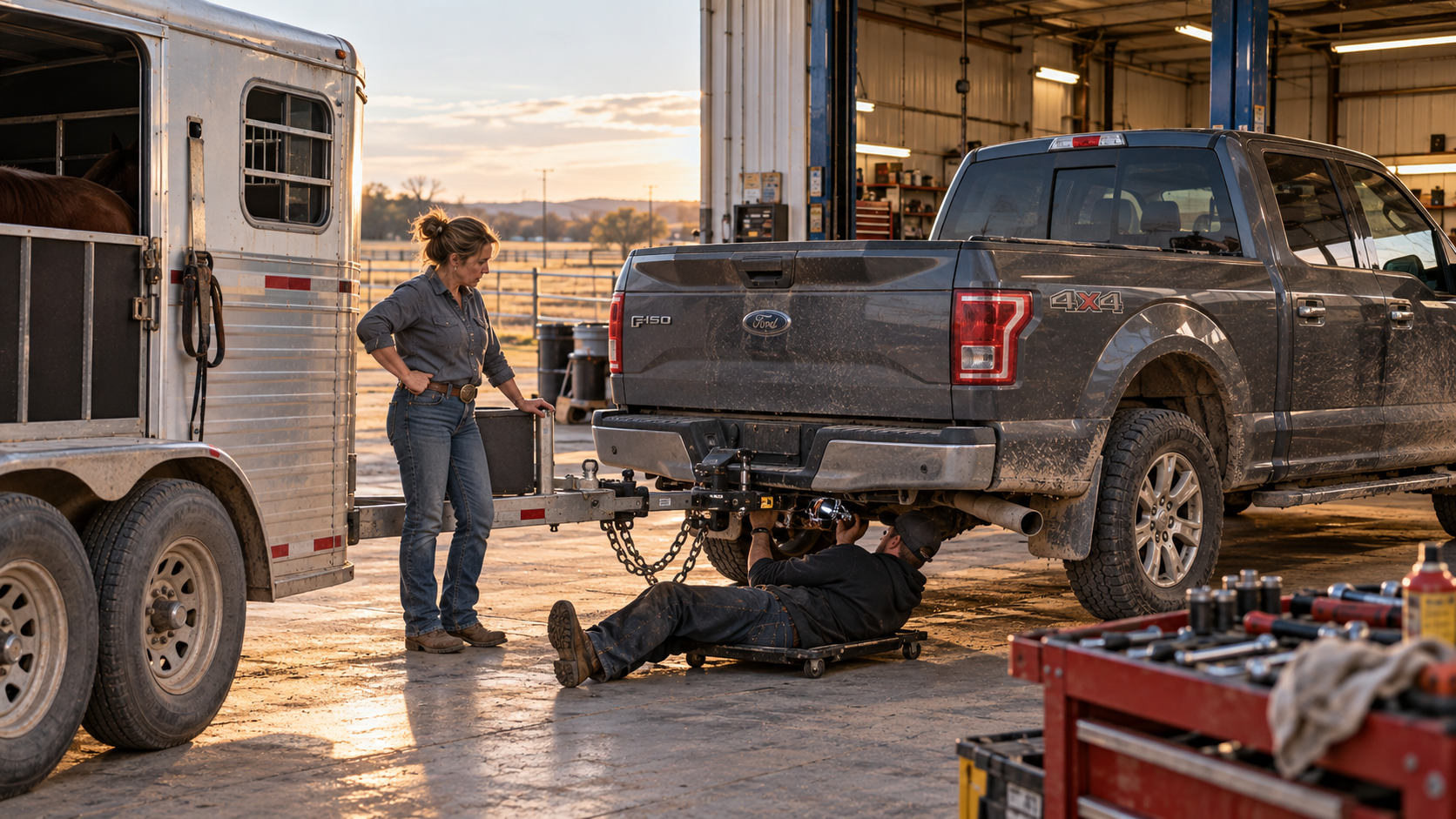
Rebecca was 42 and trained horses outside Tulsa, Oklahoma. Her 2016 Ford F-150 5.0L had 173,000 miles.
It was a real work truck.
The bed had scratches from feed bags and fence supplies. The receiver hitch showed regular use. There was red Oklahoma dust in places no detail shop would ever completely remove.
Rebecca used the F-150 to pull a two-horse trailer several weekends a month.
That was why the noise bothered her.
She could tolerate an old truck making old-truck noises.
She could not tolerate a driveline failure with two horses behind her.
The first symptom was a clunk.
She noticed it when shifting from Reverse to Drive or when taking off after a stop.
Then she began feeling a vibration around 50 to 60 mph.
Some days it was mild.
Other days it came through the seat and floor strongly enough that she backed out of the throttle.
A metallic knock occasionally joined the clunk.
Rebecca took the truck to another shop.
They found driveline play and discussed several possible sources. Their estimate outlined a repair path that could approach $5,800 if inspection confirmed major differential and driveshaft work.
Rebecca heard one phrase:
Rear end.
By the time she reached us, she had already looked at used-truck prices.
I read the paperwork.
The previous shop had not written that the differential was definitely destroyed.
They had identified play and outlined what a larger repair could cost if deeper inspection supported it.
That distinction mattered.
I told Rebecca I would not promise a smaller number.
I wanted to separate the symptoms.
She left the truck.
More importantly, she agreed to bring the empty horse trailer later if we needed to verify the repair under realistic load.
The first road test reproduced the vibration.
At roughly 55 mph, a low-frequency vibration came through the floor.
It changed somewhat with speed.
It did not behave exactly like an engine misfire.
Back in the parking lot, shifting between Reverse and Drive produced the clunk Rebecca described.
That gave us two repeatable complaints.
Now we needed evidence.
We raised the truck and inspected the driveline.
The U-joints were checked carefully for looseness, binding, rust evidence, and abnormal movement.
The driveshaft was inspected for damage, missing balance weights, dents, and other clues.
We checked the pinion area.
We inspected the differential fluid.
We looked at the transmission mount and related support points.
We checked rear suspension components that could allow axle movement.
There was some backlash in the driveline.
At 173,000 miles, zero movement would have been an unrealistic expectation.
The question was whether the differential itself had enough abnormal wear to explain Rebecca’s complaints.
The fluid did not show the kind of metallic debris that would immediately justify condemning the differential.
The pinion did not give us evidence of the catastrophic bearing failure Rebecca feared.
Then one technician loaded the drivetrain while I watched from a safe position.
The transmission and driveline moved.
Too much.
The transmission mount had deteriorated enough to allow excessive movement as torque direction changed.
That explained the hard clunk during Reverse-to-Drive transitions and takeoff.
But it did not fully explain the steady vibration around 55 mph.
This is where diagnosis can go wrong.
Once you find one bad part, there is a strong temptation to make it responsible for every symptom.
We replaced nothing yet.
We continued testing the vibration.
The driveshaft deserved closer attention.
It did not have a dramatic bend.
There was no giant dent.
But measurements and inspection indicated a problem that could create a speed-related vibration.
Rather than guessing with parts, we removed the shaft and sent it to a driveline specialist for evaluation.
Their equipment confirmed it needed correction and balancing.
Now we had two faults.
A deteriorated transmission mount was allowing excessive drivetrain movement and creating the clunk.
A driveshaft condition was producing the highway-speed vibration.
The rear differential showed normal wear for its age and use, but we did not have evidence supporting replacement.
I called Rebecca.
“So the rear end isn’t bad?”
“I don’t have evidence that it needs to be replaced.”
She paused.
“Can I still tow?”
“Let me repair what we found and verify it first.”
She asked again.
“You think it’ll tow?”
“I think the truck deserves the test before I promise you anything.”
The approved repair included replacement of the worn transmission mount with a quality component, driveshaft correction and balancing by the specialist, required hardware and labor, inspection of the related driveline components, and verification.
The total came to $1,965.
That was not pocket change.
It was also not a miracle $30 fix.
The driveshaft work required removal, specialist equipment, balancing, reinstallation, and correct torque procedures.
The mount required labor and proper support of the drivetrain.
We also had diagnostic time invested in separating two complaints that initially felt like one failure.
Once the parts were back, we started with the truck unloaded.
The Reverse-to-Drive clunk was gone.
Takeoff felt controlled.
Then we took it onto the highway.
At 45 mph, smooth.
At 55, smooth.
At 65, still smooth.
We repeated the speed range several times.
No previous vibration.
Then I called Rebecca.
“Bring the trailer.”
She arrived the next morning with the empty two-horse trailer.
We inspected the hitch, safety chains, trailer connection, and tires before leaving.
I was not diagnosing the trailer, but if we were going to verify the truck under towing conditions, the combination needed to be safe enough for the test.
With the trailer connected, the truck sat differently.
That was the point.
Loads change driveline angles and how worn components behave.
We drove a route that included low-speed starts, moderate acceleration, and highway speed.
The clunk did not return.
The vibration did not return.
Back at the shop, we inspected the repaired areas again.
Everything remained secure.
Only then did I tell Rebecca I was comfortable releasing the truck for the kind of towing she had described, within the vehicle’s proper ratings and with normal trailer safety checks.
She picked it up that afternoon.
The final invoice was $1,965.
I showed her the old mount.
The rubber had deteriorated enough that the assembly could no longer control drivetrain movement properly.
Then I explained the driveshaft work.
Rebecca looked at the differential.
“So you didn’t open that?”
“We inspected what the evidence told us to inspect. Nothing we found justified rebuilding it.”
She laughed.
“You know how close I was to trading this thing?”
I believed her.
Then she pulled four $100 bills from an envelope.
“This is for the shop.”
I handed the money back.
Rebecca pushed it toward me.
“You saved me from buying a truck.”
I told her we had not saved her from buying anything.
She had paid us to diagnose and repair the F-150.
The $5,800 figure was a possible repair path, not money she had already lost.
Then she pulled out her phone and showed me a photo.
A chestnut mare named Ruby.
Ruby belonged to a teenager at the stable where Rebecca trained.
The girl’s family had fallen behind on boarding costs after her father was injured and missed work.
Rebecca had been quietly covering part of the expense because the girl was preparing for a local youth riding event.
The $400 in Rebecca’s hand had originally been set aside for Ruby’s farrier visit and part of the next month’s board.
When Rebecca thought the truck needed nearly $6,000 in work, she had planned to use that money toward the repair instead.
Now she wanted to tip us with it.
I pointed at the picture.
“Ruby already spent it.”
Rebecca laughed hard enough that one of my technicians came out of the bay to see what happened.
She put the cash back in the envelope.
The following week, she sent us a picture of Ruby after the farrier visit.
I printed it and taped it inside a cabinet door in the shop.
That was the photo that stayed.
A few months later, Rebecca returned for an oil change.
The F-150 had added several thousand miles.
She had towed multiple times.
The clunk was still gone.
The highway vibration had not returned.
Before we closed the repair order, I also talked with Rebecca about maintenance that could affect future driveline life.
Towing adds heat and load. That does not mean a truck used for towing is being abused, but it does make correct service intervals and regular inspections more important. We documented the differential-fluid condition, checked for leaks, and noted the condition of the remaining joints and mounts so there would be a baseline at her next service.
I also explained that balancing a driveshaft is different from simply looking at it and deciding it appears straight. A shaft can look normal on the shop floor and still create a vibration at road speed. A driveline specialist can measure runout and balance using equipment designed for the assembly.
Rebecca asked whether the transmission mount had caused the driveshaft problem.
I told her we could not prove that.
Excessive movement can place additional stress on surrounding components, but the truck had 173,000 miles of towing and normal use. It was more responsible to say we found two worn conditions than to invent a chain of failure we could not demonstrate.
That answer mattered because good diagnosis includes knowing where the evidence stops.
We had proved the mount was allowing excessive movement.
We had proved the driveshaft required correction.
We had not proved that one had caused the other.
And we had not found evidence that the differential needed the major repair Rebecca feared.
There were several useful mechanical lessons in her story.
First, driveline play does not automatically mean the differential needs rebuilding.
A truck’s driveline contains multiple joints, mounts, splines, shafts, gears, and support points. Wear in several locations can combine into one sensation.
Second, two symptoms that appear at the same time do not have to share one cause.
Rebecca’s clunk and vibration both felt like “something underneath the truck.”
Testing separated them.
The mount explained the excessive movement during torque reversal.
The driveshaft explained the speed-related vibration.
Third, finding one failed part should not end diagnosis if another complaint remains unexplained.
Had we replaced the mount and stopped, the highway vibration would still have been present.
Had we focused only on the driveshaft, the takeoff clunk would have remained.
Fourth, differential backlash must be interpreted in context.
Some gear lash is necessary.
The amount, the location of the movement, noise behavior, fluid condition, bearing condition, and other evidence all matter before recommending major differential work.
Fifth, towing verification should reflect the customer’s actual use when it can be done safely.
An unloaded road test told us a lot.
The empty trailer added a realistic load and changed driveline conditions enough to make the final verification more meaningful.
And finally, estimates, diagnoses, and final invoices are different things.
Rebecca arrived worried about a repair path approaching $5,800.
Our confirmed repair cost was $1,965.
That did not prove the other shop was dishonest.
It meant additional diagnosis separated the complaints and narrowed the repair.
Rebecca also made a smart ownership decision.
She did not ask me whether an old truck with 173,000 miles was “good” or “bad.”
She asked what was wrong now, what it cost to repair, and whether the evidence supported continuing to use it.
Those are better questions.
An older work truck will need maintenance.
Another component may fail next month or three years from now.
No mechanic can promise otherwise.
But replacing a vehicle because of an unconfirmed worst-case repair can be just as expensive as ignoring a confirmed problem.
The last time Rebecca came in, she brought another photo.
The teenager riding Ruby had competed in her event.
Rebecca said they did not win.
The girl did not care.
She had gotten to ride.
I still have the first photo inside the cabinet.
Every time I see it, I remember the woman who came in convinced her rear differential was dying.
The truck needed real work.
Just not the work she feared.
And the best $400 connected to the repair went exactly where it had been intended before the F-150 ever started clunking.