The woman who walked into my shop had already spent about $1,100 trying to fix a problem that refused to happen when a mechanic was watching.
She slid another estimate across my counter and said, “Please don’t sell me another part unless you can show me why.”
Her name was Lisa Moreno.
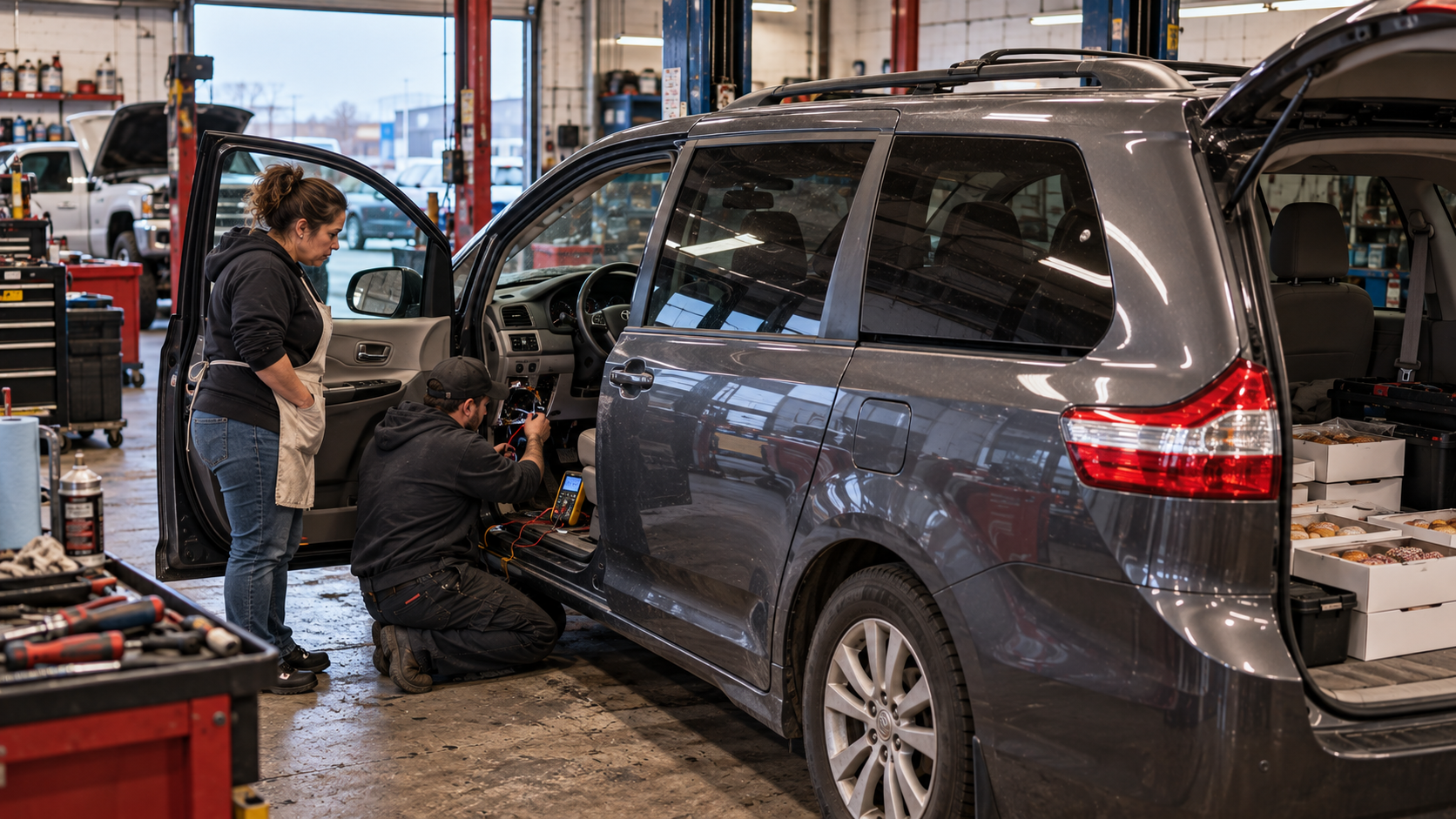
Lisa was 37 and owned a small bakery in Wichita, Kansas. Her 2019 Toyota Sienna had 132,000 miles and did everything from hauling flour and cake boxes to carrying folding tables for weekend events.
Most days, the van started instantly.
That was the problem.
If it had failed every time, diagnosis would have been easier.
Instead, Lisa could drive it for three days without trouble. Then she would stop for a delivery, come back twenty minutes later, turn the key, and get a dashboard full of normal-looking lights with no engine cranking.
Sometimes she waited five minutes and tried again.
The Sienna would start.
Sometimes it took half an hour.
The first time it happened, the battery was several years old and tested poorly enough that replacement was reasonable.
For a while, Lisa thought the problem was solved.
Then the no-start returned.
At another visit, the starter became the focus. The starter was replaced.
Again, the van behaved.
Again, the failure came back.
Between towing, diagnosis, the battery, the starter, and related charges, Lisa had spent roughly $1,100.
Now she had paperwork outlining a deeper electrical diagnostic path. If testing eventually confirmed a control-module problem and associated programming or wiring work, the repair could approach $4,700.
The paperwork did not say a $4,700 module repair was definitely required.
Lisa’s frustration had turned the possible number into the only number she could see.
“I own a bakery,” she told me. “If I guessed this many times making a wedding cake, nobody would pay me.”
I understood why she was irritated.
But I also told her something she probably did not want to hear.
Intermittent electrical problems can consume diagnostic time without producing a dramatic broken part on the first visit.
The mistake would be pretending certainty we did not have.
I asked Lisa for permission to keep the Sienna long enough to catch the failure.
“No more parts?”
“Not until the testing gives me a reason.”
She left the keys.
We began with the basics.
The replacement battery was charged and capable.
The main battery connections were inspected.
The starter installation and accessible connections were checked.
We scanned the relevant modules for current, pending, and history faults.
Nothing on that first pass gave us permission to order a control module.
Then we tried to reproduce the complaint.
Cold start.
Normal.
Hot restart.
Normal.
Multiple key cycles.
Normal.
We drove the van, parked it, let heat soak build under the hood, and tried again.
Normal.
The first day gave us nothing.
The second day was equally unhelpful.
This is where intermittent diagnosis tests a shop’s discipline.
It is tempting to replace the next likely component simply because the vehicle is occupying a bay and the customer wants an answer.
But probability is not proof.
On the third morning, one of my technicians turned the key.
No crank.
He did not touch it again.
He called me over.
That moment mattered.
When an intermittent fault finally appears, you do not want to erase the evidence by cycling the key twenty times.
We checked battery voltage.
Healthy.
We checked what the starting system was being asked to do.
The starter itself was not the first thing I blamed because the control side was not behaving as expected.
We watched scan data from the modules involved in start authorization.
One input changed state in a way that did not match what the driver was actually doing.
Then, before we could finish every test, the condition disappeared.
The van started.
But now we had captured something useful.
We pulled the factory wiring information.
The circuit on the diagram was straightforward enough.
The wiring in the van was not.
Under the lower dash area, wrapped neatly enough to avoid immediate attention, were additional wires and connections that did not belong to Toyota’s original harness.
Aftermarket equipment.
Lisa had bought the Sienna used.
She knew it had remote start.
She had used it during Kansas winters.
The system still seemed to work.
That did not make it innocent.
Many aftermarket remote-start systems interface with factory ignition or start-authorize circuits. Depending on the design, relays and interface modules can temporarily take control of circuits that normally pass directly through the factory system.
If one of those added connections becomes intermittent, the factory vehicle can appear to have a problem even when its original components are doing exactly what they were designed to do.
We did not rip the system out and declare victory.
First, we identified how it had been installed.
We compared the altered wiring with the factory diagram.
We inspected the splices and connections.
Then we monitored the relevant circuit while operating and manipulating the aftermarket system.
The van still started.
We needed the fault.
Heat became useful.
The customer had reported several failures after short stops with the interior and under-dash area warm.
We reproduced those conditions and monitored the circuit.
Eventually, the start command disappeared again.
This time we were ready.
The factory side of the circuit was behaving.
Across part of the aftermarket interface, it was not.
A relay inside the added remote-start system was intermittently failing to pass the start-authorize circuit correctly.
That was why the problem could vanish.
The relay might work dozens of times.
Then temperature, internal contact condition, vibration, or simple bad luck could leave Lisa with lights but no crank.
The battery had not caused that.
The starter had not caused that.
And we had no evidence that the Toyota control module needed replacement.
I called Lisa.
“You made it fail?”
“Yes.”
“And you know why?”
“We can make the fault appear in the added remote-start circuit and make the factory start circuit work correctly when that interference is removed.”
There was a pause.
“Can you take it out?”
That was one option.
We discussed repairing or replacing the aftermarket system versus removing its control over the factory start circuit.
Lisa cared more about reliability than remote start.
She authorized removal of the problematic remote-start interface and restoration of the affected factory wiring to a proper, protected configuration.
That sounds simple in one sentence.
It still required labor.
We had to remove the added equipment carefully, identify each altered circuit, restore the factory paths correctly, solder or connect repairs using appropriate automotive methods, protect the wiring, secure the harness, and make sure removing the system did not leave another function compromised.
The final bill for diagnosis, removal, wiring restoration, reassembly, and verification was $1,260.
It was not a $25 relay miracle.
A relay inside the aftermarket system was the failed element, but finding it required catching an intermittent failure and proving where the start signal disappeared.
The repair also involved undoing years-old modifications without creating new electrical problems.
Then came verification.
We started the Sienna cold.
We brought it to operating temperature.
We shut it down and performed hot restarts.
We let it heat soak.
We restarted it again.
We repeated the process the next morning.
We checked the restored circuits and scanned the modules again.
The Sienna cranked every time.
Only then did I call Lisa.
She arrived carrying a white bakery box.
“I brought two forms of payment,” she said.
The invoice had already been paid electronically.
She opened the box.
Inside were cinnamon rolls.
Then she pulled three $100 bills from her pocket.
“This is because you didn’t put another starter in it.”
I took the cinnamon rolls.
I handed the cash back.
Lisa frowned.
“You saved me thousands.”
I told her that was not how I viewed it.
We had charged her for the diagnostic time and repair.
The possible $4,700 path had never become a confirmed $4,700 failure.
It would be misleading to act as though we had handed her $3,440 in savings.
We had simply found evidence that supported a different repair.
Then Lisa told me why she had brought exactly $300.
Every December, her bakery ran a small program for families who could not afford a birthday cake for a child.
Customers sometimes donated.
Lisa covered the rest.
The previous year, roughly $300 had paid for ingredients, boxes, decorations, and some delivery costs for several cakes.
When the van trouble kept draining money, she had decided she might skip the program that year.
“I figured the tip was extra anyway,” she said.
I pushed the bills toward her.
“Then it already has a job.”
She laughed.
The $300 went back into the bakery program.
A month later, Lisa stopped by with another box.
Not cinnamon rolls this time.
Cupcakes.
She showed us photos of several cakes the bakery had made through the program.
None of us needed to know the children’s names.
The pictures were enough.
The Sienna was still starting normally.
Months later, Lisa returned for routine maintenance.
The no-crank had not returned.
There was another reason I was comfortable restoring the factory circuit instead of recommending a Toyota module.
During the failed-state testing, we verified the factory inputs on both sides of the point where the aftermarket system had been inserted. The command existed before the added interface and disappeared across it when the fault occurred. Once that interface was bypassed for testing, the factory circuit behaved consistently.
That kind of isolation matters with electrical diagnosis. A scan tool can show what a module sees, but it cannot always tell you where a signal was lost. A meter, the wiring diagram, and carefully chosen test points can narrow the circuit one section at a time.
We also inspected the old splices instead of assuming the relay was the only concern. Some were serviceable, but because Lisa wanted the remote-start system removed, we restored the altered sections rather than leaving abandoned connections buried under the dash. Loose unused wiring can become tomorrow’s intermittent problem.
Before reassembling the trim, we tug-tested the repaired connections, protected the harness from sharp edges, and confirmed that normal key starting, accessory operation, security functions, and other nearby circuits still worked.
That extra work was part of the $1,260 bill.
It was also why I would not describe the repair as “a cheap relay fixed everything.” The failed relay gave us the answer, but diagnosis and proper restoration were the actual job.
There were several useful lessons in her repair.
First, a new part is not proof that the old part caused the symptom.
Lisa’s battery had legitimate age and condition concerns, but replacing it did not solve the intermittent no-crank.
The starter replacement also did not eliminate the complaint.
When a symptom returns after parts replacement, the diagnostic process has to return to evidence.
Second, intermittent faults should be captured whenever possible before disturbing the vehicle.
When the Sienna finally refused to crank in our shop, we stopped cycling the key and measured the system in the failed state.
That gave us information we could not get while everything was working normally.
Third, factory wiring diagrams describe the vehicle as the manufacturer built it.
Used vehicles may contain remote starters, alarms, stereos, trackers, trailer wiring, lighting, or old repairs that change the circuit.
When the physical wiring does not match the diagram, that difference matters.
Fourth, aftermarket equipment is not automatically bad.
Millions of vehicles use added electronics without trouble.
The correct lesson is not “aftermarket equals failure.”
The lesson is that anything connected to the affected circuit belongs in the diagnostic process.
Fifth, an estimate is not a diagnosis.
Lisa arrived worried about a possible $4,700 repair path.
Testing did not support replacing the control module.
The confirmed problem was an intermittent failure inside the added remote-start interface.
The final repair cost was $1,260.
Finally, verification is especially important with intermittent problems.
One successful start would have proved almost nothing.
We repeated cold starts, hot starts, heat-soak restarts, and next-day testing before releasing the van.
Lisa once compared automotive diagnosis to baking a wedding cake.
I thought about that later.
A baker can have flour, sugar, butter, and an oven and still ruin the cake if the process is wrong.
A shop can have batteries, starters, modules, and scan tools and still miss the problem if the process is wrong.
The expensive tool in Lisa’s repair was not a replacement part.
It was patience.
And the best $300 connected to the whole job never reached my technicians.
It turned into birthday cakes.