My brother sold our father’s 1971 John Deere 4020 three days after we buried him.
He got $6,800 for it.
He never asked me.
By the time I found out, the tractor was already sitting on somebody else’s farm almost ninety miles away.
My father, Walter Hayes, had owned that 4020 for longer than either my brother or I could remember.
Dad bought it used when he was twenty-six years old.
By the time I came along, the tractor was already part of the farm.
There are family photographs of me at four years old sitting on the fender while Dad held me with one arm.
There are pictures of my younger brother, Eric, asleep against Dad’s shoulder while the tractor sat beside a hay wagon.
Later, Dad taught both of us to drive it.
The John Deere wasn’t a show tractor.
The green paint had faded.
The seat had been replaced more than once.
The steering wheel had cracks.
One rear fender carried a dent from the time Dad backed into a gravity wagon in the early 1990s and refused to replace the metal because, as he put it, “It still holds the light.”
The tractor worked.
That mattered more to Dad than how it looked.
It planted.
It pulled wagons.
It ran an auger.
It moved snow.
It hauled feed.
It spent thousands of hours doing the ordinary work that kept our Iowa farm alive.
Dad was seventy-eight when he died.
By then, Eric and I were both grown.
I lived about twenty minutes away and ran a small welding and equipment-repair business.
Eric still lived near the farm, but he worked construction and had never been as attached to farming as Dad hoped he would be.
Neither of us farmed full-time anymore.
Dad had rented most of the ground to a neighbor several years earlier.
But he kept the home place.
He kept his shop.
And he kept his tractors.
Especially the 4020.
During Dad’s final summer, I noticed something strange.
He started working on that tractor almost every Saturday.
Not major work.
At least, that was what I thought.
He replaced hydraulic hoses.
Changed fluids.
Repaired wiring.
Cleaned connections.
Rebuilt the seat suspension.
He even ordered several pieces of sheet metal.
I asked him once why he was putting so much effort into a tractor he barely used.
He looked at me and smiled.
“Old equipment deserves to leave better than you found it.”
That sounded exactly like Dad.
So I didn’t question it.
Then his health declined quickly.
By October, the shop stayed dark.
Dad died early the following spring.
The funeral was on a Monday.
On Thursday afternoon, I drove out to the farm.
Eric’s pickup was beside the barn.
A flatbed trailer was pulling away.
I slowed down.
There was something green on the trailer.
For a second, my brain didn’t understand what I was seeing.
Then I recognized the rear tires.
Dad’s 4020.
I stopped my truck in the middle of the driveway.
The trailer continued toward the road.
I got out.
Eric walked from the barn carrying an envelope.
“What’s going on?”
He looked toward the road.
“I sold the Deere.”
I thought he was joking.
“You what?”
“The 4020.”
“I know which Deere you mean.”
He shrugged.
“We don’t need it.”
I stared at him.
“We buried Dad three days ago.”
“And?”
“And you sold his tractor?”
“Matt, it’s machinery.”
I hated the way he said it.
Just machinery.
Like fifty years of our father’s life could be reduced to scrap weight and horsepower.
“How much?”
“Sixty-eight hundred.”
“That’s it?”
“It needs work.”
“Dad was working on it all summer.”
Eric shook his head.
“Dad tinkered with everything. That doesn’t mean it was good.”
“Who bought it?”
“A farmer over by Newton.”
“Name?”
Eric’s face tightened.
“Why?”
“Because I want his name.”
He gave it to me.
Calvin Brooks.
I wrote it down.
Then I asked Eric the question that mattered.
“Who gave you permission to sell it?”
He stared at me.
“We’re both handling the estate.”
“That isn’t an answer.”
“Dad didn’t leave instructions for every wrench and tractor.”
“No. But you could’ve called me.”
“You would’ve said no.”
“Exactly.”
He laughed once.
Not because anything was funny.
“That’s why I didn’t call.”
I looked at him for several seconds.
Then I walked toward Dad’s shop.
Eric followed me.
“What are you doing?”
“Finding the service records.”
“For what?”
“For the tractor you just sold.”
He rolled his eyes.
“You’re going to drive ninety miles and beg some stranger to sell back a fifty-year-old tractor?”
“If I have to.”
“Matt, this is ridiculous.”
I ignored him.
Dad’s shop smelled exactly the way it always had.
Diesel fuel.
Old oil.
Metal dust.
Grease.
The faint burnt smell from the welding table.
His red toolbox stood against the wall.
I started searching.
Top drawer.
Sockets.
Second drawer.
Wrenches.
Third drawer.
Electrical tools.
The service manuals were usually in the bottom drawer.
I pulled it open.
The manuals were there.
So was a small white envelope.
My name was written across the front.
Matt.
I stopped.
Eric noticed.
“What’s that?”
“I don’t know.”
I opened it.
Inside was a folded piece of notebook paper.
Dad’s handwriting was shaky but unmistakable.
There was one sentence.
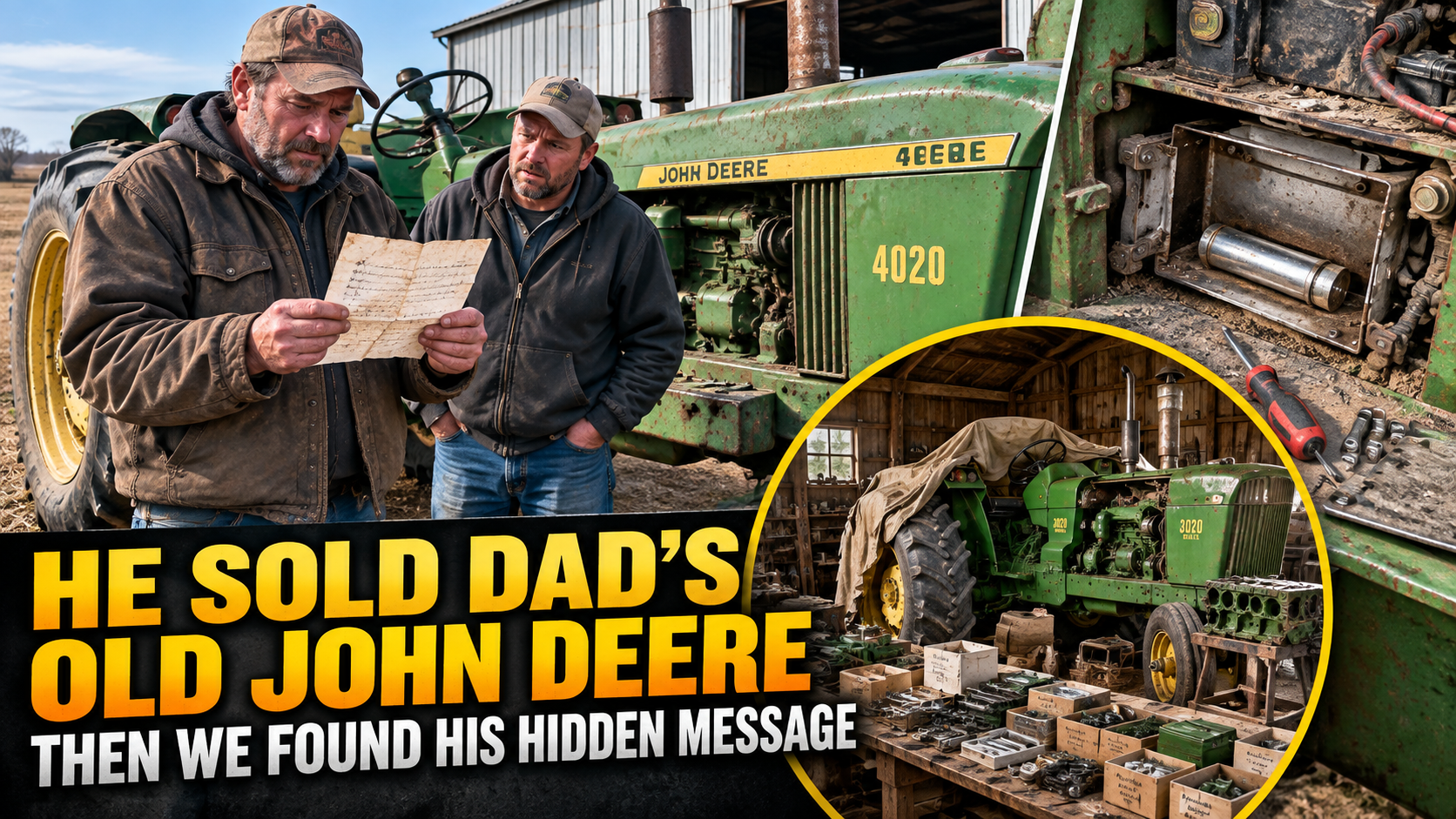
“Before anyone sells the 4020, remove the right-side battery box and look underneath the tray.”
I read it twice.
Then handed it to Eric.
He frowned.
“What does that mean?”
“I don’t know.”
He read it again.
Then laughed.
“You think Dad hid money in the tractor?”
“Why would he leave this?”
“Because he was old.”
I looked at him.
“Don’t.”
Eric’s smile disappeared.
I folded the note and put it in my pocket.
The next morning, I called Calvin Brooks.
I expected resistance.
Instead, he was surprisingly calm.
“Yes, I bought it.”
“My brother didn’t have my approval to sell it.”
There was a pause.
“That sounds like an estate problem.”
“It is.”
“I paid cash.”
“I’m not accusing you of doing anything wrong.”
That softened him.
I explained the note.
When I finished, Calvin was quiet.
Then he said, “Well, now you’ve got me curious.”
He agreed to let me inspect the tractor.
Two hours later, I pulled into his farm.
The 4020 sat beside a machine shed.
Seeing it there felt wrong.
Calvin was probably in his early sixties.
He wore bib overalls and had the kind of hands that told me he had spent his life fixing his own equipment.
He shook mine.
“Your dad’s tractor?”
“Yeah.”
“She’s rough, but not terrible.”
“That sounds like him too.”
Calvin smiled.
We walked over.
The right-side battery box showed fresh paint around two bolts.
Dad had definitely been in there recently.
We disconnected the battery.
Lifted it out.
Removed the tray.
Underneath was a thin steel plate.
Calvin tapped it with his finger.
“That factory?”
“No.”
I knew Dad’s fabrication work.
Those welds were his.
Two small bolts held the plate.
I removed them.
Behind it was a narrow cavity.
Inside was a metal tube wrapped in oily cloth.
Calvin whistled.
“Well, your dad definitely wanted somebody to find that.”
I opened the tube.
No cash.
There was an old photograph.
A folded piece of paper.
And what looked like an equipment record.
The photograph showed Dad as a young man standing beside another John Deere.
Not the 4020.
This tractor was older.
Smaller.
The photograph was faded, but I recognized the shape.
A John Deere 3020.
Dad stood beside it with another man.
My grandfather.
I had seen very few photographs of them together.
Grandpa died before I was born.
I turned the photograph over.
Dad had written:
“1968. First tractor Dad trusted me to overhaul.”
Under the photograph was a hand-drawn map of our farm.
A red X marked the old north machine shed.
That building hadn’t been used regularly in years.
Dad kept it locked.
The final document listed a serial number.
At the bottom, Dad had written:
“Eric will recognize this.”
I stared at those words.
Calvin leaned closer.
“Your brother?”
“Yes.”
“What’s the number?”
I read it.
It meant nothing to me.
But apparently Dad believed it would mean something to Eric.
I called him.
He answered on the fourth ring.
“What?”
“I found something.”
“Money?”
“No.”
“What?”
“A serial number.”
He sighed.
“Matt, I’m working.”
I read the number.
Silence.
“Eric?”
“Read it again.”
I did.
He stopped me halfway through.
“No.”
“What?”
“Where did you find that?”
“Inside the tractor.”
Another long silence.
Then he said something I wasn’t expecting.
“That was Grandpa’s 3020.”
I looked at the photograph.
“How do you know?”
“Dad made me memorize that number when I was a kid.”
“Why?”
“Because I lost the serial plate.”
I laughed.
“You what?”
“I was twelve.”
The story came back to him slowly.
Dad had removed the tractor’s serial plate during restoration work.
Eric had been helping clean parts.
He put the plate in a coffee can.
Then lost the can.
Dad made him write the serial number repeatedly so they would still have a record of it.
“What happened to the tractor?”
“I thought Dad sold it.”
I looked at the map.
“Maybe he didn’t.”
I drove home.
Eric was waiting.
Neither of us mentioned our argument.
We walked directly toward the north machine shed.
The padlock looked newer than the building.
I had Dad’s keys.
The third key opened it.
We pushed the doors apart.
Dust floated through the sunlight.
Old cultivator parts lined one wall.
There were seed bags, chains, worn tires and stacks of lumber.
Then I saw the canvas tarp.
Something tractor-shaped was underneath.
Eric stopped walking.
“No way.”
We pulled the tarp back.
Green paint.
Round fenders.
A narrow front end.
John Deere 3020.
Eric put both hands on his head.
“I thought this thing was gone.”
The tractor was partially disassembled.
The hood was off.
The cylinder head had been removed.
Parts sat neatly on a workbench.
Every component had a tag.
Dad’s handwriting.
Rocker assembly.
Injectors.
Fuel lines.
Head bolts.
Water pump.
There were boxes of new parts.
Gaskets.
Hoses.
Belts.
Electrical components.
Dad had been restoring Grandpa’s tractor.
But why hide it?
Then I noticed another envelope taped to the steering wheel.
It said:
“Boys.”
Not Matt.
Not Eric.
Both of us.
I opened it.
The letter was longer.
Dad had written it over several days.
Some lines were steady.
Others shook.
He explained that the 3020 had belonged to his father.
After Grandpa died, Dad kept it for years.
Eventually it developed engine problems.
He parked it in the north shed intending to repair it.
Life got busy.
Farming got harder.
Then decades passed.
Dad wrote:
“I kept saying I’d get to it next winter. Winters have a way of disappearing.”
Eric sat on an old bucket.
I kept reading.
Dad had finally begun restoring it after renting out the farm.
Then his health declined.
He knew he wouldn’t finish.
That was why he had been working on the 4020.
He wasn’t preparing the 4020 to sell.
He was preparing it to become a donor of something more valuable than parts.
Knowledge.
Dad had hidden maintenance notes throughout the tractor.
Measurements.
Settings.
Repair procedures.
Little handwritten explanations of jobs he had done over fifty years.
He wanted us to use those notes while finishing Grandpa’s 3020.
Then came the part that silenced both of us.
“I know you boys don’t always agree. That’s partly my fault. I spent too many years teaching you how to work and not enough teaching you how to work together.”
Eric looked away.
I continued.
“If you sell the tractors, that’s your decision after I’m gone. Iron is iron. But before you sell them, finish one job together.”
Below that:
“Make Grandpa’s 3020 run again.”
For several minutes, neither of us spoke.
Finally Eric said, “I screwed up.”
“Yes.”
He nodded.
“I know.”
“You could’ve called me.”
“I know.”
“Why didn’t you?”
He stared at the floor.
Then he told me.
He was in debt.
Not catastrophic debt.
But enough.
A construction job had gone bad.
A customer hadn’t paid him.
His truck needed repairs.
He had property taxes due.
Selling the 4020 looked like quick money.
“Why didn’t you tell me?”
He laughed bitterly.
“Because you’re the brother who owns a repair business and has everything figured out.”
I almost laughed.
“You think I have everything figured out?”
“Compared to me.”
“That doesn’t mean you sell Dad’s tractor behind my back.”
“I know.”
The next day, Eric called Calvin.
He apologized.
Then he asked whether we could buy the 4020 back.
Calvin surprised us.
“I haven’t done anything with it,” he said. “Give me what I paid, cover my hauling, and take it home.”
Eric didn’t have all the money anymore.
He had already used $1,900.
I could have paid it.
I didn’t.
Instead, Eric sold an ATV he barely used and picked up extra weekend work.
It took several weeks.
Calvin kept the tractor for us.
When we finally brought the 4020 home, Eric drove it off the trailer.
The old diesel settled into that familiar uneven idle.
For the first time since Dad died, the farm sounded right.
Then we started on Grandpa’s 3020.
Dad had already done more than we realized.
The head had been checked.
The injectors were tagged.
The cooling system parts were boxed.
The wiring harness needed work.
The fuel system needed attention.
There were dozens of smaller jobs.
We worked Saturdays.
At first, Eric and I argued constantly.
He wanted to move faster.
I wanted to measure everything twice.
Then we found one of Dad’s notes taped inside an old service manual.
“If Matt and Eric are arguing, both of you stop and drink coffee.”
We laughed so hard we had to sit down.
So we followed the instruction.
Coffee became part of the repair procedure.
Our sons started joining us.
Then our daughters.
Sometimes Mom came out and sat in Dad’s old chair.
By late summer, the 3020 was back together.
The first start didn’t go well.
It cranked.
Smoked.
Almost caught.
Then nothing.
Eric looked at me.
“Fuel?”
“Probably.”
We bled the system again.
Checked connections.
Tried again.
The engine fired.
For two seconds.
Then died.
On the third attempt, it caught.
The old diesel stumbled, coughed, smoked heavily and finally settled into a steady rhythm.
Nobody spoke.
We just listened.
Mom started crying.
Eric did too.
I pretended I had dust in my eyes until that excuse became ridiculous.
A month later, we used Grandpa’s 3020 to pull a hay wagon during a family gathering.
The paint still wasn’t perfect.
Dad would have complained about that.
But it ran.
The 4020 ran beside it.
Two old green tractors.
Three generations of our family.
One unfinished job finally completed.
Eric never sold another piece of Dad’s equipment without talking to me.
Eventually we sold some things.
Dad was right.
Iron is iron.
Keeping every machine forever would not have honored him.
But the 4020 stayed.
So did the 3020.
Eric repaid the estate for every dollar connected to the sale.
More importantly, he started coming to the shop even when nothing needed fixing.
Sometimes we work.
Sometimes we drink coffee.
Sometimes we argue.
Then one of us points at Dad’s handwritten note hanging above my workbench:
“If Matt and Eric are arguing, both of you stop and drink coffee.”
That usually ends it.
People sometimes ask what Dad hid beneath the battery box.
They expect me to say money.
Gold.
A valuable title.
Something worth thousands.
What he actually hid was an old photograph, a serial number and directions to a broken tractor.
On paper, none of it was worth much.
But Dad understood machinery.
He knew a machine can sit for decades and still run again if somebody is willing to take it apart, understand what failed, and patiently put it back together.
Apparently, he believed brothers could work the same way.
And every time that old 3020 starts, I think he was right.