My sister was less than an hour away from selling our father’s 1970 Chevrolet Chevelle for $18,000 when she called me.
The buyer told her the big-block was basically finished.
I listened to the engine for less than a minute and knew something about that diagnosis didn’t make sense.
My name is Mike Lawson.
I’ve worked as a mechanic for almost thirty years.
Dad was the reason.
He wasn’t a professional mechanic.
He was an electrician by trade, but he believed owning an old car meant learning how to repair it yourself.
Sometimes that philosophy saved money.
Sometimes it produced three-day arguments in the garage.
His Chevelle was the center of most of them.
Dad bought the car in 1988.
It wasn’t some untouched museum piece even then.
It had been repainted.
The original engine was gone.
Someone had changed parts of the interior.
But it was solid.
Dark blue.
Black interior.
Four-speed manual.
By the time I was old enough to understand cars, the Chevelle was simply part of our family.
Dad drove it to work occasionally.
He took Mom out in it.
He drove my sister, Amy, and me for ice cream on summer evenings.
And when I turned seventeen, he decided the engine needed rebuilding.
That became the project that pushed me toward becoming a mechanic.
We pulled the big-block in our garage.
Dad made me label everything.
Every bracket.
Every bolt bag.
Every wire.
I complained constantly.
Years later, I made young mechanics in my own shop do exactly the same thing.
Dad would have enjoyed that.
The rebuild took most of one winter.
When we finished, the car ran strong.
Not race-car strong.
Not internet-horsepower strong.
Just the kind of torque-heavy old Chevrolet that made you smile every time second gear came in clean.
Dad kept the car for the next twenty-six years.
Then cancer took him at seventy-four.
After he died, the Chevelle sat in Mom’s garage.
Mom didn’t want to sell it.
Amy didn’t care much either way.
I wanted to keep it but already had too many projects, a business to run and nowhere appropriate to store another car long-term.
So we did what families often do with emotionally complicated possessions.
Nothing.
For fourteen months.
Then Mom decided to move into a smaller place.
Suddenly everything had to be dealt with.
Furniture.
Tools.
Dad’s old fishing gear.
Boxes nobody had opened in twenty years.
And the Chevelle.
Amy handled most of the estate-sale arrangements because she lived closer.
One Tuesday, she called me.
“I found somebody for Dad’s car.”
I stopped what I was doing.
“What do you mean, somebody?”
“A buyer.”
“You listed it?”
“I put it online.”
“For how much?”
“Twenty-eight.”
That wasn’t outrageous depending on condition, configuration and how much work it needed.
“What did he offer?”
She paused.
“Eighteen.”
I laughed.
Then realized she wasn’t joking.
“Why?”
“He says the engine is bad.”
“What?”
“He came today. We started it.”
“You started a car that’s been sitting fourteen months without calling me?”
“It has oil.”
“That wasn’t my question.”
She sighed.
“It makes a knocking noise.”
That got my attention.
“How bad?”
“Bad enough that he says it needs a rebuild.”
“Who is this guy?”
“He buys old cars.”
Of course he did.
“Don’t sell it.”
“Mike—”
“Do not sell that car until I hear it.”
“He has cash.”
“I don’t care if he has gold bars.”
She became defensive.
“Mom needs the garage cleared.”
“I’ll come tomorrow.”
“He’s coming back at noon.”
“Then tell him one o’clock.”
I arrived at 9:30 the next morning with a trailer.
The Chevelle looked smaller than I remembered.
Old cars sometimes do that.
As a kid, the hood had seemed six feet long.
Now I noticed every flaw.
Paint chips.
A small bubble near the lower quarter.
Dry weatherstripping.
Dust.
But it was still Dad’s car.
I checked fluids.
Pulled the plugs.
Turned the engine manually.
Did the basic things I wished Amy had done before starting it.
Nothing immediately suggested internal disaster.
We installed the plugs and started it.
The noise was there.
A sharp metallic knock or clack from the rear portion of the engine/transmission area.
Amy folded her arms.
“See?”
“I hear it.”
“So he’s right?”
“I didn’t say that.”
Oil pressure was good.
Exhaust looked normal.
No obvious misfire.
The sound didn’t behave exactly like the internal engine knock I expected from a failed rod bearing.
I changed engine speed slightly.
The noise changed.
Then I pushed the clutch.
The character of the noise changed again.
That mattered.
“Shut it off.”
Amy looked worried.
“Bad?”
“Different.”
“That’s not an answer.”
“It’s the answer you get before diagnosis.”
I loaded the Chevelle onto my trailer.
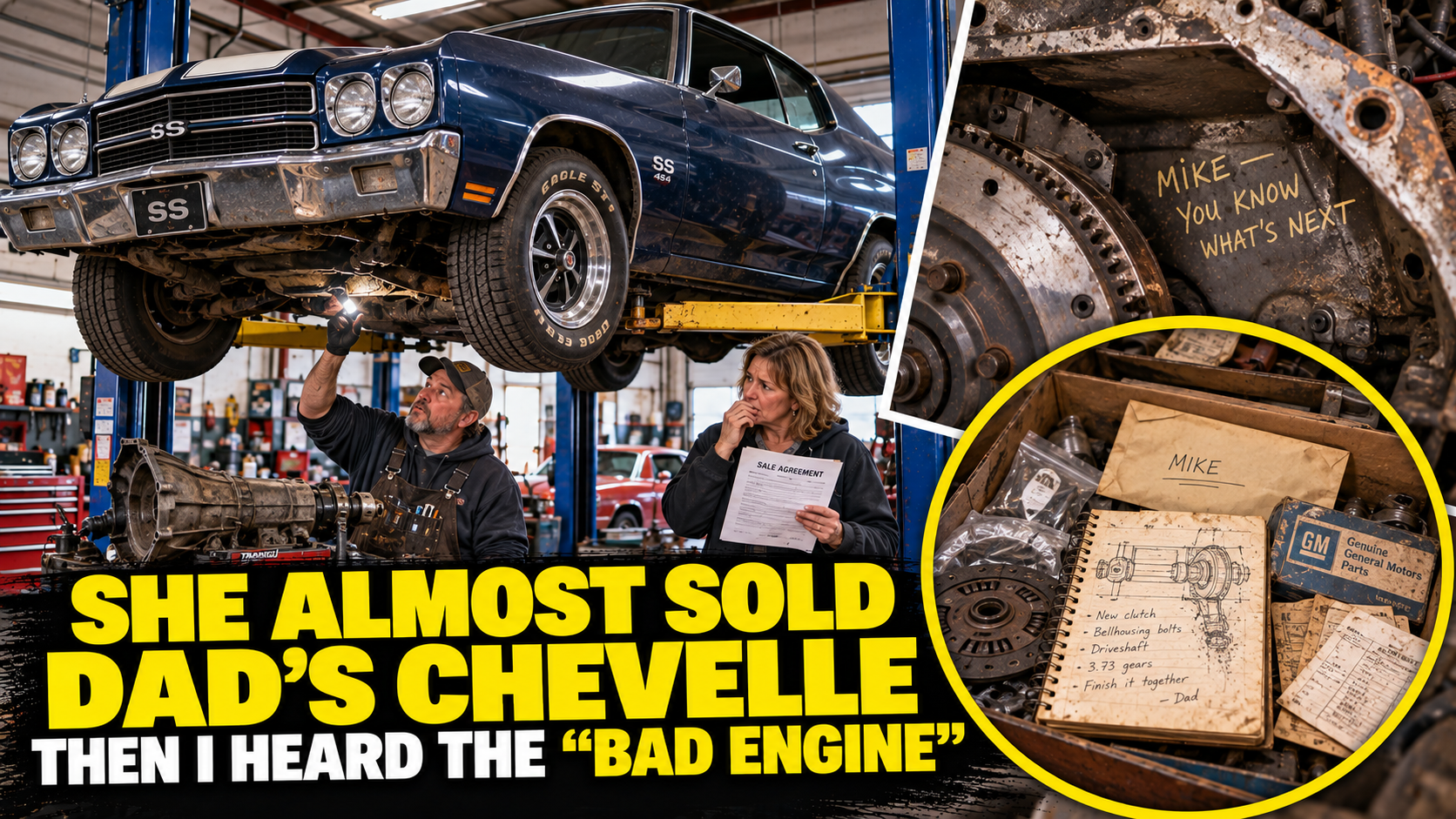
At the shop, we put it on a lift.
The inspection became interesting quickly.
Two bellhousing bolts were loose.
One fastener was missing.
There were signs of movement.
We removed the inspection cover.
Something in the clutch/flywheel area had been making contact.
My technician, Jordan, looked at me.
“Think that’s the knock?”
“Very possible.”
The more we inspected, the less I believed the engine itself was ruined.
That didn’t mean the car was fine.
Loose hardware around a rotating assembly isn’t something you ignore.
We decided to remove the transmission and inspect properly.
Amy stayed.
She rarely cared about mechanical work when we were young.
Now she watched every step.
Once the transmission was out, we found witness marks consistent with the noise.
Nothing about it looked like a destroyed engine.
Amy exhaled.
“So Dad’s motor isn’t blown?”
“Doesn’t look like it.”
“Then why were the bolts loose?”
That bothered me too.
Dad wasn’t perfect.
Nobody is.
But he was obsessive about certain things.
Bellhousing hardware was not something I could imagine him casually leaving loose.
Then Jordan called me over.
“Mike.”
He pointed to the back side of a metal surface normally hidden with the drivetrain assembled.
There was writing in paint marker.
Old.
Faded.
But readable.
MIKE — YOU KNOW WHAT’S NEXT.
Amy looked at me.
“What does that mean?”
I knew immediately.
I hadn’t heard those words in twenty-six years.
When Dad and I rebuilt the engine, we’d planned another modification.
Dad wanted to change the clutch and make several drivetrain improvements while everything was apart.
Money ran short.
I was seventeen and impatient.
I wanted the car running.
Dad finally agreed to reassemble it and revisit the rest later.
He put the unused parts into a cardboard box.
Before closing it, he wrote on top:
MIKE — YOU KNOW WHAT’S NEXT.
It became a family joke for a while.
Whenever something was unfinished, Dad would say it.
Garage shelves.
Fence repair.
My college paperwork.
“You know what’s next.”
I hadn’t thought about that box in years.
“It’s in Dad’s garage,” I said.
Amy frowned.
“What is?”
“A parts box.”
We drove back to Mom’s house.
Dad’s garage had been partially cleaned, but one tall metal cabinet remained untouched.
The lower door was stuck.
I pulled harder.
It opened with a metallic pop.
There were old fluids we needed to dispose of properly.
Belts.
Electrical parts.
Manuals.
And on the bottom shelf, a cardboard box.
The cardboard had softened with age.
Across the top, in Dad’s handwriting:
CHEVELLE.
Underneath:
MIKE — YOU KNOW WHAT’S NEXT.
Amy looked at me.
“You’ve got to be kidding.”
Inside were old clutch-related parts, hardware, notes, receipts and measurements from the project we’d planned.
Not everything was still usable.
I wouldn’t install decades-old components simply because they were sentimental.
But the notes explained what Dad had intended.
There was also a newer envelope inside.
That surprised me.
The paper wasn’t twenty-six years old.
Dad had added it later.
My name was on the front.
I opened it.
The letter was short.
Dad wrote that he’d noticed noise from the clutch area the last few times he drove the car.
He suspected something was loosening or wearing.
His health had already declined.
He didn’t have the strength to pull the transmission himself.
He wrote:
“If you ever have it apart again, don’t just tighten what’s loose. Finish it correctly.”
Then:
“I know I used to say we’d do it next winter. Apparently there are only so many winters.”
That line hurt.
Amy read over my shoulder.
Neither of us spoke for a while.
Then she said, “So he knew it had a problem?”
“Looks that way.”
“Why didn’t he tell us?”
“He just did.”
She rolled her eyes.
“You know what I mean.”
I did.
Dad was from a generation that could write a technical note about a car more easily than tell his kids what he wanted them to do with it.
The letter continued.
He didn’t demand that we keep the Chevelle.
That mattered.
He wrote:
“If neither of you wants the car, sell it. Cars are supposed to make life better, not become family arguments.”
Then:
“But don’t let somebody tell you it’s junk because it makes one bad noise.”
I laughed.
Amy didn’t.
She looked embarrassed.
“I almost did exactly that.”
“You didn’t know.”
“I should’ve called you first.”
“Yes.”
She gave me a look.
“Don’t enjoy this.”
I enjoyed it a little.
Then we had a bigger question.
What did we actually do with the car?
The buyer still wanted it.
Once he learned the engine likely wasn’t destroyed, his $18,000 offer suddenly looked much less attractive.
But repairing the Chevelle properly would cost money.
Amy wanted her share of the estate settled.
Mom didn’t want ongoing expenses.
I wanted the car but didn’t want family resentment attached to it.
So we did something Dad would have appreciated.
We wrote down the numbers.
Estimated repair cost.
Likely market range based on actual condition.
Storage.
Insurance.
What Amy needed.
What Mom wanted.
What I could afford.
No emotional guessing.
No “Dad would’ve wanted” arguments.
Just facts first.
Then I made Amy an offer for her share based on a fair valuation after repair.
She didn’t answer immediately.
“Are you going to keep it forever?”
“No.”
That surprised her.
“I thought you’d say yes.”
“Dad literally wrote that we don’t have to.”
“So why buy it?”
“Because I want to finish it once.”
That was the truth.
I wanted one chance to complete the job Dad and I had postponed since I was seventeen.
Amy agreed.
Mom agreed.
The Chevelle stayed at my shop.
We didn’t turn it into a wild restomod.
That wasn’t the point.
We inspected the engine carefully and confirmed the frightening noise had not been a catastrophic internal failure.
The clutch and related hardware needed attention.
Some old components showed wear.
We replaced what needed replacing with appropriate modern-quality parts.
We corrected the loose-fastener problem.
Checked the flywheel.
Inspected the transmission input area.
Addressed seals while access was easy.
Then I went through Dad’s old notes.
Some of his planned changes no longer made sense.
Parts technology had improved.
Some components in the box were too old to trust.
So I followed the spirit of his instruction, not every old part number.
Finish it correctly.
Jordan helped.
So did my son, Evan.
He was sixteen.
One evening I caught myself telling him to label the bolts.
Every bag.
Every bracket.
He complained.
I froze.
“What?” he asked.
“Nothing.”
“Why are you smiling?”
“Your grandfather just won an argument from the grave.”
Evan didn’t understand.
Someday he will.
When everything was ready, we lowered the Chevelle.
I checked our work twice.
Then once more because Dad would’ve.
I started the engine.
The big-block came to life.
No knock.
No metallic clack.
Just the familiar uneven sound of an old V8 settling into idle.
I pushed the clutch.
Quiet.
Released it.
Still quiet.
Jordan smiled.
“There you go.”
I sat behind the wheel longer than necessary.
The garage smelled like exhaust and old upholstery.
For a second, I was seventeen again.
Dad was leaning over the fender.
My hands were dirty.
We had no money.
And the whole world seemed to fit inside one garage.
Amy came by the next day.
I let her drive.
She hadn’t driven the Chevelle since high school.
She stalled it leaving the parking lot.
I laughed so hard she threatened to sell my tools.
On the second attempt, she got it.
We drove to Mom’s house.
Mom stood in the driveway when we arrived.
She put her hand on the roof.
Then she said, “Your father would complain that you took too long.”
Probably.
I kept the Chevelle through that summer.
Evan and I took it to a local cruise night.
Amy borrowed it once for her daughter’s graduation photos.
Mom rode in it one final time.
Then, the following spring, I made a decision that surprised everyone.
I sold it.
Not for $18,000.
Not to the man who tried to buy it as a supposedly blown-engine project.
I sold it to a local father and son who had followed the repair through my shop.
They understood what the car was.
They promised nothing.
I asked for nothing except a fair price.
Before they left, I handed the father a folder containing copies of Dad’s notes.
I kept the originals.
On top, I put one new page.
It listed the work we’d done.
Torque specifications.
Part numbers.
Dates.
Then I wrote:
YOU KNOW WHAT’S NEXT.
Evan saw it.
“Seriously?”
“Family tradition.”
I used part of my share from the sale to buy something smaller.
A rough 1967 Chevy C10 that Evan had been staring at for months.
No big-block.
No valuable history.
No connection to Dad.
Just a tired old pickup that needed work.
Evan looked confused when I brought it home.
“I thought Grandpa’s Chevelle was the family project.”
“It was.”
“Then why sell it?”
“Because finishing something doesn’t mean you have to own it forever.”
He thought about that.
Then he looked at the C10.
“What does this need?”
I handed him a marker and a box of plastic bags.
“First, you’re labeling everything.”
He groaned.
I smiled.
Dad would’ve loved it.
My sister nearly sold the Chevelle because somebody heard an ugly noise and gave her a frightening diagnosis.
The engine wasn’t ruined.
The car wasn’t junk.
And Dad hadn’t left us a command to preserve it forever.
What he left was better.
Finish the job correctly.
Don’t let one bad noise make the decision.
And when the work is finally done, understand that the lesson can matter more than the machine.
Dad’s Chevelle belongs to somebody else now.
But every time my son complains about labeling bolts on that old C10, I hear Dad in my own voice.
And I know exactly what’s next.