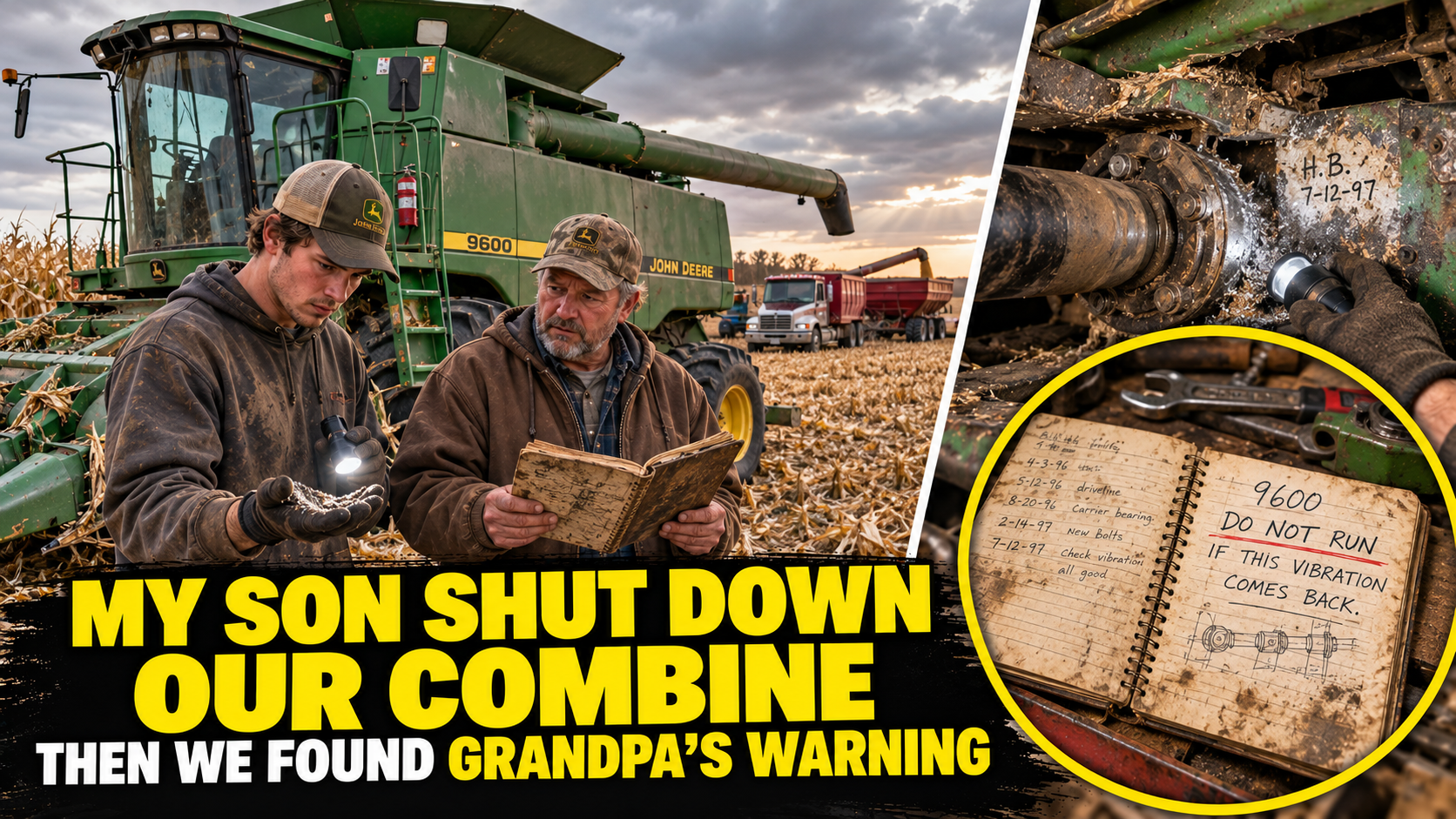
My twenty-four-year-old son shut our combine down with sixty-three acres of corn still standing.
Then he climbed out of the cab and told me he wasn’t starting it again.
I was furious.
Rain was supposed to move into our part of Iowa by the following afternoon.
The grain cart was waiting.
Two trucks were scheduled.
The corn was ready.
And our 1997 John Deere 9600 had already cost us almost two full days of harvest because of a vibration none of us could identify.
“Get back in it,” I told Tyler.
He shook his head.
“No.”
There are moments when your adult child suddenly looks twelve years old again.
That was one of them.
Same stubborn jaw.
Same look he used to give me when I told him to clean his room.
Except this time he was standing beside a machine worth far more than anything he’d owned at twelve.
“Tyler, we’ve got weather coming.”
“I know.”
“Then what are we doing?”
“Not wrecking Grandpa’s combine.”
That sentence made me angrier than it should have.
The 9600 had belonged to my father, Harold Bennett.
Dad bought it used in 2001.
He was the kind of farmer who could tell you what he paid for a machine twenty years later, including the interest.
He kept records for everything.
Fuel.
Repairs.
Seed.
Tires.
Bearings.
Even the little jobs most people would never write down.
When Dad slowed down, the combine became mine.
When he died six years ago, I kept running it.
Not because it was the newest machine in the county.
It wasn’t.
Not because it was perfect.
Definitely not.
I kept it because I knew it.
I knew which cab vent rattled.
I knew how long the unloading auger took to swing out.
I knew which grease fittings were easy to forget.
I knew the hydro handle had just enough wear that somebody unfamiliar with the machine always pushed it farther than necessary.
And I knew Dad had spent half his life keeping that combine going.
Tyler had grown up around it too.
He was eight the first time Dad let him ride through a full afternoon of harvest.
By twelve, he could identify half the machine’s noises.
By sixteen, he was running grain cart.
Now he was back on the farm full-time after finishing a diesel technology program.
That should have made me trust him.
Instead, that afternoon, all I could think about was the radar on my phone.
“What’s different now?” I asked.
“The vibration got worse.”
“You said that yesterday.”
“It did.”
“And we checked it.”
“We checked the obvious stuff.”
We had.
The vibration showed up mostly under load.
Not constantly.
It was worse in heavy corn.
We had inspected belts and pulleys.
Checked accessible bearings.
Looked over the feederhouse.
Checked the separator drive.
Greased everything we could reach.
Nothing was hot enough to scream failure.
Nothing was visibly coming apart.
I had convinced myself the old combine was simply being old.
Tyler hadn’t.
He crawled underneath again with a flashlight.
I stood beside the header watching clouds build in the west.
Five minutes later, he slid out.
His hand was closed.
“What?”
He opened it.
Fine metallic dust glittered across his palm.
Not dirt.
Not chaff.
Metal.
My anger disappeared.
“Where?”
“Near the drive.”
He led me underneath.
We removed an inspection cover.
Once the area was cleaned, the problem became easier to see.
There was movement where there shouldn’t have been.
Not dramatic.
Not yet.
But enough.
A mounting area around an older repair had begun to work.
The metal dust was evidence of parts shifting and wearing.
Tyler pointed his light at an old weld.
“Who did that?”
I knew immediately.
“Your grandpa.”
The weld wasn’t pretty.
Dad’s welds rarely were.
He believed appearance ranked somewhere below penetration, strength and getting back into the field.
Beside the repair were scratches in the paint.
At first, I thought they were random.
Then Tyler wiped the area.
Three numbers.
A date.
And the initials H.B.
Dad.
I recognized the year.
2008.
I stood up too quickly and hit my shoulder on the machine.
“What happened in 2008?” Tyler asked.
I remembered.
That harvest had been miserable.
Wet fall.
Mud.
Breakdowns.
Dad had spent half a night repairing the combine after something failed in the driveline.
I was running trucks then.
By the time I returned, he had it back together.
“What broke?” Tyler asked.
“I don’t remember exactly.”
“You were here.”
“I was thirty-four and thought your grandfather would live forever. I didn’t ask enough questions.”
That answer stayed between us.
Then Tyler said, “Grandpa wrote everything down.”
He was right.
Dad’s notebooks were still in the old shop.
We shut the combine down completely and drove back to the yard.
The shop looked almost the same as when Dad was alive.
Same steel workbench.
Same dented cabinet.
Same faded seed-company calendar that nobody had bothered to remove.
Dad’s notebooks were in a drawer beneath the bench.
There were dozens.
Some labeled by year.
Some by machine.
Some labeled so badly only Dad could have understood them.
Tyler found one marked:
9600.
The cover was stained with grease.
Several pages were loose.
We sat at the workbench.
The notes started when Dad bought the combine.
Hours.
Filters.
Belts.
Repairs.
Part numbers.
Then Tyler found a folded page.
At the top Dad had written in block letters:
9600 — DO NOT RUN IF THIS VIBRATION COMES BACK.
I read the line twice.
Underneath, Dad described the 2008 failure.
A driveline-related mounting area had cracked during harvest.
He had repaired the damaged area, replaced worn components and reinforced the mount enough to finish the season.
Later, he inspected it again and made additional repairs.
But he didn’t trust the area forever.
His note said that if the same vibration returned, the machine needed to be stopped and the repair checked before continued operation.
Tyler looked at me.
I didn’t say anything.
Dad had written the warning sixteen years earlier.
And I had nearly ignored the exact symptom.
The next line bothered me even more.
“Don’t let weather make the decision.”
That was Dad.
He knew exactly what harvest pressure did to farmers.
A storm appears on the forecast and suddenly every noise becomes something you can inspect tomorrow.
Every small leak can wait.
Every warning light becomes optional.
Dad had made the same mistakes.
Apparently he wanted me to avoid repeating one.
Tyler turned the page.
There was a rough sketch showing the repair area.
Measurements.
A reinforcement idea.
And a note about checking alignment before replacing anything.
“This is enough to start,” Tyler said.
“We’ve got sixty-three acres.”
“We’ll still have sixty-three acres if it rains.”
“And if the corn goes down?”
“Then we’ll pick slow.”
I stared at him.
He sounded like Dad.
That was irritating.
It was also probably why I finally listened.
We called our neighbor, Jim Wallace.
Jim farms ground about five miles east of us and runs a newer combine.
He was finishing soybeans.
I asked whether he knew anybody with shop space and experience on older 9600s.
He laughed.
“You’re standing in the county that kept those things alive for thirty years.”
Within an hour, we had two more sets of eyes on the problem.
We cleaned the area thoroughly.
Removed components necessary to inspect the mount.
The deeper we went, the worse it looked.
The old repair itself hadn’t simply “broken.”
Years of use had introduced wear.
A bushing was badly worn.
Movement had transferred load into the repaired mounting area.
That allowed the assembly to shift.
The shiny dust Tyler found was the warning.
If we had kept running, nobody could say with certainty whether it would have failed on the next pass or fifty acres later.
But continuing would have been gambling with an increasingly loose driveline.
Tyler looked at me.
“Still want me to get back in it?”
“No.”
He smiled.
I pointed at him.
“Enjoy this moment. You don’t get many.”
We made calls.
Parts availability became the next problem.
Some items were easy.
Others weren’t sitting on a shelf ten minutes away.
A dealer located what we needed.
Jim offered to drive for parts while we disassembled.
By evening, the shop floor was covered with tools.
The weather forecast got worse.
I checked my phone every twenty minutes.
Tyler finally took it away from me.
“Hey.”
“Give me that.”
“You told me Grandpa hated phones in the shop.”
“Your grandpa had a flip phone.”
“Exactly. Tradition.”
I laughed despite myself.
Around nine that night, we found another note in Dad’s notebook.
It wasn’t technical.
It was written in the margin beside the 2008 repair.
“Mark will push when he should stop.”
I stared at it.
Tyler read it over my shoulder.
Then laughed so hard he had to sit down.
“Grandpa knew you.”
“Apparently.”
Below that:
“He gets it from me.”
That shut both of us up.
Dad hadn’t written the note as criticism.
He was admitting something.
He knew his own habit had become mine.
Keep going.
Finish the field.
Get home before the rain.
Make the machine survive one more day.
That attitude had built the farm in some ways.
It had also broken plenty of equipment.
The next morning, parts arrived.
We repaired the worn area properly.
Not simply another harvest patch.
We replaced the worn pieces that had allowed the movement.
Checked alignment.
Inspected surrounding components.
Tyler insisted on going farther than I wanted.
This time I didn’t argue much.
By early afternoon, we were ready to test.
The sky was gray.
Wind had picked up.
I could smell rain.
Tyler climbed into the cab.
I rode with him.
We started slowly.
Empty machine first.
No unusual vibration.
Then into the corn.
The 9600 took the crop.
The engine loaded.
Everything sounded normal.
Tyler looked at me.
“Feel anything?”
“No.”
“Me neither.”
We made another pass.
Then another.
Still good.
I finally exhaled.
We weren’t going to finish before the rain.
That became obvious within an hour.
Drops hit the windshield.
Then more.
We stopped with forty-eight acres remaining.
A day earlier, that would have felt like failure.
Instead, I looked at the repaired machine and felt relieved.
The rain lasted most of the night.
We lost the next day too.
Some corn leaned.
Not enough to ruin us.
When the ground dried, we went back.
The combine ran.
No vibration.
No metal dust.
No ugly surprise.
We finished the field three days later than I wanted.
Nothing terrible happened.
That’s the part people sometimes forget about farming.
Not every delay becomes disaster.
Sometimes stopping is simply the correct decision.
A week after harvest, Tyler cleaned the combine.
I went into Dad’s shop and photocopied the notebook pages.
One copy went into my office.
One went into a sealed plastic sleeve inside the combine.
Then I took Dad’s original notebook home.
That evening, I read the entire thing.
There were notes about repairs I remembered.
Repairs I’d forgotten.
Repairs I never knew happened.
There were comments about weather.
Yield.
Neighbors.
Parts prices.
One page complained that I had borrowed a 15/16 wrench and not returned it.
I still have that wrench.
Near the back was a page titled:
THINGS TYLER SHOULD KNOW SOMEDAY.
I stopped.
Tyler would’ve been about eight when Dad wrote it.
The list wasn’t sentimental.
It was pure Harold Bennett.
How to check a bearing by temperature without burning your hand.
Where moisture collects in a particular connector.
Which grease fitting gets missed.
How to tell when the clean-grain elevator chain needs attention.
Then, at the bottom:
“Teach him why, not just how.”
I sat there for a long time.
I’d spent years teaching Tyler how to work.
How to weld.
How to change bearings.
How to listen for a failing component.
How to run equipment.
But that harvest, he taught me something Dad had apparently been trying to teach both of us.
Experience doesn’t mean you’re always the person who notices the problem first.
Being the father doesn’t make you the smartest person in the cab.
And finishing the field isn’t worth destroying the machine.
The following winter, Tyler and I went through the 9600 more thoroughly than we had in years.
We replaced several wear items before they became failures.
We corrected old wiring repairs.
Changed hoses.
Inspected chains and sprockets.
Cleaned grounds.
Checked areas Dad had mentioned in his notes.
Then Tyler did something I hadn’t expected.
He bought a notebook.
A cheap black one.
On the front he wrote:
9600 — CONTINUED.
“Seriously?” I asked.
“Grandpa’s book is full.”
The first entry was the harvest repair.
Date.
Machine hours.
Symptoms.
Metal found near the mount.
Parts replaced.
Alignment checked.
Then he wrote:
“Dad wanted to keep running.”
I grabbed the pen.
Underneath I added:
“Tyler was annoyingly correct.”
He laughed.
That notebook now stays in the shop.
We use it.
Not because we’re afraid of computers.
Not because every old farming tradition is better.
Because there is something useful about a record written by the person who heard the noise, held the broken part and made the repair.
The 9600 is still on our farm.
Eventually, we’ll replace it.
Machines don’t become immortal because they belonged to somebody you loved.
Dad understood that.
He never told us to keep the combine forever.
What he left was more practical.
A warning.
A sketch.
A few measurements.
And one sentence that probably saved us from a much more expensive harvest:
Don’t let weather make the decision.
I think about that whenever the forecast turns ugly and every farmer in the county starts pushing harder.
That afternoon, I thought my son was quitting with sixty-three acres left.
He wasn’t.
He was doing exactly what I’d spent years telling him a good mechanic should do.
Pay attention when the machine tells you something has changed.
And know when to shut it down.