A widow hired me to get her late husband’s 1969 Ford F-100 running so the family could sell it.
Twenty minutes after opening the hood, I realized somebody had deliberately made sure that truck would never start.
My name is Ray Collins.
I own a small repair and restoration shop outside Springfield, Missouri.
Most of our work is ordinary.
Brakes.
Suspension.
Cooling systems.
Electrical problems.
The occasional engine replacement.
But old vehicles have a way of bringing old stories through the door with them.
This Ford didn’t come through the door.
I went to it.
The owner, Carol Whitaker, called me on a Tuesday morning.
“My husband had an old pickup in the barn,” she said. “It’s been sitting forever. My sons say I should sell it, but nobody wants to buy it without hearing it run.”
“How long has it been sitting?”
“Seventeen years.”
I laughed.
“You might want to lower your expectations for the first afternoon.”
She laughed too.
At least she understood.
The Whitaker property was about forty minutes from my shop.
Carol’s husband, Earl, had died six months earlier.
He was seventy-two.
The family planned to sell part of the property, and the barn needed to be emptied.
When I arrived, Carol met me outside.
She was carrying a ring of keys and a cardboard box full of paperwork.
The barn doors fought us all the way open.
Then sunlight hit the truck.
I stopped.
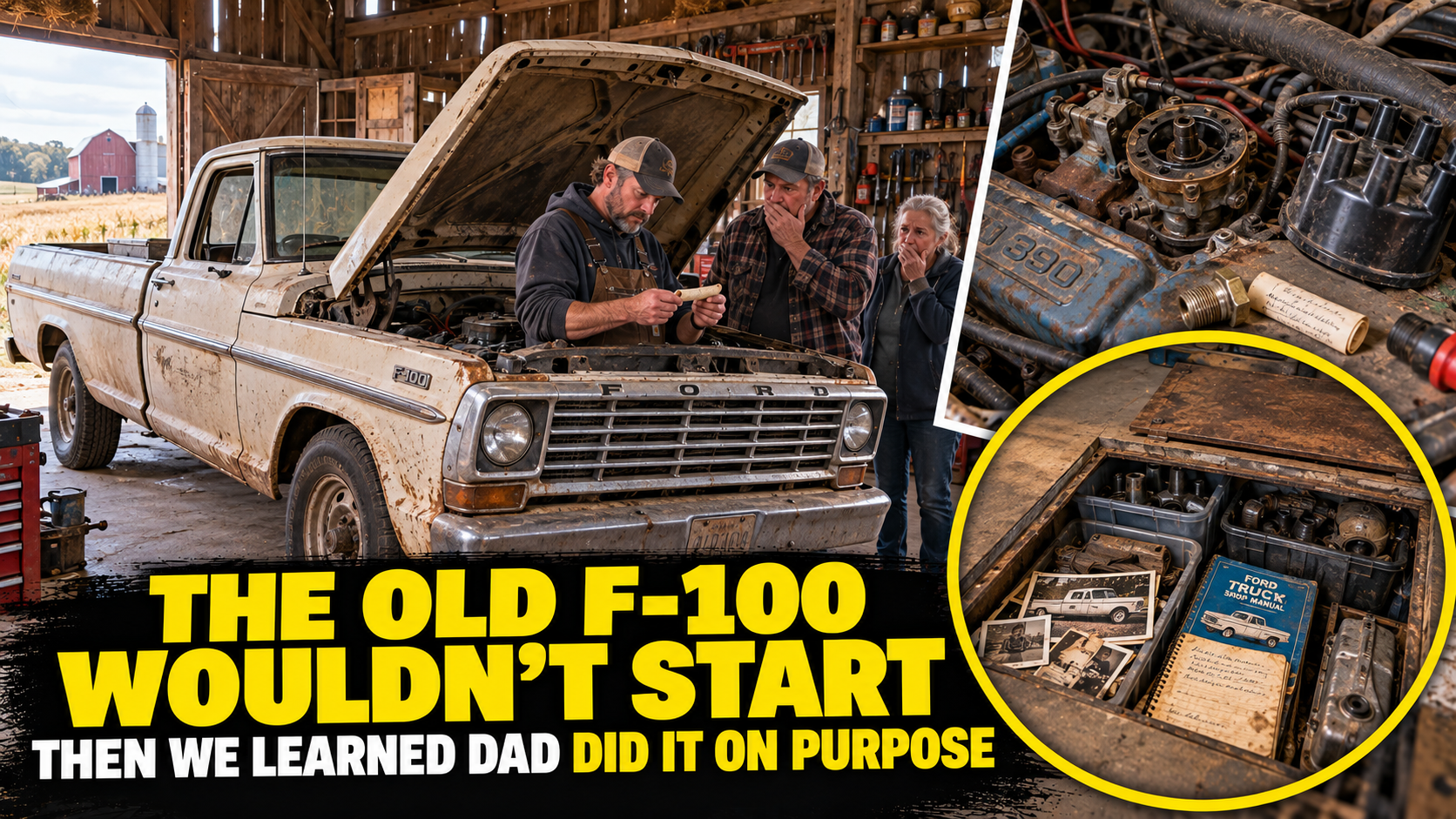
Even under the dust, it was a good-looking old Ford.
1969 F-100.
Regular cab.
Long bed.
Two-wheel drive.
Wimbledon White, or what remained of it.
A 390 V8 sat under the hood.
Four-speed manual.
Steel wheels.
Old farm-style rear bumper.
The body wasn’t perfect.
The driver’s fender had a dent.
The bed floor was scarred.
One cab corner needed attention.
But it was remarkably complete.
“Earl bought it when he was nineteen,” Carol said.
“He kept it that long?”
“He kept everything that long.”
I liked Earl already.
I walked around the truck.
Tires were old.
Brake system would need inspection before anybody moved it under power.
Fuel would be questionable.
Every rubber component deserved suspicion.
I explained that “make it run” and “make it safe to drive” were two different jobs.
Carol nodded.
“I just want to know whether the engine is still good.”
Fair enough.
I brought my helper, Mason, over later that afternoon with tools, a battery, fuel equipment and enough supplies to begin waking the truck carefully.
We didn’t pour gasoline down the carburetor and hit the key.
Seventeen years of sitting deserves more respect than that.
First, we checked whether the engine turned.
It did.
That was good.
Oil looked old but not obviously contaminated.
Coolant was low.
Fuel smelled terrible.
No surprise.
Then I removed the distributor cap.
I stared inside.
“Mason.”
“What?”
“Where’s the rotor?”
He leaned over.
“Gone.”
Exactly.
Not damaged.
Not broken.
Missing.
That was unusual.
Old trucks lose parts while sitting.
People borrow things.
Mice chew wires.
But a distributor rotor doesn’t usually remove itself.
We started looking closer.
The coil wire was missing too.
Mason found it in the glovebox.
Wrapped neatly inside a shop rag.
“Somebody didn’t want this started,” he said.
That was my thought.
Carol was standing nearby.
“Would Earl have done that?”
“Maybe.”
“Why?”
“No idea.”
We checked the ignition system more carefully.
Then Mason noticed one plug looked wrong.
At first glance, it resembled a spark plug body.
But there was no porcelain.
No terminal.
Just a threaded metal piece.
Somebody had made a plug specifically to fit the spark-plug hole.
That stopped me.
Removing a spark plug and replacing it with a storage plug can make sense for preservation under certain circumstances.
But why only one cylinder?
I removed it carefully.
Inside the hollow center was a tightly rolled piece of paper.
Mason looked at me.
“You’ve got to be kidding.”
I pulled the paper out with needle-nose pliers.
The handwriting was faded.
Six words:
BEN — BEFORE YOU START IT, LOOK DOWN.
Carol sat on an old wooden chair.
“Oh, Earl.”
“Ben your son?”
“Our oldest.”
“Can you call him?”
She looked uncomfortable.
“Ben and his father didn’t speak.”
“For how long?”
“Eleven years.”
That changed the atmosphere in the barn.
I didn’t ask why.
Carol volunteered part of it.
Ben had worked with Earl when he was younger.
They restored equipment together.
Cars.
Tractors.
The Ford.
Then they tried running a small construction business together.
It went badly.
Money got mixed with family.
There was an argument.
Ben left Missouri.
They spoke occasionally at first.
Then stopped.
“Did Earl ever try contacting him?”
“Yes.”
“Did Ben answer?”
“Sometimes.”
“What happened?”
“They were both stubborn.”
She looked at the truck.
“Very stubborn.”
I handed her the note.
“Do you want me to stop?”
“No.”
Then she changed her mind.
“Yes.”
We stopped.
The next morning Carol called Ben.
He almost hung up when she mentioned the truck.
Then she read Earl’s note.
According to Carol, the phone went silent.
Ben arrived the following afternoon.
He was forty-six.
Broad shoulders.
Work boots.
Hands that looked like he’d spent his life around machinery.
He walked into the barn and didn’t look at me.
He looked directly at the F-100.
“Still has that dent.”
Carol smiled.
“You put that dent there.”
“No. Dad put it there avoiding what I was about to hit.”
That was the first time I saw them laugh together.
I introduced myself.
Then showed Ben the missing rotor, the wrapped coil wire and the metal plug.
He shook his head.
“That’s Dad.”
“You know why?”
“No.”
I showed him the note.
Look down.
We all looked at the barn floor.
Nothing.
Concrete beneath the truck.
Dust.
Oil stains.
Ben walked around the Ford.
Then he crouched.
“Move it.”
“What?”
“The truck.”
I wasn’t comfortable dragging it without checking that the wheels would turn.
We inspected enough to move it safely by hand and with a winch.
The brakes weren’t locked.
We pulled the Ford forward several feet.
Under the spot where it had been parked was a rectangular steel plate almost flush with the concrete.
Years of dirt had hidden the edges.
Carol looked shocked.
“I’ve been in this barn thirty years.”
Ben smiled slightly.
“Dad poured this section himself.”
There was a recessed handle.
We lifted the plate.
Underneath was a shallow service pit.
Not deep enough to stand in.
More like a storage/service cavity.
Inside were two sealed plastic totes.
We pulled them out.
The first contained parts.
Distributor rotor.
Ignition components.
Several labeled bags.
A Ford shop manual.
Old photographs.
The second contained a notebook and one large wrapped metal component.
Ben unwrapped it.
An oil-pump driveshaft.
Beside it were several related parts.
I looked at the engine.
Then at the missing spark plug.
Then at Earl’s note.
Suddenly I understood why he had made the truck impossible to start.
“Did your dad have the engine apart before he parked it?”
Ben nodded slowly.
“We rebuilt the 390.”
“When?”
“2009.”
The same year the truck stopped running.
“What happened?”
Ben’s face changed.
“That was the last thing we worked on together.”
He told us.
The 390 had been tired.
Low oil pressure hot.
Leaks everywhere.
Burning oil.
Earl and Ben decided to rebuild it.
They pulled the engine.
Had machine work done.
Reassembled it in the barn.
Then the business argument happened.
Ben left before the job was finished.
“I thought Dad finished it himself.”
Apparently not.
The notebook confirmed that.
Earl had documented the build.
Clearances.
Torque specifications.
Parts.
Machine work.
But near the end, his notes changed.
One page read:
BEN LEFT TODAY.
The next few pages contained technical notes with almost no personal comments.
Then:
DO NOT START.
OIL PUMP DRIVE NOT INSTALLED.
PRIME SYSTEM FIRST.
I sat back.
That explained everything.
Earl hadn’t merely hidden a sentimental object.
He had prevented somebody from starting an engine that wasn’t ready.
Without the oil-pump drive properly installed and the lubrication system verified, firing the engine could have caused serious damage.
He removed the rotor.
Removed the coil wire.
Made the special plug.
Then hid the remaining parts under the truck.
It was the mechanical equivalent of locking the door and hiding the key.
“Why hide it?” Carol asked.
Ben looked at the notebook.
“He didn’t want anybody finishing it except me.”
That sounded possible.
But the next page made it clear.
Earl had written:
IF I DON’T GET BEN BACK HERE, SELL IT AS A NON-RUNNER. DO NOT LET SOMEBODY “SEE IF IT FIRES.”
Then underneath:
HE KNOWS WHAT’S LEFT.
Ben closed the notebook.
“I didn’t.”
“What?”
“I didn’t know what was left.”
He looked embarrassed.
“I left angry. I never came back to check.”
Carol said quietly, “Your father thought you would.”
Nobody had a useful answer to that.
We kept reading.
Near the back of the notebook was a letter.
Not hidden separately.
Just written across four pages.
It was addressed to Ben.
Earl didn’t apologize perfectly.
Some people don’t.
He admitted he’d mixed business decisions with family.
He admitted he’d spoken to Ben like an employee when he should’ve spoken to him like a son.
He also wrote that Ben had made mistakes too.
That sounded more like Earl, according to Carol.
The letter wasn’t a dramatic confession.
It was a stubborn man’s attempt to repair something using the only language he trusted.
Work.
He wrote:
“We left the Ford unfinished. Maybe that’s fitting. If you ever want to finish one thing with me, come home.”
Ben read that sentence several times.
“Did he send this?”
Carol shook her head.
“I never saw it.”
“Why wouldn’t he send it?”
She looked toward the barn door.
“Probably the same reason you never came.”
That landed hard.
Ben didn’t argue.
The family no longer wanted to sell the truck immediately.
Carol asked me what it would take to finish the engine correctly.
I gave her the answer mechanics hate giving.
“We don’t know until we inspect what was done.”
A notebook is useful.
Seventeen years is a long time.
We couldn’t assume everything remained perfect.
Ben asked whether he could help.
“Do you know what you’re doing?”
He gave me a look.
Then told me he was a heavy-equipment mechanic in Oklahoma.
“Okay,” I said. “You can help.”
We moved the F-100 to my shop.
The job became less about making an estate-sale truck start and more about verifying a seventeen-year-old unfinished engine build.
We inspected carefully.
The engine turned freely.
Cylinder condition looked encouraging.
We checked what we reasonably could without tearing down a good assembly unnecessarily.
We installed the missing components correctly.
Verified the distributor drive arrangement.
Changed fluids.
Addressed dried seals and hoses.
Cleaned the fuel system.
Rebuilt the carburetor.
Inspected wiring.
Before any attempt to start the engine, we primed the oiling system and verified oil delivery.
Ben stood beside me watching the gauge.
Pressure came up.
“Dad would’ve watched that for ten minutes.”
“How long are you going to watch it?”
“Eleven.”
Fair enough.
When we were satisfied, we prepared for the first start.
Carol came.
Mason came in on his day off.
Ben stood beside the driver’s door.
“You do it,” Carol told him.
He climbed in.
The engine cranked.
Nothing.
He stopped.
We checked.
Made an adjustment.
Tried again.
The 390 coughed.
Then fired.
For a few seconds it ran rough.
Smoke drifted from years of residue.
Then the idle began to settle.
Ben didn’t cheer.
He just sat behind the wheel with both hands resting on it.
Carol was crying.
I watched the oil-pressure gauge.
Because somebody had to.
We shut it down after the initial checks.
No dramatic revving.
No burnout.
No magical transformation.
There was still work to do.
Brakes.
Tires.
Cooling system.
Fuel hoses.
Suspension inspection.
Everything required after seventeen years asleep.
Over the next several months, Ben drove up from Oklahoma whenever he could.
He and Carol decided to keep the truck.
Not forever necessarily.
But long enough.
They didn’t restore it into something too perfect to use.
They preserved the old paint.
Fixed the mechanical problems.
Repaired the seat.
Made it safe.
Ben refused to repair the dent in the driver’s fender.
“Dad saved me from hitting a concrete post when I was seventeen,” he said. “That’s his dent.”
The first real drive happened in spring.
Ben drove.
Carol sat beside him.
I followed in my service truck because I don’t trust anything merely because it has become emotionally important.
The F-100 made the entire trip.
Twenty-two miles.
No overheating.
Good oil pressure.
No strange noises.
When we returned, Ben parked it outside my shop and let the 390 idle.
“You know what’s stupid?” he said.
“What?”
“I spent eleven years waiting for him to call me.”
I leaned against the shop door.
“He spent eleven years waiting for you to walk into the barn.”
“Yeah.”
He looked at the Ford.
“That’s a lot of wasted time.”
I couldn’t disagree.
A year later, Carol still owns the F-100.
Ben takes it to local shows when he’s in Missouri.
Not fancy shows.
Mostly community events where people actually like trucks with dents.
The steel floor cover is still in the barn.
The shallow pit is empty now.
Ben keeps Earl’s notebook.
The strange metal spark-plug substitute sits on a shelf in my office because Ben gave it to me.
“Good reminder,” he said.
“For what?”
“Don’t start something before you know what’s missing.”
I thought he meant engines.
Maybe he did.
But I kept it.
People like to imagine barn finds as forgotten machines waiting for somebody to turn a key.
Real old vehicles are rarely that simple.
Fuel goes bad.
Rubber dries out.
Brakes seize.
Wiring corrodes.
Engines that were “running when parked” may have been parked for a reason.
Earl knew that better than most.
That’s why he removed the parts required to start his Ford.
He wasn’t trying to create a mystery.
He was protecting an unfinished engine from the next person who might show up with a battery and too much confidence.
But he was also protecting something else.
One unfinished job.
One last reason for his son to come back into the barn.
Earl never got to hear the 390 run again.
Ben did.
And when that old Ford finally started after seventeen years, the most important thing we restored wasn’t under the hood.
It was the part of a father-and-son story that both men had left unfinished.