A woman brought an old red Chevy pickup into my shop because it kept dying at stoplights.
Before she handed me the keys, she lowered her voice and said something I wasn’t expecting.
“Please don’t tell my husband what you find.”
I’ve been repairing vehicles for twenty-six years.
Usually when someone says that, there’s a story coming.
Sometimes it’s a surprise repair bill.
Sometimes somebody has been ignoring a warning light for six months.
Once it was a man who had filled his wife’s diesel Volkswagen with gasoline and wanted me to somehow make the evidence disappear.
This was different.
The woman introduced herself as Melissa Carter.
She was forty-three, maybe forty-four.
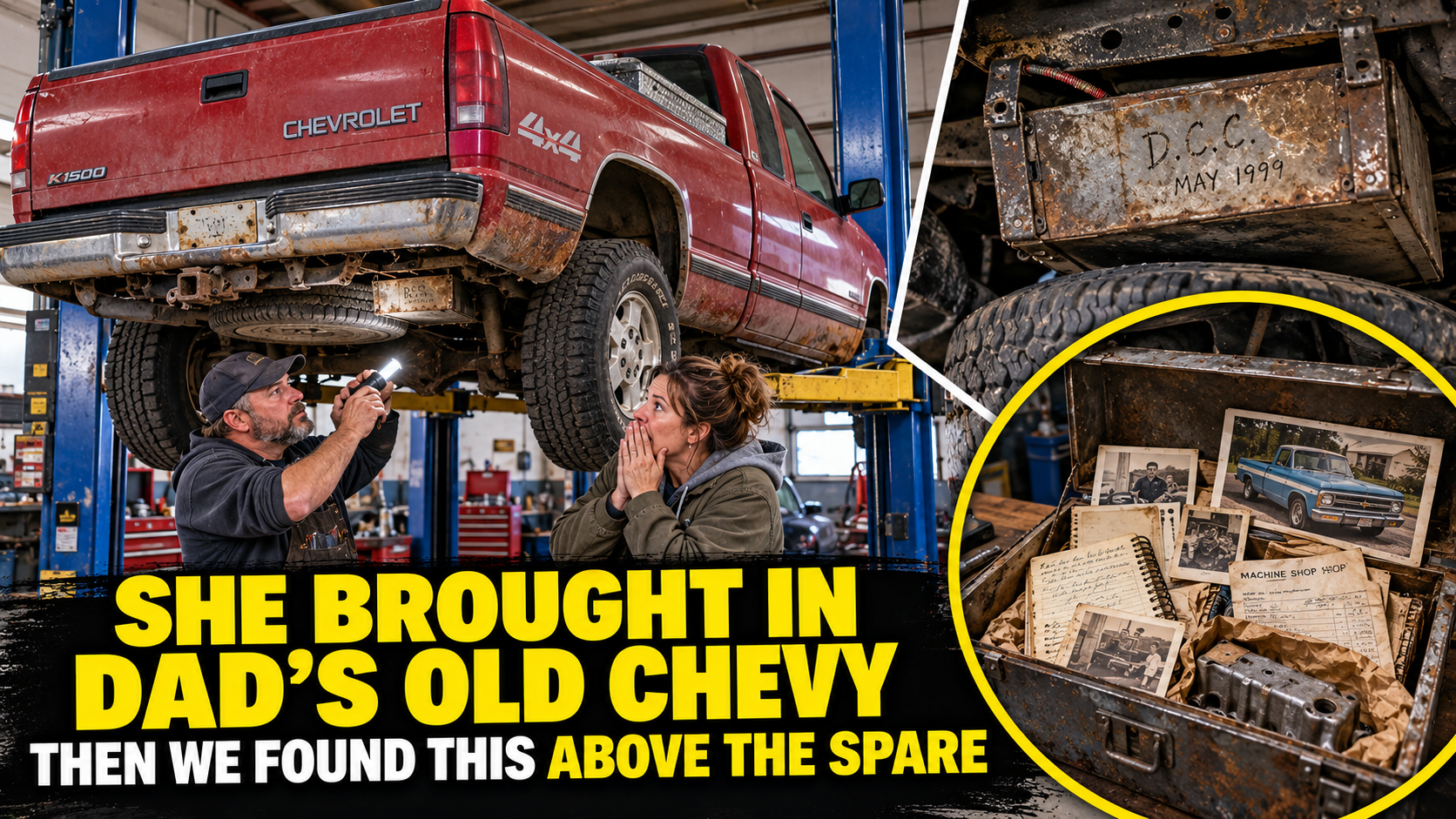
The truck was a faded red 1996 Chevrolet K1500 extended cab.
Four-wheel drive.
5.7-liter Vortec.
Almost 280,000 miles.
The driver’s side rocker panel was rusty.
The bench seat was cracked.
One wheel didn’t match the others.
There was an old aluminum toolbox in the bed and a faded farm-supply sticker in the rear window.
It looked exactly like what it was.
An old working truck that had survived long enough to become part of somebody’s family.
“What’s your husband got against it?” I asked.
Melissa looked back at the Chevy.
“Everything.”
She almost smiled.
“He says I’ve spent more keeping it alive than it’s worth.”
“He may not be wrong.”
“I know.”
That surprised her.
Then I added, “Doesn’t mean you have to sell it.”
She nodded.
“It was my dad’s.”
That explained more than any service history could.
Melissa’s father, Dean, had bought the truck used when she was a teenager.
He worked construction and did small equipment repairs on the side.
According to Melissa, the Chevy went everywhere with him.
Job sites.
Hardware stores.
Fishing trips.
School pickup.
She learned to drive in it.
Then, when Melissa was sixteen, her father left.
Not died.
Left.
One morning he was there.
A week later he wasn’t.
Her parents had been arguing for months.
Dean packed clothes, some tools and a few personal things.
He told Melissa he needed time.
Then he moved out of state.
For years, contact was inconsistent.
A birthday card.
An occasional phone call.
Then less.
Eventually almost nothing.
The truck stayed behind because it was titled in Melissa’s mother’s name at the time.
When her mother bought another vehicle, the Chevy became Melissa’s.
“Your dad’s still alive?” I asked.
“As far as I know.”
That answer told me not to push.
I wrote up the work order.
Customer complaint: engine stalls intermittently at idle and low speed after warming up.
That was normal enough.
The request about her husband wasn’t.
“What exactly don’t you want me telling him?”
Melissa hesitated.
“He wants me to stop putting money into it.”
“Okay.”
“If it’s something expensive, call me first.”
“That’s standard.”
“He may call you.”
“I don’t discuss a customer’s vehicle with someone else unless you authorize it.”
She visibly relaxed.
“Thank you.”
I handed the truck to my apprentice, Noah, with instructions to start with basics.
Noah was twenty-two and smart enough to know he wasn’t done learning.
That’s why I liked him.
We verified the complaint that afternoon.
Cold, the Chevy ran fairly well.
Once warm, idle quality deteriorated.
It stumbled at a stop.
Restarted.
Then stalled again while backing into the bay.
Fuel pressure on those Vortec trucks matters.
So did ignition condition.
Vacuum leaks.
EGR problems.
Dirty injectors.
We weren’t going to fire a parts cannon at it.
We checked codes.
Nothing gave us a clean answer.
We started working through the basics.
That’s when Noah called me over.
“What’s this?”
He had removed the air-cleaner assembly while inspecting some deteriorated hoses.
A small wire had been routed along the firewall.
It wasn’t part of the factory harness.
It had been wrapped carefully and disappeared through an old grommet.
“Aftermarket something,” I said.
“Alarm?”
“Maybe.”
We followed it under the dash.
The wiring was old.
Not something installed recently.
Behind the lower dash panel was a relay.
Above the parking-brake pedal, almost invisible unless you were on your back with a flashlight, was a tiny toggle switch.
Noah flipped it.
Nothing obvious happened.
“Leave it where it was,” I said.
We traced the wiring farther.
It ran along the cab.
Then toward the rear.
That was unusual.
Not impossible.
People install all kinds of things in trucks.
Auxiliary lights.
Fuel pumps.
Trailer equipment.
Radios.
But there were no extra lights.
No obvious accessories.
We put the K1500 on the lift.
The wire followed the frame toward the spare tire.
Noah shined his light upward.
“Uh… boss?”
“What?”
“You need to see this.”
Above the spare tire, tucked between the frame rails, was a rectangular steel box.
It was maybe fourteen inches wide.
Flat.
Weathered.
Bolted to two homemade brackets.
Not factory.
I lowered the truck.
Then called Melissa.
“I found your stalling problem?”
“Not yet.”
“Then what’s wrong?”
“Maybe nothing. But there’s something attached under the back of your truck.”
She was quiet.
“What kind of something?”
“A steel box.”
“I don’t understand.”
“Neither do I.”
She arrived forty minutes later.
We raised the Chevy again.
When she saw the box, she looked genuinely confused.
“I’ve never seen that.”
“You wouldn’t unless the spare was down or the truck was on a lift.”
Noah wiped years of dirt from the lid.
Three letters appeared.
D.C.C.
Melissa reached upward.
“Dean Charles Carter.”
“Your dad?”
She nodded.
Then Noah found a scratched date.
May 14, 1999.
Melissa stepped backward.
“What?”
Her face had changed.
“What is it?”
“That was the week he left.”
Nobody spoke for a moment.
The box was locked.
Not with a padlock.
The lid used a small tubular lock.
Melissa didn’t have a key.
I told her we could stop.
She said no.
“This is my truck.”
We carefully removed the box from its brackets.
On the workbench, I drilled the lock.
The lid opened.
No money.
No jewelry.
No dramatic pile of secrets.
Mostly paper.
Old receipts.
Several Polaroid photographs.
A small spiral notebook.
A few metal parts wrapped in shop towels.
One photograph showed the Chevy parked beside an older blue Chevrolet C10.
Another showed Dean standing beside an engine on a stand.
Melissa picked it up.
“I’ve never seen this truck.”
“The blue one?”
She nodded.
The notebook contained measurements.
Part numbers.
Compression readings.
Machine-shop notes.
It looked like somebody documenting an engine build.
One receipt was from Hartman’s Machine & Engine Service.
May 1999.
The address was less than forty miles away.
The receipt listed machining work for a small-block Chevrolet.
Bore.
Hone.
Crank polish.
Valve work.
Melissa turned the receipt over.
On the back, her father had written:
“For Mel’s truck.”
She stared at it.
“My truck?”
I looked toward the K1500.
“This isn’t for a Vortec 5.7.”
The part numbers and notes suggested an older small-block project.
The blue C10 suddenly seemed more important.
We found another photograph.
This one showed a much younger Melissa standing beside that blue truck.
She looked maybe five years old.
“I don’t remember this.”
On the back:
“Mel says blue is faster.”
For the first time since opening the box, she laughed.
Then cried immediately afterward.
I gave her space.
Eventually she asked, “Why would he hide this under the Chevy?”
“I don’t know.”
The toggle switch and relay were still unexplained too.
The wiring ended near the box but didn’t actually power it.
We discovered it had once controlled an auxiliary work light mounted near the rear bumper.
The light had disappeared years ago.
So the electrical mystery wasn’t connected to the box after all.
That mattered.
Real repairs don’t always tie every clue into one perfect story.
The stalling issue didn’t either.
We eventually found the engine was losing fuel pressure as it warmed up.
The pump was weak, and the electrical connector at the tank showed heat damage.
That explained the stalling.
But by then, nobody cared only about the fuel pump.
Melissa wanted to know about the blue C10.
Hartman’s Machine & Engine Service was still open.
I knew of the place but had never done business there.
Melissa called.
The owner, Robert Hartman, was seventy-four.
When she mentioned Dean Carter, he remembered the name.
When she described the photographs, he asked her to come by.
Melissa asked whether I’d go with her.
I almost said no.
Mechanics get pulled into family situations because we happen to be standing beside the machine when the story begins.
But I was curious too.
So the following Friday, we drove to Hartman’s.
Robert was a thin man with white hair and hands permanently stained by a lifetime of engine work.
Melissa put the photograph on his counter.
He stared at it.
“That’s Dean.”
“You knew him?”
“Knew him pretty well for a while.”
He pointed at the blue C10.
“That was supposed to be yours.”
Melissa looked at him.
“What?”
“Your dad was building it for you.”
She laughed in disbelief.
“I was sixteen when he left.”
“Exactly.”
Robert disappeared into the back office.
He returned with an old file folder.
On the tab:
CARTER — 72 CHEVY.
Inside were invoices matching the receipts from the steel box.
Dean had bought a 1972 Chevrolet C10 project.
He had been rebuilding a small-block for it.
The plan, according to Robert, was to finish the truck for Melissa before she graduated high school.
“Then why didn’t he?”
Robert’s expression changed.
“That’s where things got ugly.”
Dean’s construction business had failed.
Not slowly.
Quickly.
A contractor owed him a large amount of money.
Dean had personally guaranteed equipment debt.
Bills piled up.
His marriage was already struggling.
“He sold almost everything,” Robert said.
“Including the C10?”
Robert nodded.
“The project truck, tools, equipment. He was trying to keep creditors from taking the house.”
Melissa said nothing.
That didn’t excuse leaving his family.
Robert didn’t pretend it did.
“He handled it badly,” he said. “Really badly.”
“Did he ever talk about me?”
“All the time.”
That hit her harder than I expected.
Robert pulled out another paper.
It was a photocopy of a handwritten letter.
Dean had left it with the engine parts.
The original, Robert said, had gone with Dean.
The letter was addressed to Melissa.
He apparently never mailed it.
It said he had promised her a truck and failed.
It said he was ashamed.
It said he kept thinking he would come back once he had fixed his financial mess.
Then months became years.
Pride became distance.
Distance became habit.
Melissa read the photocopy twice.
Then she asked the obvious question.
“Why was all of this hidden under the K1500?”
Robert didn’t know.
But I had an idea.
Dean had left the Chevy behind.
Maybe the steel box was his way of leaving part of the unfinished project with the one vehicle he knew Melissa would eventually recognize.
Or maybe he planned to come back.
We couldn’t know.
I told Melissa that.
She appreciated that I didn’t turn a guess into an answer.
Two days later, she called me.
“I found him.”
“Your father?”
“Yes.”
Dean lived in Arkansas.
He was seventy-one.
She had found a current address through an old relative.
“Are you going to contact him?”
“I don’t know.”
A week passed.
Then another.
Meanwhile, we repaired the Chevy.
New fuel pump module.
Repaired connector.
Fresh filter.
A few cracked vacuum hoses.
Plugs and wires because they were overdue, not because I wanted to sell her everything under the hood.
The truck ran better than it had when it arrived.
When Melissa picked it up, I gave her the steel box and everything inside.
She looked at the K1500.
“My husband is going to hate that this thing runs again.”
“Tell him I apologize.”
She laughed.
Then she left.
I assumed that was the end.
Three months later, the red Chevy returned.
This time another vehicle followed it.
A silver sedan.
Melissa climbed out of the Chevy.
An older man stepped from the sedan.
Thin.
Gray hair.
Work boots.
He stood in the parking lot staring at the truck.
I knew before she introduced him.
“This is my dad.”
Dean Carter held out his hand.
“You the mechanic who found my box?”
“Technically my apprentice found it.”
Dean smiled.
“Then he’s got better eyes than I did at his age.”
Melissa’s relationship with him wasn’t magically repaired.
She made that clear.
One phone call didn’t erase twenty-seven years.
Neither did one explanation.
Dean had made choices.
Some were understandable.
Some weren’t.
He admitted that.
What surprised me was why they came to the shop.
Dean wanted to show Melissa something.
He opened the trunk of the sedan.
Inside were several old photographs and a small metal emblem.
CHEVROLET.
From the 1972 C10.
“I kept one piece,” he said.
Melissa picked it up.
Then Dean asked me a question.
“You know anybody with an old C10 project?”
I laughed.
“You’re seventy-one.”
“So?”
Melissa folded her arms.
“Don’t encourage him.”
I knew a guy.
Of course I knew a guy.
Mechanics always know a guy.
The truck we found wasn’t a 1972.
It was a 1971 short-bed C10 roller that had been sitting in a barn for years.
No engine.
No transmission.
Rust in the usual places.
Not valuable enough to be untouchable.
Not clean enough to be easy.
Perfect.
Melissa bought it.
Not Dean.
That distinction mattered to her.
They started rebuilding it together.
Slowly.
Dean lived several hours away, so he came up once or twice a month.
Sometimes they worked in my shop after hours.
Sometimes they argued.
Sometimes Melissa went home early.
Sometimes Dean did.
Reconciliation isn’t a restoration video.
There isn’t a time-lapse where every ugly part disappears in eight minutes.
Old damage stays visible.
Some parts can be repaired.
Some need replacing.
Some scars remain even after the truck is back on the road.
A year and a half later, the C10 moved under its own power.
Melissa chose blue paint.
When I asked why, she smiled.
“Apparently blue is faster.”
Her father laughed from across the shop.
The red K1500 is still running too.
Her husband eventually stopped asking when she planned to sell it.
At least that’s what she tells me.
The little steel box is no longer under the spare tire.
Melissa cleaned it and mounted it on the garage wall above the C10’s workbench.
Inside she keeps copies of the old photographs and her father’s unfinished letter.
The original papers stay somewhere safer.
As for the hidden toggle switch that started the whole investigation?
It wasn’t a secret alarm.
It wasn’t connected to hidden money.
It wasn’t evidence of anything dramatic.
It had controlled an old rear work light Dean installed when he used the truck on construction sites.
Twenty years later, the light was gone and only the wiring remained.
That’s how old vehicles really are.
Some mysteries have ordinary answers.
Others don’t.
Melissa originally came to my shop because her Chevy stalled at stoplights.
A failing fuel pump brought her in.
A piece of non-factory wiring made us look closer.
And a steel box above the spare tire reopened a story that had been sitting unfinished since 1999.
I fix vehicles for a living.
Most days, a bad fuel pump is just a bad fuel pump.
But every once in a while, an old truck comes through the door carrying something no scan tool can find.
Not because the truck remembers.
Because people do.