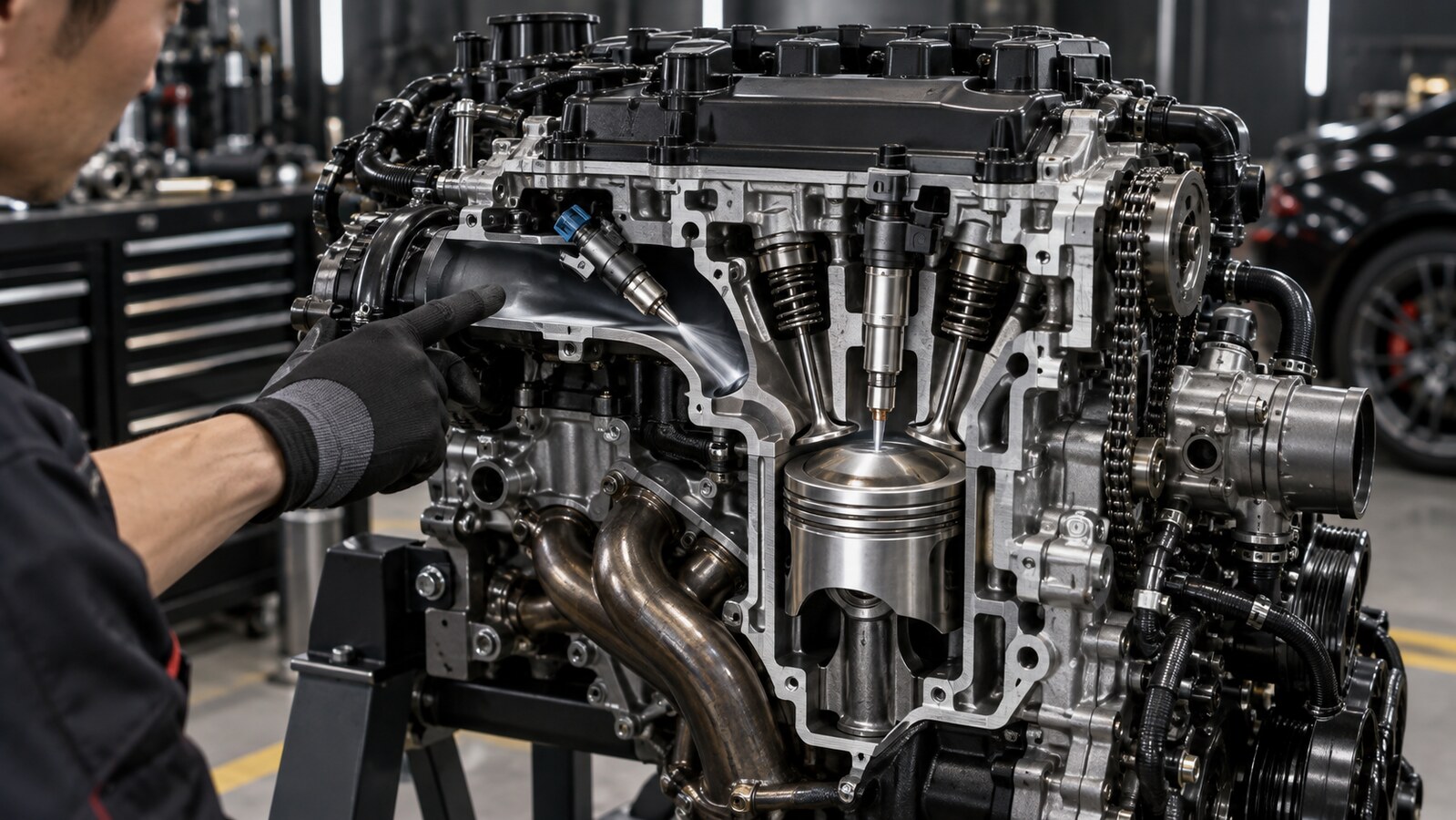
Look at the fuel system on many Toyota and Lexus engines and you may find something unusual: two injectors for each cylinder. One sprays fuel into the intake port. The other injects directly into the combustion chamber.
Toyota calls this strategy D-4S. It is not redundant hardware added for marketing. The engine computer can use port injection, direct injection, or a combination of both according to operating conditions.
Port injection and direct injection solve different problems
A port injector sprays upstream of the intake valve. The fuel has time to mix with incoming air before the mixture enters the cylinder. That can support smooth operation and good mixture preparation under conditions where direct injection is not necessary.
A direct injector delivers fuel into the combustion chamber at much higher pressure. Precise injection timing can help control combustion, support higher compression ratios, and improve performance and efficiency under demanding operating conditions.
Toyota’s official description of D-4S says the system combines higher-pressure direct injection with lower-pressure port injection and applies each method according to specific driving parameters.
Why use both?
The two systems give engineers more control over how the air-fuel mixture forms. At some engine speeds and loads, port injection may provide the desired mixture. Under other conditions, direct injection can offer better charge control. Using both can broaden the engine’s efficient operating range.
The exact strategy changes by engine family, temperature, load, and calibration. Owners should be cautious with oversimplified internet claims such as “port injection is always used at low rpm” or “direct injection only activates at full throttle.” The control logic is more complex than a single switch point.
Does port injection keep the intake valves clean?
Port-injected fuel passes over the back of the intake valve, so it can provide a washing effect that a direct-only injector cannot. That is one practical advantage of having port injectors available.
However, D-4S does not make an engine immune to deposits. Oil vapor from crankcase ventilation, operating conditions, maintenance history, and engine design still matter. No owner should assume that dual injection eliminates every possible intake-deposit problem.
What owners should know about service
- Use the specified fuel. Follow the owner’s manual for octane and fuel quality instead of assuming every D-4S engine needs the same grade.
- Use the correct oil and interval. Oil condition affects variable valve timing, turbochargers where fitted, and overall engine cleanliness.
- Do not guess when diagnosing a misfire. A cylinder may have a port injector, a direct injector, ignition components, compression issues, or an air leak. Scan data and proper testing matter.
- High-pressure fuel systems require caution. Direct-injection fuel pressure can remain dangerous after shutdown. Follow factory depressurization procedures.
More hardware means more diagnostic possibilities
A dual-injection engine has additional injectors, wiring, seals, and fuel-delivery components. That does not make it unreliable by definition, but it does mean parts should not be replaced based only on a generic code.
Fuel trims, misfire counters, injector command, fuel pressure, ignition performance, and mechanical condition should be evaluated together. If one cylinder is lean or misfiring, determine whether the fault follows a particular injector system or appears across both.
The simple explanation
Toyota D-4S gives the engine computer two tools instead of one. Port injection and direct injection each have strengths. Combining them lets the calibration choose the method—or mixture of methods—that best fits the moment.
For the owner, the best approach is equally simple: follow the correct fuel and oil specifications, avoid miracle-cleaner promises, and diagnose problems with data rather than assumptions.
Sources
- Toyota Global Newsroom: D-4S technical description
- Toyota Global Newsroom: GR86 D-4S twin-injector operation
Featured image source: Original AI-generated editorial image created exclusively for MechanicCarWorld, September 22, 2026.