FICTIONAL STORY
This original story is fictional. Its people and events are invented and are not presented as real news.
Part 1: The $600 RB26
I bought a seized Nissan RB26 engine for $600 because everyone else at the auction thought it was scrap.
When I removed the valve cover, I found my brother’s name scratched into the aluminum.
My brother Daniel had been gone for eleven years.
The engine sat on a wooden pallet behind a closing speed shop outside Tacoma. It was missing its turbos, the wiring harness had been cut, and rusty water dripped from one coolant passage.
The auction tag said only: NISSAN ENGINE — CONDITION UNKNOWN.
I knew enough to recognize the twin-cam head and the familiar RB lettering. I also knew enough to understand that buying it was probably a terrible decision.
“Six hundred, and it becomes your problem,” the shop owner said.
I hauled it home in the back of my pickup and lowered it onto an engine stand in my garage.
Daniel was the reason I loved Japanese cars. In high school, he covered his bedroom wall with Skyline posters and spent entire weekends explaining turbochargers to me with drawings on pizza boxes.
He never owned a Skyline. Neither of us could afford one. But during the summer after graduation, he worked nights at a machine shop and told me he was helping build “something special.”
He refused to say more.
Months later, Daniel died when a distracted driver crossed the centerline and hit his small pickup. Our family packed away his tools, posters, and notebooks. Whatever he had been building disappeared with him.
In my garage, I removed the RB26 valve cover and wiped away the brown film beneath it.
There, beside the number-six cam cap, someone had etched:
DAN M. — 7/14/09 — KEEP IT UNDER 8.
Daniel’s full name was Daniel Mercer.
July 14, 2009, was six weeks before he died.
I called the speed shop owner immediately.
“Where did this engine come from?”
He hesitated. “Old storage unit. Belonged to a customer named Russ.”
“Russ what?”
“I don’t know. The paperwork disappeared years ago.”
I spent the next three nights tearing down the engine. The crank would not turn because two cylinders had filled with corrosion, but the internal parts told a different story. The crankshaft had been balanced. The oil passages were hand-finished. Each connecting rod carried a tiny blue paint mark exactly where Daniel used to mark bolts on his dirt bike.
Inside the oil pan, stuck to the pickup with hardened sealant, I found a small brass key.
It had a number stamped into it: 2147.
The following morning, someone left a voicemail from a blocked number.
“Stop taking that engine apart,” a man said. “Your brother already paid enough for it.”
Part 2: Storage Unit 2147
The brass key opened a storage unit 20 miles from the old speed shop.
Inside were four wheels, two dusty racing seats, a set of factory Skyline gauges, and a gray car cover draped over something low and wide.
I pulled it back.
Underneath was a battered Nissan 240SX shell with a widened transmission tunnel and fresh engine mounts. On the windshield, Daniel had taped a yellow note:
FOR MATT. DO NOT LET RUSS SELL IT.
My name is Matt.
A binder on the passenger floor contained photographs of Daniel machining parts, receipts for the RB26, and a handwritten build plan. He had been creating the car for my eighteenth birthday.
The final page listed a debt of $4,700 owed to someone named Russ Calder.
Then I heard the storage building’s outer door open.
A man in a black jacket stopped outside Unit 2147 and stared at the uncovered car.
“Your brother never told you what that engine did, did he?” he asked.
Part 3: Keep It Under Eight
Russ Calder was not a collector or a thief. He had been Daniel’s supervisor at the machine shop.
Daniel had bought the damaged RB26 from a wrecking yard and worked off the cost after hours. Russ supplied parts, machine time, and the storage unit. The $4,700 in the binder was not a debt Russ expected to collect. It was the value of labor and parts Daniel insisted on documenting.
“He wanted every number correct,” Russ said. “He said if anything happened, you should know nobody gave him the project. He built it.”
After Daniel died, Russ could not bring himself to call our family. He paid the storage bill for a decade. When his business failed, the RB26 was mistakenly moved to the speed shop auction while the car remained behind.
The warning—keep it under eight—referred to engine speed. Daniel had chosen valve springs and oil-pump parts intended for a reliable street build, not a dyno hero chasing an 8,000-plus-rpm number.
“Your brother said fast cars are easy,” Russ told me. “Cars that come home are harder.”
The block could not be saved, but the cylinder head, crankshaft, intake, and many of Daniel’s carefully prepared parts could.
For the next eighteen months, Russ and I rebuilt the engine around a usable block. We kept Daniel’s paint marks. We reused every safe part his hands had touched. We finished the 240SX in the same quiet gray he had chosen in his notebook.
On the first startup, the engine stumbled, coughed, and then settled into a smooth mechanical idle.
I expected the moment to feel loud. Instead, Russ and I stood silently in the garage while the oil pressure climbed.
I never turned the car into a race build. I never chased a giant horsepower number. The rev limiter is set below 8,000 rpm, exactly as Daniel wrote.
Once a year, on July 14, I drive it along the mountain road where he taught me to heel-and-toe in his old Civic. I bring the binder and the brass key.
The engine I bought as scrap did not give me my brother back.
But it gave me the last thing he built for me—and one final lesson about finishing carefully enough to make it home.
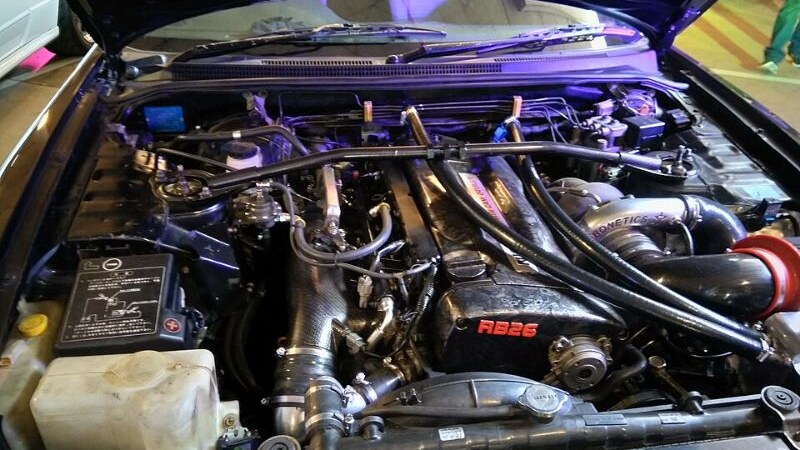
Featured image: “Nissan RB26 engine in a Nissan Skyline R32,” by Sherwin via Wikimedia Commons, licensed CC BY-SA 4.0.