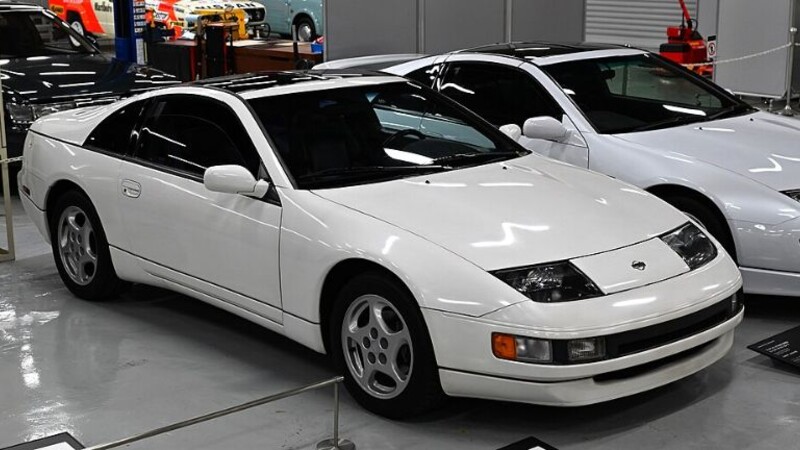
The 1992 Nissan 300ZX arrived at my shop on a flatbed with four flat tires, no title, and a grocery bag full of cassette tapes on the passenger floor.
I had bought it three days earlier at a storage auction outside Spokane, Washington.
The winning bid was $2,700.
My wife, Leah, called that “an expensive way to buy a locked metal box.”
She was not wrong.
The car had been buried behind a couch, two broken bookcases, and enough camping gear to outfit a scout troop. Under the dust, I could see white paint, T-top glass, and the low nose of a Japanese sports car I had wanted since high school.
“Please tell me you looked underneath it,” Leah said when the flatbed backed into our lot.
“I looked where I could.”
“That means no.”
“That means there was a couch.”
I run a three-bay independent shop on East Sprague Avenue. We mostly do Subarus, Toyotas, and commuter cars that need to be back before Monday. A non-running Z32 was not smart inventory.
But the body was straight. The factory wheels were still there. The odometer showed 87,412 miles.
And on the rear hatch, barely visible beneath the dirt, was a faded decal from Cascade Nissan’s 1990s service department.
My technician Owen and I spent the first afternoon opening the doors without damaging the weatherstripping. Inside, we found a dry interior, a seized parking brake, and a hand-written maintenance log in the center console.
Oil changes were recorded every 3,000 miles.
Timing belt at 61,204.
Injectors at 74,910.
The entries stopped in October 2004.
“Somebody loved this thing,” Owen said.
The auction company had warned me that a lien search and bonded-title process might take months. Until ownership was settled, I would not sell the car or spend real money on it.
Still, curiosity cost me a battery and a Saturday.
We drained the varnished fuel, pulled the spark plugs, fogged the cylinders, and turned the crank by hand. The VG30DE rotated smoothly. A borescope showed no obvious cylinder damage.
When we finally connected fresh fuel from a service tank, the starter clicked once.
Then again.
On the third try, the engine turned.
It coughed through the intake, blew a gray cloud across Bay Two, and settled into a lumpy idle.
Owen laughed so loudly that Leah came running from the office.
“You woke it up,” she said.
For eleven seconds, it felt like we had found buried treasure.
Then the shop phone rang.
A woman asked if I was the person who had bought a white 300ZX from Unit 418.
I looked across the shop at the car.
“Who is this?”
“My name is Sarah Kim,” she said. “That car belonged to my son.”
I shut the engine off.
Sarah lived in Tacoma. She had learned about the auction only after a certified letter reached an old address. By then, the unit was empty and the storage company would not release the buyer’s name.
She had spent two weeks calling shops and posting in local car groups.
“Are you saying the car was stolen?” I asked.
“No,” she said. “I’m saying the person who stored it wasn’t the person who owned it.”
That sentence turned my stomach.
Sarah emailed a photograph before we finished talking. It showed the same white Nissan parked beside Mount Rainier in 2001. A skinny young man in a Mariners cap leaned against the fender.
His name was Daniel.
Daniel bought the car used while he was studying engineering. He maintained it obsessively, recording every filter, belt, and tank of fuel. In 2004, he accepted a job in California and left the Nissan with his best friend, Marcus Bell, while he searched for an apartment with parking.
Daniel never reached California.
A wrong-way driver crossed the median outside Eugene.
Sarah’s voice remained steady until she said her son’s name a second time.
“Marcus asked if he could keep the car,” she told me. “He said working on it made him feel like Daniel was still in the garage. We agreed. We never transferred the title because none of us wanted to make it feel final.”
For nineteen years, Marcus stored the Nissan, started it, and wrote Sarah every October on Daniel’s birthday.
Then the messages stopped.
“I thought he had moved on,” she said. “Now I think something happened.”
The paperwork in the glovebox gave us one clue: a pharmacy receipt from Airway Heights dated eight months earlier.
Leah found three people named Marcus Bell in Spokane County. One was seventy-six. One had moved to Arizona. The third was listed as an emergency contact at a rehabilitation hospital.
I called.
A social worker returned my message the next morning.
Marcus had fallen from a loading dock and suffered a spinal injury. During months without work, he lost his apartment and then the storage unit. He had not called Sarah because he was ashamed.
“He believes he failed her,” the social worker said.
Sarah drove to Spokane that Friday carrying a manila envelope and a red plastic key tag.
The tag said Daniel’s Z — spare.
She stood in front of the Nissan for a long time without touching it. Then she opened the driver’s door, put one hand on the steering wheel, and laughed through her tears.
“He always left the seat too far back,” she said.
Inside the envelope was the original Washington title, still in Daniel’s name, along with a notarized estate document showing Sarah had inherited the car.
I expected her to ask for it back.
Instead, she asked what I planned to do.
“Make it safe,” I said. “Drive it. Keep every piece I can.”
She studied me for a moment.
“Then there’s one condition.”
Two weeks later, we rolled Marcus through the shop in a borrowed wheelchair. He stopped at Bay Two when he saw the clean white body under the lights.
“I’m sorry,” he said before anyone else spoke.
Sarah crossed the concrete and hugged him.
“You kept it for nineteen years,” she said. “That isn’t losing it.”
The condition was simple: when the Nissan was roadworthy, Marcus had to take the first ride.
It needed tires, brakes, every fluid, a timing-belt service, and more rubber hoses than I care to count. Sarah signed the title to me for the amount I paid at auction. I supplied the labor. A local Z-car club donated several discontinued trim pieces.
By the following spring, the 300ZX passed inspection.
Owen drove. Marcus rode beside him. Sarah and I followed in my pickup as the Nissan climbed toward Mount Spokane, its naturally aspirated V6 pulling cleanly through every gear.
At the overlook, Marcus placed the red spare-key tag in my hand.
“Daniel would’ve liked that you checked the timing belt before doing anything stupid,” he said.
“We did one stupid thing,” Leah said. “We bought it behind a couch.”
For the first time all day, Marcus smiled.
The car still comes to the shop every October. Sarah brings coffee. Marcus checks the maintenance log. We add one new line in the same careful format Daniel used.
The first entry we wrote was not a repair.
It simply said: Returned to the road—with everyone accounted for.
Story note: This is an original dramatized automotive story created for entertainment.
Featured image: “1992 Nissan 300ZX 2-seater T-Bar Roof,” photographed by TTTNIS, via Wikimedia Commons (CC0 1.0). Image cropped for display.