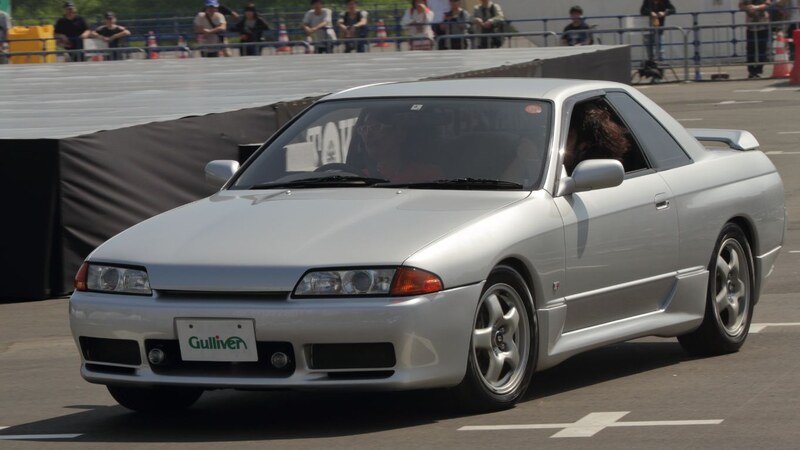
The gray Nissan Skyline had been sitting in the back corner of my father’s shop since I was eleven years old.
It was a right-hand-drive R32 GTS-t with an RB20DET, a five-speed transmission, and dust thick enough to write your name across the roof.
Dad never let anyone buy it.
“It belongs to a Marine,” he would say.
By the time Dad died, the car had been there for twenty-two years.
I inherited the shop in Oceanside, California, along with two lifts, thirty years of unpaid invoices, and a landlord who wanted the building empty by the end of the month.
The Skyline had no current registration and no title in our files.
A yellow repair order hung from the mirror.
Customer: Staff Sgt. Aaron Bell.
Complaint: Oil leak, clutch slipping.
Deposit: $900.
The date was March 2004.
I searched military records, old phone books, social media, and every filing cabinet in the office. The phone number on the repair order belonged to a disconnected landline.
My landlord suggested filing an abandoned-vehicle claim.
“Your father stored it for free longer than you’ve been an adult,” he said. “You can’t keep every promise he made.”
I was beginning to agree.
Then a woman arrived carrying a padded envelope and a Nissan key with a cracked black head.
Her name was Kayla Bell.
She was twenty-seven.
“I think you have my father’s car,” she said.
Aaron bought the Skyline while stationed in Japan. He brought it to California under a temporary military import arrangement, planning to handle the permanent paperwork when the car became eligible.
Before his next deployment, the clutch began slipping and oil appeared beneath the engine. He left the car with my father.
Aaron was killed in Iraq four months later.
Kayla was five years old.
Her mother believed the Nissan had been sold to cover the repair bill. My father apparently believed Aaron’s family would eventually come for it.
Neither side knew how to reach the other.
“Why now?” I asked.
Kayla opened the padded envelope.
Inside was an old MiniDV tape, a Japanese export certificate, and a handwritten note with our shop’s address.
Her mother had found them while cleaning a storage closet.
We connected a battery booster. The dash lights came on, but the engine would not turn. The fuel smelled like varnish. The clutch pedal stayed on the floor.
Kayla stood beside the open door and touched the worn steering wheel.
“I don’t remember him driving it,” she said. “I only remember him washing it.”
The videotape changed everything.
A local camera shop transferred it to a digital file. The recording showed Aaron inside the Skyline, speaking to the camera while rain tapped against the windshield.
He talked about the car for several minutes—the turbo whistle, the strange toll-booth reach from the right-hand seat, the plan to teach Kayla to shift when she was old enough.
Then his tone changed.
“If I don’t come back,” he said, “Mike knows the car is hers. Don’t sell it cheap. Make her decide.”
Mike was my father.
I found his response two days later.
It was written on the back of the repair order and folded beneath the cash-drawer liner.
Aaron—No storage charge. I’ll keep it inside. Come home and argue with me about the clutch.
Dad had never collected the final repair bill because he had never finished the job. After Aaron’s death, he simply pushed the Skyline into the safest corner of the shop and waited.
Kayla had inherited legal ownership through her father’s estate, but the import and registration issues required a specialist. We contacted a licensed importer and the California DMV before doing anything else.
Once the paperwork path was confirmed, Kayla made her decision.
“I want to hear it run,” she said.
The engine did not need a dramatic rebuild. It needed patient work.
We drained the tank, cleaned the injectors, changed every fluid, replaced the timing belt, water pump, fuel hoses, clutch hydraulics, and cracked vacuum lines. The oil leak came from hardened cam-cover seals.
The clutch disc was worn to the rivets.
Three months later, Kayla returned with her mother.
I turned the key while Kayla watched from the passenger side.
The RB20 cranked for six seconds, stumbled, and then settled into a fast idle. Smoke from the assembly oil drifted toward the open shop door.
Kayla covered her mouth with both hands.
Her mother began crying before the engine reached normal temperature.
After the inspection and paperwork were complete, Kayla took the first drive in an empty industrial lot.
She stalled twice.
On the third try, she eased the clutch out, rolled forward, and laughed exactly once—the same short laugh Aaron made on the old tape.
Dad had kept the Skyline for a Marine.
It turned out he had really been keeping it for a five-year-old girl who needed twenty-two years to find the missing key.
Story note: This is an original dramatized automotive story created for entertainment.
Featured image: “Nissan Skyline R32,” photographed by TTTNIS, via Wikimedia Commons (CC0 1.0). Image cropped for display.