The third time the blue Ford came into my shop, its owner asked me not to fix it.
That was a first. Most people bring a truck to a mechanic because they want it running. But Walter Briggs stood beside his 1978 F-150 in my gravel lot outside Chillicothe, Ohio, and asked whether I could tell him why somebody had been working on it after he parked it.
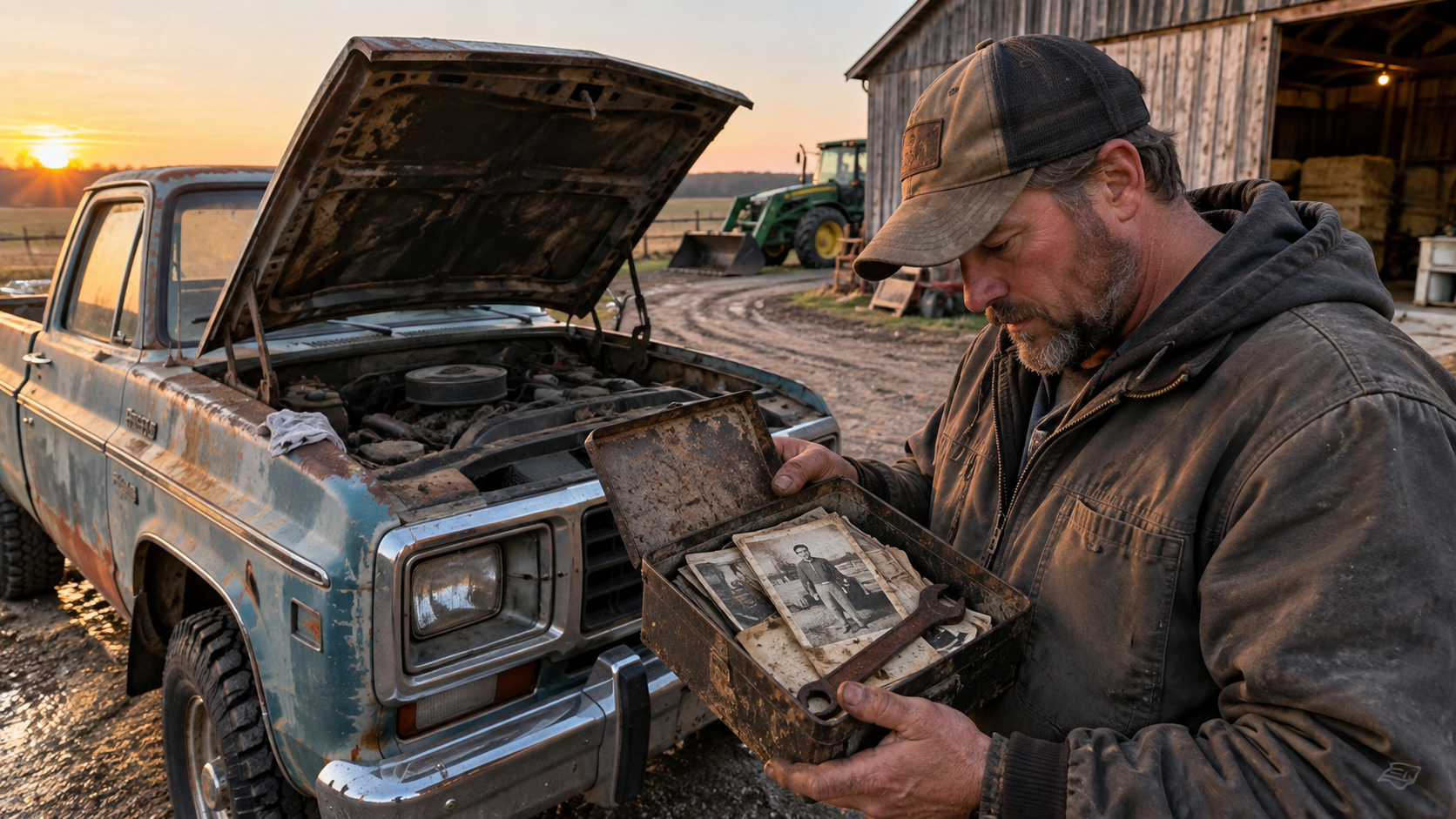
Walter was seventy-two, a retired county road worker with a careful way of speaking. He had owned the truck since 1981. The paint had faded on the hood, the bench seat was split at the driver’s side, and a small dent above the left rear wheel had been there longer than I’d been alive.
He said the engine had begun stalling at stoplights. Twice he had brought it in, and twice I’d found the same loose connection at the starter relay on the passenger-side fender. I had cleaned the terminal, replaced the damaged ring connector, and tightened the nut. Both times the truck ran perfectly when he left.
Now Walter held out a small paper envelope. Inside was a new brass nut and a short length of black wire.
“I found these under the hood this morning,” he said. “That wasn’t there yesterday.”
I looked at the wire. One end had a fresh crimp. The other had been cut cleanly. It wasn’t something that would have shaken loose from an old harness.
“Who else has a key?” I asked.
“Just me.” He looked past me toward the service bay. “At least that’s what I thought.”
I pulled the truck inside, set the parking brake, and disconnected the battery before touching the relay. The replacement terminal I’d installed was still tight. But a second wire had been tucked behind the battery tray, its insulation rubbed through where it passed a sharp metal edge. Whoever routed it had done a neat job everywhere except that one spot.
The wire led toward the cab, through an old rubber grommet in the firewall. It wasn’t part of the factory harness. Under the dash, it disappeared behind a metal bracket held by two newer screws.
Walter watched from the open door. “My brother used to put little fixes on this thing,” he said. “He could never leave well enough alone.”
His brother, Eddie, had died the previous winter. They had spent thirty years working on the truck together. Walter said Eddie was the only person who knew its quirks as well as he did.
I removed the bracket. Behind it sat a small toggle switch, wrapped in electrical tape, with a second wire running toward the ignition circuit. Someone had built a crude anti-theft cutoff. The switch itself was sound, but its old crimp had started separating. When the truck hit a bump, the ignition feed could open just long enough to kill the engine.
“That explains the stalling,” I told Walter. “It doesn’t explain the new nut.”
He leaned into the cab and stared at the switch. “Eddie put that in when the truck got stolen from the feed store. That was 1994.”
The truck had been recovered the same afternoon, abandoned beside a creek. Eddie had installed the hidden switch the next weekend. Walter hadn’t used it in years and had forgotten it existed.
I traced the added wiring carefully, checking it against the truck’s original circuit rather than trusting the color of the insulation. The loose splice could have interrupted power without leaving any visible damage at the relay. I removed the failing connection and restored the circuit with properly insulated terminals and secure routing. Then I tested the truck in the lot and on a short drive, watching for a repeat stall.
The engine stayed running. But Walter still wanted to know who had opened his hood.
He said he kept the Ford in a detached garage behind his house. The side door had a sticky latch, and the overhead door could be raised by hand when the power was out. He had noticed the hood wasn’t fully closed one morning but blamed himself.
I asked whether there were fresh marks around the latch or missing tools. There weren’t. We agreed not to treat a loose wire as proof that someone had been sneaking into his garage. I showed him the bright metal on the new nut, then the older oxidation on the relay stud. The nut had probably been fitted recently, but I couldn’t tell by whom or exactly when.
Walter took a long look at the truck. “Can you check one more thing?” he asked.
He opened the glove box and handed me a folded receipt from a parts store in Waverly. It was dated six weeks earlier, two days before his first visit to my shop. The receipt listed a starter relay, two ring terminals, and a roll of black wire. At the bottom was a name written in block letters: M. BRIGGS.
“That’s my granddaughter, Molly,” Walter said. “She doesn’t know anything about this truck.”
I didn’t answer right away. The relay installed on the fender was an older unit, not the new one on the receipt. The parts might have been purchased for some other job. And a name on a receipt didn’t mean Molly had worked under the hood.
Walter called her from the shop office. Molly answered on the second ring. She was twenty-six and worked evening shifts at a nursing home outside town. When Walter asked about the parts, she went quiet.
“I was going to tell you,” she finally said. “I thought I could get it fixed before you noticed.”
Molly came by after her shift, still wearing her work shoes. She had borrowed the truck one afternoon to move a dresser and had stalled twice on the way home. She knew Walter had been worrying about repair bills. At the parts counter she’d described the problem and bought what the clerk suggested.
Then she’d called her father, Walter’s son Daniel, who lived forty minutes away. Daniel had changed the relay in Walter’s driveway while Walter was at a doctor’s appointment. He had also tried to tidy an old loose wire he spotted near the battery. The extra nut and clipped wire were leftovers from that job.
“But I never opened the dash,” Daniel said when Molly put him on speaker. “I didn’t know about any switch.”
I believed him. The switch and its brittle splice had clearly been there for decades. Daniel’s repair hadn’t created the fault; it simply hadn’t reached the real cause. My first two repairs hadn’t reached it either.
Walter folded the receipt again, more slowly this time. He wasn’t angry about the parts. He was hurt that his family thought they had to work around him.
“I can still pay a mechanic,” he said. “And I can still ask for help when I need it.”
Molly looked down at the floor. “You kept saying you weren’t going to spend another dollar on that truck. I thought if it quit on you, you’d finally sell it.”
Walter ran a hand over the worn steering wheel. “I said that because I was frustrated. I didn’t mean it.”
The next afternoon Daniel came to the shop so I could show him the old cutoff switch, the failed splice, and the corrected wiring. He admitted he’d been in a hurry when he worked on the relay. I told him the same thing I tell anyone who repairs an old vehicle: a fresh part doesn’t guarantee the fault is gone, especially when someone has modified the wiring over the years.
Walter asked me to leave the switch in place as a reminder of Eddie. We agreed to disconnect its old wiring safely and keep the switch mounted, no longer part of the ignition circuit. That way he could still reach under the dash and feel the little metal lever without risking another roadside stall.
Before they left, Molly asked whether I could show her how to check the battery connections. We spent ten minutes going over the basics with the engine off. Daniel held the flashlight while Walter explained why Eddie had hidden the switch behind that particular bracket: it was the only place the two brothers could reach without kneeling on the wet gravel at the feed store.
They laughed at that. It was the first time I’d seen Walter smile all day.
A week later he returned, not because the Ford had stalled but because he wanted me to hear it idle. The old straight-six settled into a steady rhythm outside my bay. Walter handed me a coffee and said he’d driven to Waverly and back without a hiccup.
Molly had gone with him. They’d stopped at the parts store, where she returned the unused relay she’d kept in her trunk. Then they’d bought a cheap notebook for the glove box. Walter wrote down the date, the repair, and the name of anyone who worked on the truck. He said it would save the next mechanic some trouble.
On the first page, in Walter’s careful handwriting, was a line that made me grin: “Ask before fixing. Ask before worrying, too.”
I still think about that truck whenever an older vehicle comes back with the same complaint. The obvious loose connection can be real and still not be the whole problem. Sometimes the missing piece is a wire hidden behind the dash. Sometimes it’s a conversation nobody thought to have.
Walter didn’t need a stranger sneaking into his garage to explain the new hardware. He needed to know his family had been trying, clumsily, to look after him. And they needed to hear that keeping his old Ford on the road was still his choice.
There was one more thing I checked before calling the job finished. I put the old splice and the piece of cut wire side by side on my workbench. The splice had a dull, brittle sleeve and green corrosion inside the copper strands. The cut wire from Walter’s envelope had clean copper and a bright new terminal. They were two separate repairs, made years apart. That mattered. It meant we could explain the stalling without accusing Daniel of causing it, and explain the loose hardware without imagining an unknown visitor.
I also showed Walter how to recognize the warning signs if the truck acted up again. If the engine died, he should pull over safely rather than keep trying to drive through an intersection. If he smelled hot insulation or saw smoke, he should shut it off and have it towed. An old truck can be dependable, but forty-plus years of wiring changes deserve respect.
Walter listened, then asked what Eddie would have said about all this. I told him I couldn’t know. He thought about it and said Eddie probably would have complained about the price of my labor before asking to borrow my crimping tool. That sounded like a brother to me.
When I closed the hood, Walter checked the latch twice. Then he asked Molly to take the driver’s seat while he stood beside the open window and explained the old column shifter. She’d driven the truck before, but she’d never heard why the shift indicator sat a little crooked. Eddie had broken the plastic pointer while replacing the steering column bearing and insisted the replacement looked worse than the broken original. Walter had kept it that way ever since.
For the first time that afternoon, they weren’t talking about what might go wrong with the Ford. They were talking about where it had already taken them.
Story note: This is an original dramatized automotive story created for entertainment.