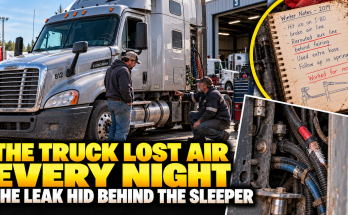
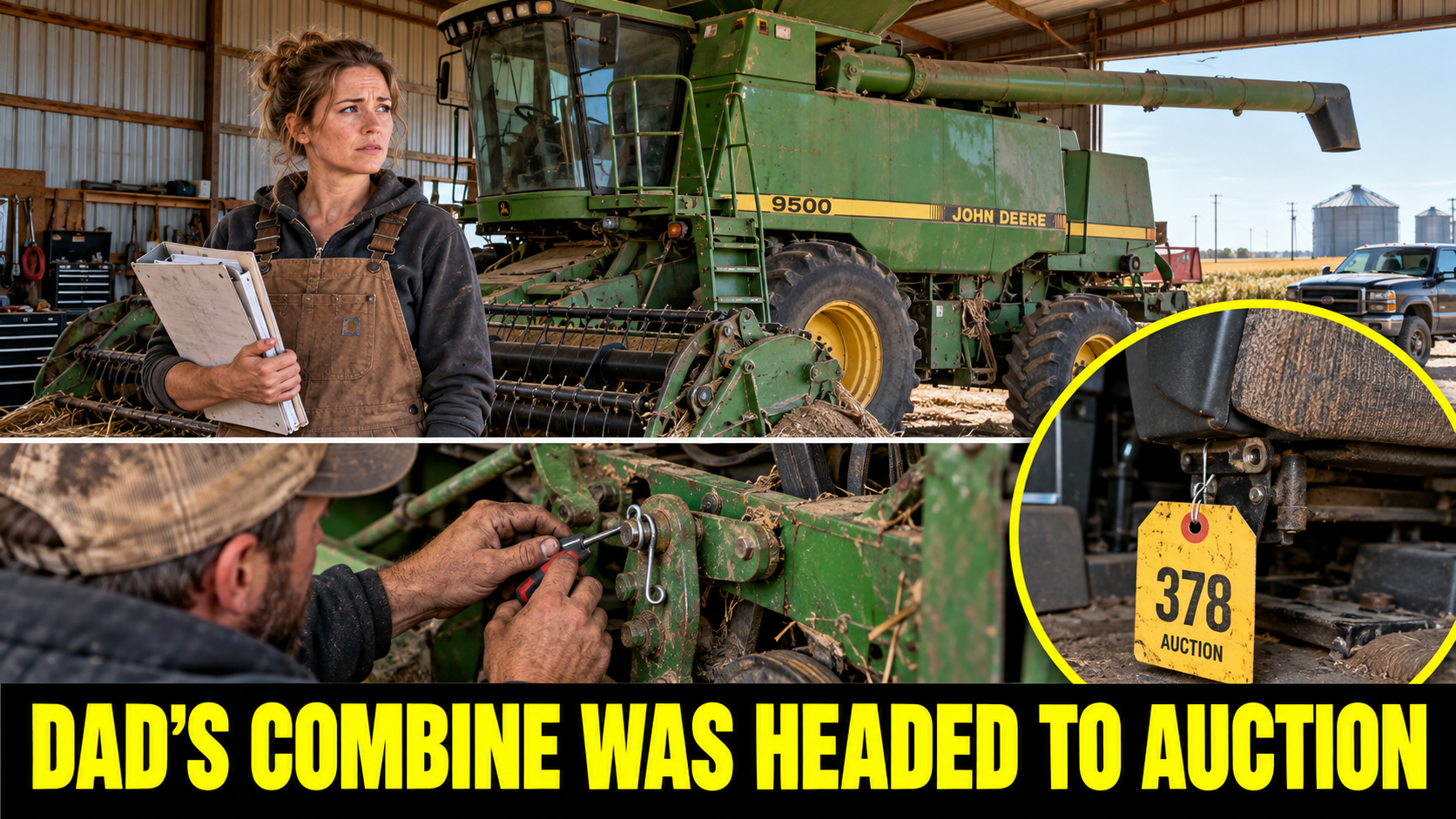
My brother said Dad’s combine needed an $11,000 repair or we would lose the harvest. Then I found an auction tag wired beneath the operator’s seat.
The tag had our machine’s serial number on it. The sale date was next Tuesday.
My name is Leah. I’m thirty-six, and our family farms outside Salina, Kansas. Dad’s 1998 John Deere 9500 combine has carried us through more wheat harvests than I can count. I can still remember sitting in the buddy seat as a kid, watching the header work its way through a field that seemed to go on forever.
Dad bought the combine used. He maintained it carefully, but he never pretended an older machine could run indefinitely without repairs. Every winter he checked belts, bearings, fluids, and the parts most likely to cost us time once harvest started. He kept service records in a battered binder in the shop office.
Last spring, Dad injured his knee stepping down from a tractor. His doctor told him to stay off the equipment while he recovered. My younger brother Grant took charge of the machinery. I handled invoices, grain contracts, and the farm accounts while still working three days a week at the local library.
It was supposed to be temporary. Dad had always said that neither of us needed to do everything alone. Grant understood machinery better than I did, and I was comfortable tracking the money. We trusted each other to report problems before they became emergencies.
Then Grant called me on a Thursday afternoon.
“The combine’s done,” he said. “Hydrostatic drive. Mechanic says eleven grand to get it moving again.”
I pulled over beside a field entrance so I could hear him properly. He said the repair had to be paid for immediately, or the shop wouldn’t order the parts. Wheat harvest was close enough that the warning frightened me.
“Send me the estimate,” I said.
“He gave me the number over the phone.”
“Which shop?”
Grant named a mechanic in town. I knew the man by reputation, though I’d never taken equipment to him myself. I asked whether the technician had checked hydraulic pressure, inspected the drive linkage, or run the combine.
“Leah, I’m telling you it’s broken. Do you want us to lose the crop?”
I told him I would help solve a real mechanical problem, but I wasn’t transferring $11,000 from Dad’s recovery fund without written information. That account covered his medical travel, household expenses, and anything the farm might need while he couldn’t work.
Grant said I was choosing paperwork over the harvest. He hung up before I could ask another question.
I spent the next hour staring at the farm ledger. A major hydrostatic repair on an aging combine could be expensive. So could renting another machine at the last minute. I knew that waiting too long might create a genuine problem. I also knew that spending Dad’s savings without a diagnosis could create one just as serious.
After supper, I drove to the machine shed. The combine sat inside, dusty but intact. I didn’t try to start it; if something had failed, I didn’t want to make it worse. I climbed into the cab to find the service log Dad usually kept behind the seat.
Instead, I found a bright paper tag wired beneath the operator’s seat.
It listed the model, serial number, and an auction lot number. A handwritten note read, “Pickup after Tuesday sale.”
I checked the serial number against Dad’s binder. It matched.
At first I wondered whether Grant had bought a used part from an auction and left the tag in the cab. But the description clearly referred to the entire combine. I took photographs, climbed down, and called the auction company printed on the tag.
A woman answered. I gave her the lot number and asked whether the combine was scheduled for sale. She confirmed it was. She said Grant had consigned the machine and described himself as the owner.
I explained that the equipment belonged to our father and asked her not to release it until the ownership question was resolved. She said she could flag the file for review and asked us to send documentation. I thanked her and called Dad.
He was sitting in his recliner with an ice pack on his knee when I arrived. I showed him the tag. He read it twice, then asked whether I was certain the serial number matched. I opened the binder and showed him the equipment record.
“Did you tell Grant he could sell it?” I asked.
“No.”
Dad didn’t raise his voice. He looked toward the window and said he wanted to hear Grant’s explanation before deciding what to do next.
I called my brother. He said the auction was only a backup plan in case we couldn’t afford the repair. When I asked why he’d listed Dad as no longer owning the machine, he said the auction staff must have misunderstood him.
“Then why didn’t you tell either of us?”
“Because I knew you’d react like this.”
I ended the call and dialed the mechanic Grant had named. The mechanic listened as I explained the supposed $11,000 hydrostatic repair. Then he said he had not inspected the combine or quoted that amount.
He had seen Grant the previous day, though. Grant had asked whether the combine could be loaded onto a trailer without starting it. The mechanic had explained that loading procedures depended on the machine’s condition and that he would need to inspect it before advising anyone.
That was all he could tell me. He had no diagnosis to offer, and he made it clear that he couldn’t say whether the drive was good or bad without seeing the machine.
I thanked him. The uncertainty was frustrating, but at least it was honest.
The next morning Dad and I checked the farm records. The combine’s purchase paperwork, insurance schedule, and equipment inventory all named Dad. We found no written permission for Grant to sell it. We also found a document in the office printer tray that neither of us had seen before.
It was an application for a short-term business loan, listing the combine as proposed collateral. The application was incomplete, but it included Grant’s name and the same $11,000 figure he’d asked me to transfer.
Dad sat down slowly at the kitchen table. “Bring him here,” he said.
Grant arrived just after lunch. He took one look at the auction tag, the loan application, and the service binder laid out in front of Dad and stopped in the doorway.
Dad asked him to sit. Then he asked one question: “What happened to the money from the grain advance?”
I hadn’t known about an advance. Grant had arranged a small early payment against a future grain delivery, something Dad normally handled himself. Grant admitted he had used part of it to cover losses from a side business repairing and reselling used equipment.
He had bought a skid steer that needed more work than he expected. Then a buyer backed out. He borrowed money to finish the repairs and fell behind on the payments. He said he intended to repay the farm before anyone noticed.
When the lender began asking for money, he tried to arrange another loan using the combine. When that looked uncertain, he listed the combine for auction. He planned to replace the machine with a rental for harvest and hoped he could buy something else later.
“The eleven thousand?” I asked.
Grant looked down. “That was what I needed to get current.”
I felt angry, but what hurt most was the way he had turned Dad’s recovery into an opportunity to ask for money we were afraid to refuse. He had invented a repair emergency because he knew the thought of losing harvest would frighten us.
Dad asked Grant to put every outstanding loan, payment, and farm transaction on the table. He told him he would no longer be allowed to make equipment or financial decisions for the farm without written approval. Grant agreed. He also agreed to meet with a qualified adviser to sort out his personal debts rather than shifting them onto the farm.
We contacted the auction company together and provided the ownership documents. The company removed the combine from the sale pending its review of the consignment paperwork. We also spoke with an attorney about the attempted sale and the loan application. I wasn’t interested in guessing what legal consequences might follow; I wanted Dad’s property and accounts protected properly.
There was still one practical problem: the combine might genuinely have been broken. We arranged for an independent agricultural equipment technician to inspect it in the shed.
He began with the basics. He checked the fluid level and condition, inspected the visible hoses and linkage, and looked for leaks or obvious damage. After following the proper safety checks, he examined the drive controls and tested the machine’s operation.
The technician found that a linkage retaining clip had come loose, allowing the control linkage to move out of adjustment. He replaced the clip, adjusted the linkage to specification, and performed the checks needed to confirm the machine responded normally. He also identified a worn belt and a leaking hydraulic hose that we should address before harvest.
The invoice for the inspection and immediate repair was $465. The additional maintenance cost more, but it was work the technician could explain and show us. He did not promise the combine would never fail. He told us what he had tested, what remained to be done, and what to watch once it was back in the field.
Dad authorized the work himself. When the combine was ready, the technician walked us through the invoice and demonstrated the controls. Dad stood beside the machine with his cane and listened to every word.
Grant wasn’t there. For the moment, Dad had asked him to stay away from the farm office and equipment. It wasn’t a decision Dad enjoyed making. He told me he loved his son, but loving him didn’t mean handing him the keys and hoping the next story would be true.
Over the following weeks, we hired a local operator to help with harvest while Dad recovered. I learned more about the combine’s maintenance schedule than I ever expected to. I kept copies of every invoice and made sure any future repair estimate went directly to Dad and me.
Grant began repaying the farm under a written plan. I don’t know how long it will take him to rebuild the trust he lost. Some days Dad talks about him with sadness. Other days he asks whether Grant has called. Neither of us pretends that one apology fixes what happened.
On the first clear morning of harvest, I stood at the edge of the wheat field while the old combine rolled past. Its green paint was faded, and dust trailed behind it in the sunlight. Dad watched from the pickup, one hand resting on his cane.
He said, “I’m glad you checked the paperwork.”
I told him I was glad we checked the machine, too. A repair quote can be legitimate, and an old combine can absolutely need expensive work. But a number without a diagnosis is not a reason to surrender somebody else’s savings.
The auction tag is still in the farm binder. I keep it beside the technician’s invoice, not because I want to relive that week, but because the two pieces of paper tell different stories. One was a plan to sell a machine without its owner’s permission. The other explained what was actually wrong and what it cost to repair.
Dad still calls the 9500 his old workhorse. This year, when he says it, I hear something else beneath the words: it is still his to decide what happens to it.