My brother said our roadside-service truck needed a $6,300 transmission. Then I found a second set of keys inside the shop safe.
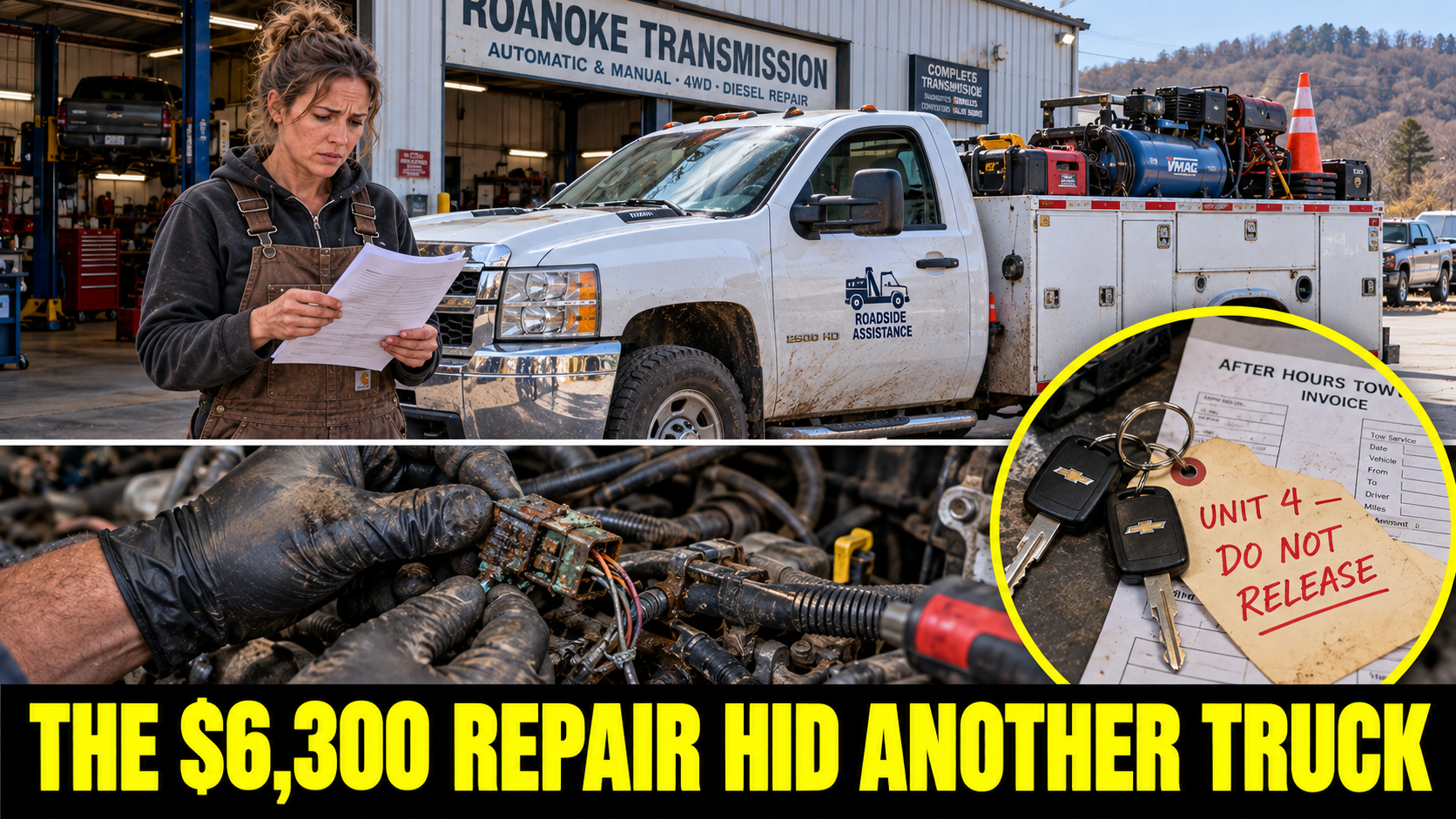
The tag attached to them read, “Unit 4 — DO NOT RELEASE.” Unit 4 was our truck, and my brother had told me the mechanic had already finished diagnosing it.
My name is Leah Mercer. I was thirty-five, and my dad and I ran a roadside-assistance business outside Roanoke, Virginia. We had two service pickups, a small garage, and a phone that rang at inconvenient hours.
Our white 2011 Chevrolet Silverado 2500HD carried batteries, jump packs, an air compressor, cones, and the hand tools we used when drivers broke down along Interstate 81. We changed tires, delivered fuel, and jump-started dead batteries.
Dad had started the business twenty years earlier. He taught me to park well clear of traffic, wear my reflective vest, and never promise a stranded driver that a repair would work until I had checked the actual problem.
That spring he was recovering from knee surgery. He could answer calls and handle invoices from home, but he could not climb in and out of the truck all day. My younger brother, Adam, offered to take over scheduling and maintenance while Dad healed.
I handled roadside calls while our part-time driver covered nights. Then the Silverado started hesitating when I shifted from reverse into drive.
I wrote the symptom in our maintenance log. The fluid level needed to be checked by the correct procedure, and the truck needed a proper inspection. I parked it and told Adam not to schedule it until a shop had looked at it. He said he would take care of the appointment.
The next afternoon he called while I was helping a family with a flat tire near Troutville. He announced that the transmission was finished. He said the shop wanted $6,300 immediately and would sell the truck for parts if we did not pay.
“Send me the estimate,” I said.
“The printer is broken,” Adam replied.
“Then send me a picture of the screen. Who did the diagnosis?”
“He already went home. Leah, we don’t have time for this.”
We had enough for payroll, fuel, and the next insurance payment. We did not have another $6,300 sitting around. Dad had always told us not to spend the operating reserve on a repair we did not understand.
When I said I wanted to talk to the mechanic before transferring anything, Adam slammed his hand on the kitchen counter. “You want Dad to lose the business over paperwork?” he asked.
I told him paperwork was exactly how we kept the business running. He left before dinner. Dad, who had heard the argument from the living room, asked me to visit the shop in the morning and call him from there.
The shop was on a side street behind a tire warehouse. Our Silverado sat inside the fenced yard, dusty but intact. I walked to the counter with the registration and asked for the written transmission diagnosis.
The service adviser, a man named Paul, frowned. “We haven’t opened the transmission,” he said. “We were waiting for authorization to continue testing.”
He explained that the truck had arrived with an intermittent engagement complaint. The technician had checked for stored codes and made a short controlled test, but had not yet isolated the cause. A replacement transmission was one possible outcome, not an approved repair.
I asked about the threat to sell the truck. Paul said the shop had made no such demand. There were storage terms on the work order, but nothing like the deadline Adam had described.
Paul went to retrieve the file. On the counter I noticed a key tag marked “Unit 4 — DO NOT RELEASE.” Beside it was an invoice for an after-hours tow. Our business name appeared on the paperwork, but the vehicle description was wrong.
When Paul returned, he asked whether my father was available. “Why did your brother tell us to keep the other truck hidden from your father?” he asked.
I called Dad. He arrived forty minutes later, moving slowly on crutches. We showed Paul the registration and company documents so he could verify who was authorized to discuss our vehicles. Then he brought out the second file.
The other truck was our older 2004 Ford F-350, Unit 2. It had been parked behind our garage for months because its brake lines were badly corroded. Dad had removed it from the schedule and taped a bright orange OUT OF SERVICE card to the steering wheel. We planned to repair it after the busy season.
The shop’s photographs showed Unit 2 on a flatbed after midnight, with fresh damage to its front bumper and right fender. The orange card was still visible through the windshield. According to the intake note, Adam had arranged the tow and asked the shop not to contact Dad until he had “sorted out the bill.”
Dad sat down hard in the waiting-room chair. “That truck wasn’t supposed to move,” he said.
Paul explained that the shop could document the damage and repair requests, but could not tell us why Adam had taken the vehicle out or who had been driving. The intake sheet showed only what the tow operator reported. We requested copies of the records we were entitled to receive and went home to ask Adam directly.
He arrived that evening carrying a paper bag of takeout food. When he saw Dad at the table with both files, he stopped in the doorway. I asked him to sit down. He stared at the photographs and admitted he had used Unit 2 to cover a late-night service call after our regular truck had been parked.
He said he had only meant to deliver a battery to a stranded customer a few miles away. On the return trip, a brake pedal that felt soft at the first stop went almost to the floor at the next intersection. He steered onto an empty gravel shoulder and struck a roadside post at low speed.
He was not injured, and no other vehicle was involved. He arranged a tow rather than drive the truck again. He had been afraid Dad would fire him for taking a truck clearly marked out of service. Instead of telling us what happened, he tried to make the Silverado’s possible transmission repair sound like the only emergency.
I asked why he needed the $6,300 so quickly. He admitted he had planned to use part of it to pay the tow, damage assessment, and a personal credit-card balance he had run up buying parts for side jobs. He thought he could replace the money before Dad checked the account.
Dad did not yell. He looked at Adam and asked whether he understood what could have happened if the brake failure had occurred in traffic. Adam nodded. Dad said a roadside call was never worth taking an unsafe truck back onto the highway.
We spent the next morning doing something less dramatic than arguing: we called the customer to confirm the service had been completed, reviewed the dispatch log, and reconciled the receipts. Adam had performed the battery delivery, but he had used a vehicle he had no permission to operate. We documented the incident and contacted our insurer to report the damage and ask what information they needed.
Then Dad and I returned to the transmission shop. Paul introduced us to the technician, who explained the Silverado’s symptoms without pretending he knew the answer yet. We approved a limited diagnostic inspection with a written maximum charge and asked him to call before doing additional work.
The technician checked the electrical connections and found moisture and corrosion in a connector at the transmission control circuit. He repaired the affected wiring and connector, checked the fluid according to the service procedure, and repeated the engagement test. The original hesitation did not return during his checks or the follow-up road test.
The repair and diagnostic bill was $486. The technician warned us that an intermittent problem could return and gave us the test results so we would know what had actually been checked. We did not treat a successful road test as a lifetime guarantee, but the truck was back in service without an unexplained $6,300 withdrawal.
Unit 2 was a different matter. Its brake system needed a thorough repair before anyone could consider driving it, and the body damage had to be assessed separately. Dad decided to leave it out of service while we obtained written estimates and reviewed whether restoring an aging truck made financial sense.
Adam offered to work extra hours to repay what he owed. Dad told him repayment was necessary but not enough. For the time being, Adam would not dispatch vehicles or access the business account. He could help with inventory and office work under supervision while we decided whether he could regain those responsibilities.
Over the next month, we changed our procedures. Keys for out-of-service vehicles went into a locked cabinet. Every truck had a dated inspection sheet. Any repair estimate above a set amount required two authorized people to review it, and every service call had to be assigned to a vehicle cleared for use.
Dad worried that the new rules made our little operation feel impersonal. I told him they were there precisely because we were family. We needed a way to disagree about money and safety without turning every question into a test of loyalty.
One evening, after we closed the garage, Dad handed me the old maintenance log. His handwriting filled the first pages. He had recorded oil changes, tire replacements, and the mileage at which he bought each truck. On the last page he had written a note years earlier: “If the numbers don’t make sense, stop and check before spending.”
I laughed when I read it. Dad said he had forgotten writing it, but he still meant every word. We put the log in a new binder with the current repair records, the insurance documents, and the updated dispatch rules.
A week later I drove the Silverado to a battery call on I-81. The morning was cold and clear. I parked well off the shoulder, put on my vest, and checked the customer’s vehicle before touching my tools. The driver thanked me for coming so quickly.
On the way back, the Silverado shifted smoothly. I thought about how close we had come to draining our operating account because someone insisted that asking for a diagnosis meant I did not care about the business. The real threat had been the decision to hide an unsafe truck’s use and then hide the cost.
Adam eventually repaid the tow and assessment expenses under a written plan. He also apologized to Dad and me without trying to turn his fear into an excuse. Trust did not return in a single conversation, but the apology was a start. Dad let him keep helping with office work, and the decision about future driving duties remained open.
We still have two trucks, a small garage, and a phone that rings at inconvenient hours. We still have bills we would rather not pay. But now, when someone says a vehicle needs thousands of dollars of work, we ask for the inspection notes before we touch the account.
The spare key tag is pinned above my desk. It reminds me that the most important thing we found at the shop was not a cheap repair. It was the truth about the truck we had been told not to look for.