A woman walked into my shop with a $5,300 estimate, put her keys on the counter, and said something that made the repair feel bigger than the car.
“I can fix the car or pay my daughter’s tuition deposit. I can’t do both.”
Her name was Megan Brooks.
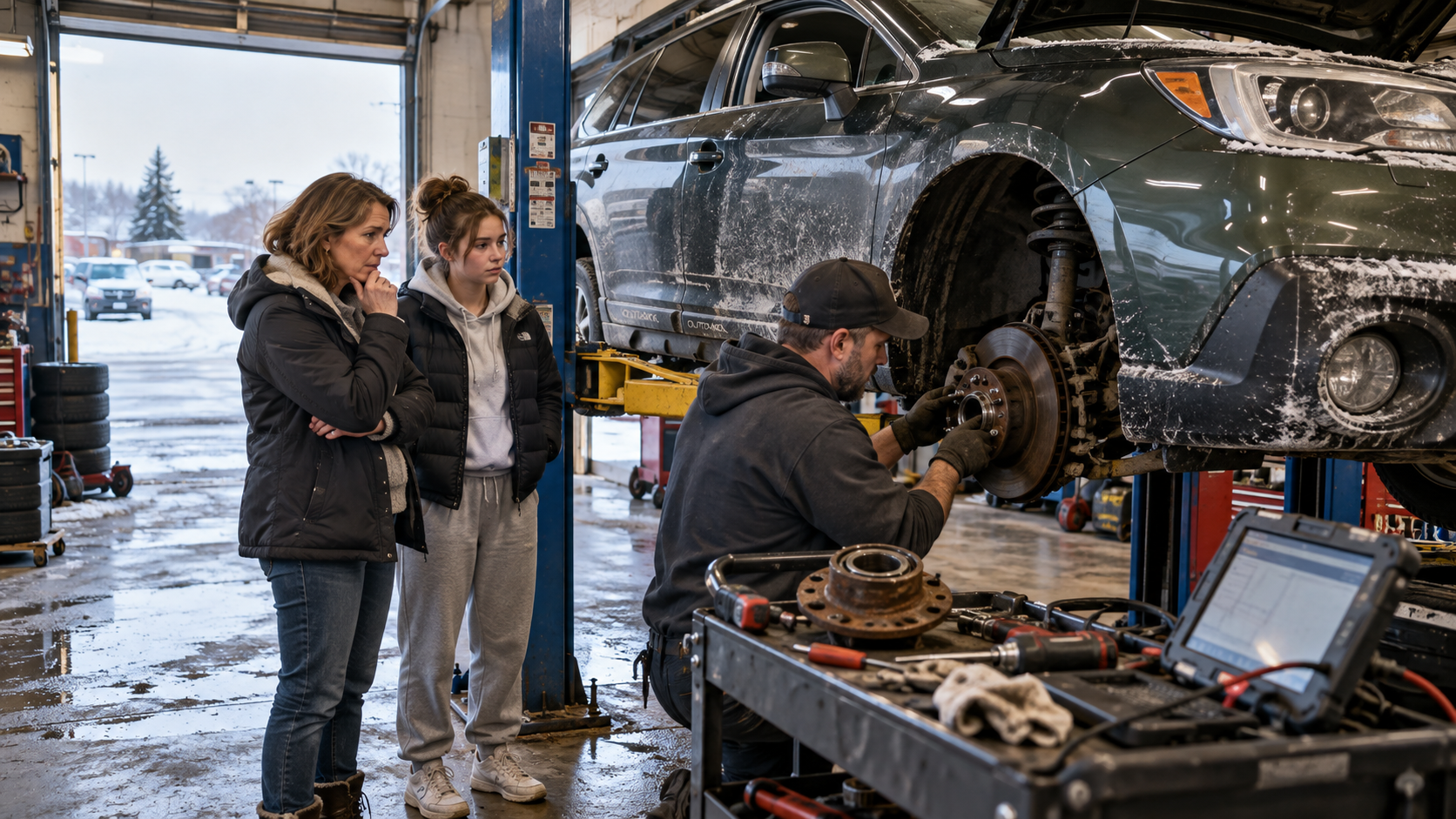
Megan was 46, worked as a dental hygienist, and lived outside Grand Rapids, Michigan. Her 2016 Subaru Outback 2.5i had 164,000 miles.
The Outback was the kind of vehicle mechanics see every day.
It had scratches around the hatch, winter grime underneath, a few stains in the cargo area, and service stickers from several different shops.
It was not a showpiece.
It was transportation.
Megan’s daughter, Claire, had recently been accepted into a nursing program. A tuition deposit was due soon, and Megan had been setting money aside for it.
Then the Outback started humming.
At first, Megan thought it was tire noise.
The sound became louder with road speed. On some roads it was barely noticeable. On others, especially around 45 to 60 mph, it sounded like a distant airplane inside the cabin.
A week later, the ABS and traction-control lights began appearing intermittently.
That changed how she viewed the noise.
She took the Outback to another repair facility.
Their inspection identified several concerns and documented the possibility that the road-speed noise could require deeper drivetrain work if it proved to be transmission-related. The warning lights also required diagnosis.
The estimate Megan remembered was the worst-case path.
About $5,300.
By the time she reached our shop, that number had become a fact in her mind.
“My transmission is going,” she told me.
I asked whether anyone had confirmed that.
She handed me the paperwork.
The previous shop had not written that the transmission was definitely failed. They had outlined possible work depending on further diagnosis.
That difference was important.
I told Megan I could not promise her a cheaper repair.
What I could promise was that I would not recommend a transmission based only on a humming noise.
We agreed on diagnostic time.
The first step was a road test.
The noise appeared around 40 mph and became more noticeable as speed increased.
I gently changed the load on the vehicle by making safe, gradual steering inputs.
When the vehicle’s weight shifted, the character of the hum changed.
That was useful.
Wheel-bearing noise often changes as cornering loads change.
But “often” is not “always,” and a road test alone was not enough.
Tire patterns can create similar sounds.
Drivetrain components can transmit noise through the body.
A failing bearing can fool you about which corner is actually bad.
Then there were the ABS and traction-control warnings.
Back at the shop, we scanned the relevant modules.
One wheel-speed signal had intermittent irregularities.
That gave us another direction.
The tempting move would have been to order a wheel-speed sensor immediately.
We didn’t.
A sensor code or strange sensor reading does not automatically mean the sensor itself has failed.
The problem can be the sensor, wiring, connector, tone or encoder surface, excessive bearing movement, corrosion, or another mechanical condition affecting the signal.
We inspected the wiring at the suspect corner.
Nothing obvious was cut or hanging.
The connector looked intact.
We checked the signal and compared wheel-speed data.
Most of the time, all four wheels agreed.
Then the suspect signal briefly dropped.
That matched Megan’s intermittent warning-light complaint.
We raised the Outback.
The tires were inspected for irregular wear that might explain the humming.
They had normal age-related wear, but nothing that matched the intensity and behavior of the noise.
Then we checked the wheel assemblies.
At the suspect corner, the hub bearing did not feel catastrophically loose.
That matters because people sometimes expect a bad wheel bearing to wobble dramatically.
It does not always happen that way.
A bearing can become noisy before it develops obvious play.
We rotated and loaded the assembly while listening and feeling for roughness.
The suspect hub was different from the others.
There was a rough, dry quality to it.
We compared it with the opposite side.
The difference was clear.
Now we had a mechanical clue that fit the road test.
But we still needed to connect it responsibly to the electrical complaint.
On this vehicle, wheel-speed information depends on a clean, consistent relationship between the sensor and the rotating encoder associated with the wheel-bearing/hub assembly.
Wear, contamination, corrosion, or irregular movement at the assembly can interfere with that signal.
Closer inspection of the suspect corner showed deterioration around the hub assembly consistent with the noisy bearing and unstable wheel-speed reading.
Now the story made more sense.
The humming noise was tied to the worn hub bearing.
The intermittent ABS and traction-control warnings were tied to the unstable wheel-speed information at the same corner.
That did not mean every warning light on every car with a bad bearing has the same cause.
It meant the mechanical and scan-data evidence on Megan’s Outback pointed to the same area.
Before calling her, I wanted to make sure we were not ignoring the transmission simply because we had found something else.
We inspected the relevant drivetrain fluids and operation.
The transmission behavior during the road test was normal.
There was no shift complaint.
The noise followed road speed and changed with wheel loading rather than behaving like the internal transmission failure Megan feared.
The evidence did not support replacing the transmission.
I called her.
She answered on the second ring.
“Just tell me,” she said.
I explained the findings.
The confirmed problem was a failing wheel hub/bearing assembly at the corner where we also saw the unstable wheel-speed signal.
There were also normal maintenance items we documented separately, but I did not mix them into the repair required to solve her current complaint.
“How much?”
The repair, diagnosis, related hardware, and alignment check would come to $1,365.
There was silence.
Then Megan asked the question I expected.
“What about the $5,300?”
I explained that the larger figure represented a possible repair path before the source of the noise and warning lights had been isolated.
It was an estimate.
Our diagnosis was now narrower because we had more evidence.
That did not make the first shop dishonest.
It meant the diagnostic process had progressed.
Megan authorized the repair.
We replaced the failed hub/bearing assembly with a quality part, addressed the associated wheel-speed sensing issue at that corner, torqued the fasteners correctly, inspected the surrounding brake and suspension components, and reassembled everything.
Then came the part I care about most.
Verification.
We cleared the stored faults and drove the same route.
At 40 mph, the cabin was quiet.
At 50, still quiet.
I repeated the gentle left-right loading that had changed the hum before.
Nothing.
Then we watched all four wheel-speed signals.
They remained stable.
No ABS warning.
No traction-control warning.
We drove long enough to get the vehicle fully warm and repeated the test.
The complaint did not return.
The final repair cost was $1,365.
Megan arrived the next afternoon with Claire.
Claire was 19 and carried a folder from the nursing program under her arm.
I showed both of them the old hub assembly.
I explained that the bearing wear produced the road-speed hum and that the unstable wheel-speed information at that corner had triggered the electronic warnings.
Megan looked at the invoice.
Then she looked at Claire.
“So we’re still paying your deposit,” she said.
Claire smiled.
That was when Megan pulled out $250 in cash and put it on the counter.
“This is for you guys.”
I thanked her, but I handed it back.
A $250 tip was generous, and she had just spent more than a thousand dollars repairing an older vehicle while trying to fund her daughter’s education.
“You already paid us,” I said.
She pushed it toward me again.
Claire picked up the money before either of us could continue arguing.
For a second, I thought she was going to put it back in her mother’s purse.
Instead she asked, “Do you guys ever help students who want to learn this?”
That question changed the direction of the conversation.
We occasionally had local technical-school students visit the shop, and one instructor had sent us young people looking for job-shadowing opportunities.
Claire said she had watched her mother worry for days because neither of them understood what the estimate meant.
“What you did was explain it,” she said. “Somebody should learn how to do that.”
Megan laughed.
“She wants to donate my tip now.”
Claire handed the money back to her.
I suggested something more useful than leaving cash with us.
There was an automotive technology program in the area that accepted donations for student supplies and training equipment.
If Megan really wanted the money to go somewhere connected to the repair, she could contact the program directly.
She did.
A few weeks later, she emailed us a receipt showing the $250 donation.
The money went toward student shop supplies.
That was a better ending than putting the cash in our lunch fund.
Megan’s Outback remained quiet.
She returned several months later for routine maintenance and said the warning lights had never come back.
Claire had started her nursing program.
The tuition deposit had been paid on time.
There was one more conversation before Megan left that afternoon.
I showed her why I had not wanted to order a wheel-speed sensor from the code alone. On the scan tool, a bad signal can look deceptively simple. The computer reports what it sees; it does not always identify the physical reason the signal became wrong.
That distinction saves money.
If we had installed a sensor without checking the hub and the mechanical condition at that corner, the warning could have returned. Then Megan would have paid for a part that did not address the underlying problem, and we would still have been chasing the original complaint.
I also explained why bearing noise can be misleading. Sound travels through a vehicle’s structure. A driver may swear the noise is coming from the left when the failing component is on the right. That is why comparing corners, loading the vehicle carefully on a road test, inspecting tire wear, and checking the assembly physically all matter.
Michigan winters added another realistic factor. Road salt, moisture, and years of temperature changes are hard on wheel-end components and electrical connections. Corrosion by itself did not prove the diagnosis, but it was part of the environment the component had lived in for 164,000 miles.
Megan asked whether she should replace the hub on the opposite side too.
I told her no—not automatically.
Replacing parts in pairs makes sense for some components and situations, but we had inspected the opposite side and did not have evidence that it had failed. I documented its condition and told her what kind of noise or warning should bring the Outback back for another inspection.
That mattered to her because every unnecessary dollar still came out of the same household budget as Claire’s school expenses.
Good repair decisions are not always about choosing the cheapest option.
They are about spending money where the evidence says it belongs.
There were several useful mechanical lessons in the repair.
The first is that a noise is a symptom, not a diagnosis.
A road-speed hum can come from tires, bearings, or drivetrain components. The way the sound responds to speed, load, steering input, and surface conditions helps narrow the possibilities.
The second is that an ABS-related fault does not automatically mean the wheel-speed sensor itself needs replacement.
The sensor is part of a system.
Wiring, connectors, encoder surfaces, bearing condition, corrosion, and mechanical movement can all affect the signal.
The third lesson is that scan data becomes more useful when it is connected to a physical symptom.
We had a wheel-speed dropout.
We also had a road-speed hum that changed with loading.
Finding mechanical deterioration at the same corner connected those clues.
The fourth lesson is financial.
A worst-case estimate is not the same thing as a confirmed diagnosis.
Megan walked into our shop believing she faced a $5,300 repair.
The evidence ultimately supported a $1,365 repair.
That difference did not prove someone had tried to steal $3,935 from her.
It showed why additional diagnosis can matter before authorizing a major assembly replacement.
And the fifth lesson is verification.
Installing a bearing was not enough.
We had to repeat the road conditions, confirm the noise was gone, monitor the wheel-speed data, and make sure the warning lights did not return.
Megan originally thought she had to choose between fixing her car and helping her daughter start nursing school.
In the end, the vehicle was repaired, the tuition deposit stayed intact, and the $250 she tried to leave as a tip ended up helping automotive students instead.
I still remember Claire picking up that cash from the counter.
The most valuable question asked in the shop that day wasn’t, “How much will this cost?”
It was, “Do you guys ever help students who want to learn this?”
For once, the answer had nothing to do with a car.