The woman at my counter had a $4,900 repair estimate in one hand and two folded $100 bills in the other.
“I’m not asking you to beat their price,” she said. “I just need to know if my engine is actually dying.”
Her name was Tara Mitchell.
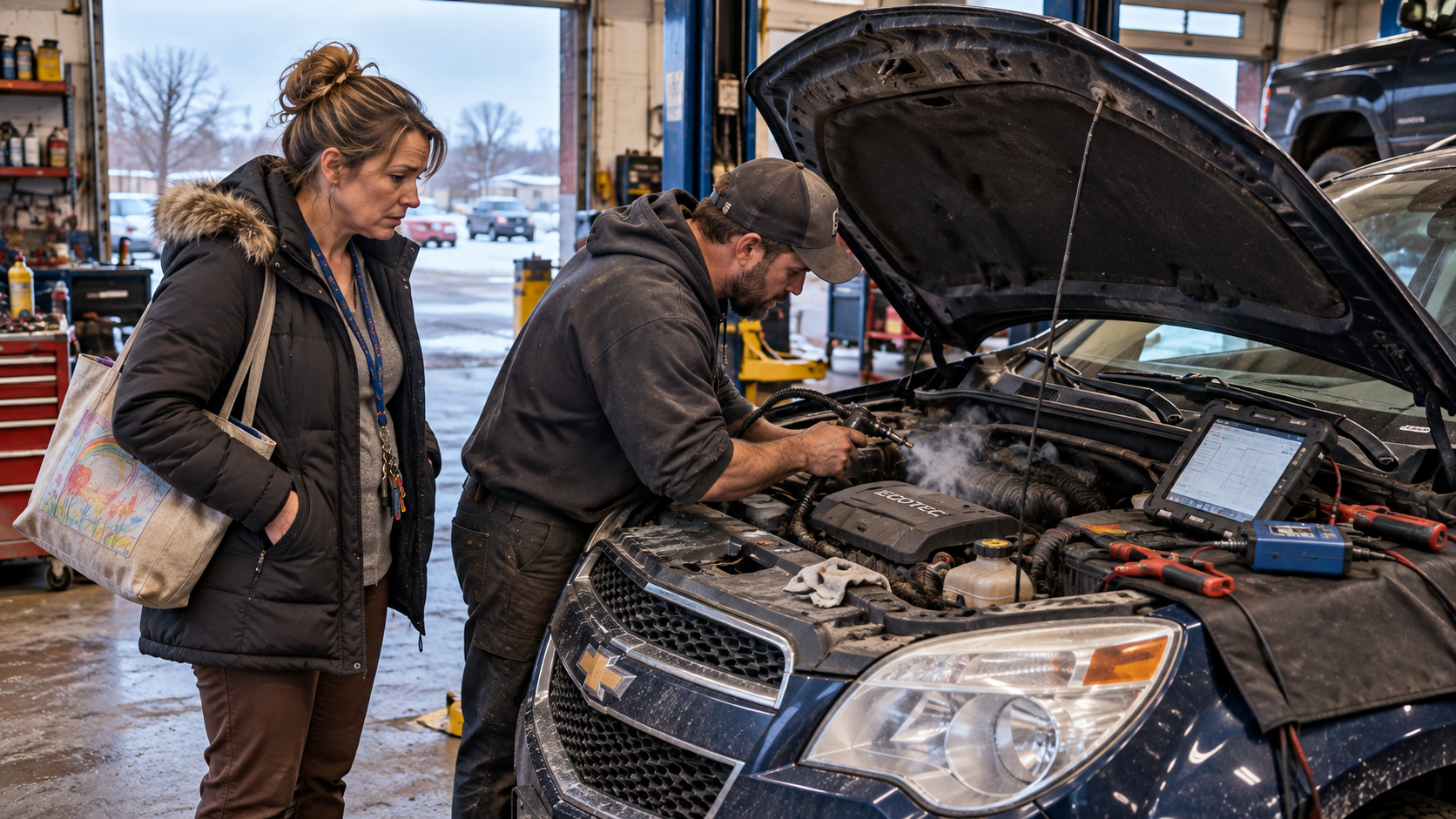
Tara was 40, taught fourth grade in Fort Wayne, Indiana, and drove a 2015 Chevrolet Equinox 2.4L with 118,000 miles.
The Equinox looked like a teacher’s daily driver.
There were reusable grocery bags behind the passenger seat, a stack of laminated classroom materials in the cargo area, and two coffee cups in the center console.
Tara had owned it for six years.
Until recently, she mostly thought about the vehicle when it needed gas or an oil change.
Then it started idling rough.
At first, the vibration was small.
She noticed it while sitting at a red light with the transmission in Drive.
A few days later, the check-engine light came on.
Then one morning it flashed briefly.
That scared her enough to stop driving and call for advice.
The other issue was oil.
Tara knew the Equinox had been using some oil between changes, but she had never measured exactly how much.
During the previous inspection, the oil level was low.
The shop found misfire faults and documented concerns about possible internal engine wear. Their paperwork outlined further testing and a possible engine-replacement path approaching $4,900 if major internal damage was confirmed.
That last part disappeared when Tara repeated the story.
By the time she reached me, she said, “They told me I need an engine.”
I read the paperwork carefully.
“They told you an engine may be where this goes if the testing supports it,” I said.
She looked at me.
“Isn’t that the same thing?”
“No.”
That was the first important distinction in the entire job.
An estimate for a possible major repair is not a confirmed diagnosis.
But I also knew enough about high-mileage four-cylinder engines—and this generation of Equinox in particular—to avoid making promises before testing.
I asked Tara to leave the vehicle overnight.
I wanted to see how it behaved cold, then repeat testing at operating temperature.
The next morning, the engine started without dramatic mechanical noise.
The idle was rough.
We connected the scan tool and watched misfire data.
One cylinder accumulated misfires much faster than the others at idle.
As engine speed increased, the pattern changed.
That interested me.
A badly damaged cylinder can misfire under many conditions, but an air-distribution or vacuum-related problem can become most obvious at idle when airflow is low and manifold vacuum is high.
That did not prove an intake leak.
It simply told us where to look next.
We checked ignition components.
The spark plug from the affected cylinder deserved attention but did not show the kind of catastrophic damage that would immediately explain the whole complaint.
We moved the ignition coil as part of the diagnostic process.
The misfire did not simply follow the coil.
Then we performed compression testing.
The cylinder readings were not perfectly identical, which is common on an engine with this mileage, but the suspect cylinder did not show the kind of compression loss that would make me immediately condemn the engine.
That was encouraging.
It still wasn’t enough.
Compression numbers tell part of the story.
A leak-down test can help identify where a cylinder is losing pressure if there is a sealing problem.
We brought the cylinder into the proper position and performed the test.
Again, the results did not support the major internal failure Tara feared.
I called her with an update.
“So the engine is good?”
I refused to say that.
“The tests don’t support replacing it right now,” I told her. “That’s different from saying it has no problems.”
She laughed nervously.
“You mechanics really like careful words.”
“We like not buying people engines they haven’t proven they need.”
The next step was looking for a cause of the idle-specific misfire.
We used smoke testing to check the intake system for unmetered air.
That test gave us something useful.
Smoke appeared where it should not.
Closer inspection revealed an intake-side sealing problem near the runner feeding the cylinder that had been misfiring most heavily.
At idle, that unwanted air had a larger effect on the mixture in that cylinder.
As airflow and engine speed increased, the relative effect changed.
That fit the scan data.
Now we had a confirmed explanation for the rough idle.
But we did not have a complete explanation for Tara’s oil consumption.
That mattered.
It would have been easy to turn the story into a dramatic reveal:
A $4,900 engine estimate was actually just an intake gasket.
That would have been misleading.
The intake leak explained the rough idle and contributed to the misfire complaint.
It did not prove the engine was using no oil internally.
Tara’s Equinox could have two separate issues.
One was diagnosed.
The other needed measurement.
We repaired the intake sealing problem using the correct gaskets and procedures, inspected the surrounding components, reassembled the intake system, and cleared the faults.
Then we started the engine.
The idle was immediately smoother.
We let it reach operating temperature.
Misfire counts remained stable.
We performed another smoke test.
The leak was gone.
Then we road-tested the vehicle.
No flashing check-engine light.
No rough idle at stops.
No obvious drivability complaint.
That solved one problem.
For the oil issue, we changed the oil and filter, filled the engine to the correct level, documented the mileage, and explained a structured consumption check to Tara.
She would return at defined mileage intervals so the level could be measured consistently.
No guessing.
No waiting until the dipstick was nearly dry.
No claiming the intake repair had somehow fixed an unrelated consumption issue.
The repair, diagnostic labor, intake work, oil service, and verification came to $1,180.
That was the final invoice for the work we had actually completed.
It was not a $4,900 engine replacement.
It also was not proof that Tara would never need major engine work in the future.
When she arrived after school, she was still carrying the original estimate.
I put our diagnostic results beside it.
I explained the three numbers.
The first shop’s roughly $4,900 figure was a possible engine-replacement estimate if internal failure was confirmed.
Our testing did not confirm that failure.
Our confirmed repair was the intake-side leak causing the rough idle and misfire pattern.
The final cost for that work and the related diagnosis was $1,180.
Then there was the unresolved question of oil consumption.
We were going to measure it.
Tara appreciated that answer more than I expected.
“You’re telling me it might still use oil.”
“Yes.”
“And if it uses enough?”
“Then we talk about why, what the manufacturer considers excessive, what the engine condition looks like, and whether repairing or replacing it makes financial sense.”
She nodded.
“That sounds less exciting than telling me you saved my engine.”
“It is.”
“But it’s true?”
“It is.”
That was when she placed two $100 bills on the counter.
I pushed them back.
She pushed them toward me again.
“I brought that before I knew what the bill would be,” she said.
I asked why.
Tara looked through the waiting-room window toward the parking lot.
Then she told me about one of her students.
I won’t use the child’s real name, but the student had been coming to school without a proper winter coat.
Tara and another teacher had quietly been collecting money for coats, gloves, and basic winter supplies for several children whose families were struggling.
The $200 in her hand had originally been part of Tara’s contribution.
When the $4,900 estimate arrived, she had pulled the money back.
She thought she would need every dollar for the Equinox.
Now she wanted to tip the shop because she felt guilty that she had almost spent the coat money on her car.
I told her that made no sense.
“You didn’t take anything from those kids,” I said. “You had a repair problem.”
“I know. But I can put it back now.”
“Then put it back.”
She stared at the cash.
I pointed toward it.
“That’s your tip.”
She smiled.
A week later, Tara returned for the first oil-level check.
The engine was still running smoothly.
No misfire codes had returned.
The oil level had moved, but not enough at that short interval to draw a conclusion.
We documented it and sent her back out.
At the next interval, we measured again.
The engine was consuming oil.
Not at a rate that required us to condemn it on the spot, but enough that Tara needed to monitor it carefully.
That result made the story less tidy and more useful.
The intake repair had been successful.
The engine still had an age-and-mileage-related oil-consumption concern.
Both things could be true.
We showed Tara how to check the dipstick correctly on level ground and encouraged her to make it part of her routine.
For someone who had previously treated the hood release like emergency equipment, she became surprisingly disciplined.
She kept a quart of the correct oil in the cargo area.
She recorded mileage.
She checked the level.
Several months passed.
The Equinox continued to run without the rough idle.
The check-engine light did not return for the original misfire.
Tara did not replace the engine.
She also did not pretend it was a new vehicle.
She began budgeting for the possibility that the Equinox might eventually reach a point where continued oil consumption, additional wear, or another major repair made replacement more sensible.
That was a healthier financial decision than panicking over one estimate.
There were several lessons in Tara’s story.
First, a misfire code identifies a symptom at a cylinder. It does not automatically identify the failed part.
Ignition, fuel, compression, air leaks, wiring, and mechanical problems can all contribute to misfires.
Testing matters.
Second, the way a symptom changes with operating conditions can be valuable.
Tara’s misfire was strongest at idle and behaved differently when engine speed increased.
That helped guide the diagnosis toward an air-distribution problem instead of immediately blaming internal engine damage.
Third, compression and leak-down testing have different roles.
Neither test is magical, but together with scan data and physical inspection they can provide evidence about cylinder sealing before someone authorizes an engine replacement.
Fourth, one successful repair does not automatically explain every symptom.
The intake leak caused the rough idle.
It did not give us permission to declare the oil consumption cured.
We treated the oil concern separately and measured it over time.
Fifth, estimates, diagnoses, and final repair costs should not be confused.
The $4,900 figure was a possible engine-replacement path.
Testing did not support that repair at the time.
The confirmed intake repair and diagnostic work cost $1,180.
And finally, an older vehicle does not need to be perfect to remain useful.
It needs to be safe, monitored, maintained, and financially sensible for the person who owns it.
Tara kept driving the Equinox.
The last time I saw her, she came in for routine service and had a reminder on her phone labeled CHECK OIL.
She laughed when I noticed it.
“I teach nine-year-olds,” she said. “Apparently the car has to teach me.”
Before she left, I asked whether she ever put the $200 back into the winter-supply collection.
She looked at me like the question was ridiculous.
“Of course.”
Then she told me the teachers had raised enough that year to help more students than they originally planned.
Tara had walked into my shop prepared to tip us if we saved her from a $4,900 engine.
We didn’t save an engine.
We diagnosed a misfire, repaired what the evidence supported, measured what remained uncertain, and gave her enough information to make her own decision.
The best $200 in the whole story never entered my cash drawer.
It bought winter coats.