Karen Wallace had already made her decision.
If I confirmed the nearly $6,000 transmission estimate another shop had
given her, she was selling the truck.
The faded silver 2003 Chevrolet Silverado 2500HD had belonged to her
husband, Mark, who died eighteen months earlier.
It wasn’t collectible. It was simply familiar.
The 6.0-liter gas truck had nearly 247,000 miles, an old aluminum
toolbox, a worn driver’s seat and enough small dents to document twenty
years of work.
Mark had hauled lumber with it, pulled trailers, moved both children
into college and repaired countless little things in the driveway.
Now it banged violently when Karen accelerated from a stop.
The other shop believed the transmission was failing.
I drove it.
The symptom was ugly.
From a stop, moderate throttle produced a hard bang followed by a
shudder through the floor.
But the actual shifts didn’t immediately behave like a transmission
losing internal clutches or hydraulic control.
That didn’t prove the transmission was healthy.
It only meant I wasn’t ready to condemn it.
We scanned the truck, checked fluid condition, inspected for leaks and
put it on the lift.
The rear transmission mount was tired.
Then my technician Marcus looked farther back.
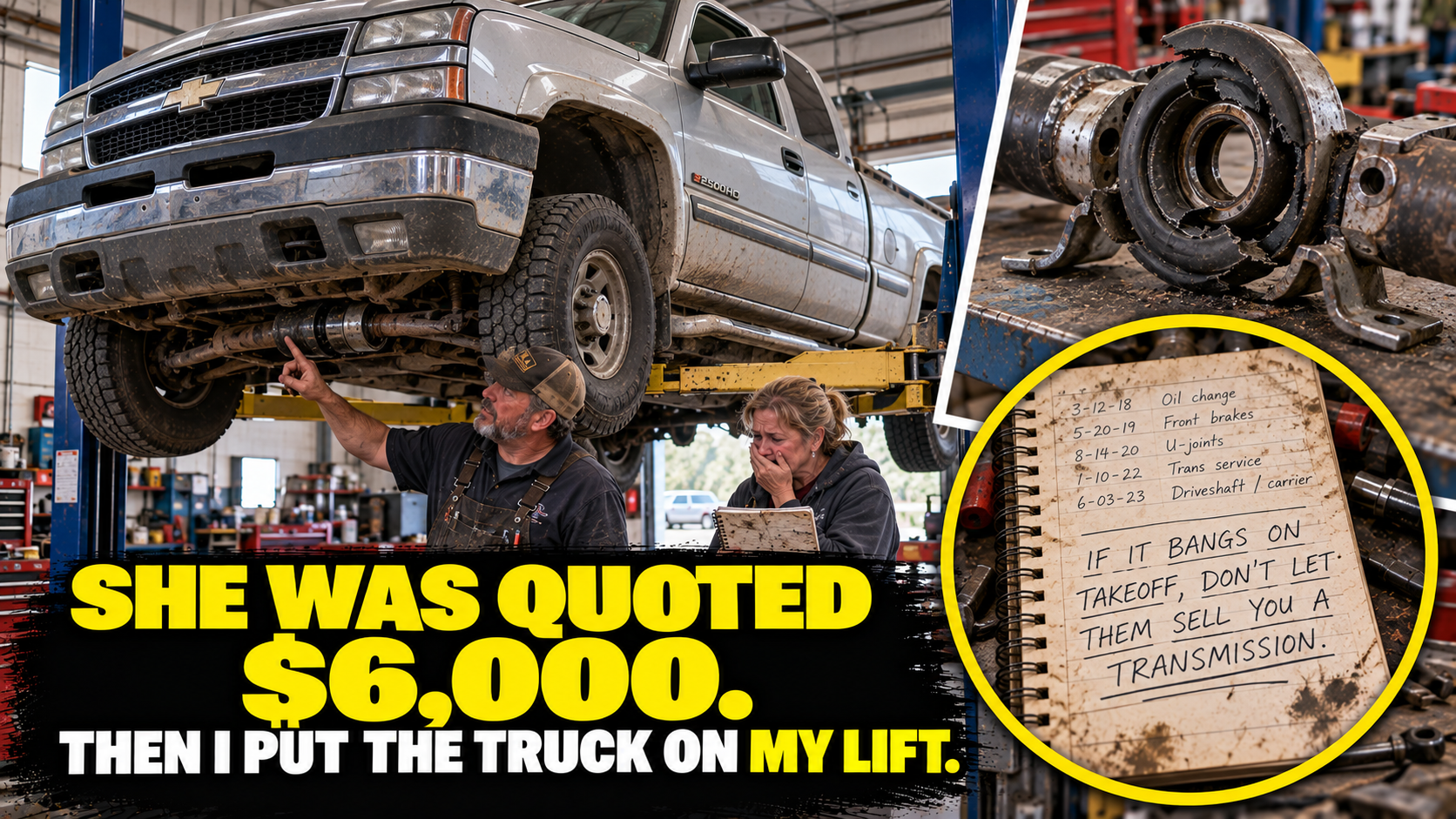
The Silverado used a two-piece driveshaft.
The rubber around the center-support bearing had separated badly.
Under load, the shaft could move far more than intended.
Then we saw physical evidence: a shiny contact mark on the shaft and a
matching mark near the crossmember.
The driveshaft had been striking metal.
That impact traveled directly into the cab floor.
Karen returned and I showed her photographs.
“So the transmission isn’t bad?”
“I can’t promise every internal part is perfect on a truck with this
mileage. But the bang you brought it in for has a strong mechanical
explanation right here.”
The repair was far less than six thousand dollars.
Karen began crying.
Then she went to the glovebox and returned with Mark’s spiral
maintenance notebook.
Oil changes. Brake work. Part numbers. Trailer wiring. Tire rotations.
She found an entry from nine years earlier.
BANG ON TAKEOFF — CENTER BEARING RUBBER GOING BAD.
Underneath Mark had written:
IF IT BANGS AGAIN, DON’T LET THEM SELL YOU A TRANSMISSION.
I laughed.
Karen laughed too.
We replaced the failed support bearing assembly and inspected the entire
driveline carefully: U-joints, shaft condition, mounts, fasteners and
related components.
The tired transmission mount was replaced too.
Then we road-tested.
The bang disappeared.
So did the shudder.
Under the conditions we tested, the transmission shifted normally.
But Karen had found another note on the same page, added years later in
different ink.
IF KAREN STILL HAS THIS TRUCK WHEN I’M GONE, TELL HER IT’S JUST A TRUCK.
DON’T KEEP IT FOR ME.
Then:
BUT IF JASON WANTS IT, MAKE HIM FIX SOMETHING FIRST.
Jason was their son.
Karen called him.
He came home that weekend.
Jason was thirty-one and hadn’t worked on a vehicle with his father in
years.
He read the notebook twice.
Then he asked what still needed fixing.
Nothing urgent.
The window regulator was slow.
A front shock had started seeping.
The tailgate handle was loose.
The toolbox latch barely worked.
Jason smiled.
“Dad would pick the toolbox.”
He and Karen repaired it together.
Over the next two months they handled several other small jobs.
Not because the Silverado had become priceless.
Because Mark had left them permission to let go of it without feeling
guilty.
Eventually Jason bought the truck from his mother for a fair family
price.
He still uses it for projects and occasional trailer work.
The original transmission remained in the truck the last time I saw it.
Will it last forever?
Of course not.
Nothing with nearly a quarter-million miles deserves that promise.
The lesson wasn’t that transmissions never fail.
It was that a violent symptom doesn’t automatically identify the failed
component.
Noise and vibration travel through shafts, mounts, frames and bodies.
Diagnosis means finding evidence before assigning a price.
Karen arrived prepared to lose either six thousand dollars or her
husband’s truck.
What she needed was a center-support bearing, a mount and somebody
willing to look farther back than the transmission pan.
Mark had already learned that lesson.
He wrote it down.
Nine years later, his note helped his family make the right decision for
the right reason.