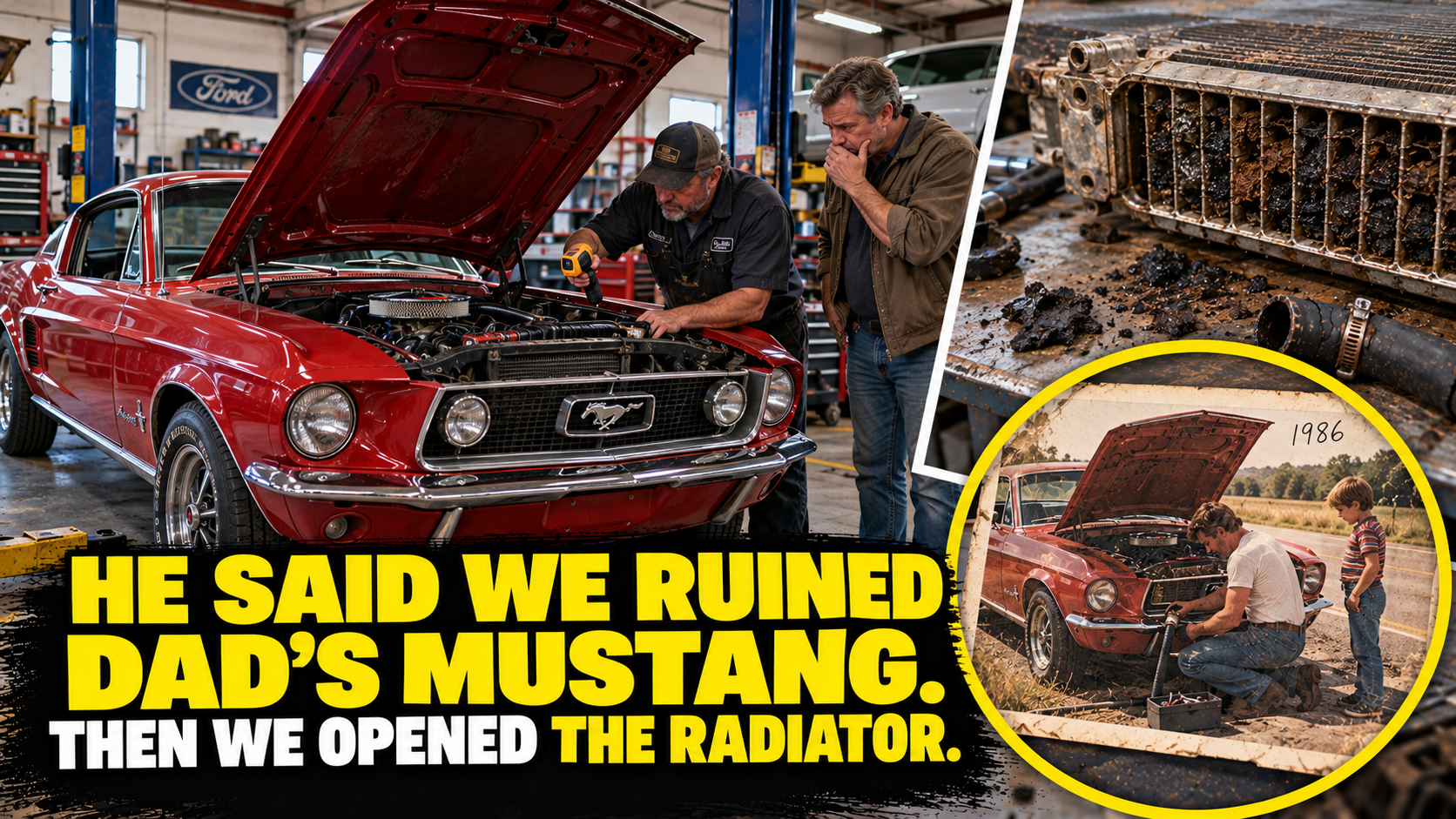
The angriest customer I had that month owned a 1967 Ford Mustang.
He walked into my shop, dropped the keys on the counter and said, “You
guys killed my father’s car.”
My name is Daniel Price. I’ve owned an independent repair shop for
nineteen years.
If you work on vehicles long enough, eventually something will fail
shortly after you touched the car.
Sometimes it is your fault. Sometimes it isn’t.
The dangerous mechanic is the one who decides which answer he wants
before inspecting anything.
The Mustang belonged to Greg Palmer.
His father bought it in the early 1970s. It was a red fastback with a
small-block V8, automatic transmission and a driver-quality restoration.
Greg inherited it after his father died.
The car had spent several years sitting, and Greg wanted it reliable
enough for weekend driving.
We found cracked hoses, tired belts, old fluids and a leaking water
pump.
We replaced the water pump with the correct part, installed new hoses
and belts, serviced the coolant and verified operation.
Temperature was stable. No leaks.
Two days later, Greg called.
The Mustang had overheated about eighteen miles from his house.
By the time it returned on a tow truck, he was convinced our work caused
it.
“You changed the cooling system,” he said.
“We did.”
“It never overheated before.”
“How far had you driven it recently?”
He paused.
“Not far.”
That mattered.
A car can sit for years with a problem that doesn’t reveal itself during
ten-minute drives.
Still, I wasn’t going to argue from the counter.
We started with basics.
Coolant level was slightly down after the overheat but not empty. No
obvious external leak. Water pump dry. Belts correct. Fan and shroud
present.
Then my technician Luis used an infrared thermometer across the
radiator.
“Dan. Look at this.”
Temperature distribution across the core was wrong.
The inlet side was hot, but large areas stayed dramatically cooler.
That suggested poor flow through portions of the radiator.
We removed it.
The radiator shop called.
“You need to see what came out of this thing.”
Several tubes were restricted with debris.
Some looked like tiny deteriorated rubber fragments. Other material was
dark sediment accumulated over years.
Greg stared at it.
“What is that?”
“That’s what we’re trying to understand.”
Then his face changed.
“My dad had a hose blow once.”
“When?”
“I was a kid.”
Eventually he remembered a family trip in 1986.
The Mustang developed a cooling problem far from home. His father
repaired it beside the road with the materials available and repeatedly
refilled the system.
Later, the car received another repair, but nobody knew how thoroughly
the system had been cleaned afterward.
“Could that stuff stay in there that long?”
“Some could. More importantly, contamination can accumulate for
decades.”
Then Luis raised an uncomfortable possibility.
Our work may have contributed to when the restriction became severe—not
because the new pump was defective, but because restored circulation and
new hoses could disturb old material.
The debris moves.
Then it finds narrow passages.
In this case, the radiator became the filter nobody intended.
Greg stared at me.
“So you did cause it.”
“Not exactly. The debris and old radiator were already here. But
servicing the system may have changed flow enough to move
contamination.”
I could have stopped at “not our fault.”
Instead, we worked out a fair repair.
Greg paid for the radiator. I covered some labor.
We flushed the block more thoroughly, inspected the thermostat and
heater circuit, then installed a properly serviced radiator.
Afterward we tested the Mustang much longer than before.
Idle. Road speed. Repeated heat cycles.
Temperature stayed stable.
Greg returned.
“I owe you an apology.”
“You were worried about your dad’s car.”
“I still shouldn’t have accused you before you looked.”
Then I admitted something too.
“We could’ve warned you that servicing a long-dormant system can expose
other weaknesses.”
That changed a procedure in my shop.
From then on, when we serviced an old vehicle that had been sitting, the
estimate included a note explaining that restoring one component can
reveal weaknesses elsewhere.
New fuel pump? Old hoses may fail.
New master cylinder? Old wheel cylinders may reveal themselves.
Fresh cooling circulation? An old radiator may become the next problem.
A vehicle is a system.
Greg drove the Mustang all summer without overheating.
Months later he returned with an old photograph.
It showed him as a child beside the Mustang in 1986. His father was
kneeling at the front with the hood open and repair supplies on the
ground.
“You were right,” Greg said.
We pinned a copy on the shop bulletin board.
Not because it proved we were innocent.
Because it reminded my younger technicians that old cars carry evidence
of every repair, even when the owner has forgotten it.
A stripped bolt. A homemade bracket. An abandoned wire. Radiator debris
from a roadside repair made before some of my employees were born.
The Mustang didn’t overheat because of one dramatic mistake.
It overheated because decades of age, contamination and new circulation
finally met in the same place.
Greg arrived believing somebody needed to be blamed.
Instead, we found a mechanical explanation.
That’s why diagnosis matters.
Replacing parts is easy.
Understanding why the system failed is the job.