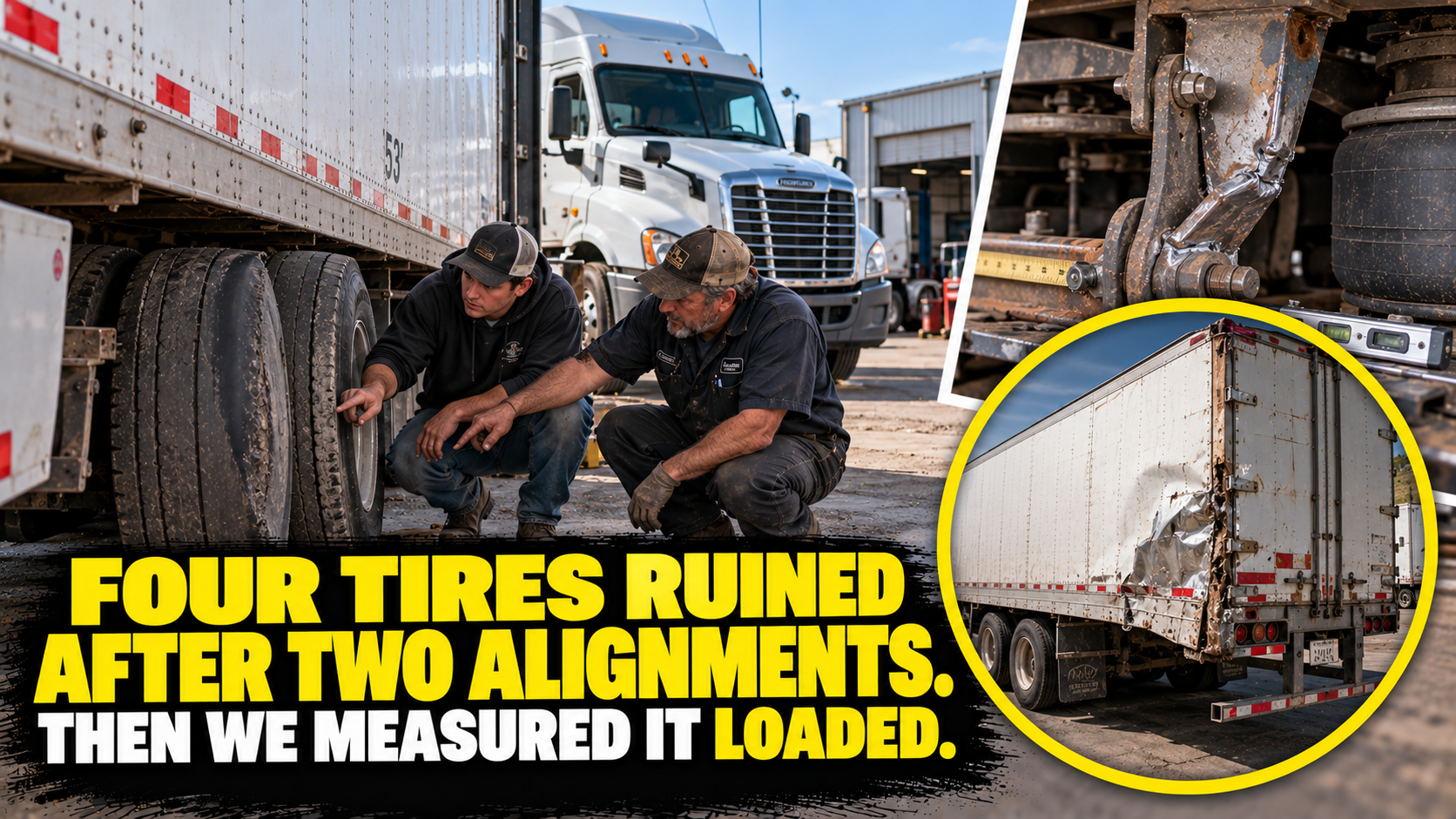
Marcus Reed arrived with four ruined trailer tires, two alignment
receipts and almost no patience left.
He was twenty-eight and had been running his own truck for less than two
years.
His tractor was a used Freightliner Cascadia. The trailer was an older
53-foot dry van he had purchased separately.
One axle kept eating the inside edges of its tires.
The first shop aligned it.
The second aligned it again.
Bushings were inspected.
Tires replaced.
Pressure checked.
Within roughly twelve thousand miles, the pattern returned.
“I’ve spent almost three grand chasing this,” Marcus said.
“Then stop chasing it.”
We started over.
Wheel bearings. Suspension components. Tire condition. Axle position.
Ride height. Fasteners. Frame condition. Basic alignment measurements.
Nothing screamed at us.
Then Marcus mentioned that the wear seemed to accelerate when he hauled
heavier freight.
That suggested the geometry might change with suspension position.
We placed the trailer on a level inspection area and measured carefully.
My mechanic Owen found an old repair near one suspension hanger.
The weld itself didn’t look terrible.
The bracket’s relationship to the frame did.
It sat slightly twisted.
Not enough to notice casually.
Enough to measure.
Empty, the trailer rested in a position where alignment numbers could
look close.
As the suspension loaded, the geometry shifted.
The axle effectively steered slightly relative to the trailer.
Not enough to create a dramatic pull.
Enough to scrub rubber for thousands of miles.
“How did two alignment shops miss it?” Marcus asked.
“They may have aligned what they could adjust.”
Alignment equipment can show where an axle is.
It doesn’t automatically explain why the axle changes position through
suspension travel.
We wanted history before cutting anything.
The previous fleet name was still faintly visible beneath removed
decals.
Marcus searched old industry groups.
A retired driver recognized the trailer number.
Two days later, an old fleet photograph arrived.
The same rear corner showed damage from years earlier.
A former maintenance manager remembered a yard accident and repair.
The old photograph didn’t prove our diagnosis.
Our measurements did.
But it explained how the bracket probably ended up wrong.
We removed the affected components and inspected the structure properly.
The hanger location was corrected to specification.
Worn suspension parts found during disassembly were replaced.
Then the trailer was aligned again.
This time we verified the geometry through relevant suspension
conditions instead of trusting one static measurement.
Marcus installed new tires.
Five thousand miles passed.
Then ten.
Then twenty.
The wear pattern didn’t return.
Months later he stopped by.
“Still good.”
“How often are you checking?”
“Every week.”
“Good.”
He framed one of the old alignment receipts in his office.
Under it he wrote:
ALIGNMENT IS A MEASUREMENT, NOT A DIAGNOSIS.
A little harsh, maybe.
Alignment is important.
But his point was useful.
A measurement can identify a condition.
Diagnosis explains the cause.
His trailer didn’t need a third shop to move an axle until the numbers
turned green.
It needed somebody to ask why those numbers changed when the trailer did
real work.
The answer was a repaired piece of steel installed years before Marcus
owned it.
The tires were only the messenger.