My uncle told me our combine had a nighttime problem.
I told him machines don’t know what time it is.
Then I watched it happen.
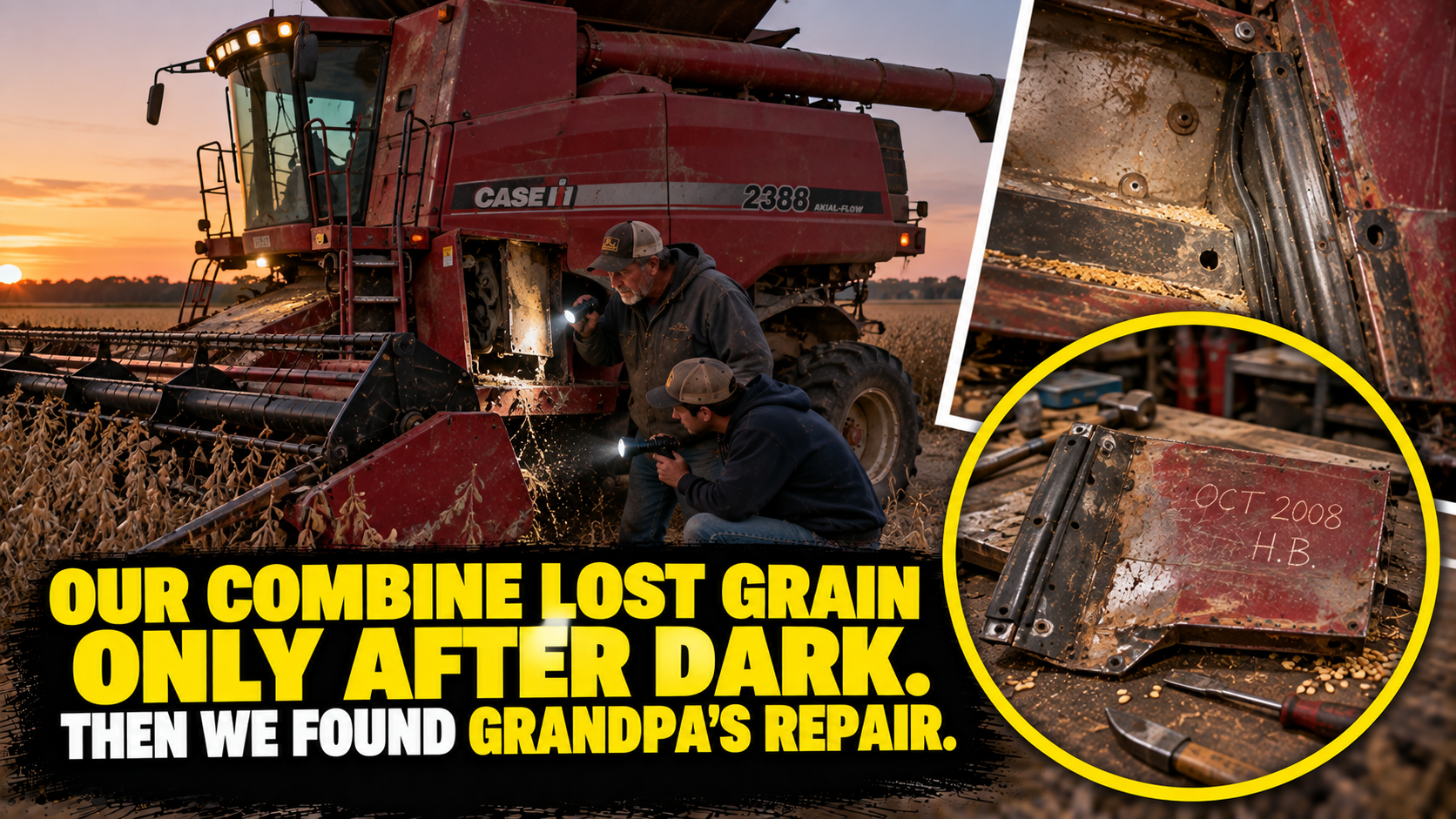
We were harvesting soybeans with an older Case IH combine that had
earned its place on our family farm.
During the afternoon, grain loss looked normal.
As evening arrived and the air cooled, beans began appearing behind the
machine.
Not a catastrophic trail.
Enough to matter.
Uncle Gary adjusted fan speed, sieve settings and ground speed.
Some changes helped briefly.
Then the pattern returned.
“Only does it at night,” he said.
“That means something changes at night.”
“Darkness.”
“Temperature. Moisture. Crop condition.”
“Or ghosts.”
I preferred temperature.
We harvested the next afternoon while watching closely.
Sample looked good.
Loss monitor behaved.
After sunset, the temperature dropped.
Within an hour, the beans behind the machine increased.
We stopped.
I inspected with a flashlight.
No giant hole.
No broken sieve.
No obvious belt problem.
Then a reflection caught my eye.
A narrow polished line near an access-panel area.
The seal appeared present, but one section of sheet metal wasn’t
perfectly flat.
The rubber was old.
Warm in the afternoon, it remained flexible enough to conform.
As evening cooled, it stiffened and pulled away from the warped section.
The gap was small.
Thousands of beans don’t need a large opening.
We made only the safe temporary correction necessary to finish the
immediate field, then returned to the shop for a proper repair.
The next morning we removed the panel.
Under years of residue was a scratched date:
OCT 2008.
Beside it were Grandpa Harold’s initials.
Dad looked at it.
“I know what happened.”
Harvest in 2008 had been miserable.
Rain.
Mud.
Equipment trouble.
Everybody behind.
One night, debris damaged that panel and surrounding sheet metal.
Grandpa and Dad worked late.
Replacement pieces weren’t immediately available.
They straightened the area, fabricated what they needed, installed a
seal and put the combine back in the field.
“Was it supposed to be permanent?” I asked.
Dad laughed.
“Nothing done at two in the morning during harvest is supposed to be
permanent.”
The repair lasted sixteen seasons anyway.
Why now?
Age.
The rubber hardened.
The sheet metal and mounting area wore.
Small changes accumulated until colder evening conditions exposed them.
We repaired the warped area correctly, installed the proper seal and
inspected nearby panels and fasteners.
Then we returned to the field.
That evening we deliberately kept harvesting after the temperature
dropped.
No unusual grain trail.
Gary walked behind the combine with a flashlight.
“Ghost’s gone.”
“Very scientific.”
“Results matter.”
The interesting part wasn’t that Grandpa’s repair eventually failed.
Sixteen seasons is a respectable life for something meant to finish one
harvest.
The interesting part was how easy it would’ve been to blame the wrong
system.
Loss monitor.
Rotor settings.
Fan.
Crop moisture.
Operator.
All reasonable things to consider.
But the actual problem was a physical opening that changed with
temperature.
Dad kept the old panel section.
Under Grandpa’s 2008 date he wrote:
PERMANENT REPAIR — 2024.
Gary added:
WE THINK.
It hangs in the farm shop now.
Not as a trophy.
As a reminder.
Farm equipment often carries temporary repairs far longer than anyone
intended.
Some are perfectly serviceable.
Some need to be revisited.
The danger is forgetting which is which.
Grandpa’s repair didn’t ruin the combine.
It saved the 2008 harvest.
Sixteen years later, it simply asked us to finish the job.