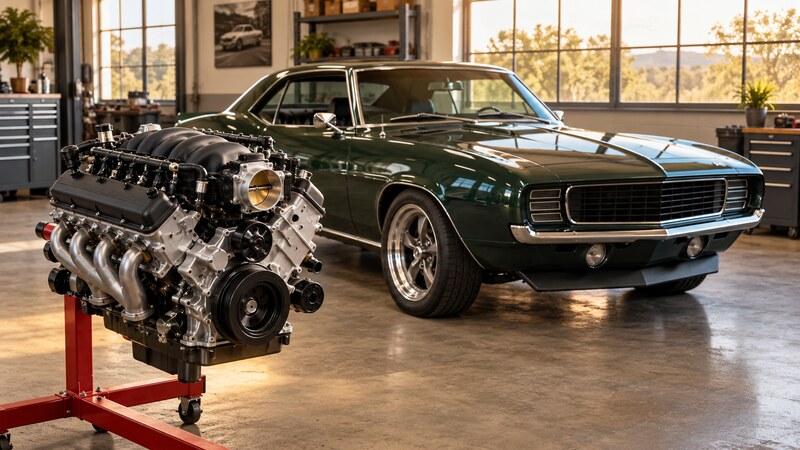
An engine sitting on a stand makes a swap look simple. A finished car tells a different story: the engine has to work with its controls, transmission, fuel supply, cooling system, and the rest of the vehicle. Start the LS-versus-LT discussion with that complete picture.
Neither family is automatically the right answer for every classic American car. A sensible choice begins with the intended use and the exact parts package, not whichever dyno number won the last comment-section argument.
Know which generation you are discussing
Chevrolet’s engine-family history dates the LS1 debut to the 1997 Corvette. Its timeline identifies the later Gen V LT1 with direct fuel injection. In modern swap discussions, those are distinct branches of Chevrolet’s small-block story, not interchangeable names for the same engine.
Be precise when discussing a donor engine or ordering parts. Write down its engine code and part number. A badge, displacement, or seller’s shorthand is not enough to establish compatibility.
Use real specifications, not family reputation
Chevrolet Performance currently lists its 6.2-liter LS3 crate engine at 430 horsepower and 425 lb-ft of torque. Its Gen V 6.2-liter LT1 crate engine is listed at 455 horsepower and 455 lb-ft. These are manufacturer engine ratings for the listed packages, not a prediction of wheel horsepower in your car.
The LT1’s direct injection is a substantive system difference. It should prompt questions about the matched fuel supply and engine controls, not an assumption that an existing LS parts list will work unchanged. Use the installation instructions for the exact package being purchased.
Price the finished installation
Ask a qualified builder for an itemized plan covering the engine, controller and wiring, transmission compatibility, mounts, oil-pan clearance, accessories, cooling, fuel system, exhaust, and necessary chassis work. Separate confirmed compatible parts from items that still need measurement.
Chevrolet also offers matched engine-and-transmission packages through Connect & Cruise. That can be a useful comparison point, but a matched powertrain is not the same thing as a complete vehicle-specific installation.
Street use needs its own check. Chevrolet’s product pages distinguish competition-use parts from E-ROD offerings. Do not assume every crate engine or swap is approved for every road car. Confirm the exact package’s stated application and your applicable requirements before committing money.
Choose around the car you want to drive
For a weekend cruiser, start the conversation with reliable operation, serviceability, and the complete budget. For a competition build, define the intended event and operating demands first. Those are better planning inputs than a blanket claim that one family always wins.
Our takeaway: choose a documented, compatible system you can finish—not just an engine you can afford to bring home.
Sources
- Chevrolet Performance: LS/LSX/LT history
- Chevrolet Performance: LS/LSX crate engines
- Chevrolet Performance: LT1 specifications and installation resources
Featured image: original AI-generated illustration created for MechanicCarWorld using OpenAI image generation. The generic engine and car are not an exact LS/LT installation or parts-identification reference.