For twenty-nine years, everyone in my family repeated the same story
about Grandpa’s 1967 Pontiac GTO.
The engine seized.
That’s why he parked it.
Nobody questioned the story because the car never moved again.
Grandpa died before I was old enough to ask detailed questions.
The GTO stayed in Grandma’s dry Oklahoma garage.
Dust accumulated.
Tires went flat.
Boxes surrounded it.
But she never sold it.
When Grandma decided to move into a smaller house, the family finally
had to deal with the car.
My cousin Eric wanted it.
So did I.
Instead of fighting, we agreed to inspect it together.
First question: was the engine actually seized?
We didn’t install a battery and hit the key.
After nearly three decades, that would’ve been foolish.
We checked fluids, removed spark plugs, inspected what we could and
carefully tried to rotate the engine by hand.
It moved.
Eric looked at me.
“Again.”
It moved farther.
A truly seized engine doesn’t usually change its mind because two
cousins show up with a breaker bar.
As we rotated it, resistance changed.
Then we heard contact near the bellhousing.
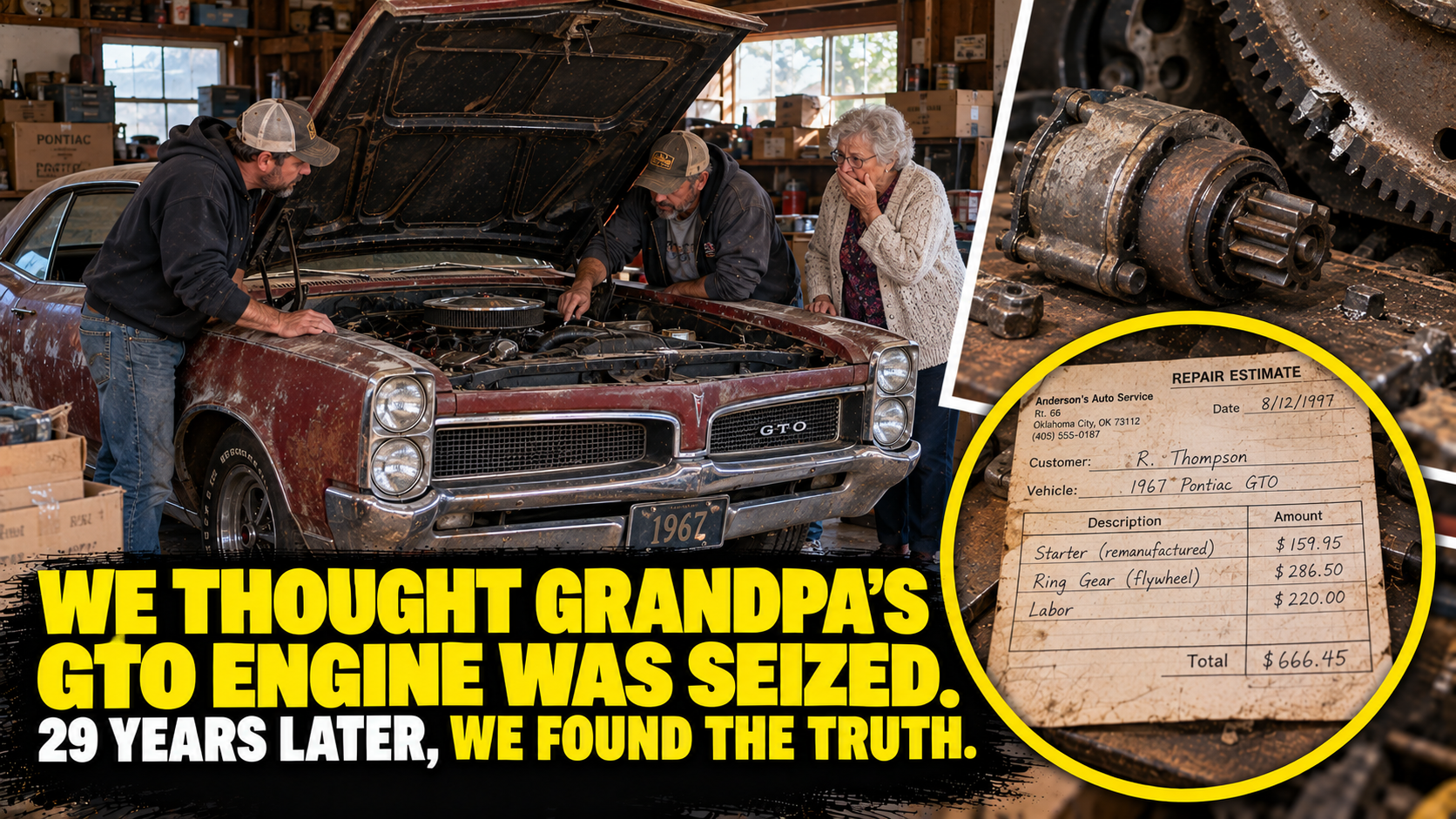
We inspected the starter area.
The starter drive was in poor condition.
A small section of the ring gear had damaged teeth.
At one position, the starter mechanism could jam against the ring gear
and make the engine appear locked from the key.
Once the starter was removed, the engine rotated normally by hand.
That didn’t prove the engine was healthy.
It proved it wasn’t frozen solid.
Eric sat on the garage floor.
“So Grandpa parked this for a starter?”
“That would be ridiculous.”
Grandma, standing in the doorway, said:
“It wasn’t the starter.”
She returned with an envelope.
Inside was a repair estimate dated September 1997.
Starter replacement.
Ring-gear/flywheel repair.
Labor.
Additional recommended work.
Grandpa already knew.
“Why didn’t he fix it?” I asked.
Grandma folded her arms.
“Because I told him if he fixed that car, I was leaving.”
Eric laughed.
She wasn’t joking.
Grandpa was in his fifties in 1997.
Apparently still young enough to behave like he was twenty.
An old friend named Walt still owned a muscle car.
When the two men got together, they drove like they had something to
prove.
One night Grandpa came home much later than expected.
A neighbor had seen the GTO and Walt’s car running hard on a rural road.
Grandma confronted him.
Grandpa denied racing.
Then admitted they had “accelerated a little.”
A week later, the starter jammed.
Grandpa had the GTO towed to a shop.
The estimate came home.
Grandma told him she was done waiting for a phone call saying he’d hurt
himself or somebody else.
“Sell it, park it, I don’t care,” she told him. “But if you repair it
just to go race Walt again, I’m not staying for the next phone call.”
Grandpa parked it.
At first, probably out of anger.
Weeks became months.
Months became years.
The family explanation simplified.
Engine locked up.
Not worth fixing.
Parked.
The real story disappeared because nobody wanted to explain a marital
argument every time someone asked about the Pontiac.
“Did he want to fix it later?” I asked.
“All the time.”
“Why didn’t he?”
“Pride.”
Eventually Grandma stopped caring whether he repaired it.
By then Grandpa didn’t want to admit she had been right.
The GTO became a monument to stubbornness.
We inspected the car carefully before attempting a startup.
Decades of storage create problems far beyond a starter.
Fuel system.
Brakes.
Rubber hoses.
Cooling system.
Electrical connections.
Tires.
Seals.
Rodent damage.
We treated it like a dormant machine, not a movie scene.
The fuel system was cleaned and serviced.
The brake system was repaired as needed.
Cooling system checked.
Starter and ring-gear problem corrected properly.
Ignition inspected.
Oil system prepared.
After weeks of work, we were ready.
Grandma came to the garage.
Eric turned the key.
The Pontiac cranked.
That sound alone made Grandma put her hand over her mouth.
After more careful work, the engine fired.
Not perfectly.
Not magically restored.
But it ran.
Grandma laughed.
“Your grandfather would be furious.”
“Why?”
“Because I was right for twenty-nine years.”
We made the GTO safe rather than immediately performing a full
restoration.
The first real drive was short.
Grandma rode passenger.
I drove gently.
At the first stop sign she looked at me.
“This thing used to be faster.”
“I’m sure it still can be.”
“Don’t.”
“Yes, ma’am.”
Months later, we found Walt.
He was eighty-one.
We drove the GTO to his house.
He stared at it.
“I thought that motor was blown.”
Grandma said:
“That’s what Richard told everybody.”
Walt started laughing.
He admitted the two men had raced that night.
Not organized racing.
Not smart.
Just two older men behaving like teenagers.
Grandma pointed at him.
“You’re lucky I don’t send you the starter bill.”
The GTO runs again now.
We don’t race it.
We don’t pretend Grandpa’s decision was noble.
He parked the car because of an argument, pride and a mechanical problem
that was repairable.
Families compress complicated stories into simple sentences.
The engine seized.
The farm was sold.
He hated that car.
Simple stories are easy to repeat.
They’re not always true.
For twenty-nine years, Grandpa’s GTO sat because everyone believed the
wrong mechanical explanation.
The engine wasn’t locked.
The starter was.
And Grandpa may have been the most stubborn component in the entire car.