I bought a dead tractor at a farm auction for four hundred dollars because the name scratched inside its dashboard was my father’s. He had been gone eleven years. The auctioneer said the machine had belonged to a stranger, and the seller swore nobody had touched it since 1998.
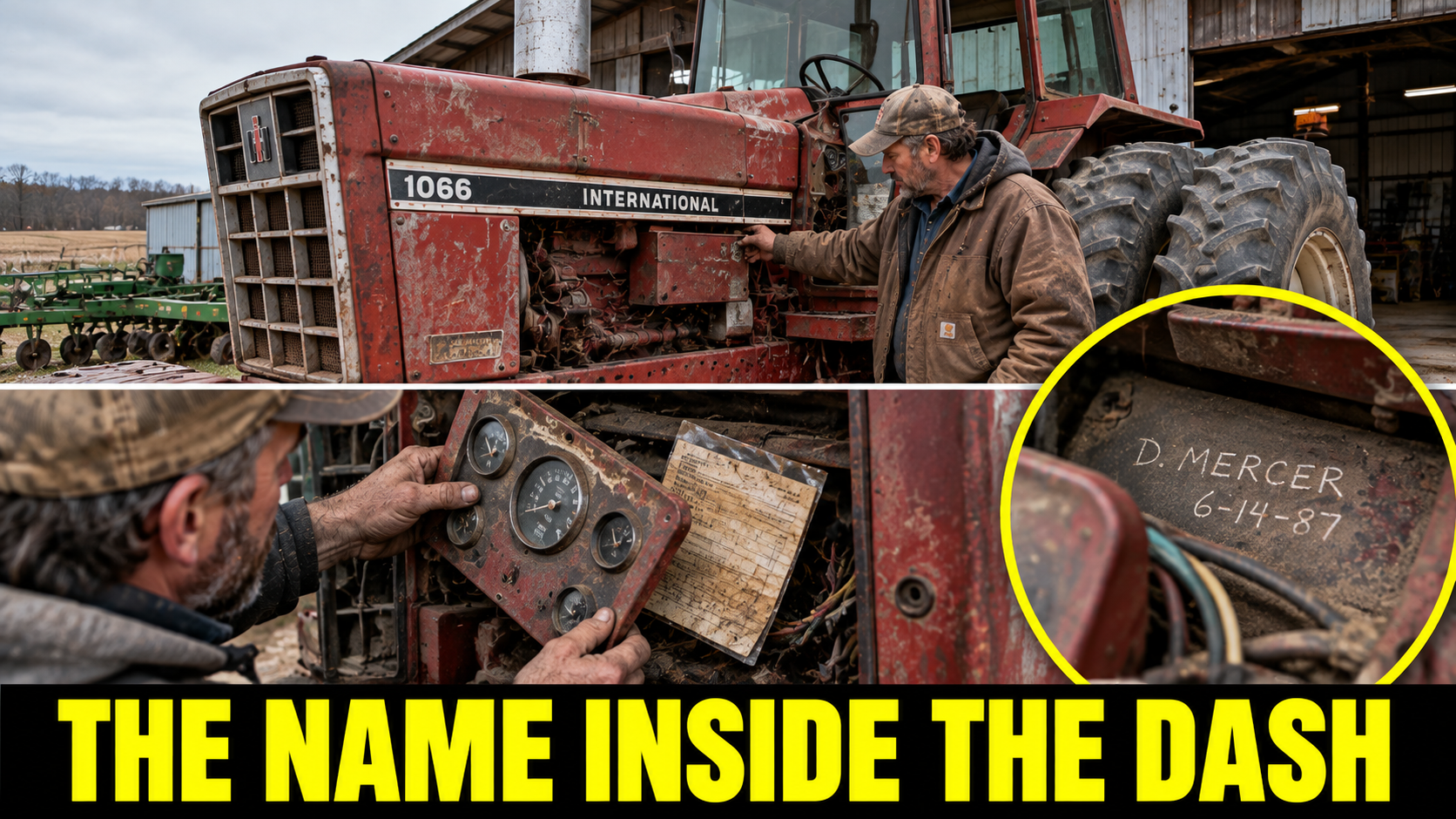
The tractor was a 1974 International Harvester 1066, faded red under a coat of dust, parked behind a machine shed outside Ottumwa, Iowa. Its rear tires were cracked, the muffler had a bird’s nest in it, and a length of baling wire held the hood shut. I wasn’t shopping for another project. I had come to buy a hay rake for our small place near Agency.
My father, Daniel Mercer, had repaired tractors for neighbors after his shift at a grain elevator. He wrote his initials on everything, usually with a paint marker. He never owned a 1066, as far as I knew. When the auction crew pulled the hood up to show bidders the engine, I saw D. MERCER scratched on the steel lip behind the instrument panel. Underneath was a date: 6-14-87.
I stood there long enough for a man in a seed-company cap to ask whether I planned to bid. I said I was thinking about it. The tractor had no battery and the engine would not turn with a bar on the crankshaft. The auctioneer called it a parts machine. I raised my hand once, and nobody raised theirs after me.
My wife, Erin, met me at the driveway with the kind of expression that comes from watching a rollback unload six tons of trouble. We had promised each other no more projects until the barn roof was paid for. I told her about the name. She climbed onto the drawbar, brushed the dirt off the dash, and said, ‘Then we ought to find out why it’s there.’
On Saturday I drained the oil into a clean pan. There was no glitter, only thick black oil and a few drops of water. I removed the injectors and poured a little penetrating oil into each cylinder. The starter was missing, so I pulled the fan belt and turned the crank carefully with a socket on the front pulley. It moved a fraction, stopped, and then moved again. That was more promising than the auction description.
The wiring under the dash was worse. Mice had chewed through the insulation, and a previous owner had twisted three wires together under a strip of electrical tape. I photographed every connection before pulling the panel. Behind the temperature gauge, taped to the sheet metal, was a folded piece of paper inside a yellowed sandwich bag.
The bag held a repair ticket from a shop called Miller Implement, dated June 14, 1987. It listed a clutch adjustment, replacement hydraulic hose, and a note in my father’s handwriting: ‘Do not send this machine out until rear wheel is checked.’ At the bottom was a customer name I recognized immediately: Walter Keene.
Walter had farmed the ridge west of town when I was a kid. He used to stop at our house with tomatoes in August and take my father fishing in October. I remembered his funeral, but not much else. His daughter, Ruth, still lived on the farm. I called her that evening and asked whether she had ever seen the old International.
She went quiet when I described the scratched name. ‘That tractor wasn’t supposed to be sold,’ she said. ‘Dad parked it after an accident. My brother handled the equipment auction when Mom moved into assisted living. I thought he’d kept it.’ She asked me to come over the next morning and bring the ticket.
Ruth’s kitchen smelled of coffee and the cinnamon rolls she’d made for her grandchildren. She laid the ticket beside a faded photograph of her father and mine standing in front of the same tractor. Its paint was bright in the picture. The left rear wheel was off, and both men were holding a measuring tape across the axle housing.
‘Dad said Daniel saved him a lot of trouble,’ Ruth told me. ‘He never said what kind.’ She pulled a small metal cash box from a cabinet. Inside were invoices, a tractor manual, and a letter addressed to my father that had never been mailed. The envelope was sealed. She pushed it toward me and said I could open it if I wanted.
I slid a butter knife under the flap. Walter had written that he was sorry for letting my father take the blame for a broken wheel hub. He said the wheel had come loose while Walter was towing a loaded gravity wagon, and the tractor had nearly rolled into a ditch with his teenage son on the fender. Walter had tightened the wheel bolts himself the week before, using the wrong pattern and an undersized wrench.
At the repair shop, Walter told everyone the hub must have failed after Daniel worked on it. My father had inspected the tractor the previous month, but he had not removed that wheel. The accusation traveled farther than the correction ever did. I remembered him losing two regular customers that summer. I had assumed it was because the elevator cut his hours and he had less time for side jobs.
The letter said Walter eventually admitted what happened to the shop owner. He wanted to apologize in person, but my father stopped taking his calls. Walter had kept the tractor because he couldn’t bear to look at it and couldn’t bring himself to sell it. Ruth read over my shoulder without speaking. Then she said, ‘I didn’t know he wrote that.’
I drove home angry at a man who had been dead for years. Erin listened while I read the letter aloud. When I finished, she asked whether fixing the tractor would change anything. I said it wouldn’t change what happened to Dad. She said, ‘Maybe it can change what the rest of us carry around.’
The next week I went back to work on the International. I pulled the left rear wheel with a neighbor’s loader supporting the axle, then checked the hub, studs, rim, and axle splines. The hub had been replaced long ago, but two wheel studs were stretched and the rim showed an old crack near a bolt hole. I ordered the correct parts rather than gamble on a machine that might eventually pull a wagon again.
The engine was less dramatic than I feared. A stuck injector and a seized accessory had made it feel locked. After replacing the injector, servicing the fuel system, changing fluids and filters, and fitting a new starter and battery, I cranked it with the fuel shut off until the oil-pressure gauge moved. Then I opened the fuel, checked for leaks, and tried again. The six-cylinder diesel coughed, smoked gray, and settled into a rough idle.
I shut it down after a minute. The coolant hose was sweating at the clamp and the alternator wasn’t charging. The next two weekends went to small repairs: hoses, wiring, brakes, and a hydraulic line that leaked when the three-point hitch lifted. I checked the steering and wheel hardware again before moving the tractor under its own power. There was no heroic first drive down the highway, just a careful lap around our gravel yard.
The hardest part of the job was resisting shortcuts. A tractor that starts is not necessarily a tractor that stops, steers, or holds a wheel under load. I kept a notebook with part numbers, torque specifications from the service manual, and the date of each test. My neighbor Dale checked the wheel installation with me before we lowered the jack. Neither of us wanted to repeat the mistake that had started the whole story.
I also learned how little a family can know about the jobs that happen after supper. Dad would leave with a canvas tool bag and return smelling of diesel and cold air. To me he was simply late for dinner. To the people waiting beside a disabled tractor, he was the person who knew which fitting to loosen and which sound meant it was time to shut the engine down. That part of his life had never fit neatly into our family photographs.
Ruth and I compared the old invoice with the tractor’s serial plate and the photograph before deciding the papers belonged to this machine. The model, date, and wheel damage lined up. We couldn’t know every conversation that happened in the shop, and I didn’t need to invent one. Walter’s own letter was enough to explain why the ticket had been hidden and why the tractor had sat so long.
At home, I showed my son, Ben, how to read the oil-pressure gauge and why we let the engine idle before putting it under a load. He asked whether his grandfather had really fixed this tractor. I said he had worked on it, warned its owner about a wheel, and written down what he saw. ‘So the note mattered?’ Ben asked. I told him it mattered because good repair work includes saying what isn’t safe, even when the customer doesn’t want to hear it.
Ruth came by when the tractor was finally safe to run. She brought her brother, Paul, who had arranged the auction. He apologized for selling it without asking her. Their mother had left him a handwritten inventory, and he’d mistaken the 1066 for the parts tractor listed on the next line. He offered to buy it back for what I’d spent. I told him I wasn’t ready to sell, but I wanted Ruth to have copies of everything we’d found.
We set the old photograph on the fender and took a new one beside it. Ruth touched the scratched letters under the dash. ‘Your dad should have gotten that letter,’ she said. I agreed. Then I told her the thing I hadn’t admitted to Erin: I had spent years thinking Dad quit helping neighbors because he got tired of people. Now I understood why he stopped answering certain calls.
I called my mother that night. She remembered the accusation and the lost work. She also remembered my father quietly repairing Walter’s snowblower two winters later when the man couldn’t afford a shop bill. ‘He was angry,’ she said, ‘but he didn’t want Walter freezing.’ That sounded exactly like Dad, and somehow it made the letter easier to hold.
By harvest, the International was working again, pulling our empty wagons around the yard and running the grain auger under supervision. I didn’t pretend the restoration erased what happened in 1987. The repair bill was more than the tractor would bring at another auction, and I still had a barn roof to pay for. But every time I climbed into the seat, I saw the date my father had scratched behind the dash.
I mounted a clear sleeve inside the shop cabinet for Walter’s letter, the repair ticket, and copies of both photographs. The originals went back to Ruth. On the tractor itself, I left my father’s scratched name untouched. It wasn’t proof that he’d owned the machine or that every story about him had been fair. It was a reminder that somebody had finally opened the panel, read the whole record, and asked the people who were still here.
The first cold morning in November, I started the 1066 to move a wagon before a storm. The diesel rattled awake and Erin came out with two mugs of coffee. She looked at the tractor, then at me, and asked whether I still regretted spending four hundred dollars on it. I told her the four hundred had been the cheap part. She laughed, handed me a mug, and stayed until the engine warmed up.