The third fuel-pump fuse blew before I even got my late brother’s Camaro out of the driveway. Then I found a fresh-looking wire tucked under a seat nobody had moved in twenty years.
My brother Danny left me his faded red 1991 Chevrolet Camaro RS after he died. It had sat behind his little house on the west side of Dayton, Ohio, long enough for weeds to grow through the gravel. I drove over on a cold Saturday in October with a toolbox, a new battery, and a rented trailer. I expected to spend an hour making the car roll and another hour explaining to my wife why I had brought it home.
Danny and I were four years apart. He had taught me how to check oil before I could drive, and he never let me forget that a car was more than a set of keys. When we were kids, our father, Frank, spent Sunday afternoons showing us how to set a torque wrench and keep bolts in labeled coffee cans. Then Dad and Danny had an argument about this very Camaro. Dad moved out of town soon afterward. Over the years, the silence hardened into a family rule nobody had actually agreed to.
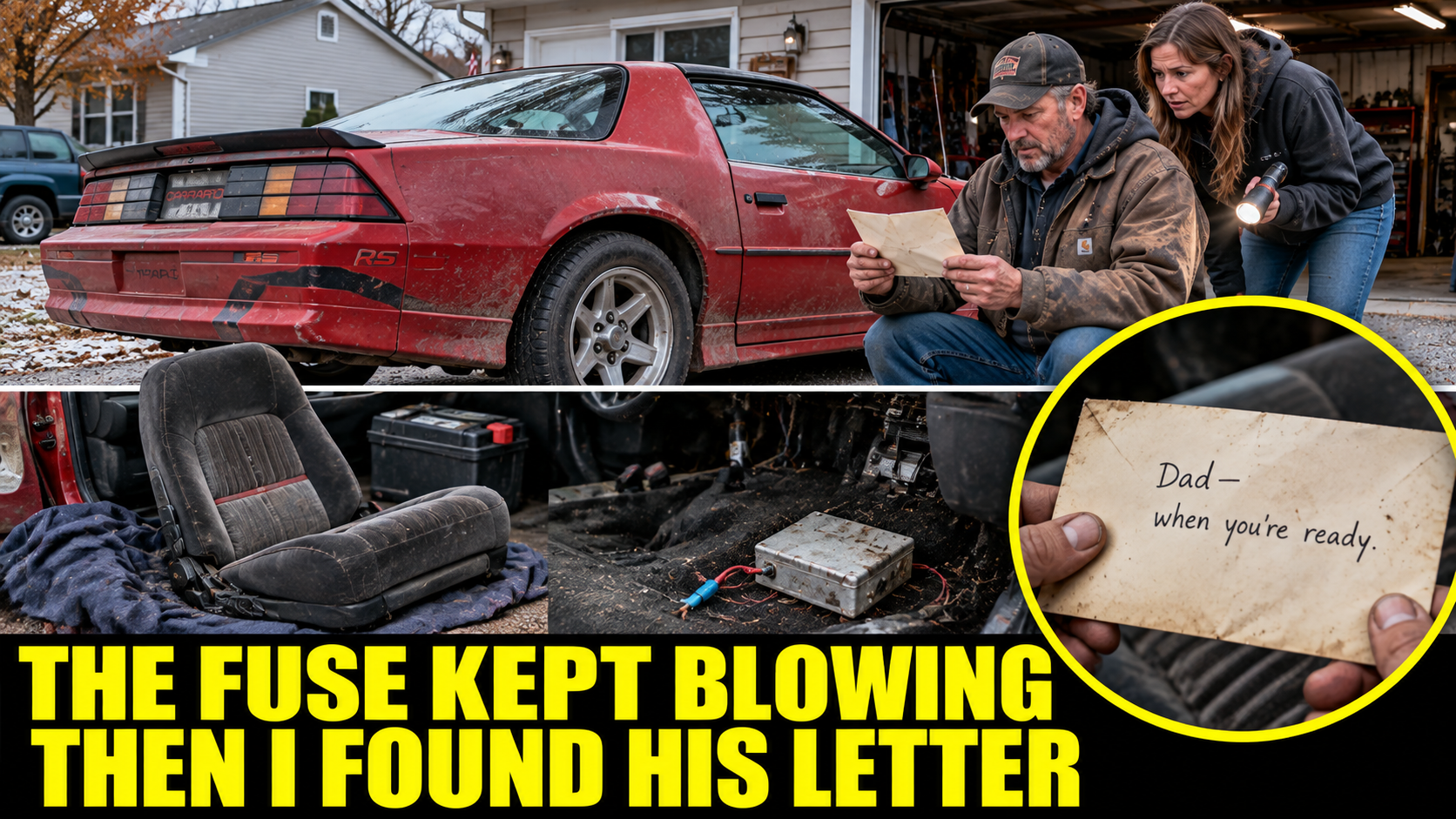
The Camaro looked rough but complete. Its clear coat had peeled across the hood, the tires were flat on the bottom, and a mouse had made a home in the air-cleaner housing. The odometer showed 143,000 miles. Danny had left a handwritten service log in the glove box. His last entry was a battery replacement six years earlier, followed by three words: “Starts, then quits.”
I drained the stale fuel into an approved container, checked the lines for leaks, installed the battery, and added fresh gas. The 3.1-liter V6 cranked slowly at first, then caught for a heartbeat. The engine died before I could touch the throttle. The fuel-pump fuse in the interior panel had opened. I replaced it with the specified amperage, turned the key, heard the pump hum, and watched the new fuse fail too.
A fuse blows for a reason. Putting in a bigger one can turn a wiring problem into a fire, so I stopped trying to start it. I pulled the negative battery cable and took out the factory wiring diagram Danny had tucked into his service binder. The pump circuit had been modified. A red wire disappeared beneath the driver’s seat through a slit in the carpet that looked too clean to be original.
Laura arrived with coffee and two sandwiches. She found me kneeling on the driveway with the door open and my knees on a flattened cardboard box. “We can sell it as-is,” she said. I told her I knew that. What I could not explain was why I wanted to hear Danny’s engine run one more time. She set the coffee on the roof, took the flashlight, and asked where to point it.
We unbolted the seat and tipped it carefully onto a blanket. The red wire was joined with a cheap blue crimp connector, the kind Danny used to cut out of other people’s repairs. It ran to a small metal box beneath the carpet. The box had two mismatched screws and a strip of black electrical tape over one corner. Its lid lifted without much effort. An envelope slid out from underneath.
The front was written in Danny’s square block letters. It said, “Dad—when you’re ready.” My first thought was that I had found a letter Danny had never mailed. My second was that I had no right to open it. Laura looked at the envelope, then at me. “You don’t have to decide this second,” she said.
I put the letter on the workbench and examined the box. It was not an alarm module. Danny had built a simple hidden fuel-pump interrupt switch, probably as a theft deterrent when he parked the Camaro outside his old apartment. The wire passed through a drilled hole with no protective grommet. Years of seat movement had rubbed away the insulation until bare copper touched the edge of the metal box. That was our short circuit.
I photographed the wiring before touching anything. With the battery still disconnected, I removed the damaged add-on wire and the homemade switch, insulated the abandoned connections, and restored the pump circuit to the diagram using properly rated automotive wire and sealed connectors. I secured the harness away from the seat track, checked continuity and resistance, and confirmed the circuit was not shorted to ground. Only then did I reconnect the battery and fit another fuse of the correct rating.
The pump primed. The fuse held. The Camaro started on the second crank, stumbling while old deposits burned away. I shut it down after a minute because the coolant hose near the thermostat was sweating and I still needed to inspect the brakes before moving the car. But the sound was enough. For one brief moment, Danny was beside me again, grinning at the rough idle and telling me not to rev a cold engine.
We ate the sandwiches in the garage while the engine cooled. Laura asked if I wanted her to read the envelope first. I shook my head and opened it myself. The note was dated eight years after Dad had left. Danny wrote that he had been wrong about the argument. He had accused Dad of selling the Camaro’s original wheels to pay a bill, then found the wheels in a storage unit Danny himself had forgotten he rented with a friend. He had been too embarrassed to call and admit it.
The next page explained why the letter was still there. Danny had planned to drive the Camaro to Dad’s place in Springfield after getting the fuel-pump problem fixed. He wanted to arrive in the car that had split them apart and ask Dad to help put the original wheels back on. He wrote that he did not need an apology from Dad. He just wanted one Sunday in the garage like the ones we used to have.
I sat there holding a page with oil smudges on the edge. Danny had never told me about the wheels or the planned trip. He had talked about Dad as if he did not care, and I had believed him because believing him was easier than asking. Now there was a letter written in his hand and a broken switch that had kept the Camaro from making that drive.
Laura found Dad’s number in an old holiday card Danny had saved in a kitchen drawer. I stared at it for a long time. I could call him and discover that he still wanted nothing to do with us. I could also keep the letter in the box, trailer the car home, and spend the rest of my life wondering. Laura did not tell me which choice to make. She just sat beside me while I dialed.
Dad answered on the fourth ring. His voice sounded older but unmistakable. I told him Danny had died, and there was a silence long enough that I thought the call had dropped. Then Dad asked whether Danny had been alone. I said no, and told him about the nurses and friends who had stayed with him. Dad thanked me in a voice I had never heard before.
I told him I had found a letter. I did not read it over the phone. I asked if I could bring it to him with the Camaro once the car was safe to drive. He said he would be home Sunday. Before hanging up, he asked whether the car still had the crooked black stripe Danny had painted on the rear bumper. I looked out at the driveway. It did.
I spent the next week doing the work I should have planned from the beginning. A local tire shop fitted four tires. I replaced the cracked coolant hose, flushed the cooling system, changed the oil, and had a mechanic inspect the brakes and fuel lines. The rear brake cylinders were seeping, so we replaced them and the contaminated shoes, then bled the system and checked the pedal. The bill was more than I had hoped. I paid it anyway because the drive to Springfield mattered more than the Camaro’s resale value.
On Sunday morning, Laura followed me in her car. The Camaro’s V6 was not fast, and the heater smelled faintly of dust, but it held a steady temperature on Interstate 70. I kept both hands on the wheel. At the Springfield exit, I almost turned around. Then I saw the old service log on the passenger seat and kept going.
Dad was standing in the driveway when I arrived. He had grown thinner, and his hair was almost white. He did not come straight to me. He walked around the Camaro once, touched the crooked stripe on the bumper, and said, “He never did fix that.” I handed him the envelope. He read it beside the open garage door without saying a word.
When he finished, Dad went inside and came back with a small key. He opened a storage shed behind the garage. Inside were four dusty factory Camaro wheels, each wrapped in an old moving blanket. Dad explained that Danny had called him once, years earlier, asking whether he could keep them there until the car was running. They had spoken for only three minutes. Dad had waited for a second call that never came.
I had thought the letter would reveal a villain or a secret fortune. Instead, it showed me two stubborn men who had each tried, in a small and awkward way, to find the road back. The wheels were not worth much. The key, the saved letter, and the fact that Dad had kept the shed dry all those years were worth more than I could put into words.
We spent the afternoon cleaning the wheels and checking their condition. They needed new tires before they could go back on the car, so we left the Camaro on its current set. Dad showed me a box of Danny’s old photographs from the summer we first brought the car home. In one picture, the three of us stood beside it in the driveway, all looking toward the camera and none of us knowing what would come later.
Before Laura and I left, Dad asked whether he could visit the following weekend. He wanted to help replace the cracked weatherstripping and see Danny’s service binder. I said yes. We did not pretend that one afternoon repaired twenty years of distance. We exchanged phone numbers, made an actual plan, and hugged in the driveway before I started the engine.
I still have the damaged red wire and its cheap blue connector in a small bag in the Camaro’s glove box. I keep it there as a reminder to diagnose the problem in front of me instead of forcing a quick fix. The letter is in a frame at home, and Dad comes over most Sundays now. Sometimes we work on the Camaro. Sometimes we just sit in the garage and talk about Danny until the light goes down.